
Produced by | Huxiu Technology Group
Author | Utada
Cover image from Visual China
#This article is a deep interpretation of the “2021 Annual MVIP” and “Best Track Investor” series lists jointly published by Huxiu and Baize Capital. It aims to uncover how listed investors create value by delving into their layouts and thoughts in their respective fields.
The capitals of Syria, Lebanon, Jordan, and Egypt—Damascus, Beirut, Amman, and Cairo—have been regulars in the last ten minutes of news broadcasts for many years.
On the map, the area surrounded by these names is called “Israel.”
This is a country that many people born in the 70s and 80s in China directly associate with the “Israeli-Palestinian conflict” and “Middle Eastern wars” during their childhood. It wasn’t until after 2010 that it was hailed by passionate entrepreneurs as a symbol of innovation that could replace “Silicon Valley” in the wave of internet entrepreneurship.
However, the general public is somewhat aware that this is undoubtedly a clever nation. They not only manage to grow food on land mostly surrounded by enemies and consisting of deserts and plateaus but also “grow” the world’s best agricultural technologies.

Modern farmland in Israel. Image from Visual China
But very few people know that this place is also a paradise for the world’s cutting-edge technology inventors and venture capital firms in the tech sector.
Here, there is Iscar, the first hard tech company outside the U.S. invested by Warren Buffett; as well as R&D centers for all major high-tech giants like Google, Apple, and Intel.
However, the most important reason we have increasingly focused on Israel’s technological innovation in recent years is due to several acquisitions in the hard tech industry that have had a profound impact over the past five years:
-
In 2015, Amazon acquired the Israeli chip lab Annapurna Labs for $350 million, directly sidelining Intel’s Xeon and AMD collaborations.
Through this acquisition, Amazon customized better hardware acceleration for its virtual server EC2, completing the heavy lifting of virtualization, replacing the Xen series virtual services, and providing customers with virtual machines that perform comparably to bare-metal servers.
-
In 2017, Intel acquired the Israeli visual processing chip company Mobileye for a staggering $15.3 billion, officially entering the vast automotive market.
It can be said that this company, which is synonymous with “automated driving assistance systems” in a certain sense, has become the object of imitation for all domestic companies focusing on the automotive market’s autonomous driving chips.
-
In 2019, NVIDIA spent $6.9 billion to acquire the Israeli chip manufacturer Mellanox, which provides a wide range of products for data center customers, including Ethernet switches and InfiniBand intelligent interconnect solutions. Among them, InfiniBand is of utmost importance.
This technology is crucial for interconnected HPC (High-Performance Computing) workloads, significantly reducing the time required for communication between computing nodes. After the acquisition, it was renamed InfiniBand DPU. Yes, it is what is commonly referred to in China as “smart network cards.”
-
Also in 2019, Intel officially acquired the Israeli data center AI accelerator company Habana Labs for $2 billion, which has two products considered the core value of the company: the AI training chip Gaudi, known for its excellent energy efficiency and high scalability, and the AI inference chip Goya, which was announced for mass production in 2018.
For anyone interested in the high-tech industry, Israeli tech companies and any acquisition actions related to them are absolutely not to be overlooked. On this war-torn land, what seems to be giving birth to tech companies is actually a large number of entrepreneurs who are random, daring to question, and adhere to the principle of “disobedience” in their work.
From 2016 to 2021, China has also welcomed a “golden age” of hard tech entrepreneurship. However, compared to the internet entrepreneurship wave of 2015, many of the new hardware technology companies that have emerged in various fields have their technological origins in Israel.

Image from Visual China
Israel goes from zero to one, while China goes from one to ten?
The harsh reality is that a turbulent environment breeds a culture of risk-taking and nonconformity, which in turn nurtures a collective character of independent thinking, disobedience, and even a hint of arrogance. Many Israeli engineers who have created unique advanced technologies hold dual identities as defense and corporate employees.
Unity, dedication, and keen observation are their natural spiritual nourishment for technological innovation. Coupled with Israel’s niche consumer market, the only choice for entrepreneurs in the hard tech field is to create highly competitive disruptive innovations on a global scale.
For example, Mobileye, mentioned above, is a typical “oligopoly” enterprise in the in-vehicle image processing system. Before being acquired by Intel in 2017, they held nearly 70% of the market share in the ADAS (Advanced Driver Assistance Systems) market, or the L2-level autonomous driving chip market.
They proudly announced a statistic in the year of their acquisition—26 car manufacturers worldwide were using their autonomous driving assistance chips. It was around that time that voices began to emerge in China, such as “we need to create China’s Mobileye” and “China needs its own ADAS giant.”

Image from Venturebeat
It is well known that the Core series CPUs released by Intel in 2006 were a key product that opened the next decade of dominance for them. However, very few people know that before this product was released, Intel encountered serious issues with chip architecture—
At that time, Wall Street and the industry adhered to the ironclad rule set by Intel itself: “increase clock frequency to improve chip performance.”
However, engineers at Intel’s Haifa R&D center, part of the original employee team led by Weillman, discovered that this “ironclad rule” did not effectively reduce chip power consumption; instead, it would reduce performance due to excessive heat, making it unsuitable for hardware products with continuously shrinking sizes.
Therefore, they adopted a “task separation” technical route, making disruptive adjustments to the architecture—improving product performance without increasing clock frequency. This led to the decade-long dominance of the Core series in the PC market.
However, in China, the objective and cultural factors are vastly different.
During the rise of internet giants, business model innovation, a large market, and demographic dividends became one of the key factors for companies to achieve commercial success;
Whereas in the hard tech and other B2B markets, on one hand, from the supply chain perspective, downstream brand manufacturers have not been very open and friendly towards local startups for a long time; on the other hand, from the capital perspective, entrepreneurship in the capital and talent-intensive hard tech field is not a priority for investors.
Bai Zongyi, a partner at Yaotu Capital who has worked for many years at the Israeli investment firm Infinity, pointed out a difference between the Chinese and foreign markets regarding hard tech innovation from a capital perspective:
“Overseas investment institutions in the hard tech field pay more attention to representing cutting-edge disruptive innovation directions, where the challenge is how to balance technological leadership with the commercialization cycle. Currently, most domestic local investment institutions focus on relatively low-end stock markets, making homogeneous investments or engaging in arbitrage in the later stages of mature markets.”
Taking the mobile phone market as an example. According to his observations, purely from the perspective of the stock market, it is increasingly difficult for startups to enter a market that has reached a relatively stable period in terms of sales and supply chain.
For instance, in the fields of power management, signal chains, and others, there are numerous players, and mobile terminal brands directly invest in and support multiple companies in power management chips, RF, sensors, etc. These fields have already seen several listed companies or leading startups, making the competition fierce and the projects noticeably homogeneous. In the long run, apart from leading companies, most others will struggle to maintain high margins and technological competitiveness.
“Most domestic second and third-tier projects can only achieve a gross margin below the industry average. Even if the Sci-Tech Innovation Board can support a few companies to go public, the fact that leading projects are listed means that their margins cannot compete with those of these leading projects, which implies that the secondary market will not focus on promoting them when pushing stocks.”
He believes that while these growth-stage or later-stage projects can go public, if there is a bubble in the primary market valuation, it is very likely to lead to a situation where the primary and secondary market valuations are inverted.
“In fields where the vertical track is not high, it is very difficult to achieve rapid growth and the competition is fierce. If the primary market is high, then the secondary market cannot make money, leading to a very painful situation later on.”
However, there is no doubt that China has the largest consumer market and manufacturing capabilities in many fields, including consumer electronics, automotive, industrial, and data centers. Besides the incremental opportunities of new applications, there is enormous room for innovation in underlying technologies.
For example, in the vertical track of the data center market, chips like GPU, ASIC, and DPU, which are designed for reasoning and training on massive data, are experiencing rapid growth in related application scenarios, with low product penetration rates, representing a real need for disruptive innovation in the incremental market.
At the same time, the trillion-dollar automotive industry is also facing a turning point in intelligent transformation, igniting opportunities for underlying changes around “perception,” “decision-making,” “execution,” and “safety,” such as sensors and computing power chips.
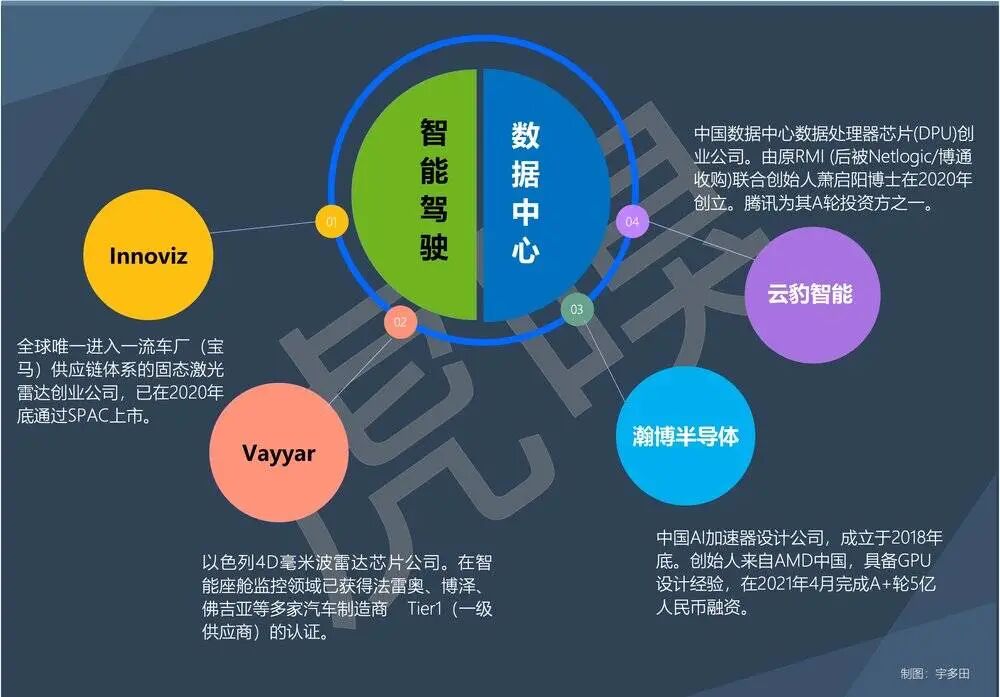
Some hard tech projects invested by Yaotu Capital
More importantly, as large Chinese cloud computing, mobile phone manufacturers, and short video giants have truly entered the ranks of world-class enterprises over the past decade, many problems arising in their businesses urgently require the same or even higher levels of world-class technological innovation to demonstrate differentiation.
Of course, considering “data security” and “geopolitics,” there is also a need for China to give birth to its own Mobileye or NVIDIA.
So, does this mean that the time has come for Chinese technology service companies in the supply chain to make top-level innovations?
Seeking Technological Inspiration from Israel
Unfortunately, at this stage, most top-level technological innovations are still generated in developed countries, and we still need to follow in the footsteps of the giants.
However, given the relatively weak foundation of China’s semiconductor industry, “learning,” “imitating,” and “surpassing” is not something to be ashamed of.
Bai Zongyi believes that “doing hard tech must have an international perspective.” This is determined by the highly globalized nature of the supply chain industry, and we cannot ignore that this “technology war” must be viewed from a global competitive perspective.
“Chinese technologists have gained a lot of inspiration from Israel, a country skilled in technological innovation.” Over the past five years, Yaotu partners Bai Zongyi and Yang Guang have taken nearly a hundred industrial capital representatives from China to Israel to investigate disruptive innovations in information technology, as there are optimal prototypes of new products launched by top global technology companies.
For example, the iPhone X launched by Apple in 2017 was the first to use 3D structured light for facial recognition payment, and this technology came from their full acquisition of the Israeli company Prime Sense for $350 million in 2013.
A year later, Chinese mobile phone companies, including Xiaomi, began to release phones with 3D facial recognition features, and the technology partner was still an Israeli company—Mantis Vision, a structured light technology company, which established a joint venture in China named Mantis Vision.
Later, after communicating with multiple mobile phone brands, Yaotu Capital found that domestic brands would not simply adopt structured light modules costing over $20 just for the FaceID function. Meanwhile, under-screen fingerprint recognition technology was also adopted by most manufacturers. Therefore, they later chose to shift towards more cost-effective sensing technology solutions like VCSEL and TOF modules in 2017.

Innoviz went public on NASDAQ, image from Israel Times
The lidar manufacturer Innoviz is also an Israeli company they invested in 2017.
According to Huxiu’s understanding, the technology and products of this company have raised “alert” among domestic and foreign automotive supply chains, as they are the only solid-state lidar startup that has received pre-installation certification from BMW. They have now gone public on NASDAQ through a SPAC.
Another Israeli millimeter-wave chip company Vayyar, which they invested in early, has also received technology and order certifications from global mainstream automotive Tier 1 suppliers like Valeo and Faurecia.
According to official information, this startup has mastered a patented technology for “achieving full cabin monitoring using a single-chip radar”—using a single multifunctional radar chip (ROC) to replace multiple single-function radar sensors. Its new round of valuation has exceeded $1.5 billion.

Image from FutureCar
However, even in a country like Israel, known for its “high success rate,” from zero to one innovation still cannot avoid a large number of failed projects. According to statistics provided by Yaotu in 2016, from 1999 to 2014, Israel established 10,185 startups, with a mortality rate of 42.8%.
Looking at China, the wave of artificial intelligence and autonomous driving entrepreneurs that surged before and after 2015 faced a wave of deaths in 2019-2020; and the number of semiconductor startups that surged around 2017 will inevitably face a day of bubble burst.
“Investing in early-stage tech projects, especially in the hot B2B market, many teams have no products before the A round, relying solely on concepts.” Bai Zongyi believes that if a GP team lacks deep understanding of market conditions, lacks understanding and judgment of cutting-edge technologies, and has no industrial ecosystem support, moving forward passively will lead to significant losses.
“In terms of valuation, B2B high-tech projects have a relatively low ceiling compared to excellent projects in the B2C market. For example, head companies in the B2C industry like Pinduoduo, ByteDance, and Kuaishou can achieve valuations of tens of billions to hundreds of billions of dollars with 200-300 million active users.” He points out that for excellent B2C funds, the strategy is not to miss out on large tracks.
“But for B2B, achieving a market value of 20 billion or 30 billion RMB for a vertical semiconductor company is already quite good; the ceiling is far lower than that of B2C, which means you cannot spread across tracks. Because if you spread across five companies, only one may bring a 10-20x return, while the other four may suffer severe losses, making it very difficult for the fund to achieve excess returns.”
For example, the AI cloud accelerator market is still in a very early stage, and globally it is also in a nascent state, but there are already more than ten companies in China. This means that investors in the hard tech track need to be extremely precise in their judgment of startup teams, technologies, and productization capabilities to improve early hit rates.
Finding “Israeli-style tech companies” must start from the early stage
Yaotu partners Bai Zongyi and Yang Guang both come from engineering backgrounds. The former worked on military radar at the Second Academy of Aerospace, while the latter has been an engineer at SK in South Korea, Microsoft Windows Mobile, and Omron in Japan. They claim to make both decisions and execute them, having basically never left the front lines of the Israeli and Chinese markets.
“Sometimes we look at some chip or software companies and can immediately identify which other similar companies exist globally, especially which Israeli companies have been involved and who acquired them.”
In the data center field, the data-centric accelerated computing model requires the cooperation and support of three major computing units. Among them, the CPU is used for general computing, the GPU for accelerated computing, and the DPU, which is used for data transmission, processes the data. The latter will become one of the three pillars of future computing.
The invention of DPU/Smart NIC technology originated from the Israeli startup Annapurna Labs, which was acquired by Amazon for $350 million, and the Israeli network architecture service provider Mellanox, which was acquired by NVIDIA for $6.9 billion.

Image from Mellanox
In recent years, Bai Zongyi and Yang Guang have maintained high-frequency communication with the core R&D and market teams of these two companies. Later, they invested in a domestic DPU design company named “Cloud Leopard Intelligent” in 2020, whose founder, Dr. Xiao Qiyang, was a co-founder of the semiconductor network architecture service provider RMI, which has been acquired by Qualcomm.
For example, they claim that the AI cloud inference chip company Hanbo Semiconductor they invested in can be somewhat compared to Habana Labs, which was acquired by Intel.
“You can understand their products as a fusion of Google TPU and VPU.”
Hanbo has two founders: one is the GPU design head of AMD China, Qian Jun, and the other is the chief architect of GPUs at AMD China, Zhang Lei. Their technical advantage is precisely in “video codec processing” + “inference algorithms,” which are considered suitable for handling “video streams” in special scenarios.
“Whether watching short videos or on Tencent, Youku, or 4K, 8K high-definition TVs, you will find that video accounts for an increasing proportion of data.” Bai Zongyi points out that in the future, over 95% of data will be unstructured video data.
“For example, a livestreamer. For the audience, their visual focus is on the livestreamer themselves, and they do not care about what is behind them. Therefore, the backend can actively differentiate compression based on the video itself—
keeping the livestreamer at 1080T or 4K clarity, while the background can be compressed to 480p clarity using Hanbo’s chips. This greatly reduces the cost of bandwidth for video companies.”
He points out that many users of these short video platforms are located in third- and fourth-tier cities and rural areas, where the signal network is poor. During the pandemic, a large number of users competing for bandwidth to watch short videos often resulted in video clarity being only 480p, with blurry images.

Kuaishou interface. Image from the Chinese version of the Wall Street Journal
Additionally, semiconductor companies must understand different industries to tackle different sectors. For example, the patience required from investors for mobile chips and automotive chips is completely different.
“Mobile phone models iterate every four to five months, requiring companies to have strong technical iteration capabilities. If they do not iterate, the next model may be eliminated;
but the introduction cycle of the automotive supply chain is extremely long, from high and low-temperature tests, vibration tests, million-kilometer tests, to parabolic tests, etc. It is difficult to introduce top manufacturers without two to three years. However, once they enter top manufacturers, as long as they do not make mistakes, it is very difficult to be kicked out.”
Therefore, he sees the current situation in which some later-stage projects in the chip track are fiercely competitive as very advantageous for himself— the earlier you invest in explosive projects, the greater the opportunity:
“Investing in later-stage projects is becoming increasingly difficult. Currently, teams in semiconductor projects that can exceed 100 million in revenue are considered good, and their valuations are generally around two to three billion. If you invest in a large track, the future growth potential is significant, so the competition for absolutely leading projects is fierce. However, it is still a highly uncertain project.
For many institutions, if they lack the ability to assess early-stage hard tech projects, it is very difficult to compete for later-stage projects. For some projects in tracks with slightly lower “box office,” entering them may not yield much profit.
But because time does not allow you to investigate and learn, everyone is very frantic, directly using B2C methods to invest in B2B, which can lead to a lot of pain.”
“This year, the Israeli and Chinese companies we invest in are likely to have a dozen become unicorns, especially in the AI chip and autonomous driving tracks, with returns already starting to appear.”
This Middle Eastern country’s ideas and practices in terms of technology and products are among the most valuable references at this moment of explosive hard tech entrepreneurship.
Regarding the series of lists, you can also read:
1. “Finding the Next ‘King of Venture Capital'”
2. “The Visible Hands Behind Entrepreneurs”
3. “Low-Key for 30 Years, They Have Built a Chinese Semiconductor Empire”
4. “Looking at Enterprise Services Requires ‘Product Thinking'”
5. “Is Investment Just About Having More Money?”
6. “Investment Combines ‘Technique, Trend, and Path’ to Make Money”
7. “Rather than Chasing the Wind, Wait for the Wind to Come”
8. “The Consumer Track is Not a Zero-Sum Game”
For more information about the lists, please contact us via the following methods: 【Email】[email protected]
This article is specially supported by:
If you have any objections or complaints regarding this article, please contact [email protected]
End
Want to gain knowledge? Follow Huxiu’s video account!