1. Overview of Intelligent Warehousing Systems
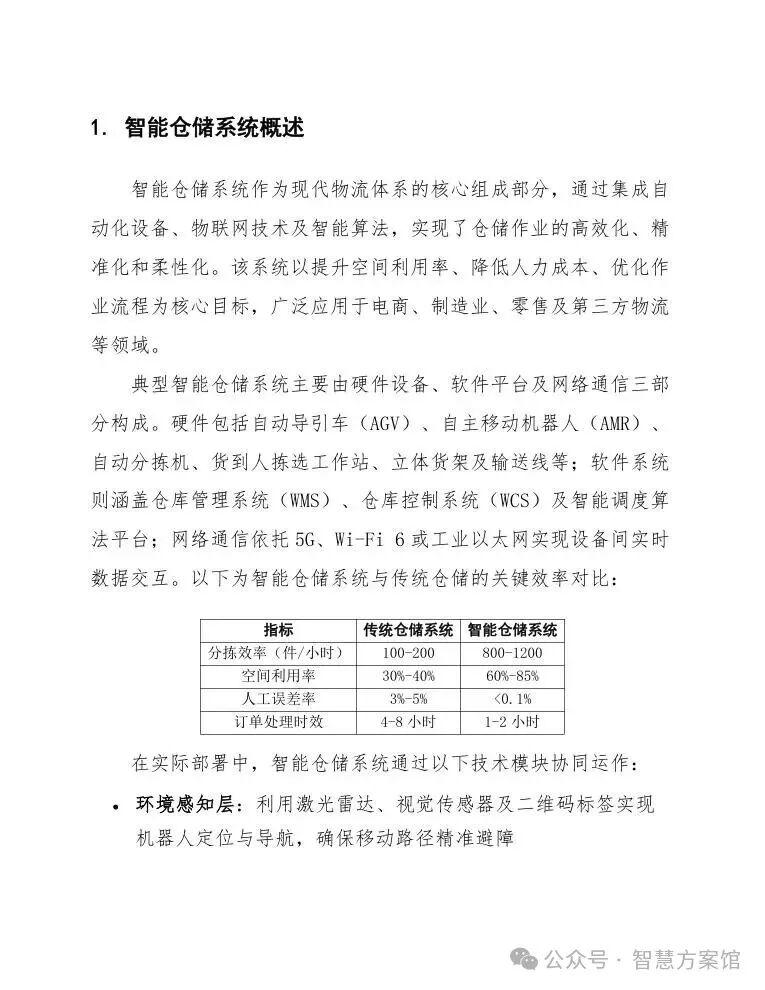
The intelligent warehousing system, as a core component of modern logistics, integrates automation equipment, IoT technology, and intelligent algorithms to achieve efficiency, precision, and flexibility in warehousing operations. The system aims to enhance space utilization, reduce labor costs, and optimize operational processes, and is widely applied in e-commerce, manufacturing, retail, and third-party logistics.
A typical intelligent warehousing system mainly consists of three parts: hardware devices, software platforms, and network communication. The hardware includes Automated Guided Vehicles (AGVs), Autonomous Mobile Robots (AMRs), automatic sorting machines, goods-to-person picking workstations, vertical shelves, and conveyor lines; the software system encompasses Warehouse Management Systems (WMS), Warehouse Control Systems (WCS), and intelligent scheduling algorithm platforms; network communication relies on 5G, Wi-Fi 6, or industrial Ethernet for real-time data exchange between devices. Below is a key efficiency comparison between intelligent warehousing systems and traditional warehousing:
| Indicator | Traditional Warehousing System | Intelligent Warehousing System |
|---|---|---|
| Sorting Efficiency (items/hour) | 100-200 | 800-1200 |
| Space Utilization Rate | 30%-40% | 60%-85% |
| Human Error Rate | 3%-5% | <0.1% |
| Order Processing Time | 4-8 hours | 1-2 hours |
In practical deployment, intelligent warehousing systems operate through the following technical modules:
- Environmental Perception Layer: Utilizing LiDAR, visual sensors, and QR code labels for robot positioning and navigation, ensuring precise obstacle avoidance along the movement path.
- Scheduling Optimization Layer: Dynamically allocating tasks based on deep learning algorithms, such as optimizing AGV cluster paths using ant colony algorithms to reduce congestion and empty running rates.
- Data Interaction Layer: Binding goods information through RFID or QR codes, updating inventory status in real-time, and seamlessly integrating with enterprise ERP systems.
Currently, leading logistics companies have achieved an average daily processing volume of over 100,000 items in warehouses, with robot endurance times exceeding 8 hours and sorting accuracy rates improved to 99.9%. The system can also automatically adjust the number of robots based on order peaks and valleys, achieving flexible capacity. For example, a regional center of an e-commerce company improved picking efficiency by three times and reduced labor costs by 60% by deploying 300 AMRs.
In the future, intelligent warehousing systems will further integrate digital twin technology, simulating operational processes in a virtual environment to optimize resource allocation in advance. Meanwhile, with advancements in robotic joint modules and battery technology, the load capacity of a single AMR is expected to increase from the current 1.5 tons to 3 tons, adapting to more heavy material handling scenarios.
1.1 Definition and Development Background of Intelligent Warehousing
The intelligent warehousing system is an integrated management system that upgrades traditional warehousing operations through advanced technologies such as IoT, big data, artificial intelligence, and robotics. Its core lies in achieving automation, informatization, and flexibility in warehousing operations to enhance efficiency, reduce labor costs, and improve inventory management accuracy and responsiveness to market changes. Specifically, the system collects inventory data in real-time through a sensor network, uses algorithms for demand forecasting and inventory optimization, and directs automated equipment (such as AGVs, robotic arms, and sorting robots) to perform a series of operations including storage, handling, sorting, and outbound logistics, forming an efficient, precise, and traceable logistics loop.
The development background is closely related to multiple factors. Firstly, the explosive growth of global e-commerce has placed unprecedented demands on logistics warehousing throughput, sorting speed, and order accuracy, making the traditional labor-intensive model inadequate to meet the delivery requirements of “same-day” or even “hourly” delivery. Secondly, rising labor costs and the increasing issue of labor shortages in the logistics industry have forced companies to seek technological solutions to replace repetitive and high-intensity physical labor. Additionally, national strategies such as Industry 4.0 and “Made in China 2025” have accelerated the maturity of the smart manufacturing supply chain, providing a broad application scenario and policy support for intelligent warehousing technology.
From a technological evolution perspective, the development of intelligent warehousing has gone through several key stages:
- Early Automation: Mainly represented by Automated Storage and Retrieval Systems (AS/RS) and conveyor systems, achieving mechanization of shelf storage and horizontal transportation.
- Flexible Automation Stage: With the popularization of AGVs and robotics technology, systems have broken through the limitations of fixed paths, allowing for more flexible layouts that can adapt to fluctuating business volumes.
- Intelligent Stage: In the current stage, systems deeply integrate AI and big data, enabling robots to possess autonomous navigation, visual recognition, and collaborative operation capabilities, achieving dynamic path planning, automatic obstacle avoidance, and intelligent decision-making based on real-time data.
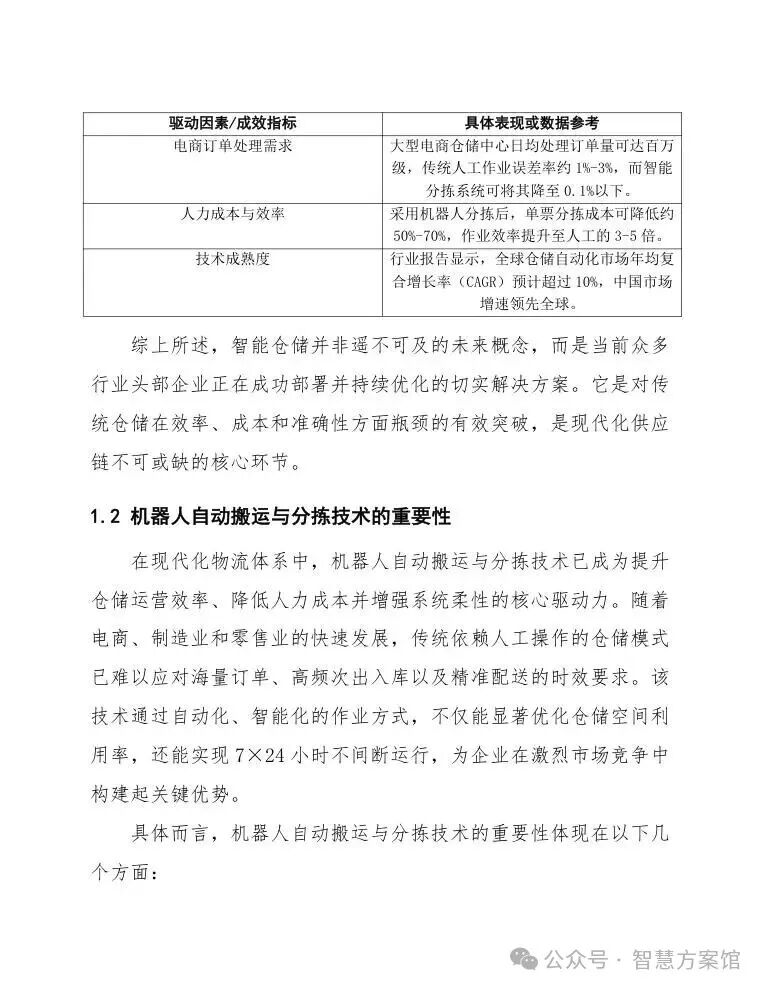
The following data can intuitively reflect its market driving force and effectiveness:
| Driving Factors/Effectiveness Indicators | Specific Performance or Data Reference |
|---|---|
| E-commerce Order Processing Demand | Large e-commerce warehousing centers can process millions of orders daily, with traditional manual operation error rates around 1%-3%, while intelligent sorting systems can reduce this to below 0.1%. |
| Labor Costs and Efficiency | After adopting robotic sorting, the cost per order can be reduced by approximately 50%-70%, and operational efficiency can increase to 3-5 times that of manual labor. |
| Technology Maturity | Industry reports indicate that the global warehousing automation market is expected to have a compound annual growth rate (CAGR) of over 10%, with the Chinese market growing faster than the global average. |
In summary, intelligent warehousing is not a distant future concept but a practical solution that many leading companies across various industries are successfully deploying and continuously optimizing. It effectively breaks through the bottlenecks of traditional warehousing in terms of efficiency, cost, and accuracy, making it an indispensable core component of modern supply chains.
1.2 Importance of Robotic Automation and Sorting Technologies
In modern logistics systems, robotic automation and sorting technologies have become the core driving force for enhancing warehousing operational efficiency, reducing labor costs, and increasing system flexibility. With the rapid development of e-commerce, manufacturing, and retail, traditional warehousing models that rely on manual operations are increasingly unable to meet the demands of massive orders, high-frequency inbound and outbound logistics, and precise delivery timelines. This technology, through automated and intelligent operations, not only significantly optimizes warehouse space utilization but also enables 24/7 uninterrupted operation, providing companies with a critical advantage in fierce market competition.
Specifically, the importance of robotic automation and sorting technologies is reflected in the following aspects:
-
Significant Efficiency Improvement: Robots can process multiple tasks in parallel, with stable and adjustable operating speeds and high sorting accuracy, greatly shortening order processing cycles. For example, systems using AGVs or AMRs can sort and process thousands of items per hour, far exceeding manual efficiency.
-
Reduced Operating Costs: Although initial investments are high, robotic systems effectively reduce reliance on long-term labor, lowering labor costs, training costs, and costs associated with human error. Additionally, robots have relatively low energy consumption, manageable maintenance costs, and significant total cost advantages over their lifecycle.
-
High Operational Precision and Reliability: Through barcode, RFID, or visual recognition technologies, robots can accurately identify goods information, achieving millimeter-level positioning and grasping, with sorting error rates reduced to below 0.01%, far lower than the 2%-5% of manual operations, greatly enhancing inventory management accuracy.
-
Flexibility to Adapt to Business Fluctuations: Robotic systems possess good scalability and reconfigurability, allowing for dynamic adjustments in the number of robots and working modes based on order peaks and valleys, without the need for large-scale infrastructure modifications to meet seasonal demand changes or business expansion.
-
Improved Working Environment and Enhanced Safety: Robots can continuously operate in harsh environments, such as cold storage or heavy goods handling, reducing the risks associated with manual operations while lowering labor intensity, allowing human resources to focus on higher-value tasks such as scheduling, monitoring, and exception handling.
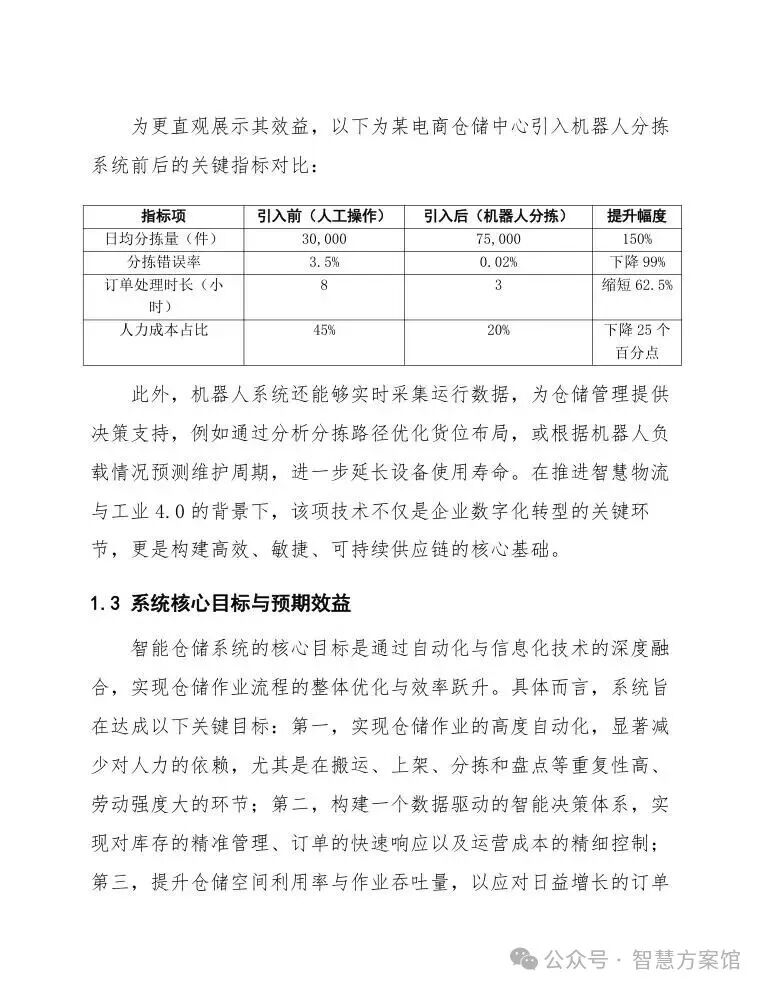
To visually demonstrate its benefits, the following is a comparison of key indicators before and after the introduction of a robotic sorting system at an e-commerce warehousing center:
| Indicator | Before Introduction (Manual Operation) | After Introduction (Robotic Sorting) | Improvement Rate |
|---|---|---|---|
| Average Daily Sorting Volume (items) | 30,000 | 75,000 | 150% |
| Sorting Error Rate | 3.5% | 0.02% | Decrease of 99% |
| Order Processing Time (hours) | 8 | 3 | Reduction of 62.5% |
| Labor Cost Proportion | 45% | 20% | Decrease of 25 percentage points |
Moreover, robotic systems can also collect operational data in real-time, providing decision support for warehousing management, such as optimizing storage layouts by analyzing sorting paths or predicting maintenance cycles based on robot load conditions, further extending equipment lifespan. In the context of promoting smart logistics and Industry 4.0, this technology is not only a key link in the digital transformation of enterprises but also the core foundation for building efficient, agile, and sustainable supply chains.
1.3 Core Objectives and Expected Benefits of the System
The core objective of the intelligent warehousing system is to achieve overall optimization and efficiency leap in warehousing operations through the deep integration of automation and informatization technologies. Specifically, the system aims to achieve the following key objectives: first, to achieve a high degree of automation in warehousing operations, significantly reducing reliance on human labor, especially in repetitive, labor-intensive tasks such as handling, shelving, sorting, and inventory counting; second, to build a data-driven intelligent decision-making system for precise inventory management, rapid order response, and meticulous control of operational costs; third, to enhance warehouse space utilization and operational throughput to meet the increasing order volume and the stringent logistics timeliness requirements of e-commerce; fourth, to ensure that the system possesses high flexibility, scalability, and reliability to adapt to rapid changes in business models and technological iterations.
In terms of expected benefits, the implementation of the system will bring direct economic returns and long-term strategic advantages to enterprises. The most significant economic benefit is reflected in the reduction of operational costs and the enhancement of efficiency.
- Labor Cost Savings: Automated handling and sorting can reduce direct labor demand by approximately 60%-70%, freeing employees from heavy physical labor to focus on higher-value tasks such as equipment monitoring, exception handling, and process optimization.
- Improvement in Operational Efficiency and Accuracy: Robots can work 24/7, increasing order sorting efficiency by 2-3 times, with sorting accuracy expected to reach over 99.99%, greatly reducing losses and customer complaints due to mis-sorts and missed picks.
- Space Utilization Optimization: By adopting dense storage technologies and collaborative scheduling with robots, warehouse space utilization can be improved by 30%-40%, delaying or reducing the need for investment in additional warehouse space.
- Refined Management: The system provides real-time data for the entire process, significantly improving inventory visualization levels, with inventory turnover rates expected to increase by over 20%, reducing capital occupation costs.
In addition to the quantifiable economic benefits mentioned above, the system will also generate significant management benefits. It standardizes operational processes, reduces reliance on individual skilled workers, and lowers management difficulty and operational risks associated with personnel turnover. Furthermore, the system possesses powerful data analysis and forecasting capabilities, providing data support for procurement, sales, and other aspects, assisting enterprises in making more scientific decisions. In the long run, building an intelligent warehousing system is a key step in enhancing the core competitiveness of enterprises, laying a solid foundation for future upgrades to full-link smart logistics.
The table below summarizes the correspondence between the core objectives and key expected benefits of the system:
| Core Objective | Key Expected Benefit |
|---|---|
| High Degree of Automation | Significantly reduce labor costs and enhance operational safety |
| Data-Driven Decision Making | Improve inventory accuracy, optimize inventory turnover, and achieve meticulous cost control |
| Enhance Space and Throughput | Delay warehouse infrastructure investment and enhance capacity to respond to order peaks |
| System Flexibility and Reliability | Ensure business continuity, support future business expansion, and reduce operational risks |
2. System Architecture Design
The overall architecture of the intelligent warehousing system adopts a layered design concept, ensuring clear responsibilities and efficient collaboration among various functional modules. The system is mainly divided into three layers: hardware execution layer, data intermediary layer, and business application layer. The hardware execution layer consists of various automation devices, including Autonomous Mobile Robots (AMRs), Automated Guided Vehicles (AGVs), six-axis robotic arms, conveyor systems, vertical shelves, and sensor networks (such as LiDAR, visual cameras, and RFID readers) for environmental perception. These devices communicate with the management platform through a unified device access gateway, enabling status monitoring and command issuance.
The data intermediary layer serves as the information hub of the system, responsible for processing real-time data streams and business logic. Its core is the warehousing digital twin platform, which continuously receives operational data from the hardware layer through IoT protocols (such as MQTT, OPC UA) and constructs a dynamic model that is fully synchronized with the physical warehouse in a virtual space. Data processing services clean, aggregate, and analyze the collected data to support upper-layer applications. Key data indicators include:
| Indicator Category | Specific Indicators | Description |
|---|---|---|
| Device Operation | Robot Utilization Rate, Task Completion Rate, Average Time per Handling | Reflects hardware efficiency and health |
| Inventory Status | Storage Location Saturation, Dynamic Inventory Accuracy, SKU |
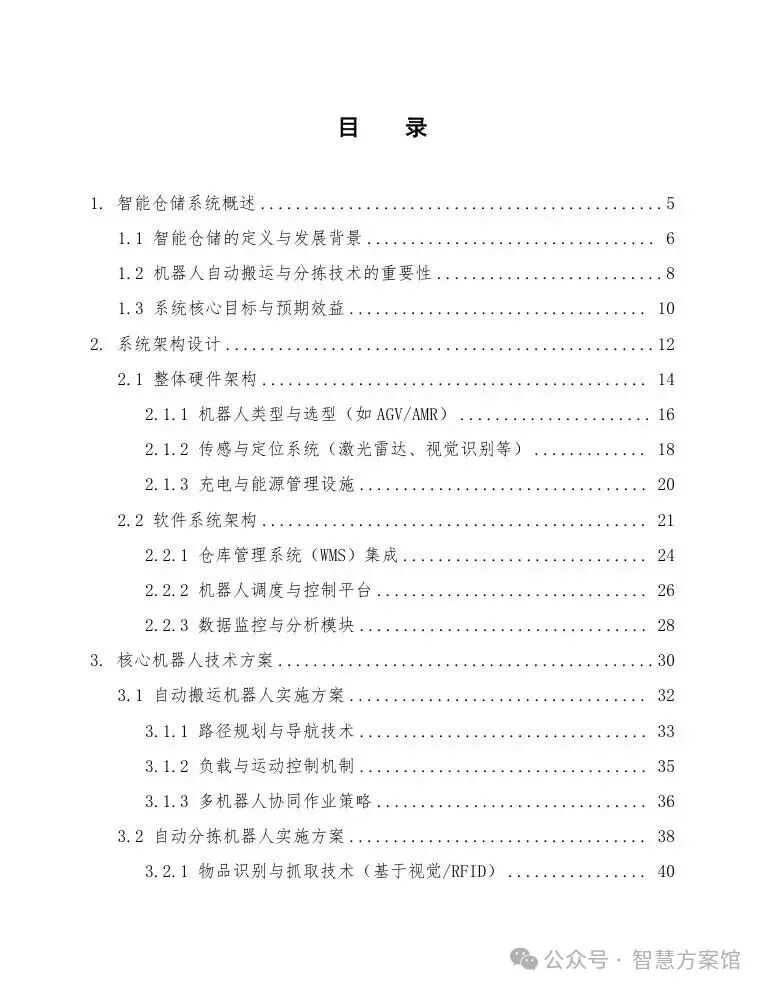
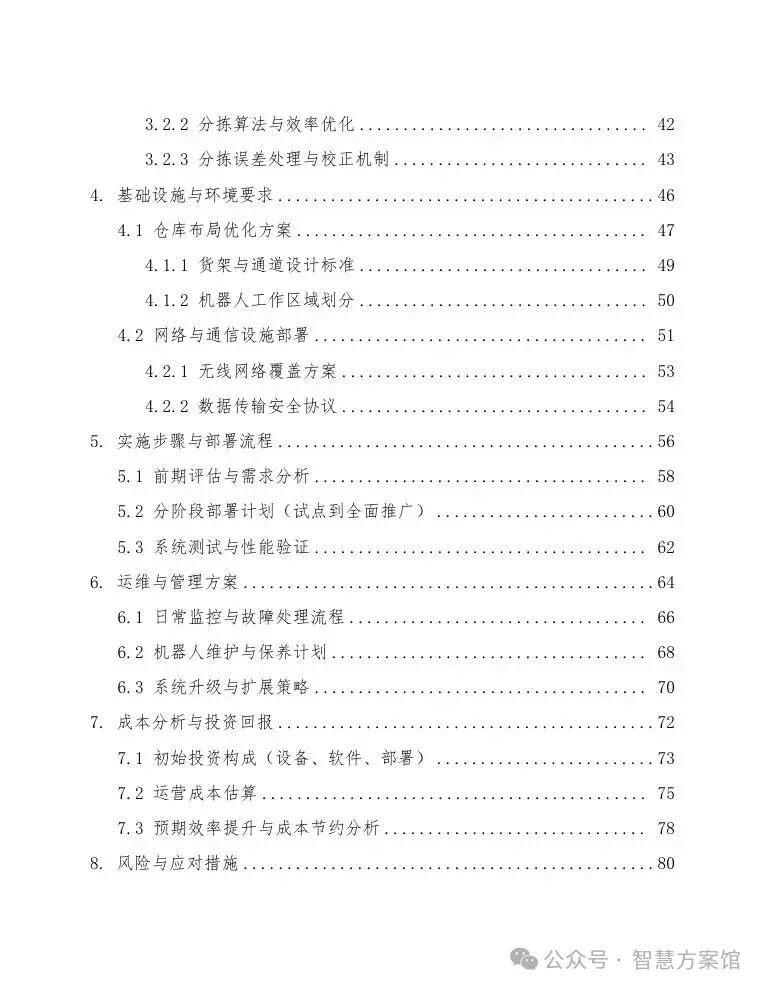
The following are screenshots of the original proposal, which can be accessed by joining the Knowledge Planet for the complete document.


Welcome to join the Smart Solutions Pavilion Knowledge Planet, where you can read and download all the plans in the planet.