Basic Information
|
1 |
Title:Effect of calcite filler on carbonation behavior in a synthesized C-S-H binder |
|
2 |
Keywords:alternative cement; calcite; carbonation; C-S-H; limestone; volcanic ash |
|
3 |
Publication Year:2025 |
|
4 |
Source:Journal of the American Ceramic Society |
|
5 |
First Author:Atolo A. Tuinukuafe, Geomechanics and Geochemistry Department, Sandia National Laboratories, Albuquerque, New Mexico, USA |
|
6 |
Corresponding Author:Jessica M. Rimsza, Geomechanics and Geochemistry Department, Sandia National Laboratories, Albuquerque, New Mexico, USA |
Abstract
Research Background
Carbonation is a critical challenge to the durability of reinforced concrete, as moisture penetration into the material can lead to corrosion of the reinforcement. While the overall impact of carbonation on the microstructure of cement varies, the tendency for carbonation to cause mass loss and volumetric shrinkage in hydraulic cement binders has been recognized for at least 60 years. The increasing use of limestone fillers in Portland cement (PC) within the concrete industry raises new questions regarding the interaction between the initial limestone content and the process of calcium carbonate formation from hydration phases during carbonation. Fundamentally understanding the impact of calcite particles on the carbonation resistance of concrete will ensure sufficient durability and mechanical performance for new cement compositions.
Papadakis et al. conducted extensive experiments and calculations, deriving carbonation as a diffusion-controlled process, with the diffusion rate described as a coefficient based on the square root of time. Based on this work, carbonation depth can be predicted as a function of the binder hydration composition and diffusion constant. The diffusion constant can be modified to account for relative humidity. Similar carbonation depth models have been applied to binders containing various supplementary cementitious materials (SCMs), including limestone, and have shown that the presence of limestone has a relatively minor impact on the chemical reaction mechanisms compared to other SCMs that can promote hydration or react with volcanic ash.
Research on Portland Limestone Cement (PLC) indicates that the addition of limestone dilutes the carbonation reaction, although influenced by various factors, this can increase the carbonation rate. Material parameters such as the water-to-binder (w/b) ratio, limestone content, and limestone fineness also affect the degree of carbonation in PLC.
Research Objective
The aim of this study is to evaluate the impact of limestone on the microstructure of hydraulic binders after carbonation at a fundamental level. This study innovatively uses synthesized C-S-H generated from the reaction of highly active Y-type zeolite and calcium oxide (CaO) as the base binder. This system eliminates the interference of other complex phases found in ordinary cement, allowing for a focused study of the interaction between calcite filler and the C-S-H phase during the carbonation process.
Research Content
This study employs a C-S-H binder made from highly active zeolite volcanic ash and lime to assess the impact of varying amounts of calcite on carbonation behavior at the microstructural level. By analyzing the microstructure of C-S-H and calcite, fundamental insights into the hydration kinetics and carbonation mechanisms of hydraulic binders were obtained. X-ray CT (X-ray computed tomography) was utilized to quantify microstructural changes, revealing that as the calcite content increased, the shrinkage rate decreased, with approximately 50% reduction in shrinkage observed at a 45% wt. calcite replacement level. Crystallography and thermal analysis measured changes in the binder’s composition and confirmed that its shrinkage is related to the decalcification behavior of C-S-H. The addition of calcite to the C-S-H binder effectively reduced the liquid-to-solid ratio, porosity, and the content of C-S-H in these binders. These experiments elucidate how to design the mixing water amount by targeting only the reactive components of the binder to mitigate the carbonation risk of PLC.
Conclusion
This study aimed to better understand the role of limestone in the durability of hydraulic binders during carbonation by preparing a synthetic C-S-H binder that included varying amounts of calcite filler in the initial mixture. The hydration and carbonation processes were designed to simulate the natural conditions encountered by hydraulic binders in practice, leading to the following conclusions regarding the characterization of the binder before and after carbonation:
-
The combination of CaO and highly active synthetic Y-type zeolite with water produced a stable C-S-H binder within 28 days of hydration.
-
CaO from the binder’s CH and C-S-H phases releases during carbonation to form CaCO3, leading to shrinkage cracking in bulk samples.
-
X-ray CT images indicate that carbonation shrinkage cracks merge through pores and dominate the 2D distance map of the samples post-carbonation. There are signs of CaCO3 nucleating on the surface of calcite in the images, but quantification is not possible.
-
Increasing the calcite filler content reduces the volume of hydrates available for reaction during carbonation, which can enhance dimensional stability.
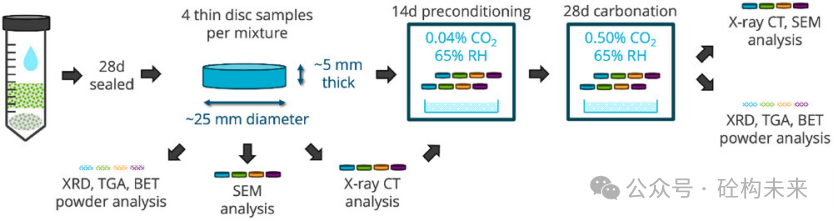
Figure 1. Schematic of sample preparation, conditioning, and analysis
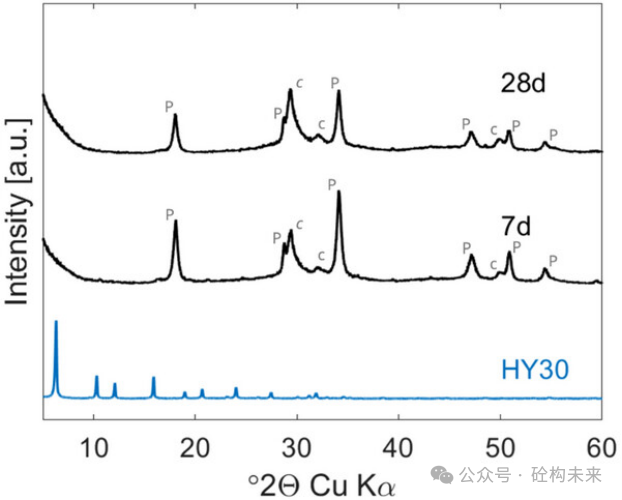
Figure 2. XRD patterns of HY30 zeolite powder, 7-day hydrated C0 samples, and 28-day C0 samples
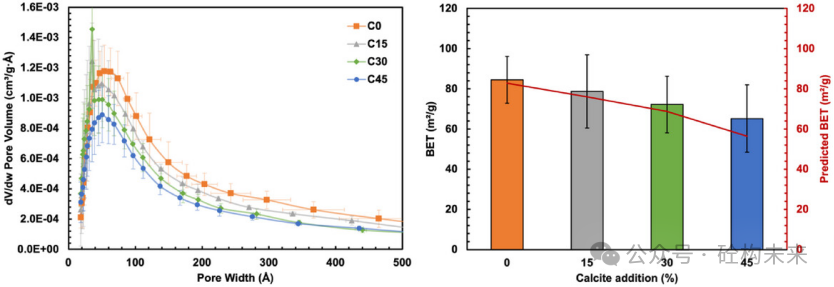
Figure 3. BJH pore size distribution and BET specific surface area after 28 days of sealed curing of samples
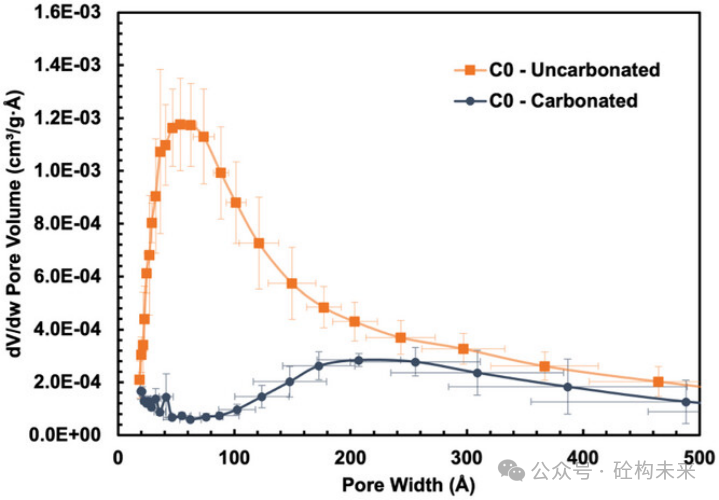
Figure 4. BJH pore size distribution of C0 samples before and after carbonation
Review and Proofreading
Tian Weichen, Distinguished Researcher and Master’s Supervisor, School of Engineering and Construction, Nanchang University. His research focuses on the integrated design of advanced civil engineering materials and the optimization of material development and engineering applications driven by artificial intelligence.
Email: [email protected]
Manuscript Organization
Chen Yu Li Yan, Graduate Student in Civil Engineering, Nanchang University.
Thanks to Chen Yu Li Yan, a master’s student at Nanchang University, for participating in the typesetting work.
Literature Link:
https://doi.org/10.1111/jace.70361
Experts are welcome to provide extensive feedback!
Contact Email: [email protected]