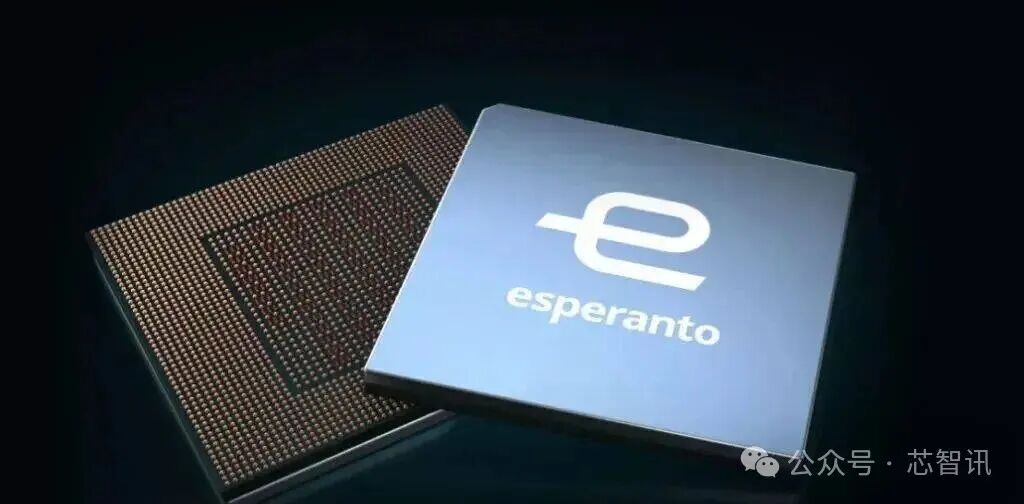
On November 20, according to EETimes, the open-source AI hardware and software startup Ainekko acquired the intellectual property and some assets of the RISC-V AI chip startup Esperanto Technologies in October this year, including its chip designs, software tools, and development frameworks. Ainekko plans to open-source Esperanto’s production-grade RISC-V architecture multi-core chips, including RTL code, reference designs, and development tools.
Ainekko initially started as a software layer for inference and distributed inference, but the founders quickly realized that improvements in software were limited without a collaboratively optimized hardware backend. Ainekko co-founder Tanya Dadasheva stated, “We have always wanted flexibility; we believe that (hardware) should be understandable by people in the open-source (software) ecosystem, they should be able to reason about it, and it should be flexible enough for people to do anything with it.”
Esperanto was founded in 2014 and completed the RTL (Runtime Code) for the Maxion CPU in September 2018, releasing a 1088-core RISC-V chip in 2021 for recommendation workloads in hyperscale data centers. The company shifted towards high-performance computing and generative AI in 2023 but ultimately found it difficult to penetrate the hyperscale data center market and suffered a severe blow after losing its European design team.
In July 2025, Esperanto officially went bankrupt, retaining only a few employees to handle the sale or licensing of its accumulated intellectual property. According to Esperanto’s official statement, competitors lured away their employees with salaries up to four times that of Esperanto, leading to staff attrition and ultimately the company’s collapse.
However, some media outlets believe the issue lies in Esperanto’s inadequate promotion and community engagement. Additionally, their website (to this day) still only features a form stating “I want to evaluate the Esperanto system” instead of an online store with prices and “add to cart” or “checkout” buttons. Starting an AI chip startup is challenging: you have to get many things right, and one mistake can be enough to lead to failure.
Dadasheva, who collaborated with Esperanto during her time at Almaz Capital, initially planned for Ainekko to partner with Esperanto to run Ainekko’s software stack on Esperanto’s hardware. However, when it became clear that Esperanto could not be a long-term partner, Ainekko decided that acquiring its intellectual property was the best option.
Dadasheva mentioned that Ainekko’s team has been using Esperanto’s chips for about six months, successfully running llama.cpp and the tinygrad framework. Some of Esperanto’s next-generation multi-core chips will be used to kickstart community projects, including the development of FFmpeg.
“Some people might think of uses that go beyond our business scope,” Dadasheva said. “For example, some want to run shaders on it, trying to develop an open-source GPU solution, but one of the most interesting applications of this technology is to use it as a complete system on a chip without a host for some edge application scenarios.”
Esperanto initially focused on hyperscale data centers and later slightly shifted towards high-performance computing (HPC) with its thousand-core design. Ainekko expects new application scenarios for the technology to focus on edge computing, where energy efficiency is crucial. The architecture is suitable for most edge AI applications, including industrial, robotics, drones, security systems, and various embedded devices.
“We do not intend to venture into high-performance computing and training; that is absolutely not possible, but even in the inference domain, we do not want to enter the data center, at least not in the next few years,” Dadasheva said.
Ainekko co-founder Roman Shaposhnik stated that Esperanto’s multi-core RISC-V design produced an excellent AI chip, but it will also serve as an outstanding general computing platform. “This is precisely where we align with open-source software, as open-source software always seeks generality, even at the risk of losing some performance metrics; generality always wins in the end.”
Shaposhnik believes that industrial PCs could be an interesting application scenario for Ainekko’s hardware and software, especially considering its vast potential market size (TAM). Another area of interest is an intelligent middleware layer for SSD interfaces, which uses AI technology to detect abnormal read/write operations and terminates system operation upon detecting security vulnerabilities. Shaposhnik noted that there are currently no SoCs on the market suitable for this application scenario.
Custom Chip Plans
Ainekko is planning its first silicon. The company plans to launch a chip with only 8 Esperanto cores (one Esperanto “neighborhood” chip contains 1088 Esperanto-designed cores), which Ainekko plans to connect to 16MB MRAM from the startup Veevx (Veevx co-founder and CEO, Doug Smith, who is also a senior figure at Broadcom, is the third co-founder of Ainekko). The chip will be manufactured by TSMC.
Dadasheva stated that the next step on the roadmap will be a medium-sized design with around 256 cores, which will be more performance-optimized for AI inference, closer to the four-core Cortex-A76 processor on the Raspberry Pi 5.
Dadasheva pointed out, “We are not afraid to open up (hardware IP) to the community, but as a business, we want to provide something similar to the Raspberry Pi 5 that can be used for prototyping.”
The existing Esperanto accelerator cards are already available for cloud access to help potential users evaluate how many cores and other design parameters they need. Dadasheva mentioned that Esperanto’s simulator and software stack have already been open-sourced, and the community has become accustomed to using these technologies.
Dadasheva said, “We see that academia is very interested in adopting Esperanto cores and starting experiments with them, not necessarily to manufacture them but to place them on FPGAs and perform inference.” “If more people use it, that is genuinely a good thing because it will increase our software footprint.”
Anyone building hardware based on Esperanto does not necessarily need to use Ainekko software, but the company’s software stack will be directly optimized for the hardware IP, and both will evolve together. Dadasheva added that by showcasing Esperanto’s existing chips and allowing full access to inspect and download code, concerns about using startup IP have been alleviated. She also mentioned plans to provide hardware IP through the embedded small chip platform ZeroASIC.
Dadasheva stated that Ainekko’s hardware IP and software have been open-sourced under the AI Foundry brand, which is not yet foundational, and discussions about a potential foundation will continue into next year.
Ainekko ultimately plans to offer ASIC design services to potential customers. Shaposhnik indicated that there is also the possibility of establishing hybrid relationships with companies developing their chips, including sales partnerships.
Shaposhnik said, “No one has really tried to run open-source RTL designs completely openly.” “But we are at a stage where we can do smaller designs at higher-level nodes. This is a big question mark; the prerequisites for achieving this obviously include that our actual RTL is open, but also the tools, at least in the front end of the design and simulation process.”
After acquiring Esperanto, Ainekko released two interesting code repositories on GitHub: et-platform and et-man. This also confirms that Ainekko has acquired the IP of ET-SoC-1 and is working to fully open-source it.
et-platform includes a simulator, a kernel driver, and various firmware/boot code/management software, all licensed under the Apache License v2. Meanwhile, et-man currently “only” contains a comprehensive programmer’s reference manual, but it seems that more documentation will be added soon. There are reports that the RTL will eventually be open-sourced, but this may only include RTL written by Esperanto and not any third-party IP (such as Synopsys’s PCIe controller) licensed for chips.
Editor: Chip Intelligence – Wandering Sword
Previous Exciting ArticlesThe Netherlands Suspends Control Over Nexperia! Wingtech: Still Restricted! Ministry of Commerce RespondsSamsung/SK/Hyundai and 7 Other Korean Companies Announce: $890.4 Billion Investment Plan!From Computing, Networking, and Storage, See How New Unisplendour Plans AI InnovationRumors of TSMC’s 2nm Secrets Leaked: Taken to Intel by a 75-Year-Old Former Executive?Intel and Superfusion Strongly Support! RISC-V Enters the Mainstream Market of Data CentersTaiwan Upgrades Export Controls: EUV Masks and Various Semiconductor Equipment Listed!Valued at 1.588 Billion Yuan, Oil Company Cross-Industry Acquires Semiconductor FirmTesla Requires US-Made Vehicle Parts to be “De-Chinese” with a Goal to Complete in Two YearsThe Netherlands’ Nexperia Has Not Resumed Wafer Supply, Automotive Customers and Chinese Nexperia Actively Self-Rescue!Rumors that Samsung Will Raise DDR5 Prices by 60%!Targeting Edge AI! Arm Technology’s “Zhou Yi” X3 NPU Released: DSP+DSA Architecture, 80TFLOPS!General Motors Requires Suppliers to Exclude Chinese Parts!Breaking Foreign Monopoly! Domestic Probe Card “First Stock” Successfully Passes Review, Huawei is the Fourth Largest Shareholder!Self-Developed Brain-Computer Interface Chip, This Hangzhou Company Achieves High-Precision Chinese Neural Decoding!Nexperia China Resumes Partial Supply, Multiple Automotive Companies Confirm First Batch of Chips Arrived!Breaking News! Intel’s Chief Technology Officer Jumps to OpenAISandisk Raises NAND Prices by 50%, Multiple Module Manufacturers Suspend Shipments!
For industry communication and cooperation, please add WeChat: icsmart01Chip Intelligence Official Communication Group: 221807116