Ultra High-Density Interconnect (UHDI) technology is rapidly transforming the design and deployment of intelligent systems in Industry 4.0. UHDI supports highly miniaturized, high-performance, and densely packaged electronic products, making it a key driving technology for the future of smart, interconnected, and automated industries.
This article explores the synergy between UHDI and Industry 4.0 technologies, highlighting applications, advantages, and future development directions.
Industry 4.0 represents the convergence of cyber-physical systems, the Industrial Internet of Things (IIoT), artificial intelligence (AI), and automation, fundamentally changing modern manufacturing and production.
At the core of this transformation is the demand for compact, reliable, and high-performance electronic products. UHDI technology features ultra-fine traces, microvias, and embedded passive components, providing practical support to meet these demands.
Author

Anaya Vardya

President and CEO of American Standard Circuits. Author of “Thermal Management from a Manufacturer’s Perspective”; co-author of “The Printed Circuit Designer’s Guide to RF/Microwave PCB Basics” and “The Printed Circuit Designer’s Guide to Flexible and Rigid-Flex PCB Basics”.

Overview of UHDI Technology
UHDI is an advanced PCB technology characterized by:
• Trace width/spacing structures of 25µm or smaller
• Laser-drilled microvias (typically stacked or staggered)
• Embedded passive components (resistors, capacitors)
• Advanced materials for high-frequency performance
These features enable higher density interconnections within a smaller footprint, improving electrical performance and enhancing mechanical reliability—key elements required in the field of Industry 4.0.
The above is an advertisement and is not related to the main content.

Applications of UHDI in Industry 4.0
Smart Manufacturing Systems
• UHDI facilitates the direct integration of AI and machine learning processors into devices
• Enables high-bandwidth data transfer between control units and sensors
IIoT Devices and Networks
• UHDI supports ultra-compact, multifunctional IoT nodes
• Enhances edge processing capabilities to reduce latency and bandwidth requirements
Robotics and Autonomous Platforms
• UHDI boards reduce weight and space requirements
• Improve sensor-actuator response times and integration density
Augmented Reality and Industrial Wearables
• Enables lightweight, battery-efficient AR systems for diagnostics and training
• Improves ergonomics while maintaining high performance
Advantages of UHDI in Industrial Environments
• Space Efficiency: Smaller devices fit into more compact industrial enclosures
• Signal Integrity: Reduces crosstalk and electromagnetic interference for real-time control
• Reliability: Enhances thermal and mechanical performance under harsh conditions
• Power Efficiency: Shorter interconnections and embedded components reduce power consumption
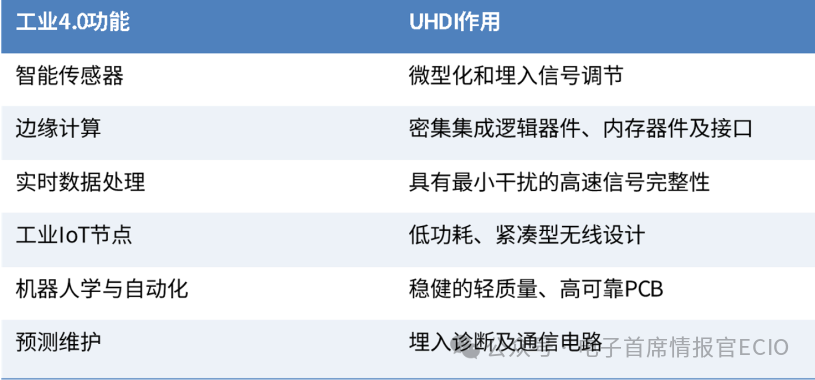
▼ UHDI supports the requirements of Industry 4.0
Future Outlook and Research Directions
• Integration with 5G/6G industrial networks for ultra-reliable low-latency communication
• Development of flexible and biocompatible UHDI substrates for wearable industrial technologies
• Collaboration with chiplet-based architectures to achieve scalable edge AI systems
• Utilizing UHDI for green electronics projects by reducing materials and improving energy efficiency

Conclusion
UHDI technology is foundational to the success of Industry 4.0. By enabling the compact, robust, and interconnected systems required for modern smart factories, UHDI is bridging the gap between miniaturization and industrial robustness.
As the industrial ecosystem’s demand for intelligence, efficiency, and sustainability continues to grow, the role of UHDI technology will only become more significant.



The above is a partner of the Chief Electronics Officer(partial)
Order does not indicate priority