While flagship Android devices are still competing with 3nm technology, MediaTek has already sent its 2nm chip to the factory.
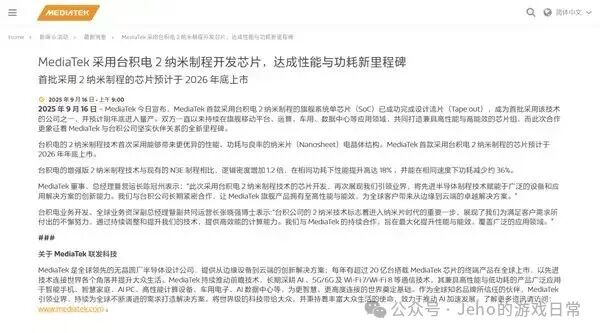
Today, MediaTek officially announced on its website that the first flagship SoC using TSMC’s 2nm process has successfully completed design tape-out, becoming one of the first chips in the world to enter the 2nm era. Those in the know understand that this chip is the next-generation flagship chip – the Dimensity 9600, which is expected to enter mass production by the end of next year and will be seen in high-end Android devices by 2026. This means that the Android camp will finally be on the same starting line as Apple, marking the end of the era of process generation gaps.
The biggest highlight this time is that TSMC’s 2nm technology has for the first time adopted a nanosheet transistor structure. In simple terms, this means changing the previously “standing” transistors to “sheets” fully wrapped by the gate, like putting a protective coat on the transistors, directly solving the leakage problem. Compared to the current mainstream 3nm enhanced version (N3E),the logic density is increased by 1.2 times, with performance potentially increasing by up to 18% at the same power consumption, or if performance remains unchanged, power consumption can be directly reduced by 36%. In terms of yield, TSMC is performing exceptionally well, currently reaching 60%, significantly ahead of Samsung’s 40% for 2nm, which means lower costs during mass production, allowing ordinary users to access new technology faster.
More importantly, these parameters are not just numbers on paper. Currently, using the Dimensity 9400 to play “Genshin Impact” at full effects drains 25% battery in one hour while the device heats up. After switching to the Dimensity 9600, under the same graphics quality, battery life can extend by an additional 20 minutes, and the back temperature can drop by at least 3 degrees. In typical multitasking scenarios like using WeChat, watching videos, and replying to emails, the switching speed will be nearly 20% faster than now, eliminating the lag during app loading. What does this mean for mobile gamers who have long been troubled by battery anxiety? It likely means no need to carry a power bank when going out, and the freedom to play games at the highest graphics settings.
However, don’t rush to upgrade your device; there is still some time before the chip goes from tape-out to mass production and market launch. According to TSMC’s schedule, the 2nm process will begin large-scale production by the end of next year, and the MediaTek Dimensity 9600 will not officially debut until mid-2026 at the earliest. Counterpoint predicts that by 2026, about one-third of flagship smartphones will use 3nm or 2nm chips, meaning that initially, it will still be exclusive to flagship devices, and it will be at least 2027 before mid-range models become widespread. Digital enthusiasts can start saving money, but there’s no need to rush to clear inventory, as current flagship devices are already sufficient for two years of use.
This collaboration also reflects the long-standing synergy between MediaTek and TSMC. From the previous N6RF + process wireless chips to the current 2nm flagship, both parties have been optimizing designs using DTCO technology, which essentially means making the design and manufacturing processes more in sync, enhancing performance while reducing costs. The benefits of this deep collaboration are tangible, as the Dimensity 9400 has already ranked among the top three in performance within its price range, and many in the digital community have noted its excellent cost-performance ratio. The Dimensity 9600 is likely to continue this advantage.
Finally, let’s talk about the practical aspects; the real change brought by the 2nm chip is in our smartphone experience. In the future, when going out to shoot vlogs, there will be no need to worry about running out of battery, playing mobile games will not require lowering graphics quality to reduce heat, and multitasking will not cause lag. Of course, technological advancements always come at a cost; the first batch of smartphones equipped with the Dimensity 9600 will certainly not be cheap, with an expected starting price above 5000 yuan.
What do you think the 2nm chip should solve for Android devices? Battery anxiety or overheating and lag? Share your thoughts in the comments section.