3D printing, also known as additive manufacturing, has a unique ability to form complex metal components, which meets the significant demand for lightweight and highly integrated new-generation aerospace equipment, and is expected to replace traditional manufacturing methods to achieve intelligent manufacturing of key components in high-end equipment. However, the application prospects have long been constrained by the generally poor fatigue performance of additive manufacturing materials and components. Previously, researchers from the Institute of Metal Research, Chinese Academy of Sciences proposed a NAMP process that couples microstructure and defect control, successfully producing near-void-free 3D printed Ti-6Al-4V alloy materials with ultra-high tensile fatigue performance, breaking the world record for tensile fatigue strength across all materials, and updating the academic community’s inherent understanding of the low fatigue performance of 3D printed materials.
However, the service environment of actual engineering components often accompanies significant changes in loading stress ratios. When the external stress ratio that materials or components endure changes, the cyclic stress amplitude and the distribution ratio of maximum stress also change, which can induce transitions between different fatigue crack mechanisms. This “trade-off” cracking pattern makes it difficult for traditional titanium alloy microstructures to maintain excellent fatigue performance across the entire stress ratio range, and a specific microstructure type often exhibits fatigue resistance advantages only within a certain stress ratio range. For additively manufactured components with complex structures, the stress distribution during actual service is even more complex, and they will endure fatigue loads with variable stress ratios. Therefore, achieving high fatigue resistance under all stress ratio conditions is key to determining whether additive manufacturing technology can be scaled for applications in aerospace and other fields, and it is one of the scientific challenges that urgently needs to be addressed.
To address the above issues, this study systematically reveals three typical “fatigue weaknesses” of titanium alloys prone to fatigue cracking and their stress ratio sensitive intervals, discovering that the near-void-free net additive manufacturing (Net-AM) microstructure can achieve synergistic optimization of the three types of fatigue weaknesses. Furthermore, the researchers proposed that 3D printed titanium alloys still possess inherently high fatigue resistance characteristics under all stress ratio conditions. Building on the team’s earlier original NAMP process, the researchers prepared a near-void-free Net-AM microstructure Ti-6Al-4V alloy and characterized its fatigue strength and fatigue crack mechanisms under different stress ratio conditions. A large amount of comparative data analysis indicates that, across the entire stress ratio range, the fatigue strength of Net-AM microstructure Ti-6Al-4V alloy is overall superior to all titanium alloy materials, and its specific fatigue strength (fatigue strength divided by density) also surpasses all metal materials.
This research reveals the inherent advantages of titanium alloy components with complex topological structures, subjected to complex loads, in terms of fatigue resistance, laying the foundation for their application as load-bearing components in aerospace and other fields. At the same time, this study provides new ideas for optimizing the fatigue performance design of forged titanium alloys under different stress ratios.
Recently, the related research results were published in Naturally high fatigue performance of a 3D printing titanium alloy across all stress ratios in Science Advances. The research work was supported by the National Natural Science Foundation of China and the Chinese Academy of Sciences.
Paper link
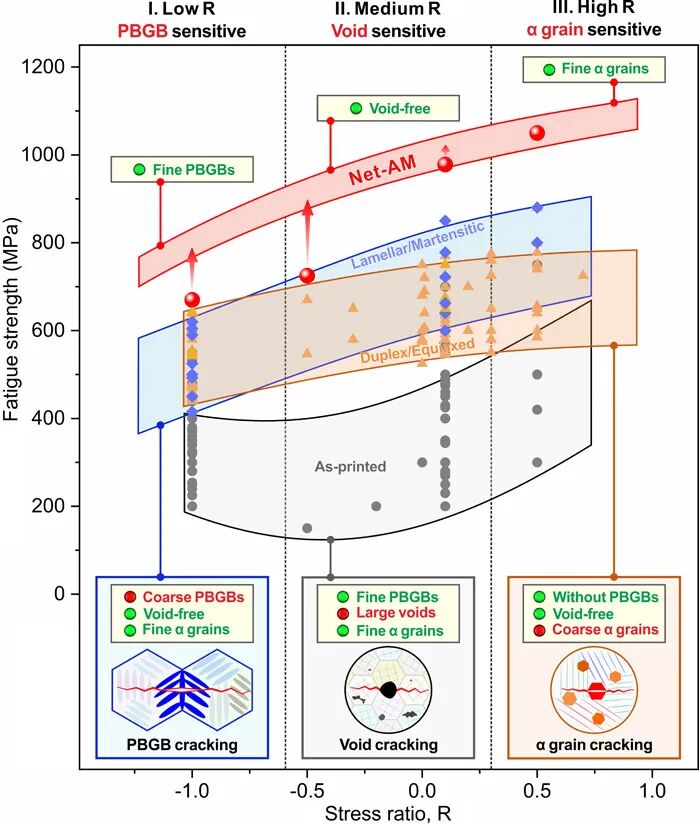
Fatigue strength and corresponding fatigue crack mechanisms of Ti-6Al-4V alloys with different microstructure types under different stress ratio conditions
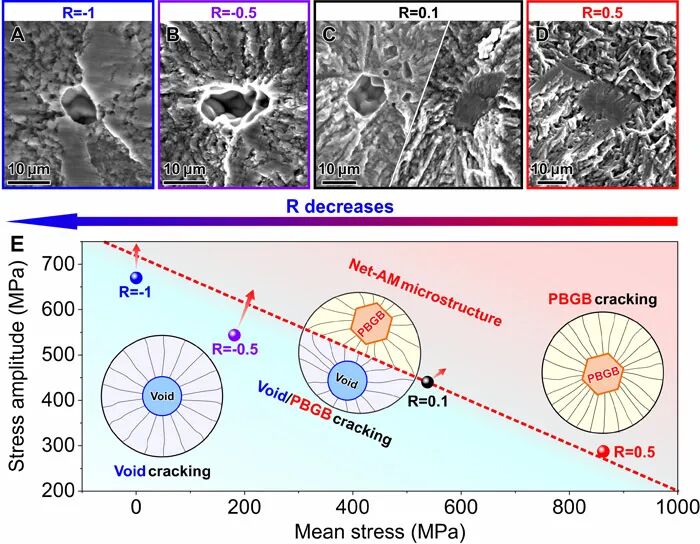
Typical fatigue fracture surfaces and corresponding fatigue crack initiation mechanisms of Net-AM microstructure Ti-6Al-4V alloy under different stress ratios
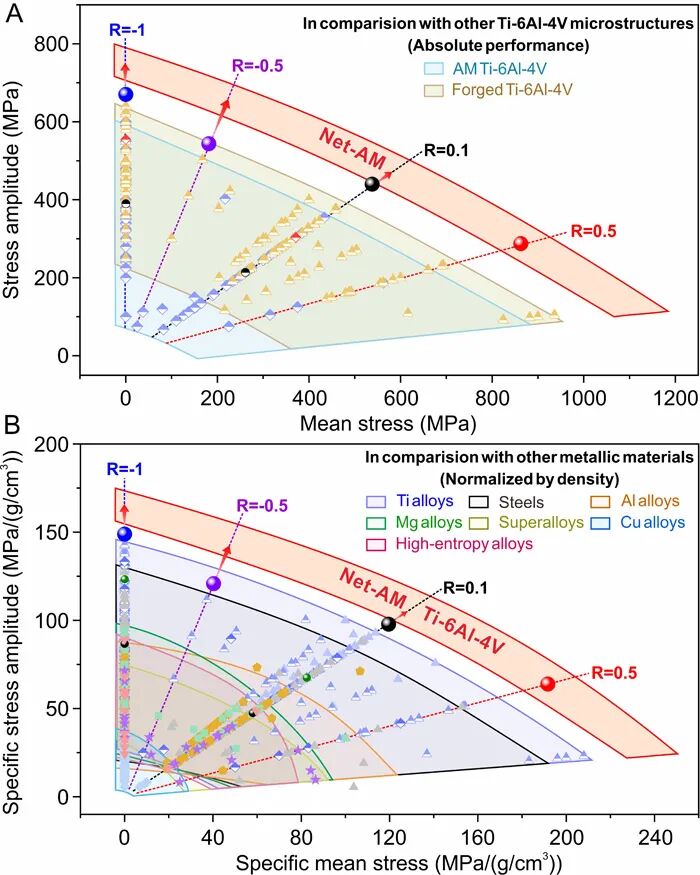
Fatigue strength distribution of Net-AM microstructure Ti-6Al-4V alloy compared to other Ti-6Al-4V alloys and common metal structural materials under different stress ratios
Copyright StatementSource:This article is from the Institute of Metal Research, Chinese Academy of SciencesRelated Reading:Mentor Complains About Students: Crying to FinishMIT Science: Why Does a Razor Blade Get Dull!Must-Collect! Mind Map of Chapters in “Fundamentals of Materials Science” If you find this useful, please share or take a look