Click the blue text
Follow us

Tip
Keywords
3D printing (3D printing); solar evaporators (Solar evaporators); structural design (Structural regulation); solar desalination (Solar desalination)
Tip
01
Research Background
With the growth of the global population and the intensification of water pollution, the shortage of freshwater resources has become a major challenge facing human society. Although70% of the Earth’s surface is covered by water, only2.5% is freshwater. Traditional seawater desalination relies on fossil energy, which has high energy consumption and serious environmental pollution. In contrast, solar-driven interfacial water evaporation (ISSG) technology has gained widespread attention due to its green and sustainable advantages. In recent years,3D printing technology, with its strong structural designability, flexible manufacturing, and high material utilization, has become an emerging means to construct high-performance solar evaporators.
Tip
02
Research Content
This review systematically summarizes the application of3D printing in the design and manufacturing of solar evaporators, mainly including:
1, structural design strategies:
(1) Light absorption layer: By constructing conical, concave, wavy, and other micro-nano structures, achieve multiple reflection and energy recovery effects to enhance photothermal conversion efficiency.
(2) Thermal insulation layer: Design double-layer structures, suspended structures, air insulation layers, etc., to reduce heat loss to the water body.
(3) Water transport channels: Construct1D,2D,3D water channels, using bionic microchannels, hierarchical pore structures, etc., to achieve efficient water supply and salt management.
2, 3D printing technology:
(1) Photopolymerization printing (SLA/DLP): Suitable for high-precision structures, commonly using photosensitive resins combined with photothermal materials.
(2) Material extrusion (DIW/FDM): Suitable for multi-material, complex structures, requiring control of the rheological properties of inks/materials.
3, multifunctional integrated applications: Integrate fog collection, salt recovery, pollutant removal, thermoelectric/water photovoltaic power generation, etc., to achieve an all-weather, multi-scenario water–energy–environmental collaborative system.
Tip
03
Illustrated Guide
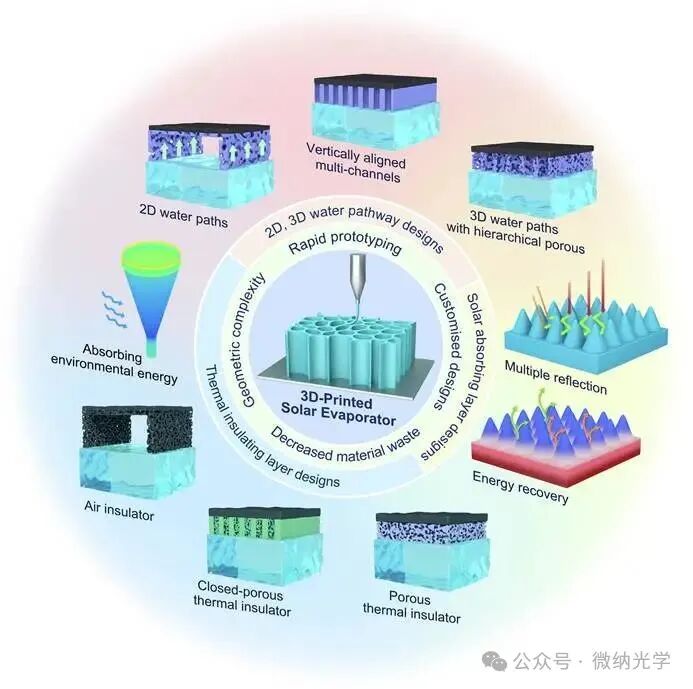
Fig. 1 Schematic diagram of a 3D printed solar evaporator, highlighting the advantages of3D printing (inner layer), as well as the structural design strategies of the solar absorption layer, insulation layer, and water channel (outer layer).
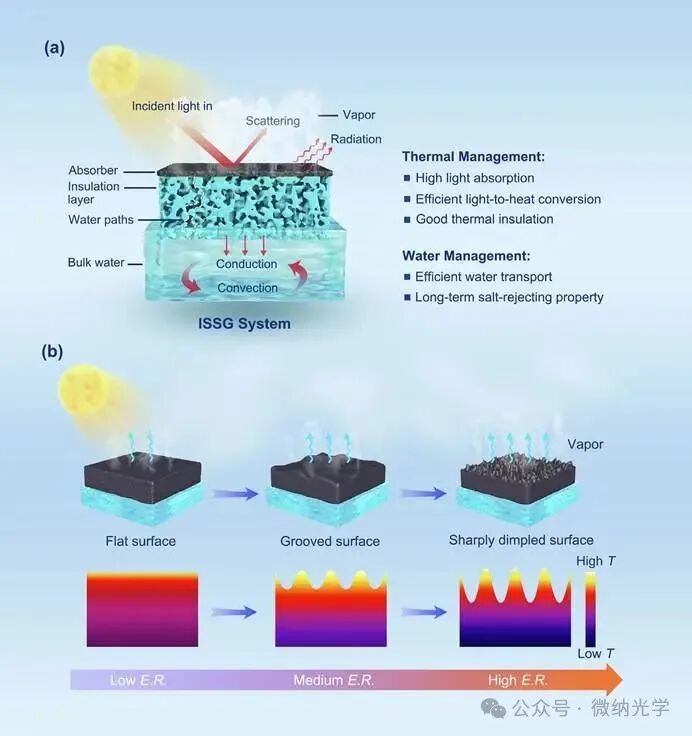
Fig. 2 Schematic diagram of a typical ISSG system structure and its surface morphology affecting performance. (a) Schematic diagram of a typical ISSG system and the heat transfer process during evaporation. It also demonstrates the overall principles of heat and water management. (B) Schematic diagram of the effect of surface morphology on solar evaporation rate,T (temperature) andE.R. (evaporation rate).
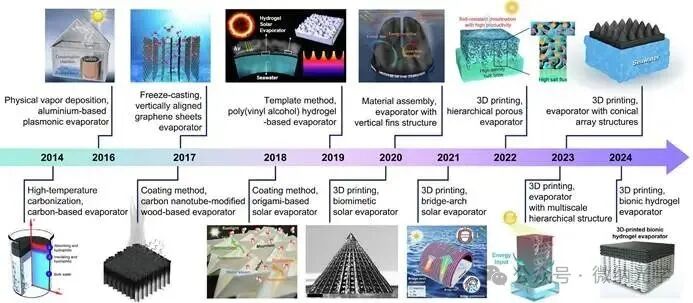
Fig. 3 Brief timeline of the main progress of the ISSG system in the past 10 years.
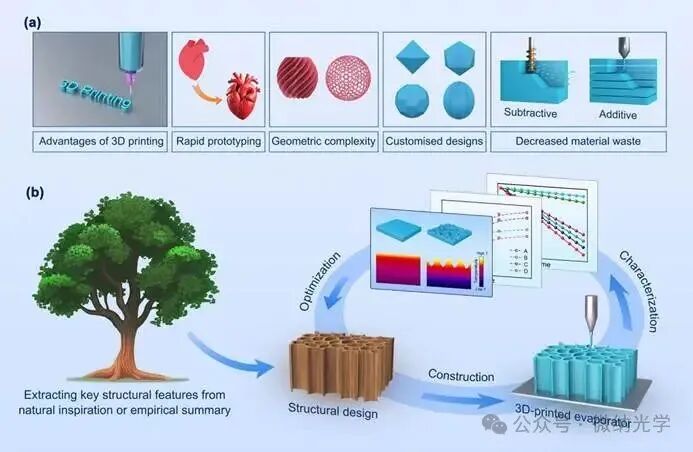
Fig. 4 Advantages of constructing solar evaporators using 3D printing. (a) Advantages of 3D printing compared to traditional manufacturing methods. (B) Exploration and optimization of structural designs for improved evaporation performance based on 3D printing.
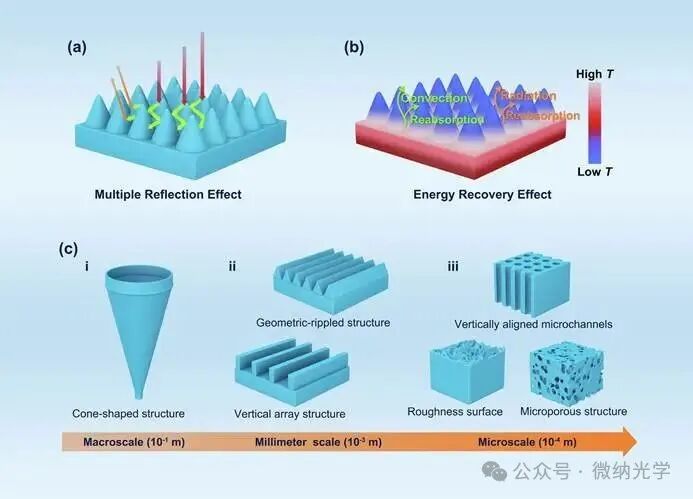
Fig. 5 (a, b) Schematic diagram of the multiple reflection effect and energy recovery effect through conical array structures. (c) Enhancing sunlight collection by capturing light within multiple reflection structures at (i) macroscopic scale, (ii) millimeter scale, and (iii) microscopic scale.
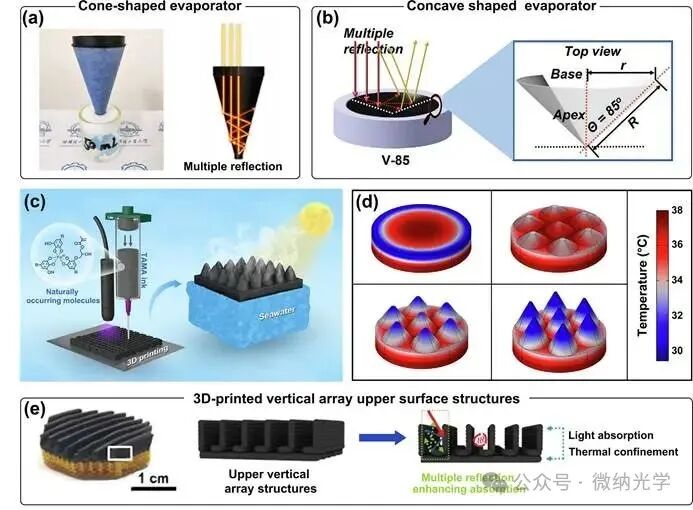
Fig 6. Structures designed to improve light utilization efficiency. (a) Schematic diagram of a 3D printed conical evaporator and its incident light multiple reflection diagram; (b) Schematic diagram of concave structure light absorption; (c) Schematic diagram of a 3D printed evaporator with conical array surface structure; (d) Simulation results of surface temperature distribution under different cone height conditions; (e) Schematic diagram of a 3D printed evaporator light absorption with array structure.
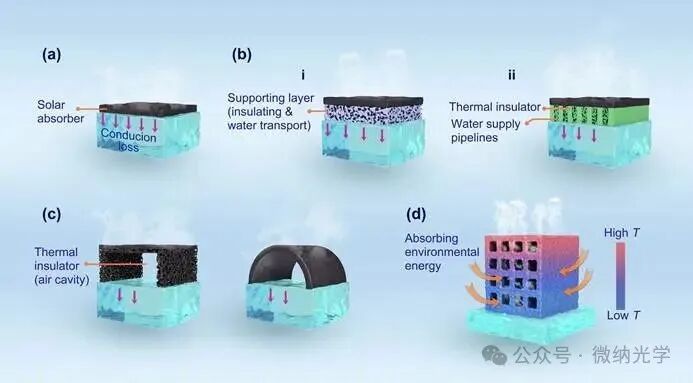
Fig. 7 Progressive thermal insulation layer design for ISSG systems. (a) Single-layer floating evaporation structure; (b) Double-layer evaporation structure: (i) Supported by floating porous thermal insulator; (ii) Supported by closed-cell thermal insulator with independent water transport channels. (c) Suspended evaporation structure: using air cavity spacing as thermal insulation layer. (d) Utilizing macro-structured evaporators to collect ambient energy.
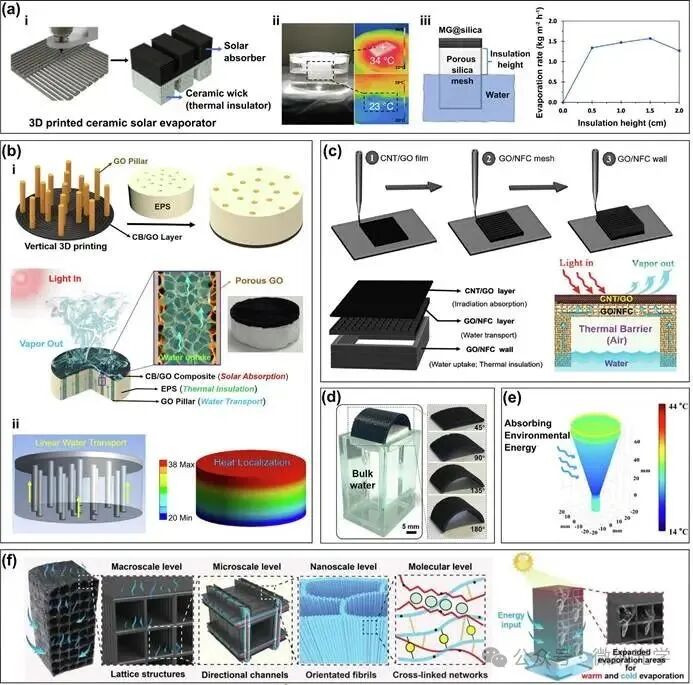
Fig. 8 Progressive thermal management design for ISSG systems. (a) Double-layer ISSG system with floating porous thermal insulator: (i) 3D printing process of ceramic solar seawater desalination evaporator; (ii) Temperature changes at the top and bottom of the evaporator during operation; (iii) Evaporation rates of the device at different insulation heights. (b) Double-layer ISSG system with closed-cell thermal insulator: (i) Schematic diagram of vertical 3D printed evaporator structure; (ii) Bottom view schematic diagram of the evaporator and its surface temperature distribution simulation results. (c) 3D printed evaporator with concave structure.NFC: Nanofibrillated cellulose.(d) Schematic diagram of the salt dissolution mechanism achieved by the aerogel lattice structure: achieving directional migration and dissolution of salt through the concentration gradient between pores.
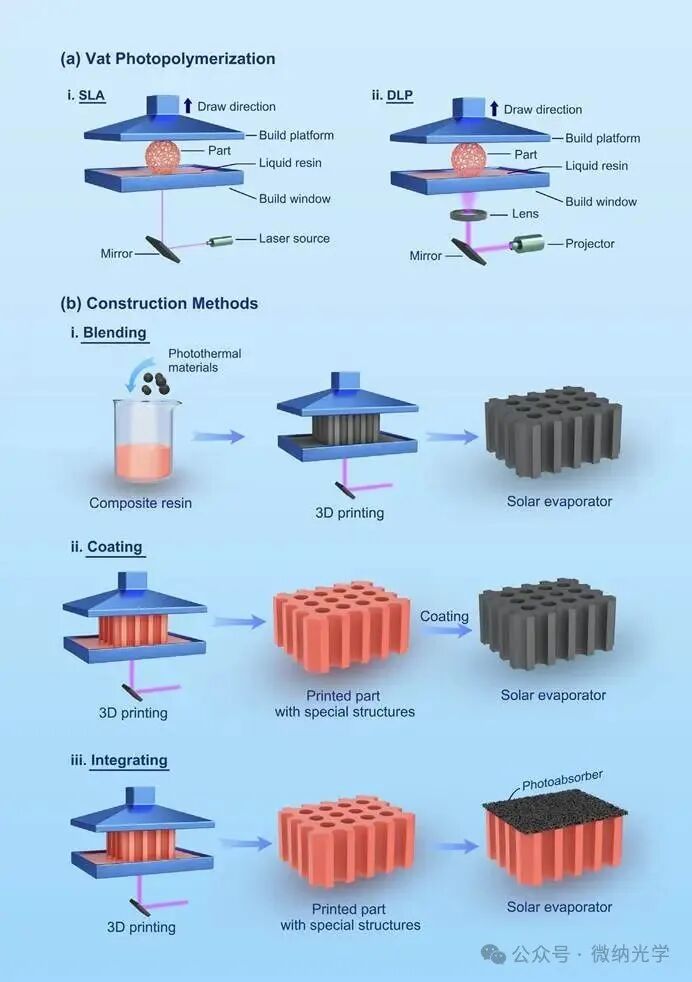
Fig. 12 Photopolymerization molding technology. (a) Two most common 3D printing methods based on photopolymerization molding: (i) Stereolithography (SLA): Selectively curing liquid resin point by point with a laser beam; (ii) Digital Light Processing (DLP): Using a projector to project an entire layer of light for full-layer curing. (b) Three methods for constructing solar evaporators based on photopolymerization molding technology.
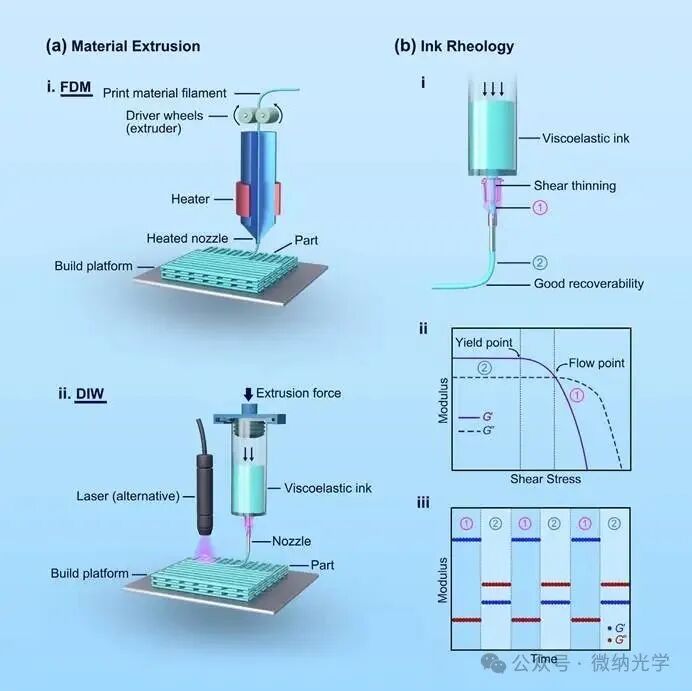
Fig. 13 Material extrusion molding. (a) Two material extrusion-based 3D printing methods for constructing solar evaporators: i) Fused Deposition Modeling (FDM) printing; ii) Direct Ink Writing (DIW) printing. (b) Ideal rheological response diagram of viscoelastic ink for DIW printing: i) Interaction of rheological characteristics during DIW printing; ii) Storage modulus (G’) and loss modulus (G”) of printable inks as a function of shear stress; iii) Elastic recovery test – measuringG’ andG” under low and high deformation conditions.
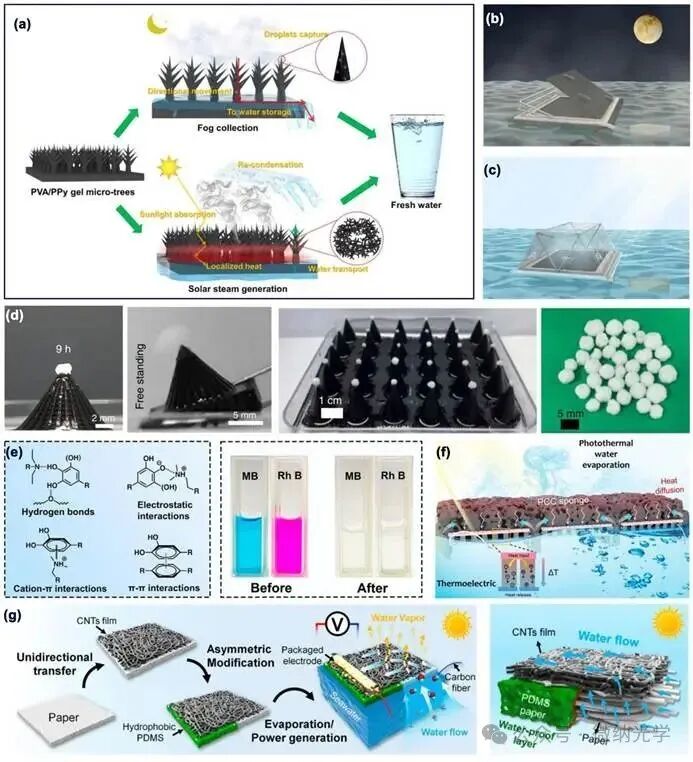
Fig. 14 Multifunctional applications of the ISSG system. (a-c) Schematic diagram of dual-function gel film: combining solar water purification and fog water collection functions to achieve all-weather freshwater collection. (d) Optical image of local salt crystallization on the bionic evaporator and its easy removal characteristics. (e) Schematic diagram of the adsorption effect of the evaporator with organic dye molecules and optical images of adsorption performance (MB: Methylene blue, Rh B: RhodamineB). (f) Schematic diagram of the sponge evaporator achieving simultaneous water evaporation and thermoelectric power generation.(g) Schematic diagram of the asymmetric functionalized mixed solar evaporator achieving simultaneous water evaporation and power generation.
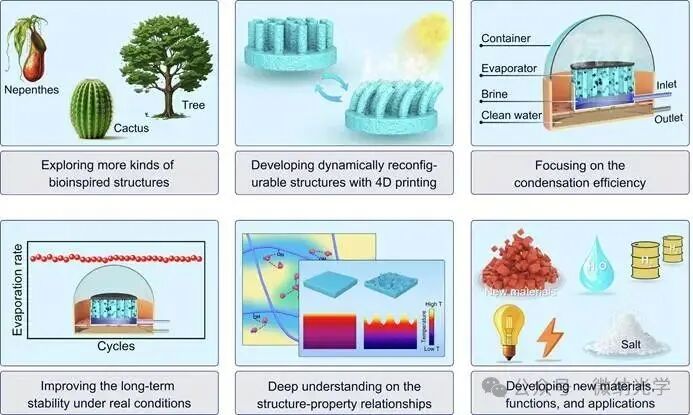
Fig. 15 Future development and remaining challenges of 3D printed solar evaporators.
Tip
04
Research Conclusions
(1) 3D printing technology provides unprecedented structural freedom and functional integration capabilities for solar evaporators, significantly enhancing evaporation efficiency (>90%) and breaking through the theoretical limits of traditional 2D evaporators.(2) Future development directions include: exploring more bionic structures (such as plant leaves, animal surfaces); introducing 4D printing to achieve responsive dynamic structures; improving condensation efficiency and long-term stability; constructing a structure-performance database to promote AI-assisted design; expanding into new application areas such as fuel synthesis, sterilization, photocatalysis, etc.3D printed solar evaporators are not only a potential technological pathway to address the water resource crisis but also provide a new paradigm for constructing sustainable water-energy-environment systems.
Tip
References
X. Zhang, J. Wang, X. Wang, Y. Xu, Y. Li, Structural and functional tailoring of interfacial solar evaporators using 3D printing. Materials Today 83, 484-512 (2025). https://doi.org/10.1016/j.mattod.2025.01.011
Tip
Journal Introduction
Materials Today CAS1 Zone (Materials Science)IF = 22
END
Source: Micro-Nano Optics
Submission Email: [email protected]
Disclaimer: Represents only the author’s personal views. The author has limited expertise; if there are any scientific inaccuracies, please leave comments below for correction!