
Wearable Devices
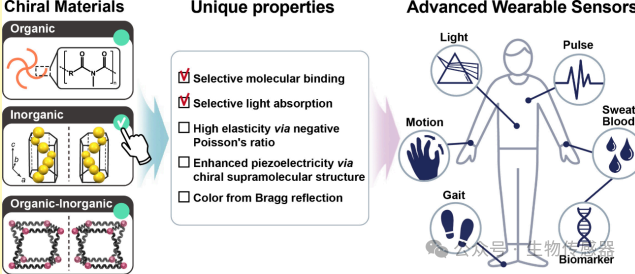
With the deep integration of the Internet of Things (IoT) and healthcare, wearable sensors have become core tools for real-time physiological monitoring, disease warning, and health management. However, traditional sensors constructed from non-chiral materials have significant limitations in molecular selective recognition, mechanical stability, and piezoelectric performance, making it difficult to meet the demands of precision medicine for high sensitivity and high specificity detection. Chiral materials, due to their unique structure of “non-overlapping with their mirror image,” exhibit excellent properties such as selective molecular binding, enhanced piezoelectric response through macroscopic polarization, and improved elasticity through negative Poisson’s ratio, providing a new solution to break through the technical bottlenecks of wearable sensors.
This article systematically reviews the design principles and classifications of chiral materials (chemical chirality and structural chirality), summarizes their core applications and mechanisms in electronic sensing (pulse, biomarkers, strain, optical detection) and optical sensing (humidity, temperature, biomarkers, pressure), and deeply analyzes the current challenges faced in the field, including insufficient multi-target monitoring capabilities, delayed diffusion of small molecular biomarkers, data security risks, and weak applications of optical technologies. It proposes future development directions from an interdisciplinary perspective, combining molecular engineering, AI technology, encryption technology, and circularly polarized luminescence, aiming to provide references for the innovative design and clinical translation of chiral material-based wearable sensors.
Driven by the demand for precision medicine and proactive health management, wearable sensors, with their advantages of real-time, non-invasive monitoring of physiological indicators (such as pulse, sweat biomarkers, skin temperature), have become a key hub connecting individual health and medical systems [6]. The integration of IoT technology further expands their application scenarios, demonstrating great potential from daily fitness monitoring to emergency warning [1-4]. However, existing wearable sensors still face three core challenges: first, insufficient selective recognition capability for chiral molecules in the body (such as amino acids, lactic acid), making it difficult to distinguish enantiomers with different physiological activities; second, poor mechanical stability under repeated deformation, unable to maintain long-term adherence to dynamic human tissues (such as muscles and joints); third, low piezoelectric conversion efficiency, making it difficult to effectively collect and amplify signals from low-frequency human motion energy [7,12].
Chirality, as a universal structural characteristic in nature (such as DNA double helix, protein α-helix), provides a unique approach to solving the above challenges. Chiral materials can achieve selective binding to specific enantiomers, enhanced piezoelectric response through macroscopic polarization, and high elasticity brought by negative Poisson’s ratio through asymmetric arrangement at the molecular or supramolecular scale [16,24]. In recent years, significant progress has been made in the application of organic chiral materials (such as cellulose nanocrystals), inorganic chiral materials (such as chiral perovskites), and organic-inorganic composite chiral materials (such as chiral metal-organic frameworks, MOFs) in wearable sensors, which not only improve detection sensitivity and specificity but also expand the coverage of sensing targets (from physical signals such as strain and pressure to chemical signals such as sweat biomarkers) [7,8,15]. This article will systematically analyze the breakthroughs in the application of chiral materials in wearable sensors, dissect current limitations, and look forward to future development directions, providing perspectives for innovative research in this field.
1. Design Principles and Classifications of Chiral Materials
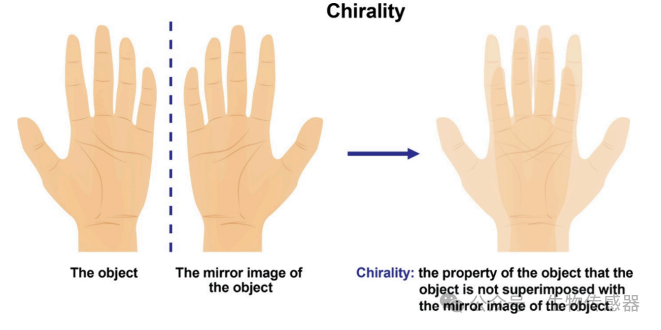
The core definition of chirality is “an object cannot overlap with its mirror image,” a characteristic that endows materials with unique physicochemical properties [16]. Based on the source of chirality, chiral materials can be divided into two main categories: chemical chirality and structural chirality. The design principles and performance advantages of the two differ significantly, but both provide key support for the functionality of wearable sensors.
1.1 Chemical Chirality: Asymmetry at the Molecular Scale
Chemical chirality arises from the spatial asymmetrical arrangement of atoms within a molecule, mainly including three types: organic chiral materials, inorganic chiral materials, and organic-inorganic composite chiral materials:
-
Organic chiral materials: such as hydroxypropyl cellulose (HPC), cholesteric liquid crystals, achieve selective molecular binding and Bragg reflection color change through chiral centers within the molecule (such as asymmetric substitution of carbon atoms) [33,35]. For example, the helical structure of HPC can change the pitch by adjusting humidity or pressure, thereby achieving reversible color changes, providing intuitive signals for optical sensing [33].
-
Inorganic chiral materials: such as chiral selenium nanowires, quasi-2D chiral perovskites [(R)-β-MPA]₂MAPb₂I₇, whose asymmetric crystal structure endows them with excellent piezoelectric performance and circularly polarized light (CPL) detection capability [15,37]. The chiral perovskite CPL detector developed by Yuan’s team has a responsivity of 1.1 A/W, detectivity of 2.3×10¹¹ Jones, and less than 10% performance degradation after 1000 bends, meeting the flexibility requirements of wearable devices [15].
-
Organic-inorganic composite chiral materials: such as chiral MOFs, imprinted polyimides, combine the molecular recognition ability of the organic phase with the stability of the inorganic phase. The luminescent chiral MOF designed by Xie’s team can achieve selective quantitative detection of L-lactic acid in sweat through fluorescence changes from deep red to bright yellow and color changes from blue to red, providing a new tool for monitoring exercise metabolism [8].
The core advantage of chemical chiral materials lies in their high selective molecular binding, where their asymmetric structure can form specific interactions with target enantiomers (such as L-phenylalanine, D-lactic acid), thereby distinguishing chiral molecules with different physiological activities [7,20].
1.2 Structural Chirality: Asymmetrical Arrangement at the Supramolecular/Macroscopic Scale
Structural chirality is formed by the spatial assembly of molecular or nanoscale units, without the need for chiral centers within the molecule, mainly including three types of structures:
-
Chiral supramolecular structures: formed by intermolecular forces (such as hydrogen bonds, van der Waals forces) into helical assemblies, can achieve piezoelectric enhancement and Bragg reflection color change. Datta’s team constructed a piezoelectric sensor using a receptor-donor-receptor (AD₂A) chiral supramolecular assembly, achieving an open-circuit voltage (Vₒc) of 2.2 V and a short-circuit current density (Jₛc) of 45.6 nA・cm⁻², significantly enhancing the piezoelectric response through macroscopic polarization, successfully monitoring the real-time pulse of the wrist artery [12].
-
Imprinted chiral spaces: formed by mixing chiral small molecules with non-chiral materials and then removing the chiral molecules, creating cavity structures that match the target enantiomers. The phenylalanine (Phe) imprinted polyimide electrode prepared by Wang’s team has a detection limit of 4.7 μM for L-Phe and can simultaneously distinguish L-Phe from D-Phe, enabling correlation analysis of Phe concentrations in sweat and blood, providing a precise tool for exercise metabolism assessment [7].
-
Chiral superstructures: artificially designed macroscopic asymmetric structures with negative Poisson’s ratio (auxetic behavior), which expand in the vertical direction when stretched, significantly enhancing mechanical elasticity. The hoof-shaped copper chiral superstructure designed by Li’s team has a Young’s modulus close to that of human skin, and the strain-force curve presents a J-shape, allowing it to conform to the skin for high-sensitivity strain detection, laying the foundation for the development of electronic skin [36].
The core advantage of structural chiral materials lies in their mechanical stability and functional tunability, where the macroscopic structural design can specifically optimize the flexibility, elasticity, and response speed of sensors, addressing the mechanical adaptation issues of traditional wearable devices in dynamic monitoring [11,37].
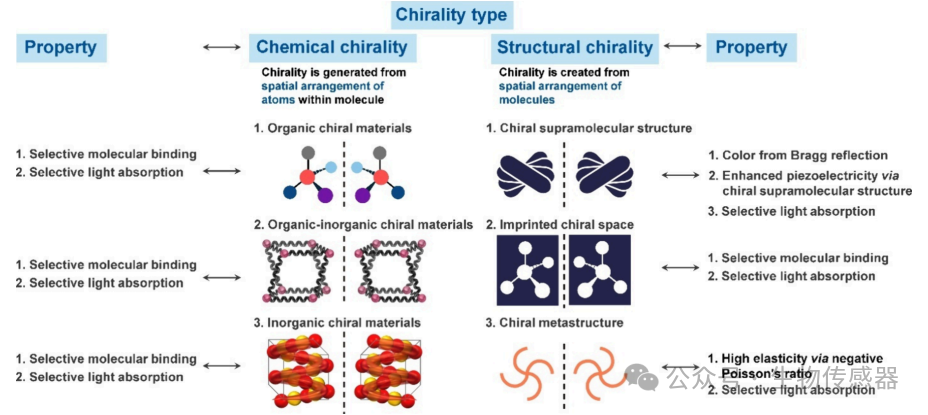
Figure 1. Schematic diagram of chiral material types and their corresponding unique properties.
2. Core Applications and Mechanisms of Chiral Materials in Wearable Sensors
Based on the unique properties of chemical chirality and structural chirality, chiral material-based wearable sensors can be mainly divided into two categories: electronic sensing and optical sensing, focusing on “precise quantification” and “intuitive visualization,” respectively, and can achieve complementary advantages through synergistic integration [30,33].
2.1 Electronic Sensing: Precise Quantification of Physiological Signals
Electronic sensing achieves quantitative detection of targets through changes in the electrical properties (such as piezoelectricity, conductivity) of chiral materials, with advantages of high sensitivity and digital data availability, suitable for monitoring targets such as pulse, biomarkers, strain, and optical signals.
-
Pulse sensing: relies on the piezoelectric enhancement effect of chiral materials. In addition to Datta’s team’s AD₂A supramolecular piezoelectric sensor [12], Wu’s team developed a chiral selenium nanowire sensor that can achieve self-powered pulse monitoring, converting the mechanical energy of arterial pulsation into electrical energy using the helical structure of selenium nanowires, with a signal-to-noise ratio (SNR) of 34.9 dB, capable of distinguishing normal pulses from arrhythmias [9]. This type of sensor addresses the issues of poor flexibility and high processing temperatures of traditional piezoelectric ceramics (such as PZT), providing possibilities for long-term physiological monitoring.
-
Biomarker sensing: based on the selective molecular binding of chemical chirality. In addition to the Phe imprinted electrode [7], Han’s team developed a chiral bio-template zeolitic imidazolate framework (ZIF) chemical resistance sensor, which can detect tryptophan enantiomers through changes in resistance, with a response time of < 10 s, and stability in the pH range of 7.0-9.5, suitable for real-time monitoring in body fluid environments [20]. This type of sensor overcomes the limitations of traditional chromatography and circular dichroism spectroscopy, achieving rapid on-site detection of chiral biomarkers.
-
Strain sensing: relies on the negative Poisson’s ratio of structural chirality. Hu’s team’s polyimide-carbon nanotube chiral superstructure sensor has a strain range of 30%, with a strain coefficient (GF) of 24653 at 30% strain, significantly higher than that of non-chiral strain sensors (typically GF<1000), suitable for monitoring dynamic signals such as joint movement and respiratory frequency [11]. The core mechanism is that the resistance change of the chiral superstructure during deformation is more significant, thereby amplifying the sensing signal.
-
Optical sensing: utilizes the selective absorption of circularly polarized light based on chemical chirality. Yuan’s team’s quasi-2D chiral perovskite CPL detector can distinguish left-handed (L-) and right-handed (R-) CPL through changes in photocurrent, with an external quantum efficiency (EQE) of 247%, and the flexible substrate allows it to conform to the skin to monitor changes in CPL of scattered light from tissues, providing a new approach for early cancer diagnosis (such as through CPL depolarization caused by changes in nuclear structure) [15,55].
2.2 Optical Sensing: Intuitive Visual Monitoring
Optical sensing achieves visual detection of targets through changes in the optical properties (such as Bragg reflection, fluorescence, circularly polarized luminescence) of chiral materials, without the need for complex electrical systems, suitable for real-time monitoring of targets such as humidity, temperature, biomarkers, and pressure.
-
Humidity/Pressure sensing: based on structural chirality and Bragg reflection. Kim’s team developed a cellulose nanocrystal-glucose-polyacrylamide composite film, where the maximum reflection wavelength shifts from 371 nm to 684 nm as humidity increases from 0% RH to 97% RH, changing color from blue to transparent, allowing real-time monitoring of skin humidity and wound healing progress [28]; Jeong’s team’s HPC pixel sensor shows a reflection peak shift from 650 nm to 467 nm as pressure increases from 0 kPa to 30 kPa, changing color from red to blue, allowing intuitive differentiation of pressure distribution, suitable for pipeline leak detection and monitoring pressure points on the body [33].
-
Temperature sensing: utilizing the thermochromic properties of organic chiral materials. Yetisen’s team embedded temperature-sensitive cholesteric liquid crystals into commercial contact lenses, where the liquid crystal wavelength shifts from 738 nm to 474 nm as temperature increases from 29.0 °C to 40.0 °C, achieving a detection accuracy of 0.3 °C through smartphone RGB analysis, successfully validating real-time monitoring of corneal temperature in a pig eye model, providing tools for diagnosing eye diseases such as dry eye and glaucoma [32].
-
Biomarker sensing: combining optical signals with selective molecular binding. Xie’s team’s chiral MOF membrane sensor shows fluorescence changes from deep red to bright yellow as the concentration of L-lactic acid in sweat increases from 0 mM to 30 mM, with color changes from blue to pink, allowing quantitative analysis of exercise intensity and lactic acid levels through naked-eye observation or fluorescence spectroscopy [8]. This type of sensor requires no electrical components, is small in size, and low in cost, making it suitable for large-scale popularization.
The synergistic integration of electronic sensing and optical sensing has become a trend. For example, Zhang’s team developed a chiral nematic cellulose nanocrystal-ionic hydrogel composite film, which quantitatively detects strain through changes in resistance (electronic sensing) and visually displays deformation through color changes (optical sensing), achieving a GF of 12829, with color changes easily recognizable to the naked eye, addressing the limitations of a single sensing method [34].
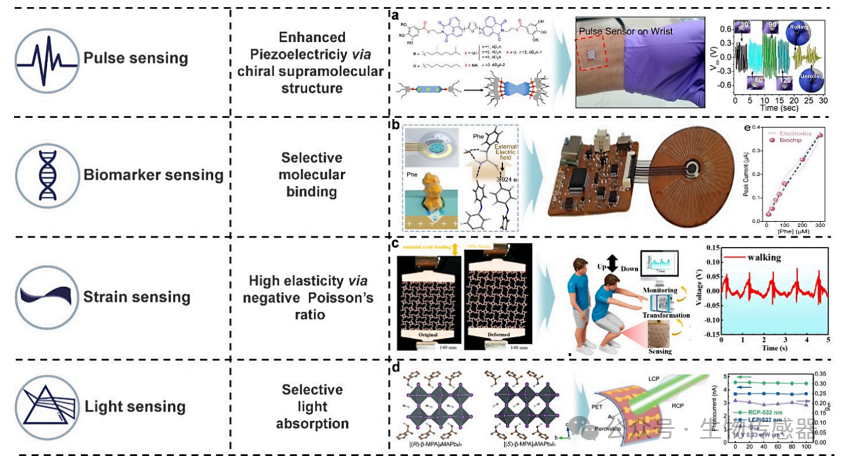
Figure 2. Wearable sensors based on chiral materials, using electronic sensing to sense targets: the left, middle, and right columns show the sensing targets, the properties of the chiral materials used, and corresponding research examples.
3. Current Core Challenges
Despite the significant breakthroughs that chiral materials have brought to wearable sensors, their industrialization and clinical application still face four core challenges:
3.1 Narrow Detection Range of Biomarkers, Lack of Multi-target Simultaneous Monitoring
Existing chiral sensors mainly focus on single small molecular biomarkers (such as Phe, lactic acid, tryptophan), while human physiological processes are the result of multi-molecular collaborative regulation, lacking the capability for simultaneous monitoring of multiple chiral biomarkers (such as various amino acids, hormone enantiomers) [7,8,20]. Additionally, the detection targets are mostly small molecules, and the recognition of large molecular chiral biomarkers such as proteins and nucleic acids is still blank, limiting their application in early disease diagnosis.
3.2 Delayed Diffusion of Small Molecular Biomarkers and Stability of Multi-sensor Integration
Small molecular biomarkers (such as Phe in sweat) experience delays in diffusion from blood vessels to the skin surface, and the diffusion rate is significantly affected by individual differences (such as skin barrier function, metabolic rate). Existing sensors have not fully considered this factor, leading to discrepancies between detection results and actual concentrations in the body [7]. At the same time, the integration of multi-chiral sensors (such as pulse + lactic acid + temperature) faces stability challenges: poor interface compatibility of different chiral materials can easily lead to signal interference, and material degradation during long-term use can lead to performance decline [36,37].
3.3 Data Security and Privacy Protection Risks
Wearable sensors transmit physiological data (such as pulse, metabolic indicators) in real-time through IoT, and this data constitutes highly sensitive personal health information. Currently, there is a lack of encryption technology for data from chiral sensors, posing risks of data leakage and tampering, and the user privacy protection mechanism is not yet perfected, restricting their application in telemedicine [73,77].
3.4 Weak Application of Optical Input and Output Technologies
Compared to the extensive research on electronic sensing, the application of optical sensing, especially circularly polarized luminescence (CPL), is still in its infancy. CPL has advantages such as adjustable emission wavelength and strong anti-interference capability, enabling long-distance and high-specificity detection, but the existing chiral materials have low CPL efficiency (e.g., the luminescence asymmetry factor |gₗᵤₘ| <0.1), and there is a lack of miniaturized optical systems compatible with wearable devices, limiting their application [14,72].
4. Future Development Directions
In response to the above challenges, combined with interdisciplinary technological innovation, the future development of chiral material-based wearable sensors can focus on the following directions:
4.1 Development of Multi-target Chiral Biomarker Detection Technologies
Designing “smart chiral materials” through molecular engineering: for example, integrating multiple chiral recognition units (such as different amino acid imprinted cavities) into a single material (such as chiral MOFs, conjugated polymers), combined with molecular switches (such as light-responsive chiral units) to achieve selective responses to multiple targets; at the same time, introducing advanced signal amplification technologies (such as surface-enhanced Raman scattering, electrochemical luminescence) to improve the detection sensitivity of large molecular chiral biomarkers [20,72]. Additionally, developing renewable chiral materials (such as light-controlled reversible assembled chiral supramolecules) to address the reusability issues of sensors and reduce costs.
4.2 Optimizing Material Design and Integration, Advancing Clinical Validation
To address the delayed diffusion of small molecules, designing “bionic skin interfaces”: for example, combining chiral sensors with transdermal microneedle arrays to directly extract interstitial fluid from the dermis, reducing diffusion delays; or using AI algorithms to correct differences in diffusion rates, improving detection accuracy [74,76]. In terms of multi-sensor integration, using flexible substrates (such as polyimide, hydrogels) to optimize interface compatibility, introducing self-healing materials (such as dynamic covalent chiral polymers) to enhance long-term stability. The key is to conduct large-scale human clinical trials to verify the reliability of non-invasive detection and promote the transition from laboratory to clinical settings.
4.3 Introducing Encryption Technologies to Ensure Data Security
Combining blockchain and edge computing technologies to build an integrated data security system of “end-edge-cloud”: embedding hardware encryption modules (such as chiral material-based physically unclonable functions, PUF) in the sensor end to achieve source encryption; performing real-time data processing at edge nodes (such as smartphones) to reduce cloud transmission volume; and using homomorphic encryption technology in the cloud to ensure the security of data storage and analysis [73,77]. At the same time, establishing data privacy protection regulations to clarify data ownership and usage rights, enhancing user trust.
4.4 Advancing Optical Sensing Technologies, Especially the Application of Circularly Polarized Luminescence
Developing chiral materials with high CPL efficiency: for example, controlling the arrangement of luminescent units through chiral supramolecular assembly (such as helical conjugated polymers) to enhance |gₗᵤₘ| to above 0.5; combining miniaturized optical components (such as flexible micro-lenses, CPL filters) to construct portable optical detection systems [14,72]. Additionally, exploring the application of CPL in multi-dimensional encryption (such as using CPL signals from chiral materials as identity markers) to expand the functional boundaries of sensors.
4.5 Interdisciplinary Collaboration Driving Technological Breakthroughs
The development of chiral material-based wearable sensors relies on the collaboration of multiple disciplines, including materials science, electronic engineering, biomedicine, and AI:
-
Materials Science: Developing chiral materials with high selectivity, high stability, and flexibility;
-
Electronic Engineering: Designing low-power, miniaturized signal acquisition and transmission modules;
-
Biomedicine: Clarifying the relationship between diseases and chiral biomarkers, establishing diagnostic thresholds;
-
AI: Achieving real-time data analysis, abnormal signal warning, and personalized health recommendations through machine learning algorithms [74,76].
For example, combining AI with chiral MOF sensors, training a model correlating fluorescence and lactic acid concentration through deep learning can reduce detection errors to below 0.1 mM while automatically grading exercise intensity [8,76]. Additionally, energy harvesting technologies (such as self-powered chiral piezoelectric materials) can address the endurance issues of sensors, promoting their application in remote areas [9,37].
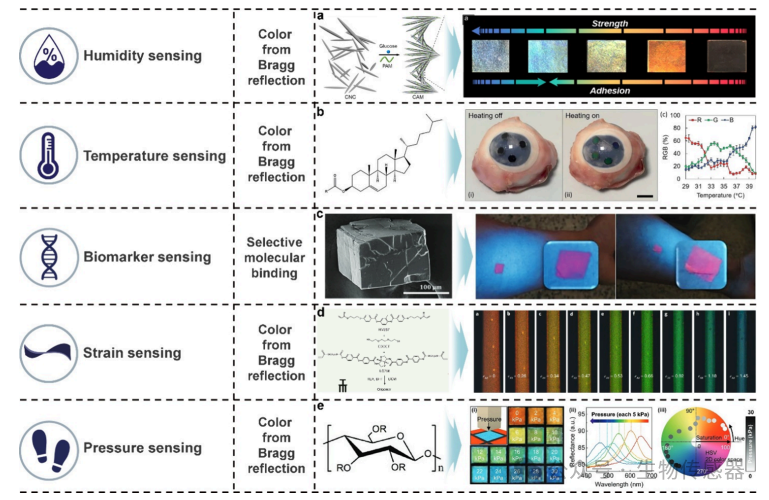
Figure 3. Wearable sensors based on chiral materials supporting optical sensing methods: the left, middle, and right columns show the sensing targets and corresponding research examples using the properties of chiral materials.
Chiral materials, with their unique molecular selectivity, piezoelectric enhancement effects, and mechanical stability, have become key materials to break through the technical bottlenecks of wearable sensors. From chemical chirality to structural chirality, from electronic sensing to optical sensing, chiral material-based sensors have achieved monitoring of multiple targets such as pulse, biomarkers, and strain, providing new tools for precision medicine and proactive health management. However, challenges such as insufficient multi-target detection capabilities, data security risks, and weak applications of optical technologies still need to be addressed. In the future, through interdisciplinary collaboration to develop smart chiral materials, optimize integration technologies, ensure data security, and advance clinical validation, chiral material-based wearable sensors are expected to achieve a leap from “single monitoring” to “multi-dimensional health assessment,” playing an important role in early disease diagnosis, personalized medicine, and sports science, opening a new chapter in precision health management.
References
https://doi.org/10.1021/acssensors.4c03423

—END—
The content is from【Biosensors】 WeChat official account,
Please indicate the source as【Biosensors】
Add to WeChat Group
To promote the dissemination and exchange of cutting-edge research, we have established severalprofessional groups. Long press the QR code below to add the editor’s WeChat to join the group. Due to the large number of applicants, please note when adding WeChat:Profession/Field, and if you are aPI/Professor, please also indicate.

If you find it interesting, please click here👇👇!