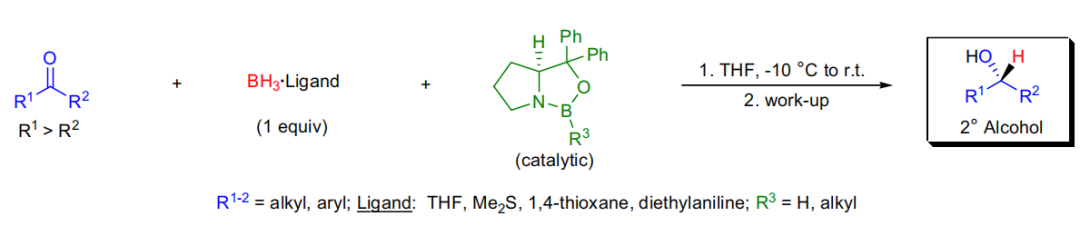
The Corey–Bakshi–Shibata (CBS) reagent is a chiral catalyst prepared from proline. Also known as Corey boron-containing oxazolidine, it can be used with boranes for enantioselective reduction of ketones, imides, and imines, and can also serve as a Lewis acid to catalyze asymmetric Diels–Alder reactions and [3 + 2] cycloadditions. This catalyst is easy to prepare, stable in air, reacts quickly, has simple operation, high yields, good enantioselectivity, a clear catalytic mechanism, and the product configuration can be accurately predicted, making it widely used in the synthesis of complex compounds. When used for the reduction of α,β-unsaturated ketones, it selectively performs 1,2-reduction.
In 1981, the S. Itsuno team first reported the use of equivalent amounts of chiral amino alcohol and borane-tetrahydrofuran to reduce ketones, achieving high yields of chiral secondary alcohols. Later, the E.J. Corey team developed a chiral boron-containing oxazolidine catalyst that can rapidly achieve high enantioselective reduction of achiral ketones to obtain chiral secondary alcohols. The Corey team found that methyl-substituted boron-containing oxazolidine (B-Me) is more stable and easier to prepare than the original unsubstituted homologue (B-H). They systematically studied the reduction reactions catalyzed by boron-containing oxazolidines and found that high ee values are achieved through the rigidity of the boron-containing oxazolidine. However, more complex cyclic systems can reduce the enantioselectivity of the reaction.Reagent Preparation
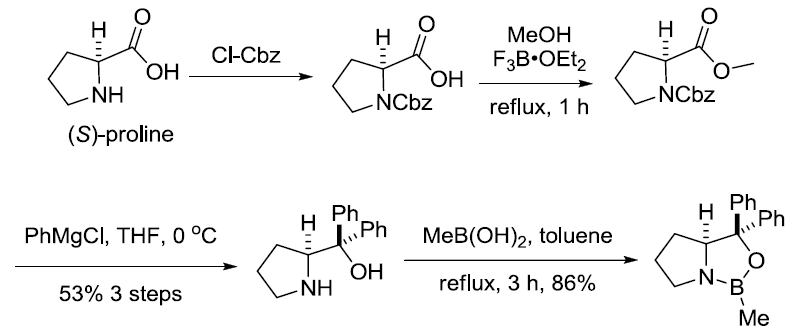
【 (a) Corey, E. J.; Bakshi, R. K.; Shibata, S. J. Am. Chem. Soc. 1987, 109, 5551–5553.
(b) Corey, E. J.; Bakshi, R. K.; Shibata, S.; Chen, C.-P.; Singh, V. K. J. Am. Chem.Soc. 1987, 109, 7925–7926.
(c) Corey, E. J.; Shibata, S.; Bakshi, R. K. J. Org. Chem. 1988, 53, 2861–2863.
(d) Mathre, D. J.; Thompson, A. S.; Douglas, A. W.; Hoogsteen, K.; Carroll, J. D.; Corley, E. G.; Grabowski, E. J. J. J. Org. Chem. 1993, 58, 2880–2888.
(e) Xavier, L. C.; Mohan, J. J.; Mathre, D. J.; Thompson, A. S.; Carroll, J. D.; Corley, E. G.; Desmond,R. Org. Synth. 1997, 74, 50–71.】
Reaction Mechanism The reaction mechanism indicates that the high enantiomeric selectivity and high reaction rate of this reaction are influenced solely by the CBS catalyst. This catalyst acts as both a chiral auxiliary and a Lewis acid in the reaction, meaning that boron activates the ketone as a Lewis acid, while nitrogen activates the reducing agent borane as a Lewis base. (Reference: J. Org. Chem. 1993, 58, 799.) First, the borane complexes with the nitrogen atom of the CBS catalyst, and the CBS catalyst-borane complex coordinates with the lone pair of electrons on the boron atom and the ketone (the lone pair is spatially closer to the smaller substituent of the ketone). At this point, the ketone and the coordinated borane are spatially close and in a cis position. Hydrogen transfer occurs through a six-membered ring transition state. Finally, the catalyst cycle is completed through two possible pathways.
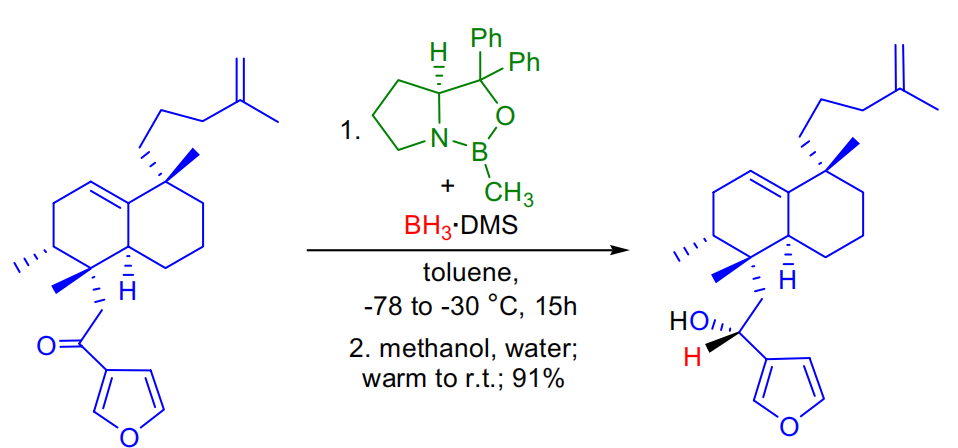
Reaction Examples
 【E. J. Corey, S. Shibata, R. K. Bakshi, J. Org, Chem., 1988, 53, 2861-2863.】
 【E. J. Corey, J. O. Link, J. Am. Chem. Soc., 1992, 114, 1906-1908.】
【J. Am. Chem. Soc. 1997, 119, 12425-12431】
【J. Am. Chem. Soc. 1998, 120, 2534-2542】
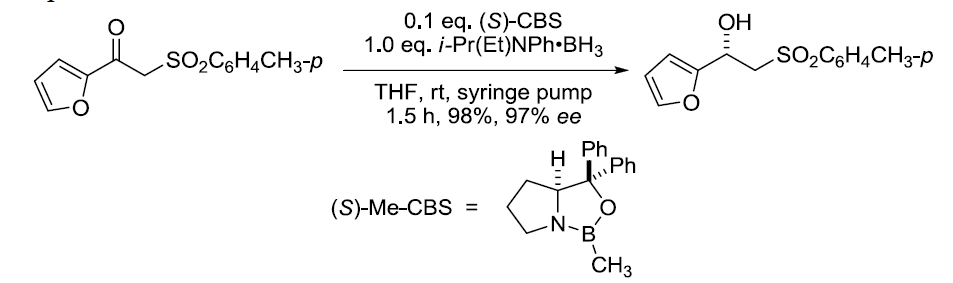
【Eur. J. Org. Chem. 1999, 2655-2662】
【Tetrahedron: Asymmetry 2001, 12, 2043–2047】
【J. Org. Chem. 2005, 70, 4652–4658】
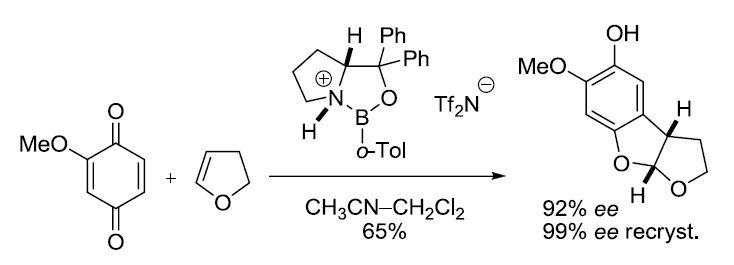
【J. Am. Chem. Soc. 2005, 127, 11958–11959】
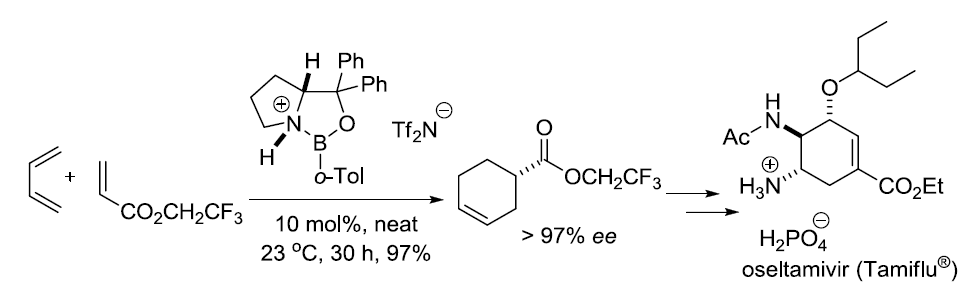
【J. Am. Chem. Soc. 2006, 128, 6310–6311】
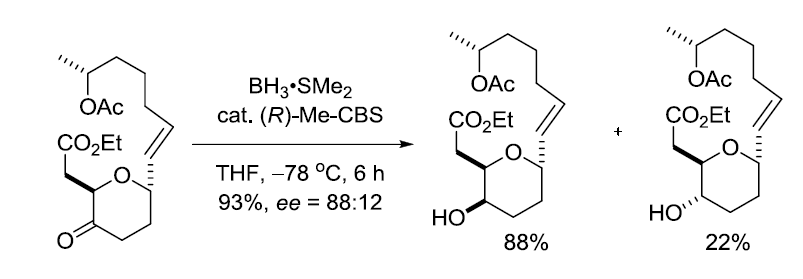
【Eur. J. Org. Chem. 2013, 578–587】
References
1. J.J. Li, Name Reactions: A Collection of Detailed Mechanisms and Synthetic Applications, Corey–Bakshi–Shibata (CBS) reagent, page 168-169.
2. Strategic Applications of Named Reactions in Organic Synthesis, László Kürti and Barbara Czakó, Corey-Bakshi-Shibata reduction, page 100-101.