Click on the above“Beginner’s Visual Learning” to select “Star Mark” or “Top”
Important content delivered promptly
Introduction: The mobile camera system consists of components such as lenses, sensors, apertures, and ISP (Image Signal Processor, generally integrated into SoC), combined with software algorithms. The quality of these components essentially determines a mobile phone’s photography performance. In terms of hardware, due to size and cost constraints, mobile phone lenses and apertures cannot offer much variety, making the importance of sensors even more prominent.
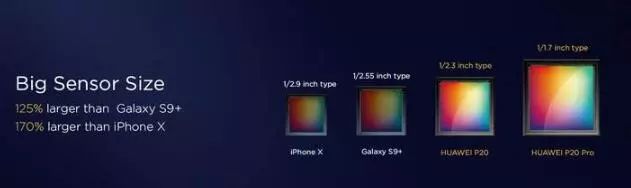
The sensor size determines how much light is captured, reference image
Currently, due to cost, product positioning, and design considerations (camera protrusion), mobile manufacturers use different image sensors across different models. Typically, mainstream image sensor parameters and their impact on imaging are points of interest for users. In simple terms, effective pixels, sensor size, and (equivalent) unit pixel size are the core parameters of mobile camera sensors.
Sensor Size
If we ignore software algorithms and other factors, a larger sensor size is better. This is because the sensor size determines how much light is captured. During photography, each pixel on the sensor records “light information”; a larger sensor means richer information. This implies that a “large base” sensor can provide a higher dynamic range, a wider ISO range, and less noise. The direct manifestation is better exposure and detail restoration in complex light conditions and better exposure and noise control in low-light environments. If it performs excellently in low light and complex lighting conditions, the phone’s performance in other scenarios will also be good.
Moreover, under consistent parameters and shooting conditions (distance), a larger sensor size can achieve physical background blur. No matter how good the algorithm is at creating blur, physical blur is more natural. Most mobile sensors are not large, so they can only produce physically blurred photos at very close distances.
Then, under consistent parameters (lens focal length) and shooting conditions (distance), a larger sensor size results in a wider imaging angle. For devices with small sensors, a lens with a wider angle (shorter focal length) is needed to achieve an appropriate angle.
The downside of large sensors is that they take up more space. Not only is the sensor itself large, but a large sensor also requires a larger lens to cover it. When both the lens and sensor are large, the phone’s thickness and the volume of the camera protrusion will inevitably increase, occupying space needed for other phone components. Choosing the size of the sensor has always been a trade-off for mobile manufacturers.
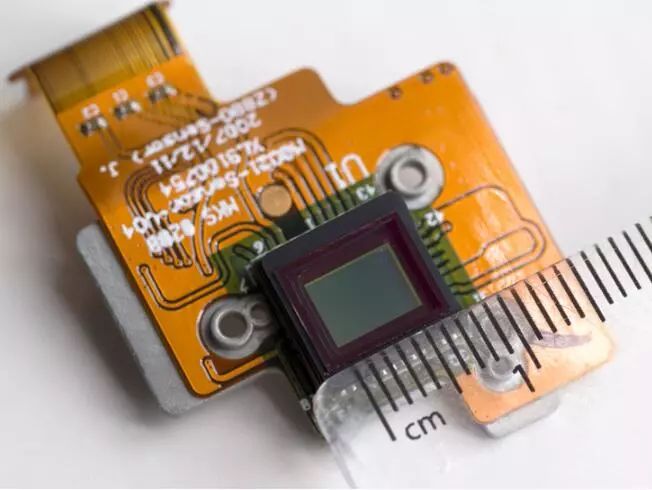
Camera image sensor, reference image
What Does Unit Pixel Size Affect?
The size of the unit pixel determines the sensor’s light sensitivity; the larger it is, the better the low-light shooting capability, with the most intuitive manifestation being the noise level.
Unit pixel size = sensor width / photo resolution width
From this formula, it can be seen that effective pixels, sensor size, and unit pixel size mutually influence each other. If a sensor has a large unit pixel size, its sensor size generally will not be small. However, some sensors have too high a pixel count, and in this case, even a large sensor cannot avoid the small unit pixel size. In this situation, pixel binning is used, combining four small pixels into one large pixel, reducing the pixel count to a quarter of the original. It is important to use a sufficiently large equivalent unit pixel size to compensate for the disadvantages of small pixel light sensitivity.
What Does Effective Pixel Count Affect?
A larger effective pixel count results in higher resolution and clearer photo details. However, larger pixels can lead to lower unit pixel sizes, so in low-light scenarios, photos taken with high pixel counts may show noticeable noise. Currently, the method to address low-light noise in high pixel sensors is pixel binning.
Sony and Samsung dominate the smartphone image sensor market, with Sony holding the largest market share, and almost all mainstream phones are equipped with Sony sensors. The following image shows the main parameters of camera sensors used in mainstream phones released after 2015 (excluding 2015).
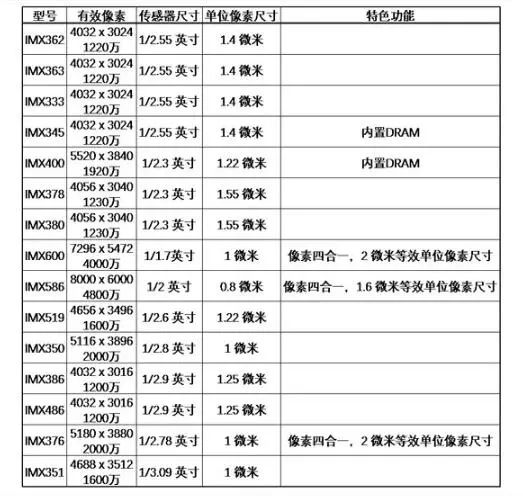
Reference image
Sensors Are Just One Factor Affecting Photography Performance
Although much has been said about how image sensor specifications affect imaging, many other factors determine a phone’s imaging quality. These include ISP, stabilization, aperture, lens, and software algorithms, among which software algorithms have a significant impact. Suppose a phone has a top-tier sensor but poor software algorithms; in that case, it cannot fully exploit the sensor’s performance, and the final imaging effect can only be considered decent. Conversely, with top-notch photography algorithms, a phone with slightly better sensor performance can also produce top-quality photos. Therefore, the sensor can only determine the upper and lower limits of a phone’s photography performance, while the specific photographic capability ultimately depends on the algorithm.
Good news!
The Beginner's Visual Learning knowledge circle is now open to the public👇👇👇


Download 1: OpenCV-Contrib Extension Module Chinese Tutorial
Reply "Extension Module Chinese Tutorial" in the background of the "Beginner's Visual Learning" public account to download the first Chinese version of the OpenCV extension module tutorial available online, covering over twenty chapters including extension module installation, SFM algorithms, stereo vision, target tracking, biological vision, super-resolution processing, etc.

Download 2: Python Visual Practical Project 52 Lectures
Reply "Python Visual Practical Project" in the background of the "Beginner's Visual Learning" public account to download 31 visual practical projects including image segmentation, mask detection, lane line detection, vehicle counting, eyeliner addition, license plate recognition, character recognition, emotion detection, text content extraction, face recognition, etc., to assist in quickly learning computer vision.

Download 3: OpenCV Practical Project 20 Lectures
Reply "OpenCV Practical Project 20 Lectures" in the background of the "Beginner's Visual Learning" public account to download 20 practical projects based on OpenCV for advanced learning.

Group Chat

Welcome to join the public account reader group to communicate with peers. Currently, there are WeChat groups for SLAM, 3D vision, sensors, autonomous driving, computational photography, detection, segmentation, recognition, medical imaging, GAN, algorithm competitions, etc. (these will gradually be subdivided). Please scan the WeChat ID below to join the group, and note: "Nickname + School/Company + Research Direction", for example: "Zhang San + Shanghai Jiao Tong University + Visual SLAM". Please follow the format for notes; otherwise, you will not be approved. After successful addition, you will be invited into relevant WeChat groups based on your research direction. Please do not send advertisements in the group; otherwise, you will be removed. Thank you for your understanding~