1. Overview of Networking Needs for Construction Sites
The 21st century is a period of rapid development for China, with infrastructure construction advancing at an unprecedented pace. Major infrastructure projects such as high-speed rail, highways, large-scale water conservancy facilities, and ports require extensive construction of roads, bridges, tunnels, dams, artificial islands, and other facilities. These construction sites are often located in remote areas, making it common to conduct operations in complex environments such as deep mountains, rivers, seas, isolated islands, and swamps. Furthermore, due to the long construction cycles of large and medium-sized infrastructure projects, which can last several months or even years, establishing communication and remote monitoring between these sites and command centers has become a crucial task for enhancing management technology and preventing theft, fire, and engineering accidents. This article aims to provide the most practical and cost-effective networking and power supply solutions for intelligent construction at these sites.
What are the networking, monitoring, and intelligent management needs for large and medium-sized construction sites? Due to the need for theft prevention, fire safety, and accident prevention, the primary requirements include video surveillance, environmental monitoring, teleconferencing, and networking for project departments.
1) Monitoring of Construction Materials
Large and medium-sized construction sites have a significant amount of machinery, scaffolding, cables, steel, and other facilities and materials, which are often targeted for theft due to their high value. In sites without video surveillance, the inability of managers and security personnel to monitor the site 24/7 leads to severe theft incidents during the night and early morning.
At key locations such as material storage areas and site entrances, infrared night vision cameras combined with AI video recognition systems can continuously monitor and trigger alarms, providing clues for police investigations and effectively deterring thieves, thereby reducing property losses.
2) Monitoring of Major Hazards on Construction Sites
In addition to unsafe behaviors by personnel, the unsafe conditions of construction machinery (such as tower cranes, track-laying vehicles, and hoists) and vehicles (such as dump trucks and concrete mixers) represent a second category of hazards, with most accidents on construction sites directly related to these hazards.
Establishing a safety monitoring system for machinery and vehicles (including: monitoring and early warning systems for machinery operation status, vehicle management and scheduling systems, etc.) will help in timely detection of violations and abnormal machinery conditions, making it possible to prevent accidents. The existence of a comprehensive monitoring system will also enhance the safety awareness of operators, preventing accidents.
3) Monitoring of Temporary Housing on Construction Sites
There are also safety hazards associated with project departments and temporary housing: the safety distance between kitchens and temporary dormitories does not meet requirements, and the temporary storage or use of flammable and explosive hazardous chemicals does not comply with standards, leading to fire or poisoning accidents; unsanitary food conditions can cause collective poisoning or disease incidents. Temporary tents that do not meet safety distance requirements are prone to fire hazards. Improperly connected electrical wires that come into contact with metal structures or pipes can lead to electric shocks and fires. When temporary facilities are dismantled, the roofs may collapse, causing injuries to workers.
Continuous safety monitoring of board houses and temporary shelters throughout the entire operation cycle is necessary to achieve the goals of fire prevention, theft prevention, and damage prevention, making the use of high-definition video surveillance and AI early warning systems essential.
4) Real-Time Monitoring of Moving Points such as Ships, Machinery, and Vehicles
Some large and medium-sized construction sites also involve numerous operational ships, heavy machinery (such as shield machines and tower cranes), and special vehicles, making coordination challenging, especially for construction operations involving ships and machinery across large bridges over seas and rivers, where even the slightest error must be strictly controlled to avoid severe consequences.
These ships, machinery, and vehicles are mobile, making wired communication methods unsuitable due to signal coverage issues, communication bandwidth requirements, and economic reasons. Relying solely on telecom operators’ 4G/5G networks is clearly insufficient, necessitating a more suitable networking solution.
5) Demand for Portable and Removable Monitoring Points
Large and medium-sized construction sites operate in a step-by-step manner, with bridges typically constructed in segments and tunnels excavated progressively. If fixed monitoring points are designed similarly to urban monitoring points, the management will frequently face the issue of losing control as the construction site moves forward.
The first three points pertain to fixed monitoring, while the latter two points relate to mobile monitoring. Given the characteristics of large and medium-sized infrastructure construction sites, choosing “wireless” technology for networking is undoubtedly the most suitable and cost-effective solution. The networking needs for office and operational connectivity at construction sites primarily involve ensuring telephone communication, Wi-Fi coverage, terminal access, as well as video surveillance, equipment monitoring, and vehicle networking. In summary, the goal is to achieve comprehensive monitoring and management of the construction site, and the products and solutions from Guoxin Longxin can provide a one-stop solution for nearly all networking scenarios at construction sites.
2. Technical Selection for Site Networking
Intelligent construction at large and medium-sized infrastructure sites often involves security monitoring systems, network telephony systems, dispatch command systems, safety management systems, material management systems, teleconferencing systems, and broadcasting systems, frequently encountering networking challenges:
Large and medium-sized infrastructure construction sites are typically divided into multiple sections, with each section spanning dozens or even hundreds of kilometers. The larger the construction area, the more pronounced the networking difficulties become. When it comes to networking across multiple sections of an entire project, the challenges become even greater.
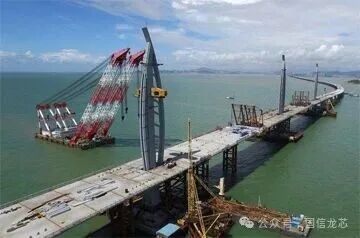
Even within a single section, networking information points (video surveillance points, data collection points, project department offices, etc.) can be very challenging, especially in remote areas with mountains and water, such as bridges, tunnels, highways, and railways. Using wired fiber optics requires crossing mountains and water, and with dispersed points, the wiring construction becomes very difficult, leading to long construction periods and high total investment. Some points cannot be resolved due to road construction, making wireless networking the most suitable solution. But which wireless solution is the most practical and cost-effective?
The design of networking solutions for construction sites must be tailored to the specific needs of users. Specifically:
1. Wireless Private Network – iMAX 5G WMAN Wireless Metropolitan Area Network System
Networking for IT system construction must inevitably use TCP/IP protocol. However, the unique environment of construction sites makes it often unsuitable to use wired optical networks designed for urban internal networks for networking and information transmission, whether in terms of economy, reliability, or feasibility of system implementation.
While telecom operators’ 4G/5G wireless technology can meet small data volume and non-real-time information transmission needs, the high costs of subsequent data packages can become an unbearable burden for system operation. Additionally, this solution must connect to the Internet, which poses a risk of data leakage. The iMAX private network system, which offers high reliability, ultra-long distance, and non-line-of-sight wireless transmission, is currently the optimal solution widely adopted in the construction industry.
Wireless Metropolitan Area Network (WMAN) refers to a local distribution wireless network that transmits information between distributed nodes covering an urban area, based on the establishment of a metropolitan area network. A wireless private network, as the name suggests, is a wireless network built by a specific enterprise or institution that is not open to the public (some private networks have public interfaces for internet access). The internal area of large and medium-sized construction sites is very suitable for building private networks, primarily because private networks are dedicated, safer, and more reliable; they also require a one-time investment without ongoing link rental and data fees, making them more economical.
Guoxin Longxin’s iMAX 5G Wireless Metropolitan Area Network system, with its unique technical advantages and outstanding performance, such as: high bandwidth, high capacity, low latency, support for multiple networking modes, IP67 protection standard, ultra-long distance transmission, strong anti-interference capability, high reliability, simple installation, and easy maintenance, offers advantages in large and medium-sized construction sites that other wireless systems cannot match.
The goal of the iMAX wireless communication system design is to build a wireless city or solve outdoor environment ultra-long distance network interconnection, with all series of devices having very long communication distances. Among them, the iMAX-6000 series serves as the urban backbone network, while the iMAX-8000S and iMAX-8000H series serve as edge access networks.
-
Communication Distance: Under line-of-sight conditions, the iMAX 5G dedicated wireless network communication system can easily achieve access requirements with a radius of 10 kilometers or even 50 kilometers for point-to-multipoint networking with the iMAX-8000 series products; the iMAX-6000 in point-to-point mode can reach up to 100 kilometers.
-
Transmission Bandwidth: The iMAX-8000H is a 300/600Mbps metropolitan area network aggregation system, the iMAX-8000S is a 100Mbps point-to-multipoint wireless private network communication system, and the iMAX-6000 is a point-to-point 150/300/600Mbps backbone network communication system. Additionally, bandwidth can be multiplied through frequency division, enhancing the total bandwidth of the system, with high bandwidth and high video capacity being its greatest advantages.
Information points (data collection points, video surveillance points, etc.) for intelligent systems on construction sites can all be connected using the iMAX 5G Wireless Metropolitan Area Network system. Particularly for high-definition video surveillance services, the iMAX 5G Wireless Metropolitan Area Network system has unparalleled advantages. The backbone network can be resolved based on actual communication conditions, choosing between self-built or leased operator optical cables (dedicated lines), SD-CX private cloud virtual private networks, etc. If conditions permit, the iMAX 5G backbone wireless system can also be used directly.
Thanks to the convenient and flexible networking of the iMAX 5G Wireless Metropolitan Area Network, monitoring points on construction sites can not only be fixed points but also deployable portable monitoring points or vehicle-mounted monitoring points, further enhancing their applicability. This is especially practical for scenarios involving bridges and tunnels, where mobility is more useful.
2. Remote Wide Area Network Networking – Cloud Exchange SD-CX + VPN Virtual Private Network Solution
For large construction enterprises with projects distributed across the country, using a wireless private network for a single project is feasible, but for different project locations, especially for remote networking, using wireless private network technology is not very suitable. For projects across the country that require centralized network management, wide area network technology must be adopted. Based on Guoxin Longxin’s years of valuable experience in the IoT industry, a solution combining “cloud exchange” and multi-mode gateways has been proposed.
The cloud computing platform, also known as the cloud platform, refers to services based on hardware and software resources that provide computing, networking, and storage capabilities. Cloud computing platforms can be divided into three categories: storage-type cloud platforms focused on data storage, computing-type cloud platforms focused on data processing, and comprehensive cloud computing platforms that balance both data processing and storage. With the development of cloud computing, almost every enterprise is currently using or planning to use cloud computing, which includes three different cloud models: public cloud, private cloud, and hybrid cloud.
How do we connect the “ground” business to the cloud? Public clouds typically use the Internet, commonly through broadband access from operators; private clouds will choose VPN or dedicated line access, often using dedicated lines from telecom operators or self-built fiber optics or wireless private networks. Since private networks are dedicated and isolated from public networks, their connection bandwidth, reliability, and security are significantly improved compared to ordinary broadband. Whether for public or private clouds, the challenge remains how to connect edge nodes to the cloud.
Guoxin Longxin’s iMWB-5GW1000, iMWB-5GW2000D, and other series of 5G wide area network multi-mode edge VPN gateways, as well as the iMAX-4GW300 series 4G metropolitan area network dual-mode wireless gateways, are powerful tools for connecting cloud computing edge nodes to the cloud. For example, the iMWB-5GW1000 provides multiple Ethernet interfaces and can be used as a multi-network fusion gateway. In terms of wireless communication, it not only utilizes 5G wireless technology to achieve high bandwidth, high reliability, and high capacity but also supports local WiFi6 high-performance coverage, providing users with the most optimal wireless networking solution.
Why is Guoxin Longxin’s SD-CX solution the best for remote networking across multiple construction sites?
First, Powerful Hardware Products
The iMWB-5GW2000D is a 5G multi-mode wireless gateway system from the iMWB brand, supporting both 5G wide area networks (SA & NSA) and WiFi6 wireless local area network coverage (2.4GHz & 5.8GHz), and provides Ethernet interfaces, serving as an edge VPN access gateway for cloud exchange platforms. It utilizes WiFi6 wireless technology to achieve high bandwidth, high reliability, and high capacity while also supporting access to telecom operators’ public 5G networks, providing users with the most optimal wireless networking solution.
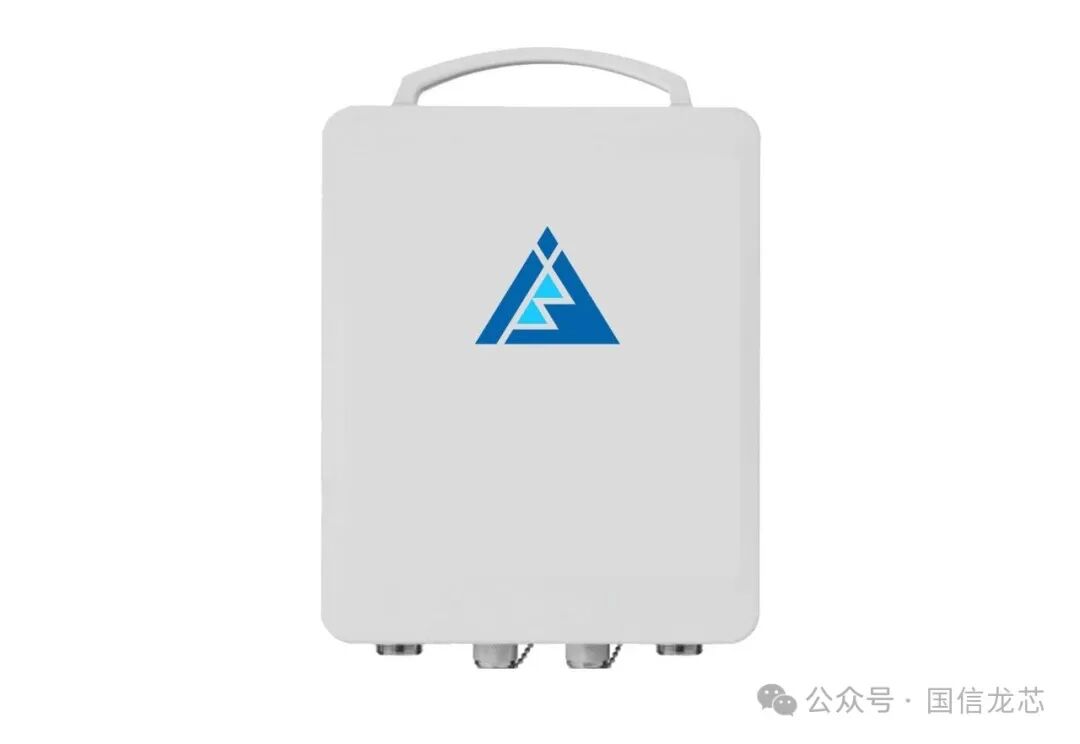
The iMAX-4GW300 is a dual-mode wireless gateway system that combines iMWB brand iMAX wireless metropolitan area network and 4G LTE, supporting both iMAX wireless metropolitan area network technology and 4G LTE (FDD-LTE & TDD-LTE), and provides three Ethernet interfaces, serving as a multi-network fusion gateway. It utilizes iMAX wireless private network technology to achieve high bandwidth, high reliability, and high capacity while also supporting access to telecom operators’ public 4G LTE networks, enhancing the system’s wireless networking applicability and providing users with the most optimal wireless networking solution.
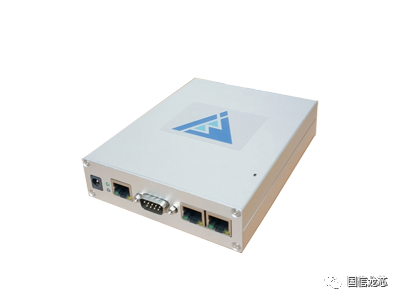
This device is designed for indoor use, compact, lightweight, and low power consumption, making it suitable for providing IoT terminal networking in industries such as construction, environmental protection, ports, water conservancy, and electricity, as well as meeting the needs of integrated systems (drones, portable monitoring points, vehicle-mounted, ship-mounted, airborne, etc.). It is an ideal choice for high-quality multi-mode wireless communication in the IoT industry.
In other words, these two devices can serve as comprehensive exchange gateways for various TCP/IP network devices (such as IP cameras, computers, tablets, advertising screens, PLCs, IP phones, IP broadcasting systems, etc.) based on various access methods, including local area network interconnection, MPLS dedicated line access, Internet broadband access, iMAX wireless metropolitan area network private network, and 4G/5G internet access.
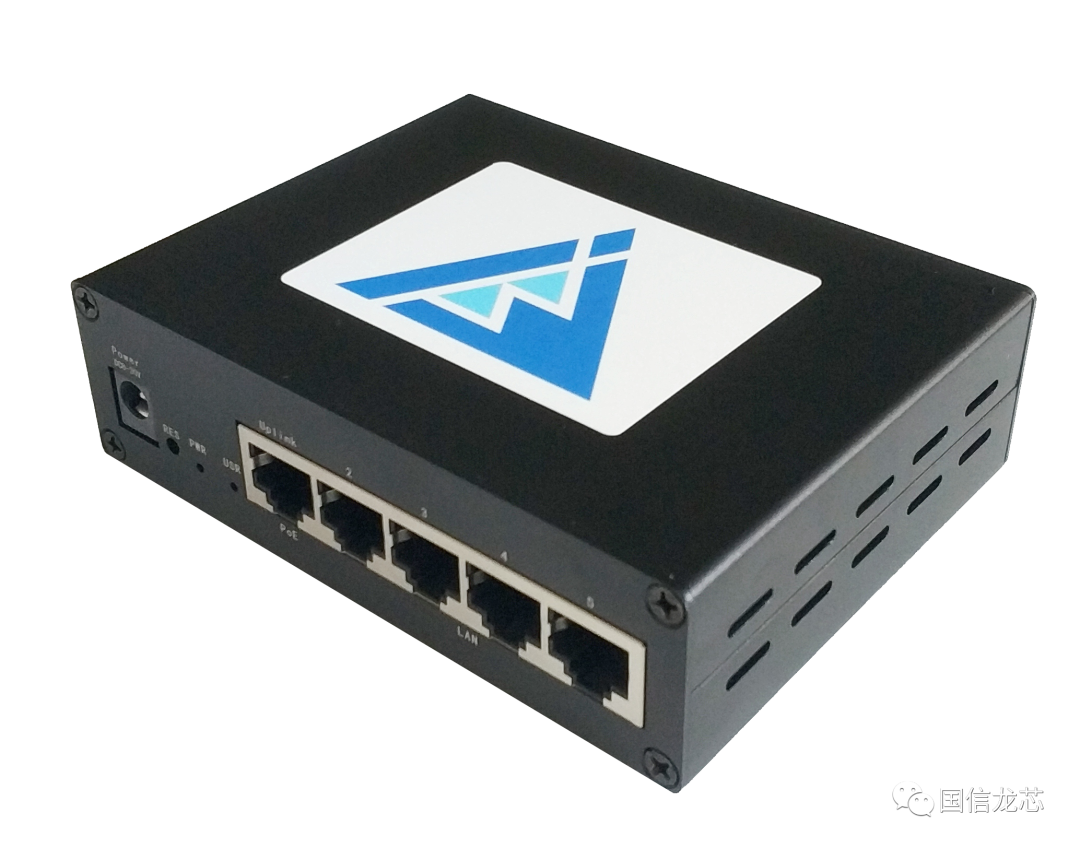
Additionally, for users needing to build private clouds with home broadband wired networking, Guoxin Longxin offers a cost-effective edge VPN gateway option – the three-layer routing VPN gateway product iMWB-ROUTE400G, which is a five-port intelligent managed routing VPN gateway device with full gigabit interfaces, intelligent management capabilities, and supports three-layer routing configuration, serving as an enterprise-level router or VPN access terminal.
Second, a Secure and Reliable “Hardware VPN + Cloud Interconnection” Framework
Guoxin Longxin’s SD-CX solution is an internet solution based on cloud platforms, which can be based on private clouds, public clouds (such as Tencent Cloud, etc.), or hybrid clouds. The virtual private network based on the cloud system is referred to as “Cloud Interconnection SD-CX (SDN based Cloud Exchange)”. Guoxin Longxin focuses on the actual application needs of users, aiming to enhance security, reduce costs, and meet demands as the fundamental purpose of system design, reflecting the capabilities of Guoxin Longxin’s technical solutions.
Specifically, Guoxin Longxin’s SD-CX solution customizes the integration of “wide area network + wireless metropolitan area network/wireless local area network + VPN technology” for cloud interconnection, with VPN technology being the core of the solution’s security assurance.
Virtual Private Network (VPN) technology establishes a “private network” over a “public network” (or builds an encrypted private network over a private network to enhance security) for encrypted communication. VPN technology primarily relies on tunneling encryption protocols, with typical tunneling protocols including PPTP, L2TP, and IPSec. Guoxin Longxin’s solution is constructed using a “VPN server + VPN gateway” approach, primarily based on hardware VPN devices, which undoubtedly offers better reliability and security.
Guoxin Longxin also offers products such as BreezeAir wireless bridges and FibeAir IP microwave systems that can be applied in construction site scenarios, but they are not the primary choice and will not be elaborated on in this article.
3. Networking Solutions for Construction Sites
Based on different construction sites, scenarios, and business networking needs, the networking solutions for construction sites mainly include the following:
1. Wireless Metropolitan Area Network Private Network Solution—- Solving Local Networking within Construction Sites
Large and medium-sized construction sites often require deployment over distances of dozens or even hundreds of kilometers. The topology diagram is as follows:
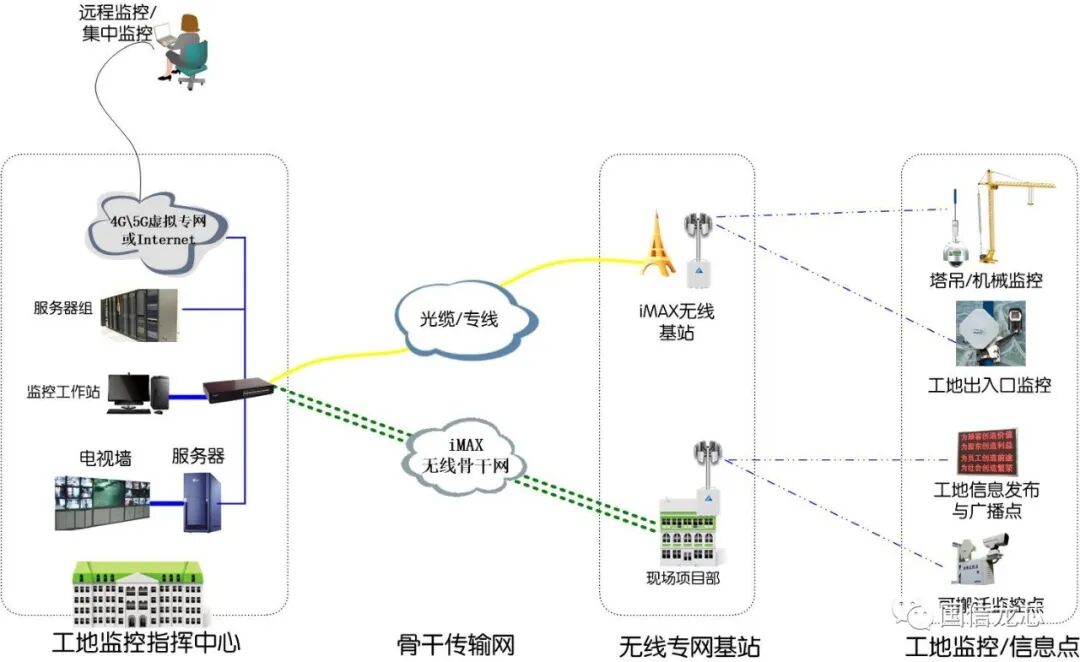
By adopting iMAX wireless metropolitan area network technology, the construction site can establish a wireless private network. The video surveillance system can choose the currently mainstream IP digital network video surveillance system. There are generally not many monitoring points on-site, and the storage time is not too long, so front-end monitoring points can be configured with IP network cameras (IPC), and storage can use network video recorders (NVR) for the best cost-effectiveness. To meet the demand for 24-hour continuous monitoring on construction sites, IPCs should be selected as infrared network integrated cameras or infrared network speed dome cameras, along with compatible NVR systems.
Once the iMAX wireless system is established, the construction site effectively has its own dedicated office network, allowing many services to be deployed directly, such as high-definition video surveillance, video conferencing, office operating systems, information collection and control, etc. In other words, this solution can provide more usage possibilities for user units, further enhancing the application value of this solution.
Wireless private networks have unparalleled advantages in terms of cost-effectiveness, reliability, and security for construction site network construction. Refer to “How do you view the cost-effectiveness of integrated project networking solutions?” and “Network Security and Physical Isolation Private Networks in the 5G Era for Government and Enterprise Clients” for more information.
For construction in enclosed spaces such as tunnels and culverts, we have specialized technologies and networking solutions, refer to “Wireless Private Network Solutions for Medium and High Frequency Leakage Wave Cables” for more details.
Wireless metropolitan area network private networks can meet the networking needs of various construction sites and scenarios, refer to “What scenarios require wireless systems in the Yaxia Water and Electricity Project?” for more information.
2. Remote Virtual Private Network Solution – A Lower-Cost Alternative to Dedicated Lines
Typical SD-CX Distributed Construction Site Centralized Networking Topology Diagram:
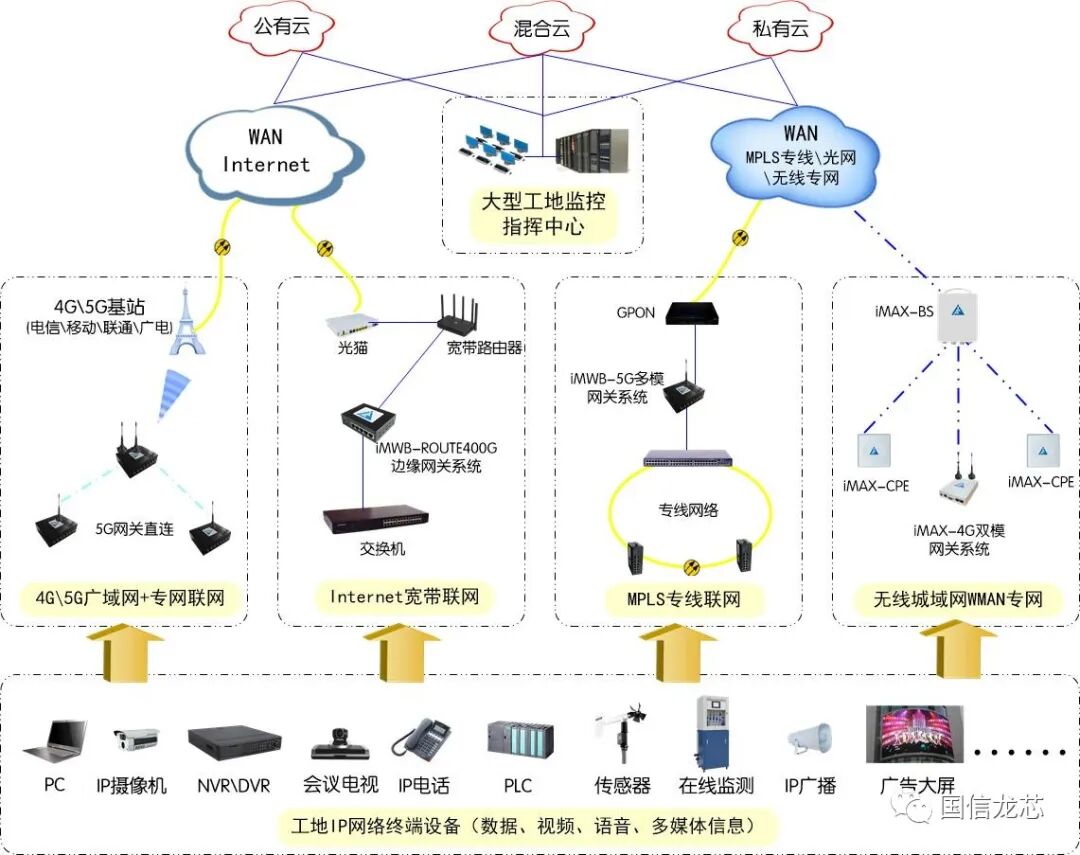
In summary, Guoxin Longxin’s SD-CX solution can connect various IP terminals, including computers, IP cameras, teleconferencing terminals, PLCs, sensors, IP broadcasting systems, large screens, etc. To some extent, any device based on TCP/IP networks can be connected using this solution. As an IP network channel, whether wired or wireless, optical network or wireless network, we adhere to the principle of recommending what users need and what is suitable for them, providing customized comprehensive link solutions. Our starting point is always the security and stability of the network, as well as the availability and practicality of the services.
It is important to emphasize that Guoxin Longxin’s SD-CX solution is a comprehensive service solution based on GL Technologies’ proprietary multi-mode gateway, no longer just a simple product, but a method and approach to solving networking challenges. Therefore, it must be tailored based on thorough research and understanding of the actual needs of users. For more information, refer to “5G Virtual Private Networks Solve Networking Challenges for Government and Enterprise Clients” for more details.
Using 4G/5G networking will incur costs for data, dedicated lines, and cloud services, and areas without operator wired broadband and 4G/5G signal coverage cannot use this networking solution. Even in areas with 4G/5G signals, the inherent “tide phenomenon” of public networks results in lower bandwidth, reliability, and service quality compared to private networks. For projects with high reliability requirements and large-capacity high-definition video surveillance needs, wired or wireless private network solutions should still be chosen.
It is crucial to point out that this solution can provide users with relatively secure means to ensure the safety of their business networking, especially when connecting to public networks. Using it for networking can effectively prevent network security issues such as hacker intrusions caused by “naked running” on the internet.
Wireless metropolitan area network private networks are suitable for networking within a certain area of construction industry enterprises, while wireless wide area networks are suitable for centralized networking across multiple remote locations nationwide. The two solutions are complementary and can be designed together.
3. Mobile Networking Solutions – Vehicle Networking, Ship Networking, etc.
As the construction site work area and operational surface advance, monitoring points also need to have mobility. In addition to tunnel excavation, bridge erection, and track laying, there is also the need for networking of vehicles and equipment on construction sites. For vehicle networking on construction sites, refer to “What scenarios are suitable for vehicle scheduling management systems based on wireless private networks?” for more information, and for ship networking, refer to “Ship Networking and Positioning Solutions” for more details.
The full networking topology diagram for mobile scenarios on construction sites is as follows:
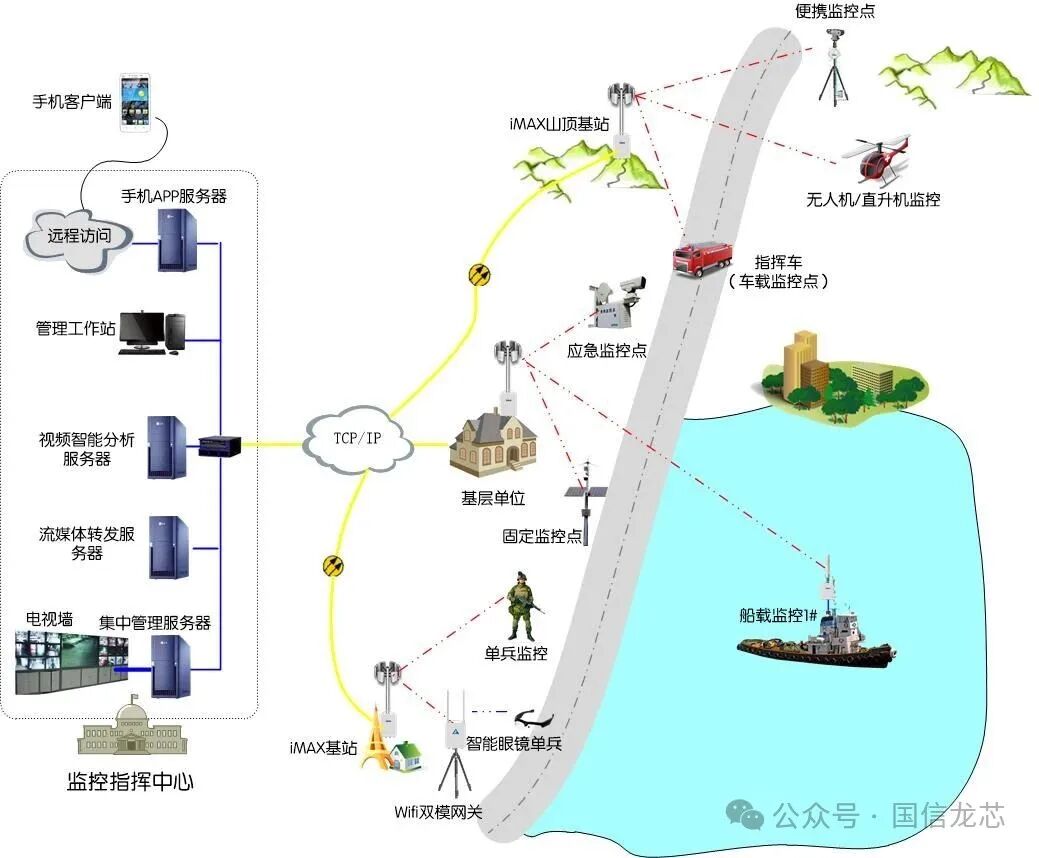
As an example of a portable monitoring point that can be freely relocated, this monitoring point is a customized product from Guoxin Longxin, integrating an IP high-definition camera, wireless metropolitan area network module, and lithium battery solar power, supporting various installation methods such as on flat ground, rooftops, and hilltops, as illustrated below:
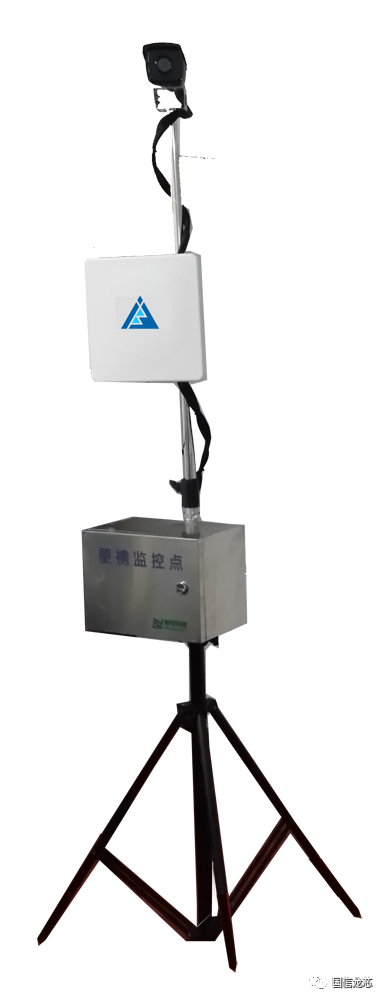
There are many types of mobile monitoring points, including but not limited to portable monitoring points, individual soldier monitoring points, drone monitoring points, etc. For more details, please refer to the relevant materials on the public account.
Summary
By utilizing Guoxin Longxin’s wireless network system for networking and lithium battery solar power for electricity supply (refer to “Why choose iPower lithium battery solar for outdoor power supply?”), we effectively address the most challenging issues in the construction of intelligent management systems for large and medium-sized construction sites.
Once the network is established, intelligent, digital, and information projects on construction sites can proceed smoothly, with numerous expandable applications, such as AI-based analysis of video to determine whether personnel are wearing safety helmets, whether there are violations of operations, and whether individuals are entering hazardous areas, with timely responses through broadcasting and information release systems. For example, comprehensive management of tower cranes on construction sites (preventing crane collisions and overloads), and internal Wi-Fi coverage systems can all be expanded based on this solution.
Vehicle-mounted and ship-mounted mobile points, as well as removable monitoring points inside tunnels, present more complex and practical applications, requiring higher demands on wireless systems and technical capabilities, making integration with fixed monitoring points more challenging. However, this is precisely where Guoxin Longxin excels. For specialized network construction for bridges and tunnels, refer to “Wireless Private Network Solutions for Bridge and Tunnel Management” for more details.
For many years, Guoxin Longxin has assisted our integrator partners in successfully completing numerous networking and power supply projects for large and medium-sized infrastructure construction sites such as bridges, tunnels, rivers, highways, and railways. For case studies, refer to “For Ship Networking, Choose Guoxin Longxin” (which includes networking cases from a national key project on the Yangtze River) and “Wireless Networking Case Sharing for Power Tower Monitoring” (networking scenarios for a UHV transmission line construction site), accumulating valuable experience in networking for infrastructure projects, allowing us to tailor the most suitable designs and solutions for industry users. We welcome inquiries!