According to a recent report by Techspot, Swedish scientists are pushing regenerative medicine towards a new breakthrough, with future doctors expected to be able to reconstruct living skin with blood vessels.
Two research teams from Linköping University in Sweden have developed two bioprinting technologies based on years of tissue engineering research, bringing medicine closer to solving the challenge of “how to provide normal blood circulation for new tissues.”
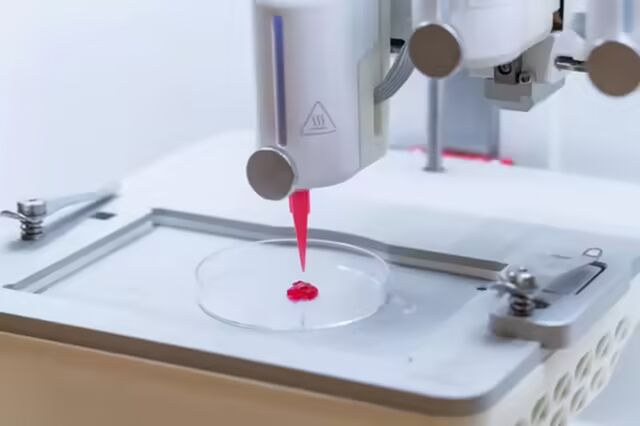
▲ Researchers using 3D printed gel
Currently, treatments for severe burns and wounds remain stuck in methods from decades ago—transplanting a thin layer of epidermis from the patient. While life-saving, this method leaves scars and fails to reconstruct the dermis layer, which includes nerves, blood vessels, and connective tissue, resulting in transplanted skin lacking natural functions.
Johan Junker, an associate professor and plastic surgeon at Linköping University, stated: “The dermis is too complex; we cannot cultivate a complete dermis in the lab, nor do we fully understand its composition. Therefore, we believe we can first transplant building blocks and then allow the body to generate the dermis itself.”
Junker’s team developed a specialized bioink called μInk, which can layer by layer construct skin through 3D printing. The researchers cultivated fibroblasts that can secrete collagen and elastin on tiny gelatin beads and printed them embedded in hyaluronic acid gel, forming artificial tissues with a high concentration of living cells.
In mouse transplantation experiments, this tissue not only survived and integrated with the host but also secreted collagen and generated new blood vessels, beginning self-repair. The appearance of blood vessels indicates that the graft can maintain life activities over the long term.
Another team developed the REFRESH technology (IT Home Note: full name Rerouting of Free-Floating Suspended Hydrogel Filaments), which uses hydrogels containing 98% water to create elastic filaments that can be knotted, woven, or shaped, and then completely degraded by enzymes, leaving microtubes that can serve as vascular channels. By designing the layout of the filaments, researchers allowed liquids to flow through these channels, enabling vascular cells to grow within them, thus simulating a vascular network.
Daniel Aili from Linköping University stated that this technology provides a flexible solution for introducing vascular networks into synthetic tissues. Experiments have also shown that these filaments can be woven into intricate three-dimensional networks, and the team plans to achieve automated production in the future to more efficiently create dense vascular networks that can nourish artificial skin or even synthetic organs.
The project also collaborates with Professor Lars Kölby from Sahlgrenska University Hospital’s plastic surgery department and has received funding from several foundations and research institutions.
Scientists remind us that despite significant progress in research, real-world issues such as inflammation and infection must be overcome before clinical applications, and extensive testing is needed to verify efficacy. The research team believes that combining skin tissue constructed with μInk and the vascular network created with REFRESH holds promise for ultimately producing functional, vascularized skin grafts to aid the recovery of severely injured patients.
Source: IT Home
▼ Previous Hot Articles ▼
The 2025 Top 500 Chinese Enterprises Released: State Grid Tops the List, with JD, Huawei, and BYD Also Making the Cut!
New Starting Point, New Journey! The Chengdu Branch of Zhongxiruang Moves to a New Address
Jiangsu Province Trademark Agency Credit Evaluation Results Publicized, Zhongxiruang Receives A-Level Credit Rating
New Address, New Chapter, New Achievements! The Taiyuan Branch of Zhongxiruang Celebrates Its Move
The First Holographic 3D Projection Prototype “FlexiVol” That Can Be Interacted with by Hand Is Released
100% Charging in 18 Seconds! RML Group Releases the World’s Highest Power Density VarEVolt Battery
Failure to Delete Photography Works After Authorization Expires May Constitute Infringement!
Scientists Create a “Virtual Headphone” That Can Only Be Heard at a Specific Location
Is It Legal to Reference Popular TV Shows in Product Links?
International First! Chinese Scientists Successfully Develop High Temporal and Spatial Resolution Brillouin Microscope
Major Scientific Issues, Engineering Technical Challenges, and Industrial Technology Problems for 2025 Released
LG Innotek Launches World’s First Copper Pillar Technology: Reducing Mobile Semiconductor Substrate Size by Up to 20% While Maintaining Performance
MIT Develops New AI Repair Technology: “Reviving” 15th Century Oil Paintings in Three and a Half Hours
New Type of Flexible Power Generation Film Material Developed in China Can Generate Power from Body Heat!
New Breakthrough! Chinese Research Team Completes Module-Level Verification of Star-Ground Quantum Direct Communication System for the First Time
New Sensor System Released! Can Detect Obstacles 200 Meters Away in Extremely Poor Visibility Conditions
[Warm Reminder] Some images in this article are sourced from the internet, and copyright belongs to the original authors. If there are any issues, please contact us to modify or delete.