
✅ Two Agents
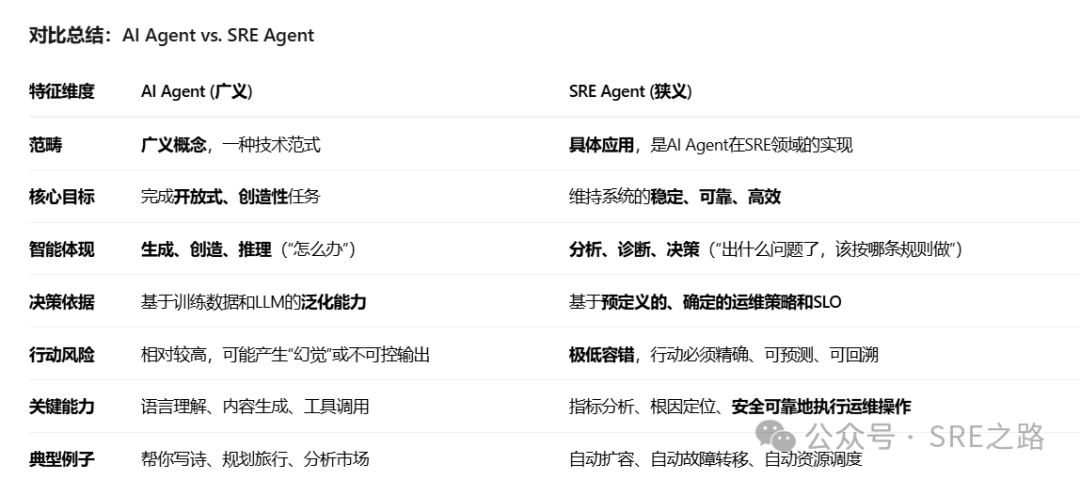
The AI Agent (Intelligent Agent) and SRE Agent (Site Reliability Engineering Agent) are two core concepts in the current field of automated and intelligent operations. They are interconnected yet have significant differences.
I will help you understand them from multiple dimensions, including core definitions, goals, working methods, and application scenarios, and finally provide a clear comparative summary.

✅ AI Agent
AI Agent (Artificial Intelligence Agent)
Core Definition
The AI Agent is a broad concept referring to any autonomous software entity capable of perceiving its environment, reasoning, making decisions, and taking actions to achieve specific goals. Its core lies in “intelligence” and “autonomy.”
Core Goals
To complete open-ended tasks assigned by humans that typically require a certain level of intelligence. For example, writing an article, booking the cheapest flight, planning a travel route, etc. The goals themselves may be somewhat vague and complex.
Working Methods and Key Capabilities
1. Perception: Acquiring information from the environment (including the internet) through APIs, sensors, text input, etc.
2. Planning and Reasoning: This reflects its “intelligence.” It processes information using large language models, knowledge graphs, machine learning models, etc., understands context, breaks down complex tasks, and plans a sequence of actions step by step.
3. Decision-making: Choosing the optimal solution among multiple possible action paths.
4. Execution: Calling tools or APIs to carry out planned actions, such as running code, operating software, sending emails, etc.
5. Learning and Adaptation (Advanced Capability): Learning from historical actions and results to optimize future decisions.
Typical Application Scenarios
Copilot-type assistants: GitHub Copilot (writing code), Microsoft 365 Copilot (handling documents and emails).
• Autonomous driving: Perceiving road conditions, planning routes, controlling vehicles.
• Game AI: Competing or cooperating with players in complex environments.
• Automated customer service: Understanding complex user issues, querying knowledge bases, and providing solutions.
A simple analogy: The AI Agent is like a “general white-collar expert”; you give it a vague goal (like “make our social media more popular”), and it will think of strategies, write copy, choose posting times, and execute the publication.

🌟 SRE Agent
Core Definition
The SRE Agent is a specific application of the AI Agent concept in the SRE operations field. It is an autonomous agent designed and trained specifically to ensure the stability, reliability, and efficiency of large software systems. Its core lies in “focus” and “determinism.”
Core Goals
To automatically maintain or restore the health of systems, with very clear specific goals:
• Ensure service level objectives (SLO) are met.
• Automatically handle alerts and fix faults.
• Optimize resource utilization and reduce costs.
• Execute standardized operational tasks (such as scaling, restarting).
Working Methods and Key Capabilities
1. Perception: Real-time acquisition of system metrics, logs, and events from monitoring systems (like Prometheus), logging systems (like Loki), and tracing systems (like Jaeger).
2. Analysis and Diagnosis: Using predefined rules and ML models (like anomaly detection, root cause analysis RCA models) to assess system status. For example, “CPU usage at 95% for 5 minutes” -> “Determine that scaling is needed.”
3. Decision-making: Making decisions based on preset, rigorously reviewed operational strategies. For example, the strategy is: “If CPU exceeds 90% for 5 minutes, automatically scale up by one instance.” The decision logic is relatively deterministic, rather than open-ended creative thinking.
4. Execution: Calling the APIs of operational systems (like Kubernetes API, cloud vendor APIs) to perform specific operations, such as scaling, restarting services, switching traffic, executing failover scripts, etc.
5. Feedback and Verification: After executing operations, continue monitoring system metrics to verify whether the operation was effective; if not, it may trigger escalation or execute the next contingency plan.
Typical Application Scenarios
• Automated fault handling: After receiving an alert for “database primary node down,” automatically trigger the operation to “promote the backup node to primary.”
• Elastic scaling: Automatically calculate the required resources based on real-time traffic and scale container instances accordingly.
• Cost optimization: Identify idle development environment resources at night, automatically shut them down, and restart them before morning work hours.
• Contingency execution: Automatically perform a series of health checks before releasing a new version; if issues arise post-release, automatically execute rollback operations.
A simple analogy: The SRE Agent is like a “highly specialized fully automated operations robot” that monitors the dashboard 24/7; if any metric is abnormal, it will immediately execute operations according to the predetermined manual (Playbook), such as taking down the faulty component and replacing it with a new one.

Relationship and Future
The SRE Agent is a subset and specialized application of the AI Agent. You can think of a powerful SRE Agent as internally using one or more AI Agent components to handle the intelligent parts.
For example:
• An SRE Agent receives a vague alert “users feel the system is slow”; its internal AI Agent component can analyze the sentiment of user feedback and query relevant metrics, transforming it into a clear, actionable technical issue (like “API latency P99 increased”).
• Then, the rule-based decision engine within the SRE Agent decides to execute a scaling operation.
In the future, as AI technology matures, SRE Agents will become increasingly intelligent, transitioning from the “automated operation” phase of executing preset rules to the “autonomous operations” phase of being able to independently discover potential issues, design solutions, and implement them. However, safety, controllability, and determinism will remain the unshakable core principles of SRE Agents.

END

Long press to scan the code and follow us
Public Account | SRE Road
Rushing towards the mountains and fields
Putting down the pace of pursuit
Persisting in sharing technical documents
For more technical content sharing, click below[Read the original text]