
The rapid proliferation of intelligent connected vehicles has driven the swift iteration of automotive digital key technology. The global cross-industry organization, the Car Connectivity Consortium (CCC), has officially released the third-generation digital key R3 technical specification, marking the formal entry of automotive digital key technology into the 3.0 era.
Based on NFC/BLE protocols, the CCC’s third-generation digital key technical specification defines UWB as the core technology for the third generation of digital keys, and will comprehensively adopt PKI cryptographic technology for mutual signature authentication between vehicles and devices. It only displays the identity of known vehicles, and only allows vehicles to unlock and start the engine if the private key corresponding to the public key stored in the vehicle is used for signature calculation. In the CCC digital key R3 version, new location-aware and seamless keyless entry functions have been added. Before the vehicle owner approaches the vehicle with their device, the system applies the minimum security distance process to achieve welcome, lock, and unlock functions. Before establishing a secure distance, the UWB distance measurement key (URSK) is applied to ensure the confidentiality and integrity of URSK throughout its entire lifecycle.
The CCC digital key architecture is based on the vehicle networking public key infrastructure PKI, achieving end-to-end trust. The digital key application on mobile devices is provided by automotive OEMs or third-party mobile device manufacturers as a native application. Mobile devices and vehicles interact with their respective OEM servers to share and manage digital keys. Even if the mobile device and vehicle are not connected to the internet, the system ensures that users can access the vehicle while allowing OEMs to add online functionality for certain operations as needed.
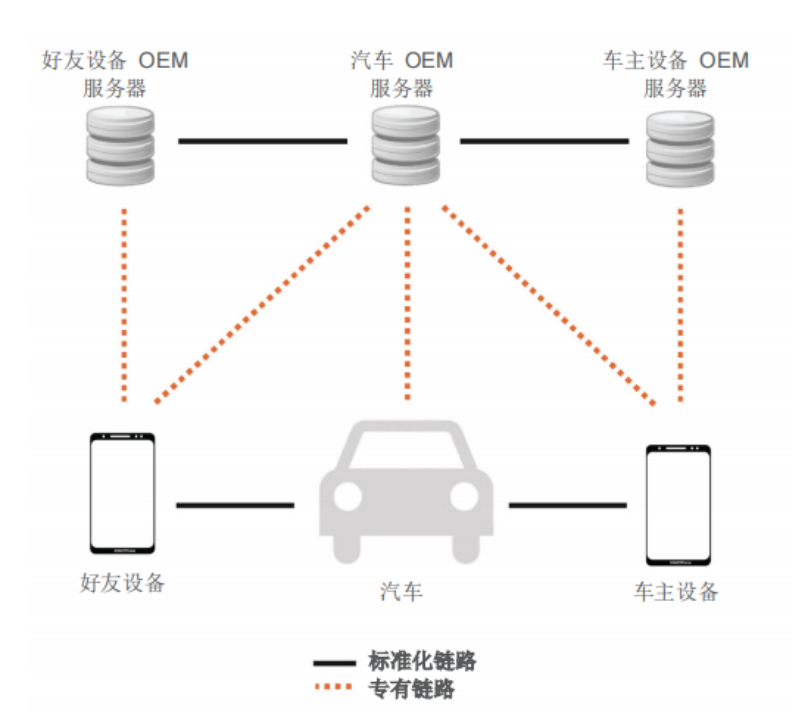
Figure 1 Digital Key Ecosystem
As shown in Figure 1, the CCC digital key ecosystem consists of vehicles, automotive OEM servers, mobile devices, and mobile device OEM servers, which communicate through standardized interfaces and proprietary interfaces. The standardized interfaces enable interoperability between different implementation solutions from mobile device manufacturers (mobile device OEMs) and automotive manufacturers (automotive OEMs), thus the CCC digital key specification comprehensively regulates the standardized interfaces.
The standardization of the automotive-device interface supports interoperability between mobile devices and vehicles. These standardizations include communication channels (NFC/BLE/UWB), protocols, and digital key structures. The automotive-device interface provides a secure communication channel based on asymmetric cryptographic algorithms for bidirectional authentication, protecting user privacy by only displaying the identity of the mobile device to verified trusted vehicles. The OEM servers of the devices and vehicles extract detailed information about mobile device management and vehicle management from each other, ensuring interoperability between them; the interface between the two provides a standardized way to manage digital keys and provide customer service. There are proprietary interfaces between mobile devices and their OEM servers, as well as between vehicles and their OEM servers. Utilizing these proprietary interfaces, OEMs can provide customized key management features.
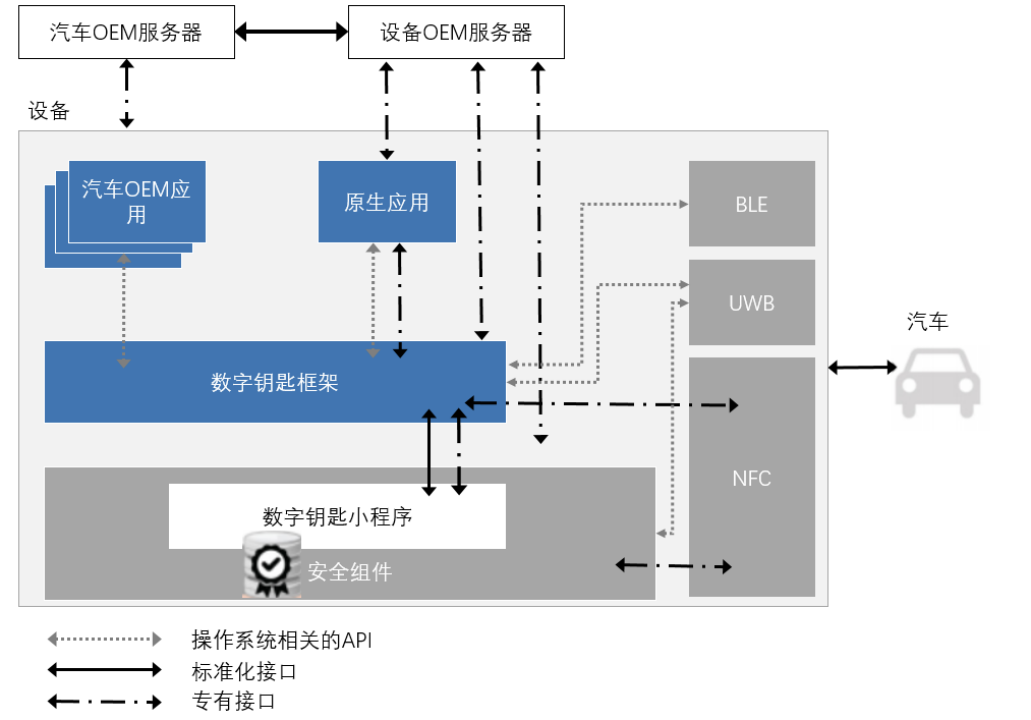
Figure 2 Mobile Device Architecture
As discussed above and shown in Figure 2, mobile devices utilize secure components, native and customized applications, the CCC digital key framework, and secure communication with device OEM servers to protect and manage CCC digital keys. The application is utilized in various scenarios including automotive OEM applications, sharing, and rental services.
Thus, the CCC third-generation digital key comprehensively applies PKI infrastructure, including CA, KMS, and SVS systems to ensure the security of digital key lifecycle management from initialization, distribution, authorization, usage, to destruction, especially in key stages such as identity authentication of communication entities, command transmission and reception, sharing, and authorization, fully employing technologies like elliptic curve digital signatures, elevating the security level of the third-generation digital key system to new heights.
China Automotive Data Co., Ltd. leverages its technical advantages in digital key standards, vehicle networking public key infrastructure construction, and intelligent connected vehicle security application R&D to fully integrate the specific security needs of the third-generation digital key, launching a digital key security protection solution.
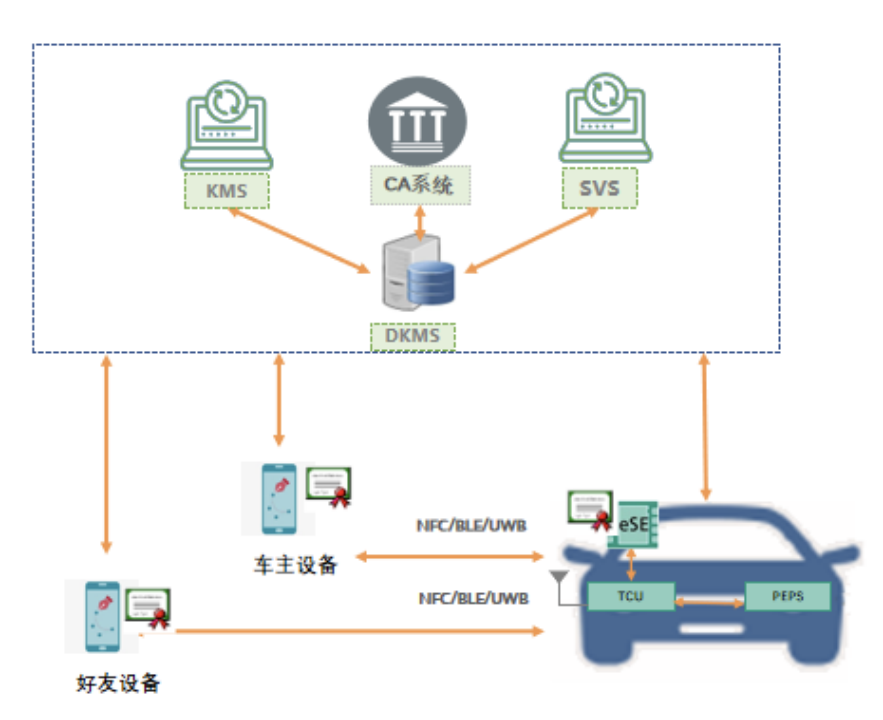
Figure 3 Digital Key Security Protection Solution
As shown in Figure 3, the entire solution centers around the digital key distribution system (DKMS), forming a public key security infrastructure for digital keys through the vehicle networking digital certificate management system CA, digital key key management system KMS, and command signature verification system SVS. The vehicle networking PKI security infrastructure provides identity authentication, channel encryption, and command signing services for communication protocols such as BLE/NFC/UWB between intelligent connected vehicle PEPS and TCU modules and mobile devices. This PKI system fully supports international AES/SHA2/EcDSA/EdDSA algorithms and China’s self-controllable commercial cryptography SM2/SM3/SM4 algorithms, and comprehensively applies a fully self-owned intellectual property PKI system to safeguard the new generation of intelligent connected vehicle digital key systems.
Contact
Zhang Wang
Phone: 15922090958Email: [email protected]

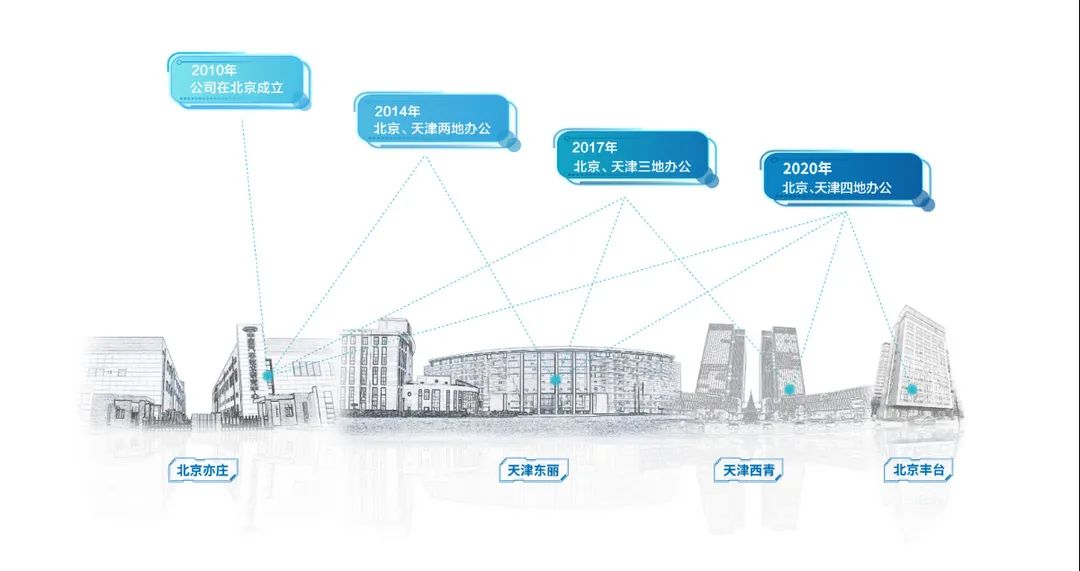
China Automotive Data Co., Ltd.
In response to the development trends and innovative development needs of the 3060 dual carbon, digital transformation, and “new four modernizations” industries, China Automotive Data Co., Ltd. uses a “one base and two wings” development framework to deeply engage in energy conservation and low carbon, green ecology, market research, and judicial authentication, accurately laying out innovative fields such as intelligent connectivity, intelligent cockpit, and industrial internet (industrial software), forming a business positioning centered on “national-level automotive industry data center, national-level automotive industry chain decision support organization, and national-level pan-automotive industry digital support organization.”
 Click the original text for more details!