The dynamic and challenging nature of battlefield scenarios necessitates the establishment of robust, secure, and efficient network systems to timely connect and share situational awareness information, which is crucial for achieving precise strikes and mission success. The Military Internet of Things (MIoT) has the potential to comprehensively and coherently meet these needs. MIoT is essential in creating a networked environment where interconnected heterogeneous devices can enhance situational awareness, communication, and decision-making capabilities. However, dynamic conditions (such as device heterogeneity, mobility, unreliable wireless communication, operational scenarios, etc.) pose challenges at various levels within common coalition domains. This article discusses these challenges, existing literature, and future design advancements related to security/privacy, mobility, robustness, and data-driven AI solutions in potential MIoT applications.
In the ever-evolving field of military technology, integrating cutting-edge innovations has become crucial for enhancing operational effectiveness, situational awareness, and overall mission success rates. The emergence of the Internet of Things (IoT) has ushered in a new era of interconnectedness, where physical objects equipped with sensors and communication capabilities can seamlessly exchange information, leading to smarter decision-making. Concepts such as the Military Internet of Things (MIoT), Internet of Battlefield Things (IoBT), or Defense 4.0 represent collaborative efforts to establish seamless connections between battlefield operations and headquarters. Their goal is to achieve robustness and reliability even in adversarial environments that span all domains (including land, air, sea, and cyberspace) and in coalition domain cooperation.
Interconnected objects such as vehicles, weapons, and wearable devices provide vast amounts of data that can be leveraged by Artificial Intelligence (AI) models. Use cases range widely from real-time asset tracking to personnel health monitoring, from enhancing intelligence capabilities through sensor networks to enabling autonomous systems through data-driven decision-making. However, these benefits come with challenges. Ensuring the security and resilience of interconnected systems against cyber threats is crucial, requiring solutions that can protect sensitive data and maintain operational integrity. The interoperability of command and control (C2) and IoT systems, as addressed by NATO’s IST-176, is also a key issue. Furthermore, maintaining connectivity among IoT objects during mobility remains an open research area, presenting new opportunities for communication and interaction.
In 2024, Pasdar et al. conducted a comprehensive classification of MIoT systems from multiple perspectives, including communication, resilience, trust, threats, and security. This article particularly emphasizes the communication and mobility aspects of these systems. To clarify and highlight our contributions, Table 1 summarizes the most relevant literature, filtered based on citation impact (over 100 citations) and publication channels, as well as recency. Notably, existing literature primarily focuses on IoT applications but does not define specific architectures or explore general IoT concepts. Additionally, no study has addressed the network layer or examined the impact of mobility on networks, revealing a significant gap that our article aims to fill. It should be noted that, given the scope and space limitations of this journal, this comparison is not exhaustive.
Existing literature extensively covers discussions on military IoT applications and their utility, but the topic remains open when network conditions may change due to mobility, network threats, and interference. This article provides a comprehensive overview of the MIoT architecture from the perspectives of communication and applications. It delves into communication management, mobility, and security while exploring the role of AI in enabling intelligent decision-making in modern MIoT applications. Furthermore, insights into potential future advancements in MIoT are presented.
The structure of this article is as follows: Section 2 introduces a six-layer military IoT architecture and discusses current solutions and key challenges of mobile MIoT from the perspective of each proposed layer. Section 3 presents insights into potential advancements in MIoT. Finally, Section 4 provides a brief summary of the entire article.
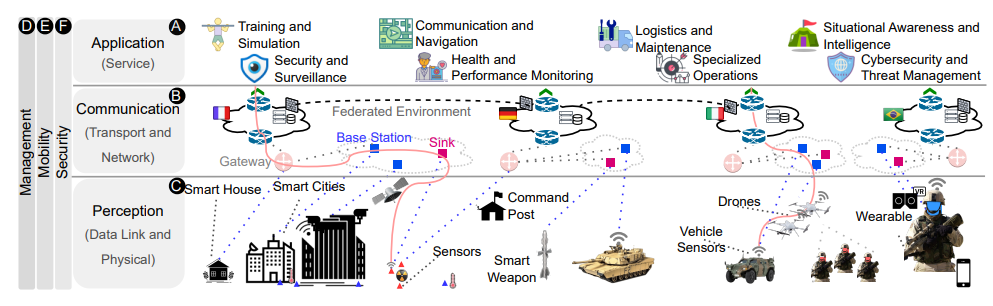
Figure 1: Simplified Military Internet of Things (MIoT) architecture—integrating lateral management, mobility, and security layers into a basic three-layer architecture.
For convenient viewing,
click the lower left corner“Read the original text” or copy the following URL to view
https://www.zhuanzhi.ai/vip/26f9e68ed684b9cbe9598d55438aa52e
-
Welcome to scan the WeChat QR code to addSpecial Knowledge Assistant, for consulting services:Access to Chinese report materials


Click “Read the original text” to view and download