Click the blue text above to follow us

Microscale Robots Become ‘Delivery Agents’ in the Body, Precisely Delivering Drugs Against Blood Flow
The future of medicine may lie within tiny blood vessels, hidden within robots smaller than grains of sand.
A research team has successfully demonstrated a microscale robot that can “swim upstream” in blood at speeds of up to 40 centimeters per second, ultimately delivering drugs precisely to the target site.
If this technology can be successfully applied in clinical settings, it will completely change traditional drug treatment methods.
“Our navigation system must withstand the high-speed flow of blood. It is surprising that blood flows through our vessels at such high speeds,” said Fabian Landers, the lead author of the study from ETH Zurich.

01 Bottlenecks in Precision Medicine
Approximately 12 million people worldwide face health threats from strokes each year, many of whom die or suffer permanent damage as a result.
The primary method for treating strokes currently involves using thrombolytic drugs to dissolve clots that block blood vessels.
To ensure that a sufficient dose reaches the target site, doctors often need to administer large doses, which can lead to severe side effects such as internal bleeding.
Drug toxicity has become a significant challenge in modern medicine. Researchers point out that about one-third of drugs developed have failed to reach the market due to their excessive toxicity.
“Severe side effects are often associated with systemic drug administration, leading to a 30% failure rate during clinical trials,” the researchers wrote in their paper published in the journal Science.
The medical community has long been dedicated to finding a method to deliver drugs precisely to specific locations, making microscale robot technology a research hotspot.
02 Design of the Microscale Robot
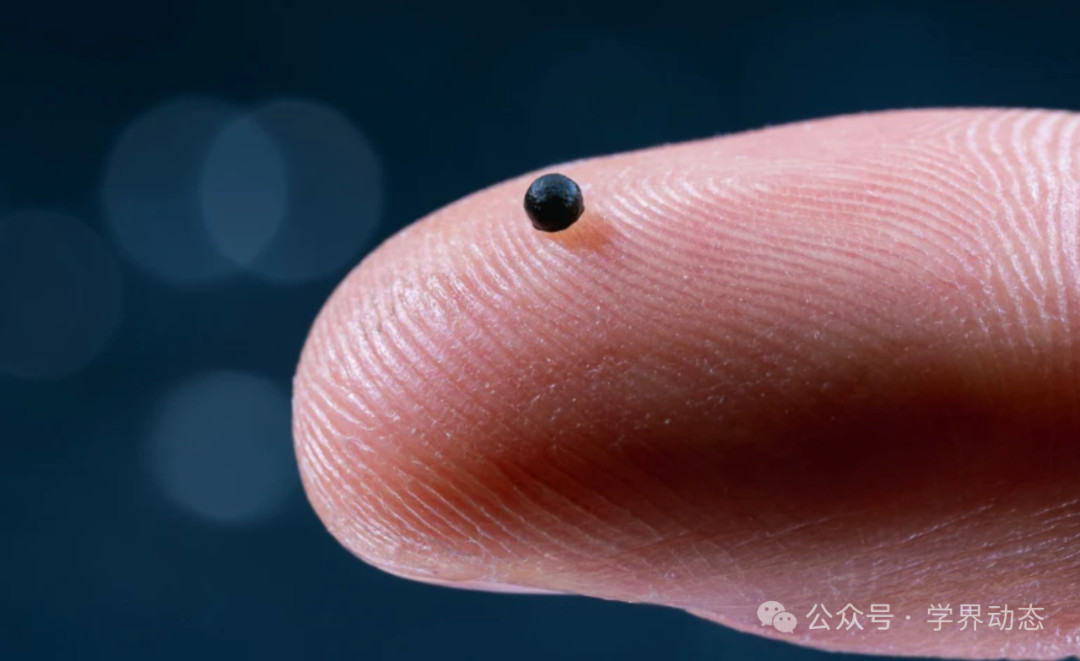
The microscale robot developed by the ETH Zurich research team is essentially a spherical capsule, only as small as a grain of sand.
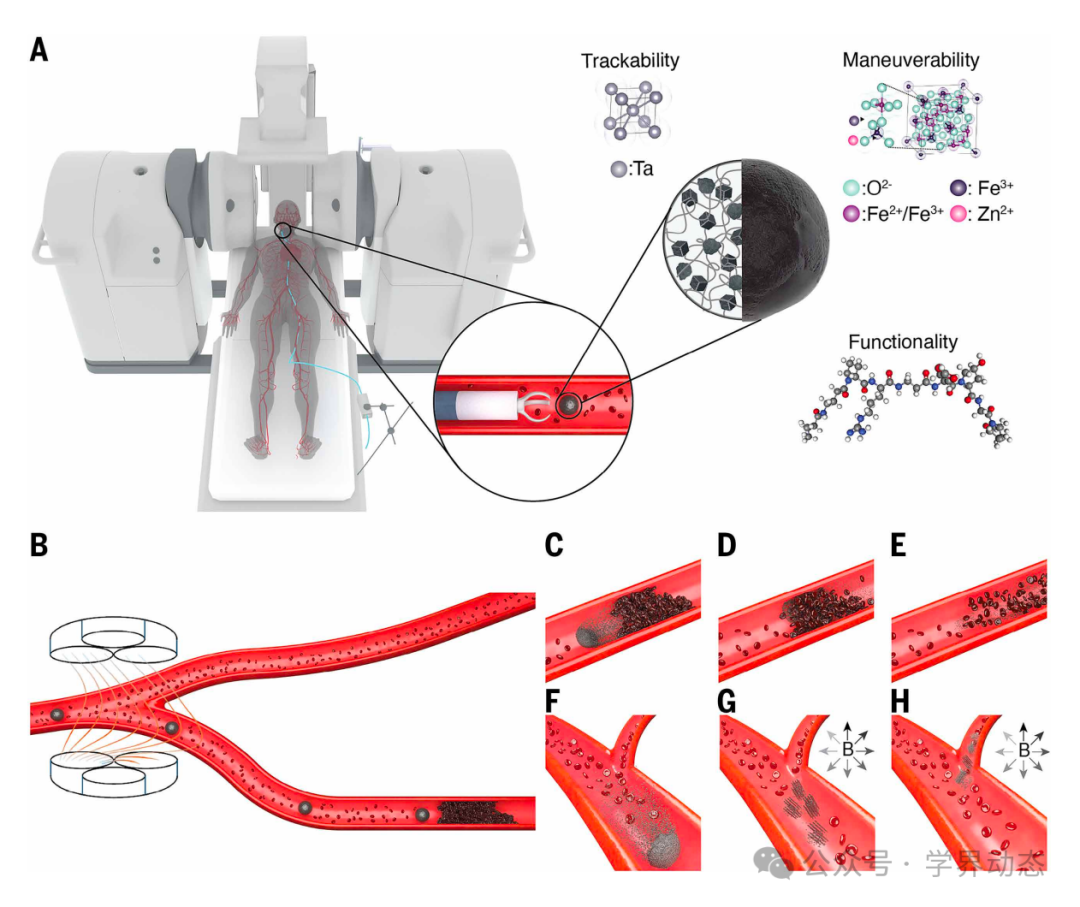
The capsule consists of a soluble gel shell, with iron oxide nanoparticles embedded inside, giving it magnetic properties that allow it to be controlled and guided by an external magnetic field.
Due to the extremely small size of human brain blood vessels, integrating sufficient magnetic material within such a tiny structure has become a technical challenge.
To solve the tracking problem, the research team chose high-density tantalum nanoparticles as contrast agents, making the capsule clearly visible under X-ray imaging.
“Combining magnetic functionality, imaging visibility, and precise control within a single microscale robot required a high level of collaboration between materials science and robotic engineering, which took us years to achieve,” explained Professor Bradley Nelson from ETH Zurich.
03 The Tri-Modal Navigation System
The research team developed a modular electromagnetic navigation system called Navion.
This system integrates three different magnetic navigation strategies to address various complex vascular conditions:
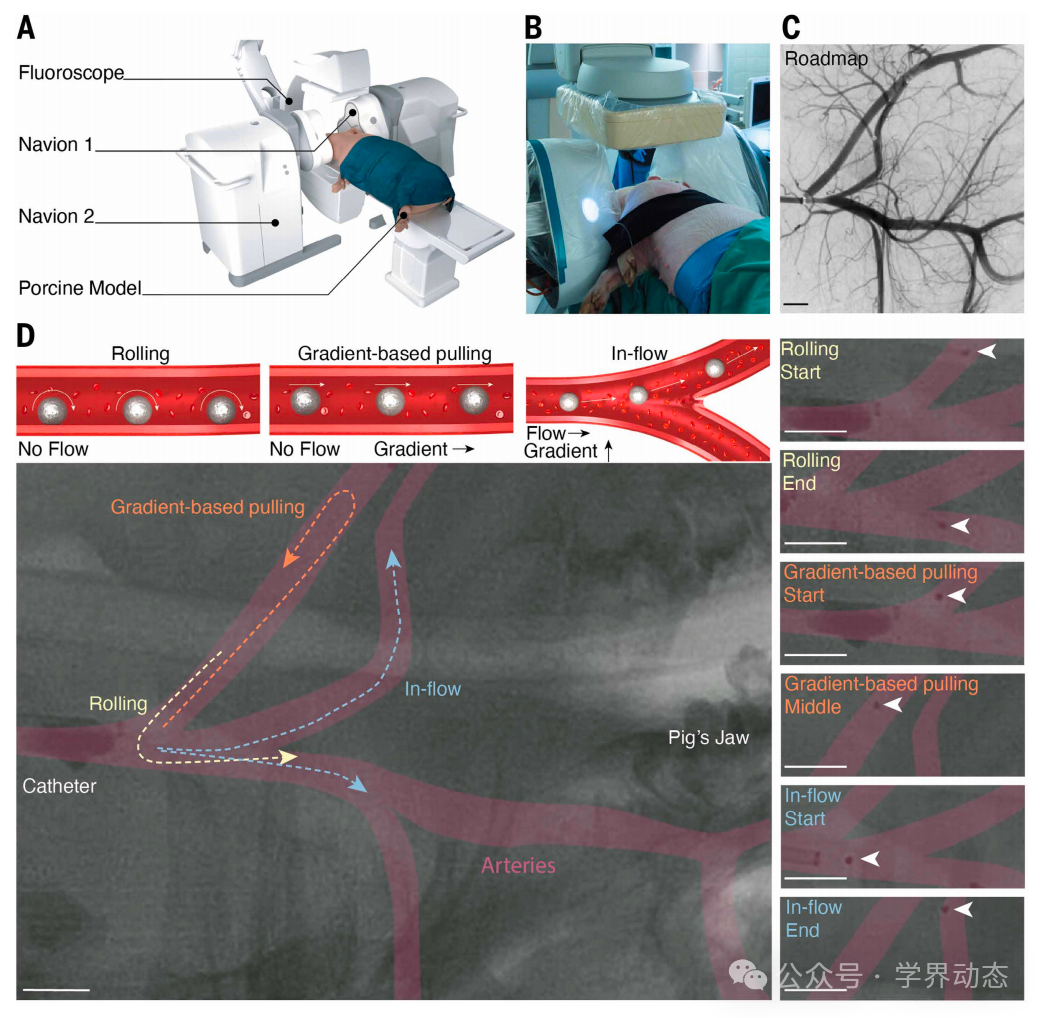
- Rolling Navigation: Utilizing a rotating magnetic field to make the capsule roll along the blood vessel wall, achieving high-precision movement at speeds of up to 4 millimeters per second.
- Gradient Traction: Guiding the capsule through magnetic field gradients for directional delivery, allowing the capsule to even “swim upstream” against blood flow speeds of up to 20 centimeters per second.
- Inflow Navigation: When encountering complex structures like vascular bifurcations, the inflow navigation strategy uses a magnetic gradient pointing towards the vessel wall to guide the capsule into the target branch.
“Blood flow speeds in the human arterial system vary significantly depending on the location. This makes navigation for microscale robots very complex,” Professor Nelson explained.
The combination of these three strategies allows the microscale robot to operate stably under various blood flow conditions and anatomical structures.
04 Successful Animal Experiments
After successful preliminary tests on silicone models, the research team conducted experiments in pigs and sheep.
The blood vessel sizes in these animals are similar to those in humans.
The experimental results showed that in over 95% of cases, the microscale robot successfully delivered drugs to the designated location.
The researchers were able to guide the microscale robot to roll along the edges of blood vessels, swim upstream, or navigate downstream, achieving speeds of up to 40 centimeters per second.
They used X-ray imaging to observe and manipulate the robot’s movement in real-time, achieving millimeter-level precision.
When the microscale robot reached the target location, the researchers applied a high-frequency magnetic field to heat the internal magnetic nanoparticles, causing the gel shell to dissolve and release the drug.
05 Prospects for Clinical Applications
This technology opens up broad prospects for the treatment of neurological diseases.
The research team validated the system’s effectiveness in the cerebrospinal fluid of pigs and sheep.
In addition to strokes, this technology can also be used to treat brain tumors, localized infections, and various other diseases.
“Doctors have already done incredible work in hospitals. What drives us forward is knowing that we have a technology that can help patients faster and more effectively, bringing them new hope through innovative therapies,” Landers stated.
Caltech biomedical engineer Wei Gao believes that if further research proceeds smoothly, remote-controlled drug delivery robots could be applied in medicine within five to ten years.
Disclaimer: The content of this article is based on publicly available information and aims to disseminate information on technological innovation for readers' reference only.
Give a thumbs up if you like it
 Conference Recommendations