Most NPUs are integrated units that excel at executing real-time AI tasks on edge devices such as smartphones and IoT systems with low power consumption. TPUs, on the other hand, are standalone processors designed for large-scale AI workloads in data centers, demonstrating exceptional performance in deep learning tasks. However, some manufacturers’ NPU chips are also used in data centers, such as Huawei’s Ascend.
Dedicated hardware accelerators like Neural Processing Units (NPUs) and Tensor Processing Units (TPUs) have revolutionized the AI hardware landscape by providing the capability to accelerate machine learning tasks. Both are designed to optimize performance for tasks involving machine learning, deep learning, and neural network computations, but they target different application scenarios and needs.
This article will delve into the differences between these two powerful processing units in terms of architecture, performance, practical applications, and the challenges they face, providing actionable insights for professionals.
Introduction
The rapid development of artificial intelligence has led to an increasing demand for dedicated hardware capable of efficiently handling complex computational tasks. NPUs and TPUs have emerged as key technologies in this field, each optimizing tasks involving complex machine learning algorithms in unique ways. NPUs, with their low-power design, significantly enhance the performance of edge computing, making them indispensable in IoT and mobile devices; while TPUs excel in handling deep learning workloads on large datasets, driving breakthroughs in cloud-based AI.
This article aims to provide professionals with a detailed comparison of these two technologies, analyzing their architectural features, application scenarios, and limitations. Understanding these differences can help make more informed decisions and optimize deployment strategies for diverse AI needs.
What is a Neural Processing Unit (NPU)?
An NPU is a processor specifically designed to optimize neural network computations, capable of efficiently performing real-time processing. With outstanding processing capabilities in workloads such as image recognition, speech processing, and natural language tasks, NPUs have become an integral part of modern Central Processing Unit (CPU) and System on Chip (SoC) designs. Companies like Huawei, Samsung, and Apple are leading the trend of integrating NPUs into their devices, significantly enhancing AI performance without sacrificing energy efficiency.
What is a Tensor Processing Unit (TPU)?
A TPU is a hardware AI accelerator developed by Google, classified as an Application-Specific Integrated Circuit (ASIC), designed to accelerate tensor-based computations, which are fundamental to deep learning. The TPU architecture is optimized for mathematical operations such as matrix multiplication and parallel computing, making it highly suitable for training large-scale neural networks and executing batch processing tasks.
The following diagram illustrates the TPU architecture:
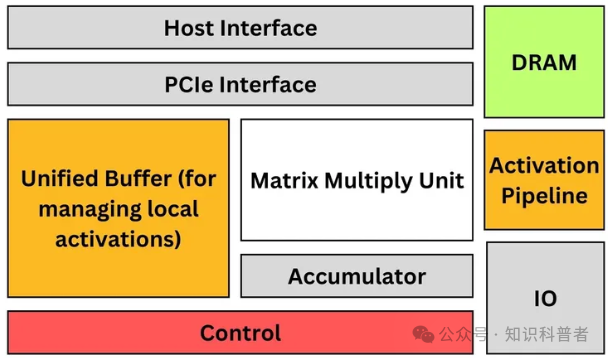
The TPU architecture is designed to optimize computation, storage, and communication by integrating specialized components, thereby enhancing the efficiency of AI workloads. The core component is the matrix multiplication unit, which performs rapid large-scale matrix operations critical to AI tasks. Data flows through a unified buffer (a local storage unit for managing activations), ensuring quick access and reducing reliance on external memory. The control unit coordinates data movement and synchronizes operations between components. PCIe interfaces and host interfaces facilitate communication between the TPU and external systems, enabling smooth data transfer and coordination. DRAM ports provide access to external memory to manage large datasets that exceed buffer capacity. The activation pipeline processes intermediate results, applying transformations crucial for refining AI computations. Additionally, accumulators temporarily store partial computation results for aggregation and further processing. Finally, miscellaneous I/O manages input/output tasks, ensuring seamless integration with broader systems. This balanced architecture guarantees high efficiency and performance for AI tasks in data centers.
Performance Comparison of NPU and TPU
NPUs and TPUs exhibit significant differences in performance characteristics, making them suitable for different types of AI workloads. The following sections will compare these two AI chips across multiple dimensions.
Speed and LatencyNPUs are designed for real-time, low-latency tasks, making them ideal for edge computing scenarios that require immediate responses. For example, NPUs can achieve instant image processing in smartphones and IoT devices.
TPUs, on the other hand, demonstrate exceptional speed and scalability when handling large datasets, with their dedicated architecture optimized for tensor computations. TPUs focus more on throughput rather than latency, making them suitable for batch data processing tasks such as training ultra-large deep learning models. In contrast, NPUs concentrate on executing real-time, low-latency AI inference tasks on edge devices.
Power Consumption and Energy EfficiencyPower consumption is a critical factor for both NPUs and TPUs, but their optimization directions differ. NPUs exhibit superior energy efficiency in edge computing and low-power applications, efficiently completing AI tasks under limited computational resources, thereby extending battery life while performing complex AI operations on small devices. While TPUs also possess high energy efficiency at their scale, they primarily target environments with relatively abundant power supply, such as data centers; nevertheless, their energy efficiency is crucial for supporting massive computational tasks.
Scalability and FlexibilityCompared to TPUs, NPUs have limited scalability as they are primarily customized for specific edge AI applications. However, the flexibility of NPUs in real-time processing tasks gives them irreplaceable value in localized AI workloads. TPUs, on the other hand, are built for scalability, easily handling large-scale AI models and datasets in cloud environments or distributed systems.
Architectural Differences
Core DesignThe core of an NPU is specifically designed for efficiently processing neural network activations and real-time matrix operations, typically employing a lightweight architecture to achieve low power consumption and optimization for latency-sensitive tasks.In contrast, TPUs utilize a systolic array architecture, integrating high-density computing cores optimized for parallel matrix multiplication operations.
Programming Frameworks and EcosystemNPUs are compatible with general AI frameworks such as TensorFlow, PyTorch, and ONNX, making it easier for developers to integrate AI capabilities into various devices. Since NPUs are often integrated within larger processors, their applications are more versatile, supporting a variety of computational tasks.TPUs, however, are deeply integrated into Google’s TensorFlow ecosystem, making them an ideal choice for teams already developing within Google AI infrastructure. This design strikes a balance between flexibility and specialization: NPUs are more flexible, while TPUs are more focused.
Application Scenarios and Practical Uses
NPUs and TPUs, with their respective specialized capabilities, are suitable for distinctly different scenarios.
NPUs demonstrate strong advantages in edge computing, enabling devices such as smartphones, cameras, and IoT sensors to execute AI tasks directly on-site. Typical applications of NPUs include:
- Real-time object detection in edge devices like security cameras
- Voice recognition for smart voice assistants running on low-power devices
- AI medical devices for monitoring patient vital signs and assisting in diagnosis
- Industrial automation systems requiring real-time decision-making capabilities
TPUs, on the other hand, are the backbone for processing massive data AI computations. Typical applications of TPUs include:
- Training large-scale machine learning models in cloud environments
- Batch processing for natural language understanding tasks in virtual assistants
- Optimization of recommendation systems in large e-commerce platforms
- Real-time analysis of large datasets in finance and research fields
Challenges and Limitations Faced by NPU and TPU
Engineering Challenges in ImplementationDeploying NPUs and TPUs faces several technical challenges, including:
- Compatibility Issues: Existing software ecosystems (such as libraries and frameworks) often require significant adaptation to fully leverage the performance of NPUs and TPUs.
- Hardware Integration Difficulty: Especially in legacy systems, seamlessly integrating them into existing architectures can be quite complex.
- Optimization Challenges: AI models often need to be specifically optimized for these dedicated processors to achieve optimal performance.
- Cost-Effectiveness: Despite their powerful performance, the initial investment in NPU or TPU hardware may be prohibitively high for smaller organizations.
Limitations in Real-World ApplicationsDespite their powerful capabilities, NPUs and TPUs still have limitations in specific environments:
- Latency-Sensitive Systems: TPUs are designed for high-throughput batch processing and are less suitable for real-time applications that require extremely low latency.
- Mixed Demand Scenarios: For example, autonomous vehicles may require a combination of TPU and Graphics Processing Unit (GPU) capabilities to balance precision and speed.
- Scalability Constraints: While TPUs exhibit excellent scalability in cloud environments, NPUs, due to their edge-oriented design, are less adaptable for large-scale deployments.
The following table summarizes the key comparisons between NPU and TPU:
| Feature | NPU | TPU |
|---|---|---|
| Main Use | Real-time AI tasks on edge devices (e.g., smartphones, laptops, IoT, robotics) | Large-scale AI workloads in data centers (e.g., deep learning model training) |
| Typical Applications | Image recognition, natural language processing, speech recognition, augmented reality | Language models, natural language processing, large-scale image classification |
| Architecture Focus | Low-latency, high-energy-efficient processing for real-time AI tasks | High-performance parallel processing and matrix operations for deep learning |
| Core Design | Lightweight architecture optimized for low power and real-time processing | Systolic array architecture optimized for large-scale parallel tensor operations |
| Scalability | Limited scalability, designed for specific edge AI tasks | Highly scalable, suitable for large-scale data training and model deployment |
| Power Consumption | Energy efficiency optimized for portable devices | Designed for data centers, pursuing efficiency in environments with relaxed power constraints |
| Programming Ecosystem | Supports general AI frameworks (e.g., TensorFlow, PyTorch, ONNX) | Deeply integrated into TensorFlow and Google Cloud services |
| Major Vendors | Apple (Neural Engine), Huawei, Samsung, etc. | |
| Integration Method | Embedded in SoCs for smartphones and IoT devices | Used as standalone accelerators in server environments |
| Core Advantages | Real-time processing, low latency, high energy efficiency | Exceptional performance in large-scale AI training and inference |
| Main Limitations | Not suitable for large-scale AI workloads | Higher power consumption, not suitable for edge applications |
Conclusion
NPUs and TPUs play complementary roles in advancing AI technology, each excelling in specific environments. TPUs provide unparalleled performance for large-scale machine learning tasks in the cloud, while NPUs are perfectly suited for real-time inference and high-energy-efficient edge application scenarios.
Frequently Asked Questions
Q: What is the main difference between NPU and TPU?A: NPUs are designed for low-power, real-time tasks, making them ideal for edge devices; TPUs are optimized for large-scale tensor computations, excelling in cloud machine learning tasks.
Q: What is the key role of NPU and TPU in AI?A: NPUs focus on real-time, low-power AI inference on edge devices like smartphones and IoT systems, supporting tasks such as image recognition and voice commands; TPUs specialize in high-performance, large-scale tensor computations in data centers, suitable for training and deploying AI models.
Q: How do NPU and TPU compare to GPU?A: NPUs are highly optimized for AI/ML tasks (especially inference), particularly suitable for low-power edge devices like smartphones; TPUs excel in tensor-based deep learning operations, primarily used for high-speed training and inference within the Google ecosystem; while GPU architectures are more general-purpose, capable of handling various parallel workloads including graphics rendering, machine learning training, and scientific computing. In short, GPUs are general-purpose parallel processors, while NPUs and TPUs focus on AI-oriented specialized optimizations.