Editor: Duohang Source: Krystal Kasal, Phys.org

According to Phys.org, micro robots—robots smaller than one millimeter—are highly useful in various applications such as targeted drug delivery or micro-manufacturing, which require tasks to be performed at scales far smaller than other tools can achieve. However, researchers and engineers designing these robots face some limitations in navigation. A new study published in the journal Nature details a new solution to these limitations, and the results are promising.
Too Small to be ‘Smart’
The biggest challenge faced by micro robots is spatial constraints. Their tiny size limits the use of components for onboard computing, sensing, and actuation, making traditional control methods difficult to implement. As a result, micro robots cannot be as ‘smart’ as their larger counterparts.
Researchers have attempted to overcome this limitation. Specifically, they explored two methods. One micro robot control method utilizes external feedback from auxiliary systems, often employing techniques such as optical tweezers or electromagnetic fields. This method allows for precise and flexible control of a small number of micro robots, facilitating the execution of complex multi-step tasks or tasks requiring high precision, but it has not been very successful in scaling up to control large numbers of independent micro robots.
On the other hand, a method known as ‘reactive control’ has shown good prospects for controlling large numbers of micro robots. The authors of the study explain: “They do not rely on continuous external feedback but instead use the robot’s own sensor inputs to immediately adjust the robot’s actions based on a global control field. This method is simple and efficient, making it very suitable for micro robots that typically lack complex sensing or computing capabilities due to their small size. Common examples include stimulus-responsive micro motors capable of achieving taxis, artificial potential fields coordinating movement through attraction and repulsion, and micro robot swarms generating behaviors through collective interaction.”
However, so far, reactive control methods have been limited to simple behaviors. Researchers have encountered difficulties in handling behaviors such as navigating in structured environments or guiding robots to converge to a desired location from different trajectories independently.
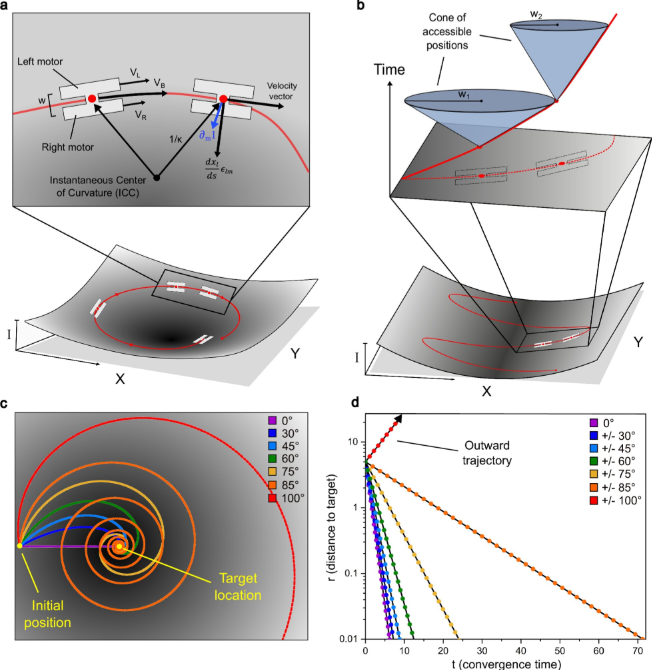
Motion in the reactive control field. Image source: npj Robotics
Solution Inspired by General Relativity
Surprisingly, researchers found that the motion of the robots is formally identical to the path of light propagation in general relativity, which allowed them to establish a mathematical framework that maps the motion of the robots to geodesics in curved spacetime defined by the control field—similar to other reactive control methods. The research team utilized conformal transformations to map complex environments to simple virtual spaces, then designed control fields and mapped them back. They termed the resulting geometric framework ‘artificial spacetimes.’
Using artificial spacetime, the research team found that robots could perform more complex tasks. They explained: “First, we proposed several metrics for generating basic behaviors in unobstructed environments. These behaviors include navigating to specific locations, constraining, diverging, or turning in predetermined ways. Then, we extended these results to bounded spaces using the invariance of geodesic motion under conformal transformations.”
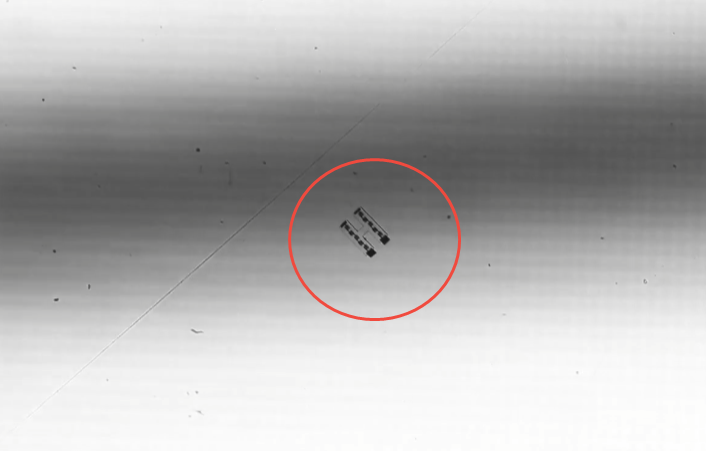
Their method successfully prevented robots from colliding with walls and could issue commands for navigation, patrolling, turning, or dispersing without requiring the robots themselves to compute. They validated the method through simulations and experiments using silicon micro robots and projected light fields. The experimental robots were equipped with two motors, each composed of a silicon photovoltaic array, with their speed of movement proportional to the intensity of incident light.
The Future of Micro Robots
Ultimately, this new framework provides a scalable and novel approach to controlling large numbers of simple robots, opening up new possibilities in fields such as medicine, environmental remediation, and micro-manufacturing. The authors of the study have already seen ways to improve the current model, which is currently limited to two dimensions and specific types of robots. They stated, “There are several promising avenues for generalization,” such as extending metrics to make them time-varying.
They said: “Research along this route may focus on avoiding collisions between robots or achieving orderly exploration of space by allowing individual robots to accelerate or decelerate when reaching specific spacetime locations or by hiding from each other when they get close.”
Other possibilities include expanding on the robot hardware side, even allowing robots to generate their own control fields, leading to emergent collective behaviors.
More information: William H. Reinhardt et al., ‘Artificial spacetimes for reactive control of resource-limited robots’, npj Robotics (2025)
Related Articles ·
▷ Mechanical Design, Motion Analysis, and Dynamics Modeling of Deformable Wheeled-Leg Hybrid Mobile Robots
▷ Scientists Use the Power of Bubble Bursting to Propel Micro Robots
▷ New Advances in Electronic Skin: Tactile Data Processing, Large-Scale Manufacturing, and Energy Autonomy Technologies
▷ Hardware Design and Verification of Cat-Like Adaptive Quadrupedal Robots with New Biomimetic Capabilities
▷ Fundamental Principles and Solutions for Soft Robot Motion
▷ Design and Development of Open-Source Quadrupedal Robots for Multi-Robot SLAM Applications
▷ Brain-Machine Interface Control Scheme for Lower Limb Assistive Robots Based on EEG
▷ Scientific Design of Soft Robot: Motivation, Methods, and Enabling Technologies
▷ Soft Robot Grippers (Part II): Flexible Grasping Techniques, Material Combinations, Physical Principles, and Device Architectures
▷ Autonomous Grape Harvesting Robots: Integrated System Architecture
▷ Energy Autonomous Electronic Skin (Part II): Self-Powered Electronic Skin, Energy Storage, and Wireless Charging Technologies