Market Overview: Dominance of Two Giants and a Diverse Competitive Landscape
The AI chatbot market in China is currently at a critical stage of rapid growth and structural transformation as of March 2025. According to QuestMobile data, the number of monthly active users for domestic AI-native apps has surpassed 287 million, showing a robust growth trend with a compound growth rate of 3.4% in the first quarter. Meanwhile, the monthly active users for mobile In-APP AI features and built-in AI assistants from smartphone manufacturers have reached 706 million and 535 million, respectively, indicating that AI capabilities are being fully integrated into the digital ecosystem in various forms.
From a market structure perspective, the field of AI chatbots in China has formed a clear tiered competitive structure:
- First Tier: Dominated by ByteDance’s Doubao and the rising DeepSeek, both of which have monthly active users exceeding 100 million, collectively occupying more than half of the native app market share. Specifically, Doubao leads with 172 million monthly active users, surpassing DeepSeek’s 145 million.
- Second Tier: Includes Tencent’s Yuanbao, Alibaba’s Tongyi Qianwen, Baidu’s Wenxin Yiyan, and Kimi, forming a user base in the millions.
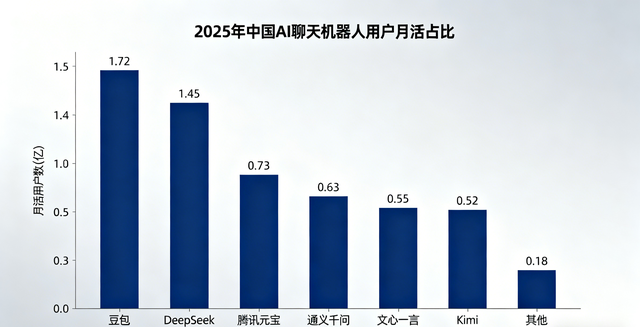
Product Competitiveness Analysis: Strengths, Weaknesses, and Market Performance
Doubao: The Leader with Comprehensive Coverage
As the core AI product of ByteDance, Doubao has achieved remarkable growth in 2025, with monthly active users reaching 172 million, making it the leader in China’s AI chatbot market. Doubao’s success stems from its unique product positioning and strategic layout:
- Ecological Synergy Advantage: Doubao effectively leverages ByteDance’s product ecosystem, especially the over 700 million daily active users of Douyin for efficient traffic diversion. Through continuous penetration via super entry points like Douyin and Toutiao, Doubao has achieved rapid user growth. This ecological synergy is reflected not only in traffic inflow but also in functional integration, as Doubao has begun linking to Douyin’s e-commerce platform to explore the integration of AI and e-commerce scenarios.
- Technical Features: Doubao’s large model adopts a Mixture of Experts (MoE) architecture, with the latest version V3.5 supporting cross-modal generation of text, images, and voice, with a response latency of less than 200ms. It performs excellently in professional scenarios, achieving an accuracy rate of over 92% in areas such as medical consultations and financial risk control. After integrating Doubao, a top-tier hospital saw a 40% improvement in outpatient triage efficiency, with the misdiagnosis rate dropping to 1.2%.
- Market Strategy: Doubao continues the smooth interaction and youthful tone characteristic of ByteDance products, successfully upgrading its brand from a functional tool to an emotional companion through short video promotions like “Using Doubao for Stress Interviews” and “Doubao Helping Kids with Homework.” In product design, Doubao emphasizes usability, attracting a significant number of child and elderly users, greatly expanding its user base with this low-threshold strategy.
DeepSeek: The Technical Dark Horse of the Open Source Ecosystem
DeepSeek has emerged as a dark horse in the market, gaining a large user base in a short time due to its technical uniqueness and open-source strategy, currently boasting 145 million monthly active users, ranking second in the market. Its product features are distinct:
- Technical Architecture: DeepSeek employs a Sparse Activation Transformer architecture, utilizing dynamic pruning technology to reduce ineffective computations while maintaining accuracy, lowering inference costs by 60%. Unlike Doubao’s comprehensive layout, DeepSeek focuses on enterprise-level deep reasoning and industry knowledge graph construction, excelling in high-value fields such as finance, law, and research. For instance, in legal document review scenarios, DeepSeek can automatically extract key clauses and generate compliance suggestions with an accuracy rate of 95%, improving processing efficiency by 10 times compared to manual efforts.
- Open Source Strategy: DeepSeek’s open-weight model has narrowed the performance gap with closed-source models to just 1.7%, significantly promoting its adoption in the developer community. Additionally, DeepSeek offers enterprise-specific model customization services, allowing clients to upload industry data to train private models, with data isolation and permission management meeting financial-grade security standards.
- Performance: According to the Stanford HAI report, DeepSeek’s open-weight model closely approaches major closed-source giants with a mere 1.7% performance gap, showcasing the technical strength of Chinese AI models. The performance gap between top AI models in China and the US has shrunk from 20% in 2023 to just 0.3% in 2025, with DeepSeek’s contributions being significant.
Tencent Yuanbao: The Ecosystem Integrator Leveraging Growth
Tencent Yuanbao, as an important player in the AI assistant field, has achieved rapid growth despite entering the market relatively late, currently reaching 32.86 million monthly active users. Its development path exhibits typical Tencent characteristics.
- Ecosystem Integration: Yuanbao deeply relies on the WeChat ecosystem, utilizing multiple channels such as public accounts, video accounts, and Moments for traffic diversion, even entering the “WeChat Nine Grid” service bar for life services, securing a valuable entry position. Additionally, Yuanbao’s internal priority within Tencent has been continuously increasing, with urgent coordination and deployment in February to promote WeChat’s integration with DeepSeek to support WeChat search functionality.
- Technical Strategy: Yuanbao adopts a unique “dual model strategy“—integrating the excellent external DeepSeek model while retaining Tencent’s self-developed Hunyuan model. Following DeepSeek’s surge in popularity, Tencent quickly announced on February 13, 2025, that Yuanbao would integrate the “fully powered” DeepSeek R1, subsequently launching a comprehensive promotional campaign. This keen market response allowed Yuanbao to rapidly capture DeepSeek’s traffic, resulting in a significant increase in user scale.
- Resource Investment: Tencent has invested substantial marketing resources in promoting Yuanbao. According to third-party data platform AppGrowing, as of February 27, 2025, Tencent Yuanbao spent a total of 281 million yuan over 27 days, exceeding the total monthly investment of the entire AI industry in 2024 (211 million yuan). Such a large investment is rare, especially after Ma Huateng’s 2022 statement to executives expressing skepticism about buying traffic, reflecting Tencent’s emphasis on the AI assistant business.
Tongyi Qianwen, Kimi, and Wenxin Yiyan: Explorers of Differentiated Competition
Among other participants in the AI chatbot market, Tongyi Qianwen, Kimi, and Wenxin Yiyan are exploring different development paths:
- Tongyi Qianwen: Alibaba’s AI assistant product reflects the company’s adjustments in its AI strategy. In November 2025, Alibaba upgraded the original “Tongyi” app to “Qianwen,” positioning it as a personal AI assistant that “can chat and get things done,” marking Alibaba’s full-scale entry into the AI to C market. The Qianwen team stated that the product plans to deeply integrate with various life scenarios within Alibaba’s ecosystem, potentially allowing users to address shopping, navigation, and ticket booking needs within Qianwen, rather than redirecting to Taobao or Gaode apps, evolving Qianwen from a “chat window” to a true “life operating system.” However, Qianwen faces significant challenges, as many of its promoted features (such as AI search) overlap with the current Quark AI search, making internal coordination of different product lines’ resources and positioning crucial.
- Kimi: As an AI assistant focused on long text processing, Kimi maintains a competitive advantage in specific scenarios. In response to market competition, Kimi’s parent company, Dark Side of the Moon, has decided to significantly reduce the product’s advertising budget, including pausing multiple Android channel promotions and collaborations with third-party advertising platforms, beginning to address the long-standing criticism of “burning money for growth.” The company’s founder, Yang Zhilin, stated at an event in November 2024 that improving user retention is Kimi’s current core task.
- Wenxin Yiyan: As a “pioneer” of domestic large models, Wenxin Yiyan has not become the market’s “vanguard,” currently showing a significant gap in monthly active users compared to the first and second tiers. Wenxin Yiyan’s situation reflects the reality that technological first-mover advantages do not necessarily translate into market victories. Despite Baidu’s over ten years of investment in AI, and Wenxin Yiyan becoming the first generative AI product in China in March 2023, later entrants like Doubao and DeepSeek have surpassed it in response speed, interaction experience, and multi-end collaboration due to their strong ecological synergy and precise scenario entry. Analysts believe that Wenxin Yiyan still exhibits a “heavy technology, light experience” approach in interface friendliness, response feedback, and functional design, failing to create sufficient user stickiness.
Development Potential and Future Outlook
Despite facing challenges, the Chinese AI chatbot market remains full of potential, with several possible development directions in the coming years:
- Vertical Deepening: As the general AI assistant market structure stabilizes, vertical fields will become a breakthrough point for new and old players. Professional fields such as health, education, law, and finance have clear demands for AI assistants, and the professional barriers in these areas provide sufficient differentiation space. For example, the rapid growth of AI health consultant AQ has proven the potential of vertical tracks.
- Accelerated Ecological Synergy: In the future, AI chatbots will be more deeply integrated into the product ecosystems of major enterprises. Doubao has already linked to Douyin’s e-commerce platform; the Qianwen team has also stated that they are collaborating with teams from Taobao, Gaode, Shanguo, and Alipay to develop deeper integrations to solve users’ practical problems; Tencent Yuanbao has been deeply integrated into the WeChat ecosystem. This ecological synergy will upgrade AI assistants from standalone chat tools to life operating systems.
- Continuous Technological Breakthroughs: Chinese AI models are increasingly shining on the global stage. The Stanford 2025 AI Index report indicates that the performance gap between top AI models in China and the US has shrunk from 20% in 2023 to just 0.3% in 2025. Meanwhile, Chinese companies are continuously pushing the technological frontier, with the DeepSeek Research Institute announcing a research roadmap for a neuro-symbolic system, aiming to combine the generalization capabilities of deep learning with the interpretability of symbolic logic, with the first version expected to launch in 2026.
- Market Scale Growth: According to McKinsey’s forecast, by 2030, the global AI to C market size will reach 1.3 trillion USD, with an average annual growth rate exceeding 35%. This figure cannot be ignored by any technology company, and competition among manufacturers will gradually intensify. In the Chinese market, the user base for AI-native applications continues to expand, with monthly active users on mobile and PC reaching 729 million and 200 million, respectively, providing ample development space for AI chatbots.