In the era of Industry 5.0, predictive maintenance of industrial equipment is crucial, and the detection of low-frequency micro-vibrations in pipelines (5-20Hz, ≤5V) poses a significant challenge. To tackle this issue, a team from Anhui Xinhua University has innovatively integrated the virtual simulation capabilities of Proteus with the real-time measurement and control capabilities of LabVIEW in their latest research published in the Internet Technology Letters. This cross-disciplinary combination provides a novel and efficient solution for intelligent detection of micro-vibrations.[1]
1. Research Background and Core Pain Points
Industry 5.0 emphasizes human-machine collaboration and personalized production. As a core infrastructure in industry, pipelines can have issues such as leaks and loose components identified through micro-vibration signals. However, traditional detection methods have limitations: contact-based detection (eddy current, ultrasonic, etc.) offers high precision but low efficiency, making it difficult to capture low-frequency details; fiber optic detection is costly and challenging to scale. Additionally, the micro-vibration signals of industrial equipment exhibit “non-linear, non-stationary” characteristics, making traditional FFT algorithms inadequate for precise analysis, necessitating new solutions for breakthroughs.
2. Core System Architecture and Technology Stack
The system is logically structured as “hardware simulation – software development – data closed loop,” integrating six functional modules and four core technologies:
-
Hardware Layer: Utilizes the CA-YD-103 piezoelectric accelerometer (wide frequency response, miniaturized) to collect signals, which are converted into standard electrical signals (4-20mA DC/1-5V DC) via the NI USB-6009 data acquisition card, and uploaded to the cloud through an IIoT gateway;
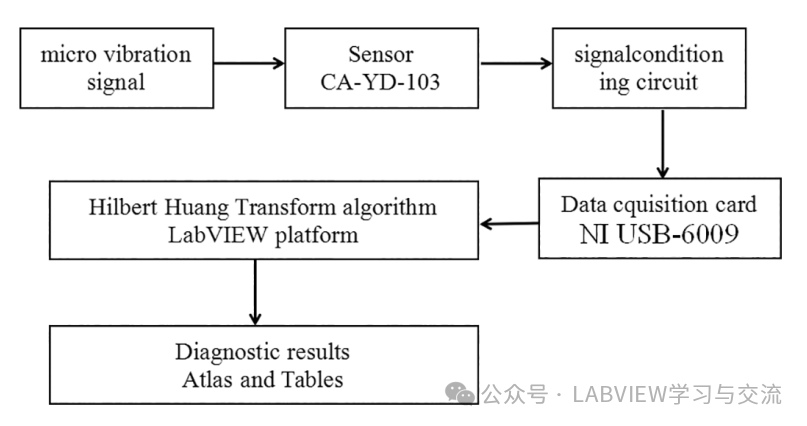
Figure 1: Sensor Structure[1]
-
Simulation Layer: The Proteus platform simulates the vibration signal generation circuit, and Multisim designs the filtering and amplification circuit, reducing hardware trial-and-error costs;
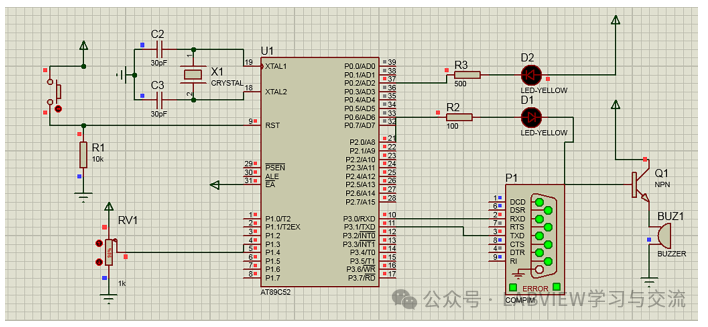
Figure 2: Signal Acquisition Module Simulation Circuit[1]
-
Software Layer: LabVIEW is used for real-time data display (raw waveforms, filtered results, time-frequency analysis) and storage. The key technology employed is the Hilbert-Huang Transform (HHT) — through Empirical Mode Decomposition (EMD), the signal is decomposed into different frequency Intrinsic Mode Functions (IMF), and then the Hilbert Transform generates a three-dimensional time-frequency spectrum, accurately extracting fault features;
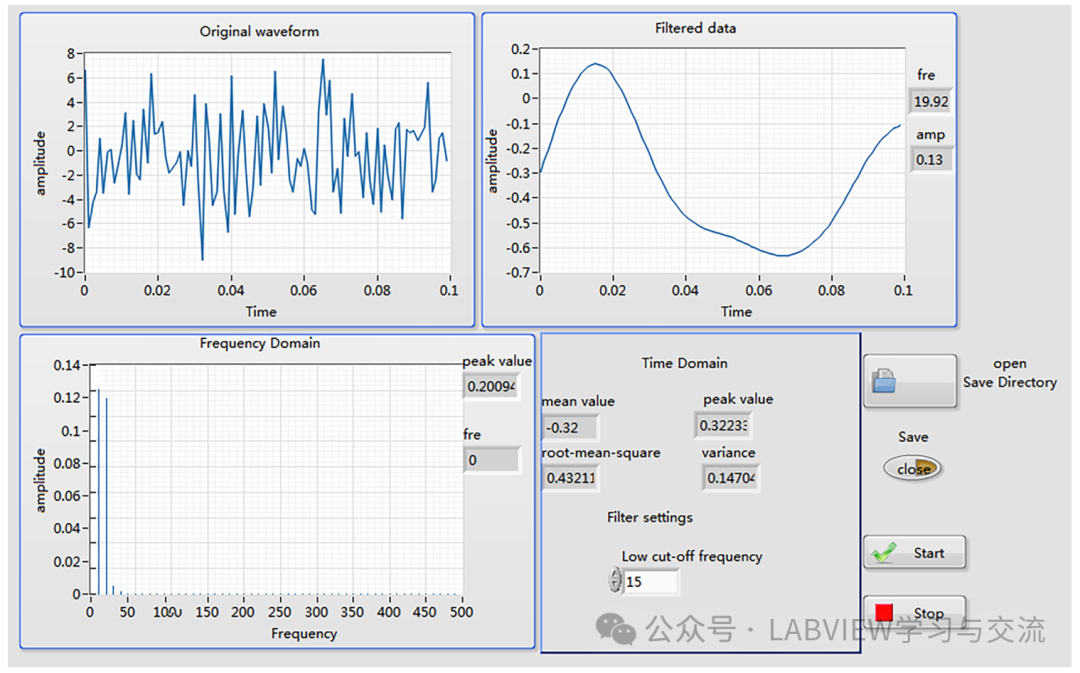
Figure 3: LabVIEW Software Control Interface[1]
-
Transmission Layer: IIoT enables remote data sharing and cloud monitoring, forming a complete process of “collection – processing – analysis – early warning.”
3. Experimental Results and Performance Verification
The system has demonstrated excellent performance through simulation and laboratory validation: it can stably detect low-frequency micro-vibration signals at 10-11Hz, with FFT analysis showing the highest spectral peak at 10Hz (0.7539); after EMD decomposition, the IMF components clearly distinguish frequency differences, providing a basis for fault diagnosis; it also possesses high detection accuracy, strong anti-interference capability, and low load effects, enabling cross-scenario remote monitoring through IIoT.
References:
[1]Wu R, Yang Z. Research on an Industrial IoT‐Enabled Pipeline Micro‐Vibration Detection System Based on LabVIEW and Proteus[J]. Internet Technology Letters, 2025, 8: 1-6. https://doi.org/10.1002/itl2.70149.