Agents need access to data, tools, and the ability to share information across systems, with outputs that can be utilized by multiple services—including other agents. This is not merely an AI issue, but rather a problem of infrastructure and data interoperability. It requires a data-driven Event-Driven Architecture (EDA), rather than just a series of commands linked together.
As a classic distributed system design paradigm, Event-Driven Architecture (EDA) is experiencing a renaissance in the age of artificial intelligence. This article will comprehensively explore the necessity of integrating EDA with AI agents, the technical implementations, industry applications, and future trends, revealing how this architectural combination is reshaping the design and implementation of intelligent systems.
The Necessity of Combining Event-Driven Architecture with AI Agents
The combination of Event-Driven Architecture (EDA) and AI agents is not coincidental, but rather an inevitable intersection of the evolution of distributed systems and the development of artificial intelligence. This integration is underpinned by profound technical logic and the demands of the times.
Continuation of Distributed System Evolution. The microservices architecture has undergone a transformation from synchronous calls to event-driven approaches over the past decade, and this history is being replayed in the field of AI agents. Early microservices communicated through direct API calls, but as system scale increased, this tightly coupled approach led to complex dependency chains and system fragility. Event-driven architecture decouples through asynchronous messaging, greatly enhancing system resilience and scalability. Today, multi-agent systems are facing similar challenges—when the number of agents increases and interaction complexity rises, direct request/response patterns quickly become bottlenecks. Just as microservices evolved from tightly coupled APIs to event-driven architectures, AI agent systems must follow the same evolutionary path, which is an inherent law of distributed system development.
Essential Needs of AI Agents. AI agents fundamentally differ from traditional software; they possess autonomy, reactivity, and social characteristics. A true AI agent is not a passive tool waiting for instructions, but an intelligent entity capable of perceiving environmental changes, autonomously planning, and taking action. This essential characteristic aligns naturally with the “event-reaction” model of event-driven architecture. In event-driven systems, components interact by producing and consuming events without a centralized control flow, which is precisely the collaborative method required by multi-agent systems. Furthermore, the decisions made by AI agents are inherently uncertain; the same input may lead to different outputs, and this randomness necessitates a robust underlying architecture capable of fault tolerance and asynchronous processing, which event-driven architecture precisely meets.
Maturity of the Technical Ecosystem. Messaging queue technology has evolved over more than 20 years, transitioning from early closed-source systems like IBM MQ to cloud-native distributed messaging platforms such as Kafka and Pulsar, which feature high throughput, low latency, persistence, and elastic scalability. At the same time, AI agent frameworks like AutoGen and Google’s A2A protocol are beginning to adopt message-driven communication patterns. The maturity of these two technological trends provides the infrastructural support for the deep integration of EDA and AI agents. In particular, next-generation messaging platforms like Apache Pulsar, with features such as multi-tenant isolation and stateless brokers, can meet the special needs of AI agent systems in complex message processing, data isolation, and elastic scaling.
Industry Demand Driving Integration. In the process of digital and intelligent transformation across various industries, the demand for real-time response, elastic scaling, and complex collaboration is growing. Whether in real-time fraud detection in finance, equipment collaboration in smart manufacturing, or multi-system interactions in smart cities, AI agents must quickly perceive environmental changes and respond collaboratively. Traditional polling or synchronous calling architectures struggle to meet the timeliness and elasticity requirements of these scenarios, while event-driven AI agent systems can elegantly and naturally address these issues.
Just as microservices architecture resolved scalability issues through EDA, AI agent systems will inevitably undergo similar architectural evolution. This combination is not a simple technical overlay, but a necessary choice for distributed system design in the intelligent era, laying the foundation for building large-scale, highly elastic, and adaptive artificial intelligence systems.
Technical Implementation and Architectural Design
Integrating event-driven architecture with AI agent systems requires careful technical design and architectural planning, involving innovations across multiple levels, including communication patterns, system components, and collaboration mechanisms. Below, we delve into the key technical elements necessary for achieving this integration.
Core Architectural Components
An event-driven AI agent system consists of several key components that form an organic whole, with each component playing an irreplaceable role:
- Event Producers: In AI agent systems, event producers are typically agents that perceive environmental changes, interfaces that receive user inputs, or sensors that monitor business status. These components are responsible for converting state changes into structured event messages. For example, in the chip design process, when a physical verification agent detects a design rule violation, it generates a “design error detection” event; in a smart home scenario, a motion sensor can produce a “room occupancy status change” event. The key to designing event producers lies in the standardization and richness of events; good events should contain sufficient contextual information for consumers to make correct decisions.
- Message Brokers: Serving as the central nervous system of the system, message brokers bear the heavy responsibility of event routing, persistence, and delivery guarantees. In modern AI agent systems, distributed message queues like Apache Pulsar and Kafka are preferred, providing high throughput, low latency, and strong persistence guarantees. In particular, Pulsar’s tiered storage and multi-tenant isolation features make it very suitable for large-scale multi-agent systems. Message brokers not only transmit events but also provide event buffering, load balancing, and retry mechanisms, ensuring that the system remains stable during peak loads and partial failures.
- Event Consumers: These are the AI agents that subscribe to the types of events they are interested in and execute corresponding processing logic upon receiving events. Unlike traditional services, AI agent consumers possess higher cognitive and decision-making capabilities. For instance, in chip design, an agent may subscribe to the “layout adjustment completed” event, subsequently triggering the physical verification process; in finance, a fraud detection agent listens for “large transaction” events and assesses risk in real-time. The design focus for consumers is on the idempotency and fault tolerance of processing logic, as the same event may be transmitted multiple times or reprocessed under exceptional circumstances.
- State Storage: This maintains the current state of agents and the system, supporting the event sourcing model. In this model, the system state is represented as the product of an ordered event log rather than traditional database records. This approach brings unique advantages such as “time travel” debugging and complete audit trails. When an AI agent needs to restore state or resolve inconsistencies, it can replay the relevant sequence of events. Siemens’ AI system employs a similar mechanism to ensure traceability and rollback capabilities for design changes.
Communication Patterns and Protocols
The event communication in AI agent systems requires carefully designed patterns and protocols to ensure efficient and reliable information exchange:
- Publish/Subscribe Pattern: This is the foundational communication paradigm for event-driven AI agent systems, allowing multiple agents to simultaneously receive and process the same event, achieving broadcast communication. For example, when the “chip simulation completed” event is published, the verification agent, power analysis agent, and performance evaluation agent can work in parallel rather than sequentially waiting. This pattern greatly enhances system throughput and response speed, serving as the key to loosely coupled collaboration among agents.
- Point-to-Point Queues: Used for directed task allocation and load balancing. When an event only needs to be processed by one agent (such as an optimization task for a specific design module), point-to-point queues can ensure an even distribution of workload. The UDA platform from Hanjian Technology adopts this hybrid model, featuring both broadcast event notifications and directed task queues.
- Event Bus: Serving as the communication backbone of the system, integrating different types of event channels. Advanced systems may adopt a layered bus design, where global events and local events propagate on different sub-buses to optimize network traffic and reduce interference. The Agent Foundry platform from Cadence connects AI agents across design, simulation, and verification through a unified event bus.
- Protocol Standardization: AI agent systems require unified event protocol definitions, including common fields (such as event ID, timestamp, source), specific domain extensions, and metadata specifications. The Model Context Protocol (MCP) provides a good reference in this regard, defining the standard format and semantics for information exchange between agents. Standardized protocols ensure that agents from different sources and at different times can understand each other, forming the basis for building an open agent ecosystem.
Control Flow and Error Handling
Introducing AI agents into event-driven architecture necessitates rethinking and innovating traditional control flow and error handling patterns:
- Reactive Control Flow: In event-driven AI agent systems, control flow is dynamically driven by events rather than predefined static processes. An event triggers actions from certain agents, which in turn generate new events, forming a chain reaction. This “event-action-new event” chain constitutes the system’s dynamic control flow. For example, in chip design, the “RTL code generation completed” event may trigger the verification agent to start working, and the verification results (whether successful or failed) will trigger corresponding actions from downstream agents. This dynamism allows the system to adapt to unpredictable workflow branches, handling exceptional situations more elegantly.
- Intelligent Error Handling: Combining AI’s anomaly detection and self-healing capabilities. Traditional systems rely on predefined error handling routines, while AI agents can analyze error patterns and generate contextualized remediation strategies. When processing fails, agents can not only retry or roll back but also attempt alternative solutions or dynamically adjust workflows.
- Compensating Transactions: For scenarios requiring transactional consistency, AI agent systems can adopt the Saga pattern, breaking long transactions into a series of compensable local transactions. Each local transaction is handled by a specific agent, triggering a compensation process upon failure. Unlike hardcoded compensation logic, AI agents can dynamically determine appropriate compensation strategies based on context, enhancing the system’s final consistency guarantees.
- Deadlock Detection and Resolution: Multi-agent systems may encounter circular waiting or resource deadlocks. AI agents can monitor event flows and resource allocation patterns to identify potential deadlocks and proactively intervene to resolve them. For instance, by analyzing the event dependency graph, coordinating agents can detect circular dependencies and inject decoupling events to break the deadlock.
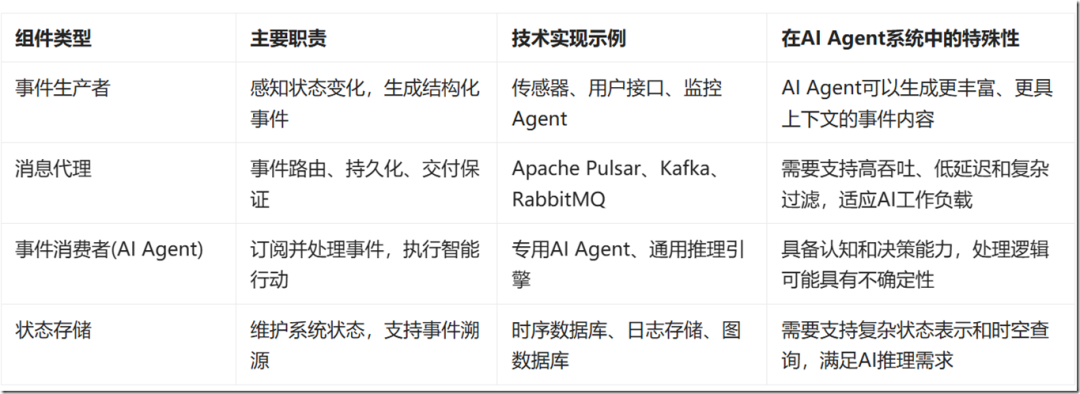
By carefully designing these architectural components and interaction patterns, event-driven architecture can provide the necessary resilience, scalability, and adaptability for AI agent systems, enabling agents to collaborate effectively in complex, dynamic environments. This technological integration not only inherits the advantages of event-driven architecture in traditional distributed systems but also endows the system with a higher level of autonomy and intelligence through the introduction of AI.
Industry Applications and Typical Cases
The combination of event-driven architecture and AI agents has already demonstrated transformative potential across multiple industries, from semiconductor design to smart manufacturing, from fintech to smart cities. This technological integration is reshaping the operational methods of various sectors. Below, we delve into several representative application areas and typical cases.
Intelligent Transformation in Electronic Design Automation (EDA)
The electronic design automation field is undergoing a profound transformation driven by AI agents, with event-driven architecture serving as the key technological foundation for this change. The complexity of modern chip design is growing exponentially, while design cycles continue to compress, making traditional EDA toolchains increasingly inadequate. The introduction of AI agents is shifting EDA from a “tool-assisted” model to an “autonomous collaboration” model, with event-driven architecture acting as the nervous system for multi-agent collaboration.
In EDA workflows, different types of AI agents collaborate through events: after the RTL generation agent completes code design, it publishes an “RTL completed” event, prompting the verification agent to initiate the verification process; when the physical implementation agent detects a design rule violation, it publishes a “DRC error” event, and the optimization agent responds to this event for automatic layout adjustment. This event-driven collaboration model breaks the traditional “manual relay” style of information transfer in EDA processes, making the entire workflow real-time, traceable, and collaborative.
More advanced EDA applications have entered the “multi-agent concurrent optimization” phase. In this model, design clusters composed of multiple independent agents work in parallel—some seeking the lowest power consumption solutions, others optimizing area utilization, and still others attempting breakthrough structural designs. These agents publish their respective optimization results through events, and coordinating agents comprehensively evaluate to select the best solution or merge plans. Hanjian Technology’s UDA platform employs a similar approach, generating multiple RTL code solutions with different PPA (power, performance, area) characteristics concurrently within hours, a task that previously took weeks to complete. This “design as search” concept brings exponential efficiency improvements.
Siemens’ AI-enhanced EDA toolset also reflects the value of event-driven architecture. Its Aprisa AI software can adaptively optimize the PPA of a given design, Calibre Vision AI can intelligently identify and rectify design violations, and Solido generative AI revolutionizes the custom IC design and verification process. These AI components collaborate through NVIDIA NIM microservices and a message bus, achieving intelligent automation of the entire EDA workflow. As demonstrated by Siemens, event-driven architecture enables EDA AI systems to organically integrate capabilities such as natural language understanding, generative design, and multi-objective optimization, resulting in an order-of-magnitude increase in productivity for chip design.
Smart Manufacturing and Industrial IoT
In the field of smart manufacturing, event-driven AI agent systems are reconstructing factory operations and production management models. Modern manufacturing environments consist of numerous sensors, devices, and control systems, generating vast amounts of events that require real-time processing and intelligent responses, which is precisely where event-driven AI agents come into play.
A typical case on industrial production lines is anomaly detection and dynamic scheduling. When sensors detect that equipment temperature exceeds a threshold, they publish a “temperature anomaly” event; the diagnostic agent receives this event and analyzes potential causes, while the maintenance agent assesses whether downtime for repairs is necessary; simultaneously, the production scheduling agent dynamically adjusts production plans based on equipment status. This event-based collaboration enables the system to respond quickly to anomalies, minimizing production interruptions. Applications from Siemens Digital Industries Software demonstrate that this architecture can reduce problem response times by over 50%, while also decreasing unnecessary preventive maintenance.
A more revolutionary application is the combination of “digital twins + AI agents.” The real-time status of physical factories is synchronized to digital twin models through event streams, with multiple AI agents analyzing these events and optimizing production parameters. These optimization suggestions are then fed back to the physical system through events, forming a closed-loop control. Cadence’s Agentic AI platform has been applied in such digital twin scenarios, achieving intelligent manufacturing through event-driven architecture.
Fintech and Risk Management
The financial industry’s high demands for real-time performance, accuracy, and security make event-driven AI agent systems an ideal choice. In the rapidly changing financial markets, traditional batch processing or polling models struggle to meet the need for instant decision-making, while event-driven architecture can respond to market changes in milliseconds.
Fraud detection is a typical application scenario. When payment systems generate a “large transaction” event, multiple AI agents work collaboratively: the risk scoring agent assesses transaction risk indicators, the user behavior agent analyzes cardholder historical patterns, and the location agent checks the reasonableness of the transaction location. These agents share information through the event bus, ultimately allowing the decision agent to determine whether to block the transaction. Compared to traditional rule engines, this architecture not only responds faster but also continuously optimizes detection models through machine learning.
Portfolio management also benefits from this technology. Market data changes (such as stock price fluctuations and interest rate adjustments) are published as events, with AI agents analyzing these events’ impacts on portfolios and suggesting strategy adjustments. Advanced systems even deploy competitive agents, some pursuing high-risk, high-reward strategies, while others prefer stable returns, balancing portfolios through an event-driven “co-opetition” mechanism.
Smart Cities and Public Management
Smart cities are a natural application scenario for event-driven AI agent systems. The vast number of events generated during city operations—from traffic flow changes to environmental monitoring data, from public safety incidents to infrastructure status—require real-time processing and collaborative responses.
Intelligent traffic management showcases the power of this architecture. Events generated by traffic lights, cameras, and vehicle sensors are analyzed in real-time by AI agents to optimize signal timing. During peak hours, the system automatically extends green light durations; when accidents or congestion are detected, it dynamically adjusts the signal lights at surrounding intersections to divert traffic. More advanced systems, such as those supported by Cadence, are already capable of handling complex demands in cutting-edge fields like 3D ICs and electric vehicles.
Public safety is another important application. When security cameras detect abnormal behavior, they publish a “safety event” that triggers a series of responses: access control agents automatically close relevant entrances and exits, patrol agents dispatch the nearest security personnel, and monitoring agents track the movement of suspicious targets. This collaboration reduces the response time of traditional security systems from minutes to seconds, significantly enhancing urban safety levels.
Healthcare and Remote Monitoring
In the healthcare sector, particularly in remote patient monitoring, event-driven AI agent systems are proving to be immensely beneficial. Physiological indicators generated by medical IoT devices are processed as event streams by multiple AI agents, enabling real-time health monitoring and early warning.
Typical cases include ECG monitoring. When devices detect arrhythmias, they publish a “cardiac anomaly” event, triggering a series of responses: alert agents notify medical personnel, medical record agents retrieve patient history, and diagnostic agents provide preliminary analysis suggestions. This integrated system allows medical teams to respond more quickly to critical situations, improving treatment success rates.
Chronic disease management also employs a similar architecture. Daily monitoring data from patients (such as blood sugar levels and blood pressure) trigger analyses and suggestions from AI agents. Siemens’ collaboration with NVIDIA on healthcare solutions demonstrates how event-driven architecture and AI technology can achieve personalized health management and treatment recommendations.
Table: Comparison of Industry Applications of Event-Driven AI Agent Systems
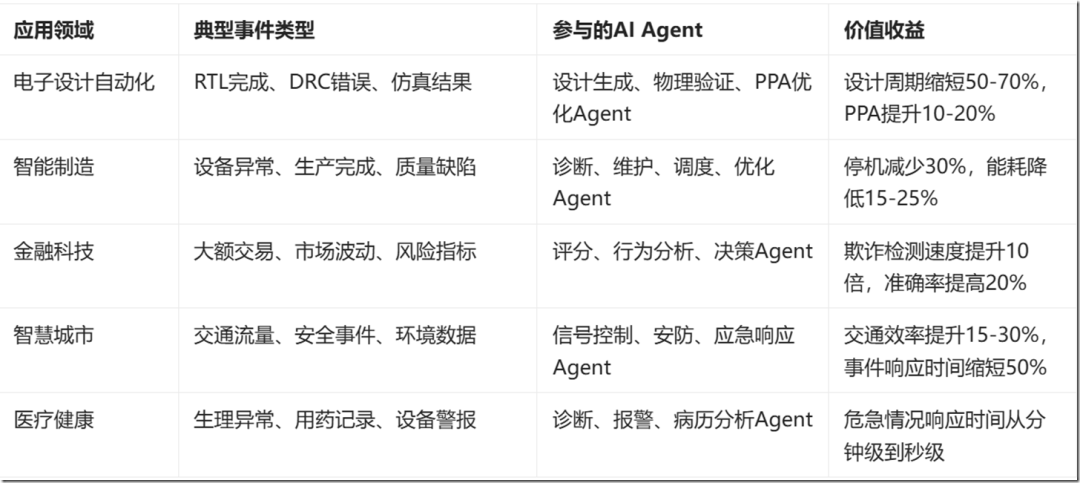
These industry applications demonstrate that the combination of event-driven architecture and AI agents is not merely a theoretical concept, but a technological paradigm that has already generated practical value across multiple fields. From semiconductor factories to city streets, from financial transactions to medical monitoring, this technological integration is redefining the design and implementation of real-time intelligent systems. As more industries recognize the limitations of traditional architectures and the advantages of event-driven AI agent systems, we can anticipate this model will flourish in even broader domains.
Advantages and Challenges
The combination of event-driven architecture and AI agents brings a series of significant advantages, while also facing non-negligible technical challenges. Objectively understanding these advantages and challenges is crucial for the correct design and implementation of such systems. Below, we analyze these aspects from two dimensions: value benefits and implementation difficulties.
Architectural Advantages
Loose Coupling and Modularity. Event-driven architecture fundamentally decouples system components, allowing AI agents to be developed, deployed, and scaled independently. In this architecture, agents do not directly call each other but communicate indirectly through events, significantly reducing interdependencies among system parts. This loose coupling characteristic brings several practical benefits: different teams can develop their respective agents in parallel, as long as they adhere to a unified event protocol; updates or replacements of individual agents do not affect the entire system; the system can evolve gradually, with the addition of new agents not requiring modifications to existing components. The success of Siemens’ EDA toolset demonstrates that this modular design enables enterprises to flexibly combine AI components from different vendors, quickly building customized solutions.
Resilience and Fault Tolerance. Event-driven architecture endows AI agent systems with stronger fault tolerance and resilience. The persistence mechanisms of message queues ensure that events are not lost; even if some agents are temporarily unavailable, events will be retained and reprocessed once the agents recover. This reliability is crucial for critical business applications. For instance, in financial trading systems, even if the risk assessment agent is briefly offline due to an upgrade, transaction events will not be lost and will continue processing once the agent is back online. Moreover, event-driven systems are more easily able to implement a “compartmentalization” model, isolating local failures within specific components to prevent cascading failures. Cadence’s Agentic AI platform utilizes this resilience mechanism to ensure that a failure in one AI tool during the chip design process does not interrupt the entire design workflow.
Real-Time Response and Agility. Event-driven architecture enables AI agents to respond instantly to state changes rather than passively polling. This real-time capability is critically valuable in time-sensitive application scenarios. In fraud detection cases, the delay from transaction occurrence to risk assessment directly relates to the success or failure of preventing fraud. The event-driven model minimizes this delay, as risk agents can immediately respond to transaction events. Similarly, in smart manufacturing, real-time processing of equipment anomaly events can minimize production downtime. Hanjian Technology’s UDA platform demonstrates how event-driven architecture can achieve instant verification and feedback of RTL code, reducing what traditionally required hours of manual checks to minutes.
Scalability. Event-driven architecture is inherently suitable for distributed deployment and horizontal scaling, perfectly matching the needs of AI agent systems. The message queue acts as a buffer layer, smoothing out peak loads, while backend processing agents can dynamically scale based on load. This scalability in practical business means: during promotional periods, e-commerce systems can quickly increase the number of inventory and recommendation agent instances to handle traffic surges; chip design companies can elastically scale the computational resources of EDA AI agents during project peaks. Cadence’s AI platform adopts this elastic architecture, supporting clients in dynamically adjusting resources based on project needs to maximize cost-effectiveness.
Collaborative Synergy. Event-driven architecture allows multiple AI agents to collaboratively solve complex problems in a complementary manner, producing an effect where the whole is greater than the sum of its parts. In EDA design, agents with different expertise (front-end design, physical implementation, power analysis, etc.) share their progress and findings through events, collectively advancing design optimization. This collaborative model transcends the cognitive limitations of human experts or single AI models, finding better solutions through collective intelligence. As the CTO of Hanjian Technology stated, multi-agent collaboration in the UDA platform “not only significantly improves the accuracy of RTL code generation but also innovatively advances the QoR exploration window to the architectural design stage.”
Implementation Challenges
Event Storms and Complexity Management. As system scale increases, the types of events and interaction paths may grow explosively, leading to what is known as an “event storm”—where the system struggles to understand and manage the intricate event flows. When hundreds of AI agents interact through events, tracking event origins, analyzing impact ranges, and debugging issues become extremely challenging. The EDA field has already encountered such problems, where complex chip design processes involve dozens of tools and hundreds of event types, making it crucial to maintain system comprehensibility and maintainability. Solutions include establishing comprehensive event classification and metadata standards, using event lineage tracking tools, and implementing robust monitoring and logging mechanisms.
Consistency and Race Conditions. In distributed AI agent systems, due to the asynchronous nature of event delivery and processing delays, different agents may make decisions based on inconsistent system views, leading to race conditions and state conflicts. For example, in smart manufacturing scenarios, inventory agents and order agents may simultaneously process different event streams, potentially leading to overselling in the absence of coordination. Traditional distributed systems resolve such issues through transactional mechanisms, but in event-driven AI agent systems, defining transaction boundaries is more challenging and costly. Current industry explorations include: adopting event sourcing models to maintain a single source of truth; using conflict resolution agents to detect and reconcile inconsistencies; and designing eventual consistency models to adapt to business needs. Cadence’s engineering intelligence platform ensures that AI agent decisions are based on consistent design constraints and physical rules through a combination of “physical simulation and computational optimization engines.”
Testing and Verification Complexity. The decisions made by AI agents often exhibit non-determinism, while the behavior of event-driven systems heavily relies on timing and environmental states, making traditional testing methods less effective. Verifying the behavior of a system composed of multiple AI agents interacting through events under various conditions becomes a significant challenge in engineering practice. Siemens EDA addresses this challenge by employing digital twin technology to construct a virtual EDA environment for testing AI agent interactions across various design scenarios. Other methods include: using formal methods to verify key event contracts; implementing chaos engineering to test system fault tolerance; and establishing rich replay test suites to validate agent responses to historical events.
Skills and Cultural Transformation. Successfully implementing event-driven AI agent systems requires not only technological changes but also corresponding shifts in team skills and organizational culture. Traditional developers need to master new skills in distributed systems, event modeling, and AI coordination; operations teams must adapt to monitoring and troubleshooting centered around events rather than services; and management must understand and accept the non-determinism and emergent behaviors of the system. Experiences from the EDA industry indicate that the most successful transformations occur in enterprises that invest in both technological infrastructure and personnel capabilities. As Cadence’s CEO Devgan stated, “AI agents are just the first layer of the cake,” requiring the layering of engineering practices, organizational adjustments, and talent development to truly realize their value.
Cost and Return on Investment. Building event-driven AI agent systems requires significant upfront investments, including messaging infrastructure, monitoring tools, testing frameworks, and talent training. While long-term benefits can be substantial, measuring and ensuring return on investment becomes a key consideration for corporate decision-making. Cases from EDA giants like Cadence and Siemens show that such investments can lead to significant order growth and customer value—Cadence reported a backlog of $6.4 billion after adopting Agentic AI, with a cRPO of $3.1 billion; Siemens’ EDA AI tools helped clients reduce tape-out times by threefold and improve PPA by 10%. However, for resource-limited enterprises, especially startups, careful planning of technological routes is necessary to balance short-term needs with long-term architectural visions.
The combination of event-driven architecture and AI agents presents unprecedented opportunities while posing significant engineering challenges. Understanding the essence of these advantages and challenges helps us more rationally assess the applicability of this technological integration and make informed design trade-offs in specific implementations. Just as microservices architecture matured through years of practice, event-driven AI agent systems will also require ongoing exploration and experience accumulation within the industry. Pioneers in the EDA field have already demonstrated the feasibility of this path, providing valuable references for other industries.
Future Trends and Development Directions
The integration of event-driven architecture and AI agents has already shown transformative potential, but this technological evolution is far from reaching its endpoint. Based on the current technological landscape and industry practices, we can foresee several key development trends and innovative directions that will reshape how enterprises build and deploy intelligent systems.
The Rise of Engineering Intelligence Platforms
From Dedicated Agents to Engineering Intelligence Platforms. Current AI agent applications are mostly task-specific or vertical, such as Cadence’s chip design agents or Siemens’ EDA optimization agents. In the future, more general engineering intelligence platforms will emerge, deeply integrating event-driven architecture, physical simulation engines, and AI agent capabilities to support cross-domain engineering decision-making and optimization. The core features of such platforms will embed the constraints and laws of the real physical world into event processing workflows, ensuring that AI agent decisions are based not only on data patterns but also on physical laws and engineering principles. As Cadence’s CEO emphasized, “Only by layering real physical simulation and computational optimization engines can AI truly ‘work.'” This engineering intelligence platform will become the core brain of Industry 4.0 and digital twins, coordinating the entire lifecycle from product design to manufacturing operations.
Advancements in Multimodal Event Processing. Future event-driven AI agent systems will handle a richer variety of event types, including video streams, 3D point clouds, and multi-physical field simulation data. This necessitates fundamental upgrades to messaging infrastructure and event processing engines. Next-generation messaging systems like Apache Pulsar have already begun to support native processing and routing of complex data types. Meanwhile, event protocol standards such as the Model Context Protocol (MCP) will evolve to accommodate richer semantic annotations and domain knowledge, enabling AI agents to understand deep correlations across multimodal events. For instance, in smart manufacturing scenarios, events from vibration sensors, thermal imaging, and acoustic sensors of the same device can be correlated for more accurate fault predictions.
Continuous Evolution of Architectural Patterns
Integration of Event-Driven and Blackboard Architectures. Event-driven architecture and blackboard systems are two classic paradigms of AI systems, each with its advantages. Future systems may organically combine the two: the event-driven mechanism will be responsible for real-time state change propagation and rapid response, while the blackboard system will maintain a shared knowledge base and long-term reasoning context. In this hybrid architecture, AI agents will be both producers/consumers of events and contributors/users of blackboard knowledge, forming a dynamic knowledge evolution system. This is particularly valuable for scenarios requiring long-term knowledge accumulation and complex reasoning, such as medical diagnosis and scientific discovery. The EDA field has already shown this trend, as Hanjian Technology’s UDA platform supports both event-driven real-time collaboration and maintains a shared design knowledge base for AI agents to reference.
Inspiration from Decentralized Autonomous Organizations (DAOs). The most cutting-edge explorations may arise from the integration of multi-agent systems with blockchain and decentralized autonomous organization concepts. In this architecture, AI agents become autonomous decision-making entities, broadcasting intentions and actions through events, with smart contract mechanisms coordinating resource allocation and conflict resolution. This model is particularly suitable for cross-organizational collaboration scenarios, such as supply chain optimization or multi-enterprise design collaboration. Cadence’s AI platform has already been adopted by top clients like TSMC and Samsung for complex designs like 3D ICs, and it may evolve into a more decentralized collaboration model, allowing design agents from different enterprises to securely and controllably share events and knowledge.
Comprehensive Enhancement of Intelligence Levels
Emergence of Self-Evolving Systems. Current event-driven AI agent systems, while possessing some learning capabilities, still operate on static designs for overall architecture and interaction patterns. Future systems will exhibit stronger self-evolution capabilities: they will be able to automatically adjust agent topologies based on event flow patterns, dynamically optimize event routing strategies, and even autonomously introduce new types of agents to address emerging needs. This self-evolution capability will enable systems to adapt to ever-changing business environments, maintaining high efficiency and reliability. The concept of “AI clusters” in the EDA field has already hinted at this direction—groups of independent agents can parallelly explore different design spaces and dynamically adjust exploration strategies based on feedback.
Enhanced Causal Reasoning and Explainability. As AI agents are increasingly applied in critical task systems, the demand for the explainability of their decisions will grow. Future event-driven architectures will not only transmit state change events but will also carry causal explanations and decision bases. Each event may be accompanied by rich metadata explaining its origin and expected impact; after processing events, AI agents will also generate explanatory events that document decision logic and reasoning chains. This enhanced event lineage mechanism will provide a solid foundation for system debugging, compliance auditing, and continuous improvement. Siemens’ EDA AI system has already begun to implement such capabilities, with its event logs capable of tracing the complete decision-making process behind design changes.
Reconstruction of Industry Ecosystems
Cross-Industry Migration of EDA Experience. As a pioneer in event-driven AI agents, the EDA industry’s experiences and lessons will provide valuable references for other sectors. In the coming years, we can anticipate that industries such as manufacturing, finance, and healthcare will draw on the mature practices of the EDA field to accelerate their own intelligent transformations. Notably, the EDA evolution path from “assistance to autonomy”—where early AI served as tools to enhance specific tasks, mid-stage development led to autonomous agents coordinating multiple links, and ultimately forming complete workflows dominated by multi-agent collective intelligence—may become the standard intelligent transformation roadmap for other complex engineering fields.
Development of Open Source Ecosystems and Standard Protocols. Currently, event-driven AI agent systems are often built on proprietary technology stacks from vendors, such as Cadence’s JedAI and Siemens’ EDA AI system. As technology matures, more open-source components and standard protocols will emerge, lowering the barriers for enterprises to adopt these technologies. Open-source messaging systems like Apache Pulsar have already begun enhancing support for AI workloads; standard protocols like the Model Context Protocol (MCP) will promote semantic interoperability between different agents. This open ecosystem will accelerate innovation, enabling more enterprises to build customized event-driven AI solutions. The collaboration between Hanjian Technology’s UDA platform and DeepSeek also signals this trend, integrating domestic large models and EDA tools to create open solutions.
Restructuring of Talent Roles and Skills. As event-driven AI agent systems take on more routine tasks, human roles will shift from executors to supervisors and coordinators. The EDA industry has already experienced this transition: “designers no longer need to plan out the entire structure at once but can select, merge, and evolve based on multiple candidate solutions provided by agents.” Future engineers will need to master new skills, including agent coordination strategy design, event flow pattern recognition, and guiding collective intelligence. Organizations will need to establish corresponding talent development systems and incentive mechanisms to maximize the collaborative value between humans and AI agents.
The integration of event-driven architecture and AI agents represents a paradigm shift, with impacts extending beyond the technical level to reshape industry competition patterns, corporate organizational forms, and talent demand structures. Enterprises that seize this trend early and systematically invest in related technologies and talent will gain significant competitive advantages in the wave of intelligence. Just as microservices architecture has reshaped application development methods, event-driven AI agent systems will redefine our methodologies for building and operating complex intelligent systems. This transformation has already begun, and its ultimate form remains to be explored and co-written by innovators.
References:
- Future AI Agents: Event-Driven + MCP: https://mp.weixin.qq.com/s/LH31sJOeAVdJXqeuXLh6aQ
- How AI Agents Will Revolutionize Electronic Design Automation (EDA): https://mp.weixin.qq.com/s/a8EQtViBdIlX-4kHKGDoRg
- Siemens: Leading the Way with the Launch of EDA+AI Toolset: https://mp.weixin.qq.com/s/KNYKn4iok6PLBTbX0C-eSQ
- Hanjian Technology Releases Digital Design AI Intelligent Platform UDA, Integrating DeepSeek to Build a Domestic One-Stop Intelligent EDA Platform: https://www.dianyuan.com/article/65647.html
- AI Agents Must Take Action, Not Wait: Event-Driven Multi-Agent Design Cases: https://mp.weixin.qq.com/s/K8Z9dIApqEQBfbYPNK6tKA