 The core of the self-powered 2D environmental monitoring sensor array is the collaboration of “energy harvesting – signal detection – array integration”. It autonomously collects environmental energy (such as mechanical energy, light energy, and thermal energy) through the piezoelectric, photoelectric, and thermoelectric properties of 2D materials, without the need for an external power supply. At the same time, it utilizes the high specific surface area and high sensitivity of 2D materials to achieve synchronous detection of multiple environmental parameters (such as humidity, gases, and heavy metal ions). In terms of material selection, mainstream 2D materials have their own strengths: The team led by Academician Wang Zhonglin from the Chinese Academy of Sciences confirmed that the piezoelectric coefficient d₃₃ of MoS₂ nanosheets reaches 30 pm/V, which can generate an open-circuit voltage of 1.2 V through environmental vibrations (such as wind speed of 5 m/s), meeting the power supply needs of the sensor; The team led by Peng Hailin from Peking University pointed out that the photoelectric conversion efficiency of Bi₂O₂Se 2D material reaches 28%, which can output a short-circuit current of 0.8 mA/cm² under weak indoor light (100 lx), suitable for photo-induced self-powering scenarios; The team led by Lin Yuanhua from Tsinghua University found that the thermoelectric figure of merit ZT of Ti₃C₂ MXene reaches 0.6 at 300 K, which can generate a voltage of 0.5 V using an environmental temperature difference (5 K), suitable for low-temperature difference energy harvesting.
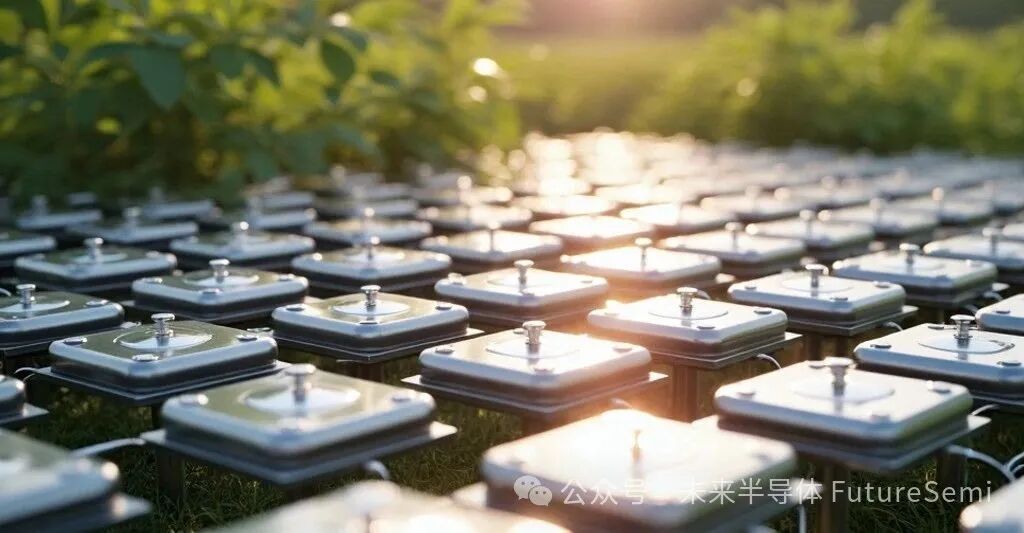 01Design and Performance Optimization of the Self-Powered 2D Environmental Monitoring Sensor ArrayIntegration Design of Energy Harvesting Unit and Detection Unit:The team led by Bao Zhenan at Stanford University constructed an integrated array of “graphene piezoelectric – humidity sensing”, using graphene nanoribbons to create comb-like electrodes. The piezoelectric voltage (0.3-0.8 V) is generated by the deformation of the graphene layers caused by changes in environmental humidity, while the resistance change of graphene detects humidity (detection range 10%-90% RH, response time 0.8 s). The energy self-sufficiency rate of the 16 units in the array reaches 95%, allowing continuous operation without an external power supply; The team led by Academician Huang Wei at Nanjing University of Technology designed a “MoS₂ photoelectric – gas sensing” array, where MoS₂ nanosheets serve as both the photoelectric generation layer and the gas-sensitive layer. Under visible light (500 nm, 10 mW/cm²), it outputs a voltage of 0.6 V and has a detection limit for NO₂ as low as 50 ppb, with response/recovery times of 12 s/18 s, and the signal consistency deviation of the array is less than 8%.Array Interconnection and Signal Anti-Interference Design:The team led by Liu Bin at the National University of Singapore developed a “2D material – flexible substrate” interconnection structure, using polyimide as the substrate and Ti₃C₂ MXene as the interconnection lines. The line resistance is only 0.5 Ω/cm, and after 1000 bends (with a bending radius of 3 mm), the resistance change rate is less than 3%, ensuring stable signal transmission among the 256 units in the array; The team led by Professor Fang Qun at Zhejiang University introduced a “differential detection” module in the sensor array, utilizing the selective response differences between graphene and WS₂ to eliminate temperature interference on humidity detection (the humidity detection error decreased from 15% to 3% when the temperature changed from 20-50℃), while cross-validation among array units improved the accuracy of distinguishing mixed gases (such as CO/NO₂) to 96%.Low Power Consumption and Long-Term Stability Optimization:The team led by Jeehwan Kim at MIT optimized MoS₂ sensors through “atomic layer doping”, doping single-atom Ni into MoS₂, reducing the operating current of the sensor from 100 μA to 5 μA. After soaking in a simulated industrial waste gas environment (containing SO₂, H₂S) for 30 days, the detection sensitivity retention rate reached 85% (50% for the undoped group); The team led by Academician Yu Shuhong at the University of Science and Technology of China coated the sensor array with an h-BN protective layer (5 nm thick). The chemical inertness of h-BN prevents environmental pollutants from eroding the sensors. Experiments showed that the coated array could continuously operate for 180 days in high humidity (95% RH) and high temperature (60℃) environments, with a signal drift of only ±4%, far lower than the ±15% of the uncoated group.
 02Typical Application Scenarios of the Self-Powered 2D Environmental Monitoring Sensor ArrayAtmospheric Environment Monitoring:The team led by Jung Seung-Min at Yonsei University deployed the “MXene thermoelectric – graphene gas sensing” array at urban air quality monitoring stations. The array can simultaneously detect PM₂.₅ (through synergistic detection of light scattering and resistance, detection limit 1 μg/m³), NO₂ (50 ppb), and O₃ (20 ppb), utilizing environmental temperature differences (8 K) and light (300 lx) for self-powering. The monitoring error is 92% consistent with commercial instruments (Thermo Fisher 49i), and the power consumption is only 1/50 of that of commercial instruments. The team led by Gu Zhongze at Southeast University developed the “Bi₂O₂Se photoelectric – gas sensing” array for industrial park waste gas monitoring, which can be powered by weak streetlight illumination (50 lx) at night, with a detection limit for VOCs (such as toluene) as low as 10 ppb, response time of 10 s, and can distinguish different types of VOCs with an accuracy of 90%.Water Environment Monitoring:The team led by Zhou Yong at Nanjing University constructed a “MoS₂ piezoelectric – electrochemical sensing” array, integrating the array on the surface of a buoy. It generates a voltage of 0.4 V using water wave vibrations (amplitude 5 cm) while detecting Pb²⁺ (detection limit 10 nM), Cu²⁺ (5 nM), and Cr⁶⁺ (20 nM). Through differential pulse voltammetry, it achieves synchronous quantification of multiple ions. In field monitoring in Taihu Lake, the deviation of data from laboratory ICP-MS results is less than 5%, and it can operate continuously for 30 days without maintenance; The team led by Academician Qu Jiuhui at the Chinese Academy of Sciences used a “graphene oxide – piezoelectric sensing” array for drinking water monitoring, which self-powers using pipeline water flow vibrations (flow rate 0.5 m/s) and has a detection limit for E. coli of 10 CFU/mL, response time of 20 min, and can stably operate in chlorinated disinfected water (residual chlorine 0.5 mg/L), avoiding interference from disinfectant components.Soil Environment Monitoring:The team led by Academician Ding Han at Huazhong University of Science and Technology buried a “black phosphorus photoelectric – electrochemical sensing” array in farmland soil, achieving self-powering through sunlight (1000 W/m²) and detecting soil pH (range 4-9, accuracy 0.1), moisture content (5%-40%, accuracy 1%), and heavy metal Cd²⁺ (detection limit 5 nM). After inserting the array’s probes into the soil, data can be transmitted to agricultural management platforms via wireless modules, with a monitoring cycle of 60 days without needing to replace the power supply, and the interference rate of soil particles on the sensor is less than 8%; The team led by Ye Xuanli at South China University of Technology designed a “Ti₃C₂ MXene thermoelectric – impedance sensing” array, which generates a voltage of 0.3 V using the day-night temperature difference in the soil (10 K) to detect organic pollutants (such as polycyclic aromatic hydrocarbons), with a detection limit as low as 1 μg/kg, and the detection error is less than 10% in different soil textures such as clay and sandy soil.03Existing Challenges and Future Directions of the Self-Powered 2D Environmental Monitoring Sensor ArrayCurrent research still faces three core challenges: First, insufficient energy harvesting efficiency. Studies show that in weak environmental energy scenarios (such as indoor weak light 50 lx, temperature difference 3 K), the energy output of existing 2D materials can only meet 30% of the power supply needs of the sensor array, resulting in a “power supply gap”; Second, cross-interference of multiple parameters. Experiments found that changes in humidity (from 20% to 80% RH) can cause a response deviation of 25% in MXene gas sensors, making it difficult to achieve precise synchronous detection of multiple parameters; Third, the bottleneck of long-term stability. Black phosphorus sensors buried in soil for 45 days showed a 50% decrease in detection sensitivity due to oxidative degradation, failing to meet long-term monitoring needs. Future research should focus on: developing “multi-energy coupling harvesting” technologies (such as piezoelectric – photoelectric – thermoelectric collaboration) to enhance energy output, designing “intelligent algorithms – selective material modification” dual strategies to suppress cross-interference, and constructing “self-healing 2D material systems” (such as MoS₂ composites with dynamic covalent bond repair) to extend service life, promoting the industrial application of self-powered 2D environmental monitoring sensor arrays in smart environmental protection, precision agriculture, and smart cities.


Statement: Compiled by Future Semi,Please contact: 18100126339 (same as WeChat)