PART.01【Introduction】
In recent years, mRNA therapy has gained significant attention for its ability to treat diseases caused by protein deficiencies or functional abnormalities through in vivo expression of specific proteins. This therapy is designed to be rapid, versatile, and cost-effective, showing great potential in the prevention and treatment of diseases such as cancer, COVID-19, and influenza. However, traditional linear RNA is quickly degraded by nucleases, leading to poor stability, high production costs, and limited long-term efficacy. In contrast, circular RNA exhibits higher stability due to the absence of free ends, making it resistant to enzymatic degradation and prolonging in vivo survival time. Additionally, it can achieve cap-independent translation through internal ribosome entry sites (IRES), making it a more promising mRNA therapeutic platform. Currently, in vitro circularization methods such as chemical, enzymatic, and ribozyme circularization techniques (e.g., PIE method) can be used for circular RNA preparation, but they still face issues such as low efficiency, high byproduct formation, and complex purification processes, especially for long-chain RNA, which limits their clinical applications.
PART.02【Results Overview】
Professor Liu Dongsheng from Tsinghua University, in collaboration with Researcher Dong Yuancheng from the Institute of Chemistry, Chinese Academy of Sciences, and Researcher Zhang Liang from the Hangzhou Medical Research Institute, published a research paper titled “A Computationally Optimized Ribonucleic Acid Circularization Strategy without Byproducts” in the Journal of the American Chemical Society. The paper reports a novel self-circularization strategy that minimizes byproduct formation and simplifies the purification process. This method is enhanced by a computational algorithm designed to improve the universality and efficiency of RNA circularization. In this study, the precursor RNA is generated by integrating the target RNA sequence with three circularization motifs (i.e., a promoter unit (purple), a lock unit (red), and a key unit (blue)). The promoter unit is located at the 5′ end of the RNA, forming a small stem-loop structure; the lock unit is adjacent to the promoter unit and is complementary to the key unit at the 3′ end of the RNA. During the annealing process, the hybridization of the key unit with the lock unit brings the 5′ and 3′ ends of the RNA close together, allowing the target RNA to be converted into mature circular RNA under the catalysis of RNA ligase.
PART.03【Illustrative Interpretation】
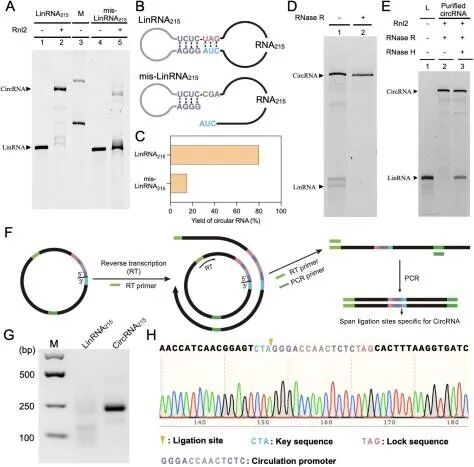 Figure 1| Results of RNA Self-Circularization. (A)Denaturing PAGE analysis of the self-circularization system. Lane 1: LinRNA215 with matching lock and key units; Lane 2: Connection system of LinRNA215; Lane 4: mis-LinRNA215 with mismatched lock and key units; Lane 5: Connection system of mis-LinRNA215; M: low molecular weight ssRNA ladder. (B)Schematic diagram of the structures of intermediates in LinRNA215 (top) and mis-LinRNA215 (bottom). In LinRNA215, the key and lock units achieve appropriate base pairing, allowing for efficient connection. In contrast, mis-LinRNA215 contains mismatched sequences that hinder effective base pairing, thus reducing circularization efficiency. (C)Yield of CircRNA215 calculated based on the band intensity in (A). (D)Results of RNase R treatment. Lanes 1/2: Circularization system without/with RNase R treatment. (E)Denaturing PAGE analysis of RNase H treatment. Lane 1: LinRNA215; Lane 2: Purified CircRNA215; Lane 3: Purified CircRNA215 treated with RNase H. (F)Schematic diagram of the RT-PCR process. RT primers (light green) are designed to reverse transcribe along the 5′ end direction of LinRNA215; PCR primers (dark green) are located at the 3′ end of LinRNA215, and the PCR product spans the specific connection site of CircRNA215. (G)Agarose gel electrophoresis analysis of RT-PCR products of LinRNA215 and CircRNA215. (H)Sanger sequencing of the product spanning the connection site in RT-PCR.
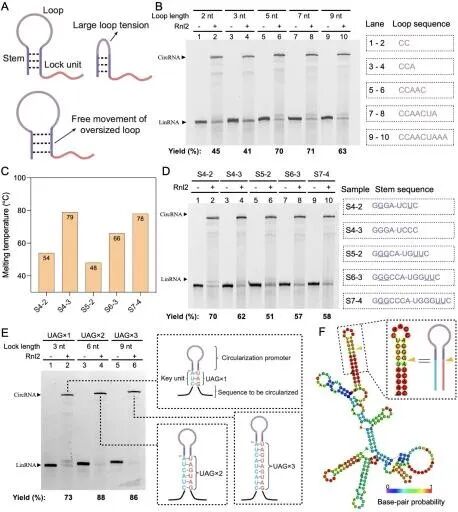
Figure 2| Impact of Circularization Motifs. (A)Schematic diagram of the stem-loop structure formed by the promoter unit. A loop that is too short increases loop tension and reduces folding efficiency, while a loop that is too long leads to suboptimal assembly. An appropriate loop length promotes accurate folding and efficient connection. (B)Effect of promoter unit loop length on circularization efficiency. (C)Effect of stem sequence on melting temperature. (D)Circularization efficiency under different stem sequences corresponding to (C). For SN-X, N represents the number of nucleotides in the stem sequence, and X represents the number of G-C base pairs. (E)Effect of key/lock unit length on circularization. The diagram shows the secondary structures of different key/lock units. (F)RNAFold prediction of the secondary structure of circular intermediates containing optimal circularization motifs. Yellow triangles indicate gap positions. The inset shows the secondary structure of the circularization motif designed reasonably.
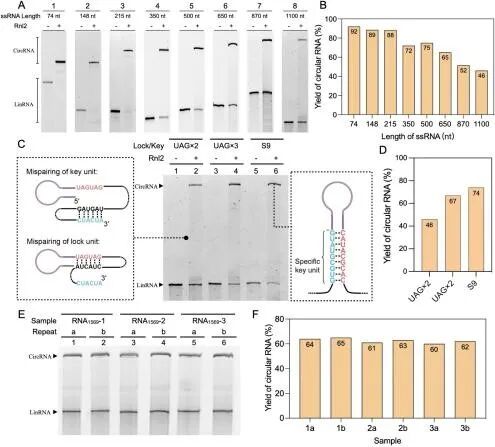 Figure 3| Optimizing the Circularization Process for Longer RNA. (A)Effect of RNA length on circularization efficiency. (B)Yield of circular RNA calculated based on the band intensity in (A). (C)Denaturing PAGE analysis comparing the circularization efficiency of LinRNA1100-UAG×2 (6 nt), LinRNA1100-UAG×3 (9 nt), and LinRNA1100-S9 (designed 9 nt lock-key pair). This scheme shows the mismatch effect of non-specific lock/key units and the expected secondary structure of specific lock/key units. (D)Yield of circular RNA calculated based on the band intensity in (C). (E)Denaturing PAGE analysis of circularization systems using three designed 1569 nt RNA sequences (1, 2, and 3) with two lock-key designs each. (F)Yield of circular RNA calculated based on the band intensity in (E).
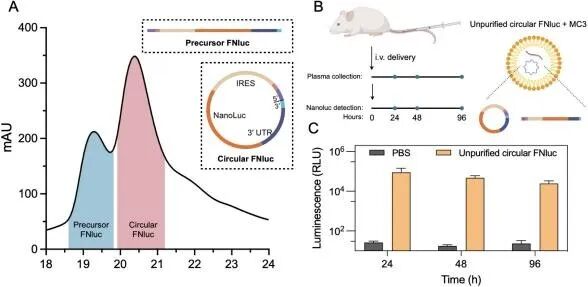 Figure 4| In Vivo Expression of Circular RNA. (A)Schematic diagram of precursor FNluc and circular FNluc, along with corresponding HPLC analysis results. (B)Schematic diagram of luminescence detection of NanoLuc in plasma at specified time points. Unpurified circular FNluc was prepared in solution with MC3 for intravenous injection in mice. (C)Detection of NanoLuc luminescence in plasma collected from mice injected with unpurified circular FNluc over 4 days.
PART.04【Conclusion and Outlook】
This study successfully developed a novel self-circularization strategy for circular RNA production, achieving efficient circularization of different lengths of RNA (up to 92% for 74 nt RNA and 68% for 2512 nt RNA) through carefully designed promoter, lock, and key units combined with computational algorithm optimization. This strategy does not require complex purification and does not produce byproducts, providing a robust platform for large-scale preparation of circular RNA. Experiments confirmed that the circular RNA produced exhibits more durable and efficient protein expression capabilities both in vitro and in vivo. This technology not only opens new pathways for the development of circular RNA drugs but also holds promise for advancing precision medical solutions targeting specific diseases due to its platform and versatility. Future optimizations through the integration of chemical modification techniques are expected to further enhance its stability and safety, indicating broad application prospects.
PART.05【Literature Link】
https://doi.org/10.1021/jacs.5c09798
PART.06【Team Introduction】

Liu DongshengProfessor
Department of Chemistry, Tsinghua University
Background:
1988.09-1993.07, University of Science and Technology of China, Bachelor
1999.05-2002.05, Hong Kong Polytechnic University, PhD
2003.02-2005.02, Department of Chemistry, University of Cambridge, Postdoctoral
2005.02-2009.05, Researcher, National Center for Nanoscience and Technology
2009.06-Present, Tsinghua University, “Hundred Talents Program”, Professor, Department of Chemistry
Research Interests:Mainly engaged in the assembly and application of nucleic acid nanostructures, including: (1) Construction and motion mechanism research of nucleic acid molecular machines; (2) Design, preparation, and application research of smart materials based on nucleic acid macromolecule assembly in biomedicine; (3) Biological function research of nucleic acid supramolecular structure assembly.
Editor: Chen Wenhui
Reviewer: Li Zhenzhen
Promoter: Gao Shuxin