Recommended Videos

The LGA packaging technology, known for its high density, high reliability, and excellent electrical performance, is becoming a popular choice in embedded product development. This article will quickly introduce the advantages of LGA packaging and share key points for mounting LGA core boards, helping you master the production process and create high-quality products.
 LGA PackagingLGA (Land Grid Array) is a surface mount packaging technology widely used in high-performance core modules and processors. Unlike traditional pin packages (such as QFP and DIP), LGA packaging uses a metal pad array on the bottom as electrical connection points instead of protruding pins. This design allows LGA packaging to have higher pin density, better electrical performance, and stronger mechanical stability.The main advantages of LGA technology include:
- Higher pin density: Suitable for high integration and high-performance chip designs.
- Better electrical performance: Pads are directly mounted on the PCB, resulting in shorter signal paths and less interference.
- Stronger mechanical reliability: The pinless structure reduces soldering issues caused by pin deformation or breakage.
- More suitable for automated production: LGA packaging is very suitable for SMT assembly processes, facilitating mass production.
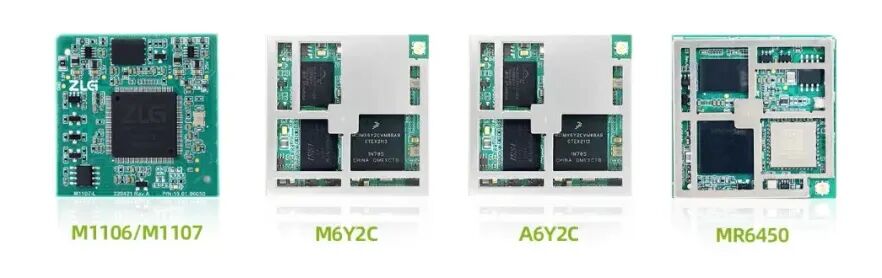
 Considerations for Mounting LGA Core BoardsIn actual production, LGA core boards, due to their packaging characteristics, typically cannot be completed through manual soldering and must rely on automated placement machines. To ensure mounting quality and product reliability, ZLG provides detailed LGA mounting guidance documents on its official website. Engineers should pay special attention to the following five aspects during the design and production process:1. Stencil DesignIt is recommended to use a stencil thickness of 0.12~0.15mm, and the stencil opening design should refer to the standards provided by the official source to ensure uniform and adequate solder paste printing.2. Pad DesignThis includes the design of the TOP layer pads and the opening design of the Solder Mask layer, which must be strictly followed according to official recommendations. The official source provides a complete AD package library, which is recommended for direct use to avoid poor soldering caused by self-modification.3. Storage RequirementsLGA core boards should be vacuum packed and stored in a constant temperature and humidity environment to prevent oxidation and moisture.4. Moisture SensitivityThe moisture sensitivity level of LGA core boards is level 3. Mounting should be completed within the specified time after unpacking; if the time limit is exceeded, baking treatment must be performed. The official guidance document provides detailed baking temperature and time requirements, which must be strictly followed.5. Reflow Temperature CurveThe reflow soldering temperature curve greatly affects the quality of LGA mounting. The official source provides recommended reflow temperature curve parameters, and it is advised to strictly follow this curve for reflow soldering to achieve the best soldering results. LGA Core BoardsAs of now, ZLG has launched a total ofM1106/M1107,M6Y2C, A6Y2C and MR6450, totaling 11 models of LGA form factor embedded core boards, covering different processor architectures such as ARM9, A7, and RISC-V, widely used in industrial control, IoT, smart terminals, and other fields, fully meeting the diverse needs of the market.
 ZLG will continue to deepen technological innovation in the future, committed to providing customers with more efficient, economical, and reliable embedded solutions to assist in rapid product launch and stable operation.In the product development process, LGA packaging technology, due to its high density, high reliability, and excellent electrical performance, has become an important choice in modern electronic product development. To ensure the mounting quality of LGA core boards during production, engineers must strictly follow the official mounting process guidance documents and standardize operational procedures.If you have any questions about the LGA mounting process, feel free to leave a message in the comments section, and we will respond promptly.
 |
Domestic High-Performance RISC-V Core BoardMR6450/6750 |
|
• 15 Serial Ports • 4 CANFD • 2 Gigabit
Long press to purchase |