Click the card below to follow Arm Technology Academy
This article is selected from the Jishu column “Arm Selection” and will briefly discuss how beginners can efficiently learn about Arm v8/Arm v9 architecture.
Do you want to get rich overnight? Have lots of money, buy many houses, have a relaxed job with no pressure, avoid coding and debugging, and have plenty of time to squander on CSDN? If that’s your thought, then just think about it. This article will not provide methods to achieve that ideal; it won’t touch on it at all.
This series of articles and videos focuses on guiding beginners (experts, please bypass) to avoid detours and pitfalls, helping you quickly become a leader in the industry, significantly increasing your salary and reaching the peak of your life. Whether or not you achieve it, it’s important to have goals. As long as you persist in continuous learning (not the kind of mindless cramming, but finding the right methods for efficient learning), I believe that in the future, even if you don’t reach the goals depicted in the images below, you can still earn some money, see a salary increase, or reduce work pressure.
Below is a high-efficiency learning roadmap for getting started with Arm v8/Arm v9 architecture, divided into six main stages. Let’s get started!
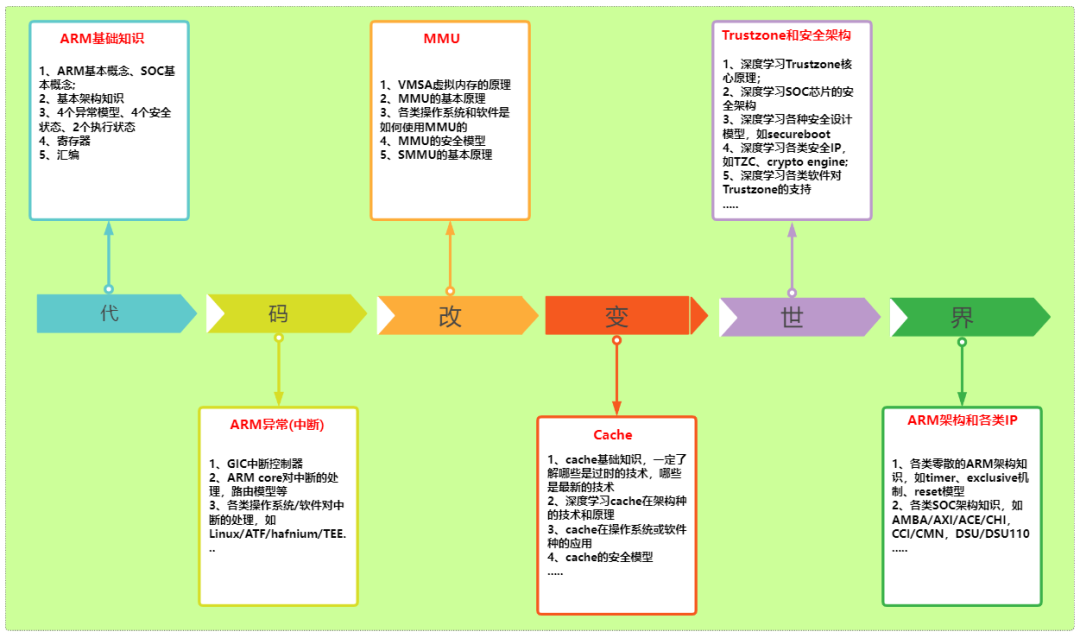
1. Learn Basic Knowledge of Arm
When learning this section, do not spend too much time and energy on learning assembly language. I believe that “those who learn assembly are just fooling around” and “those who learn assembly are slacking off.” Of course, I don’t mean to discourage you from learning assembly; rather, you don’t need to spend too much effort on it. Just understand a few dozen instructions and you’ll be fine—there’s no need to memorize them. The assembly instructions we commonly use are only a few dozen, and even if you don’t memorize them, you can still understand them. If you really want to be picky, Arm has thousands of instructions, including variants; can you memorize one and show me?
After reading this article or watching this video, you will find that I have condensed the entire assembly into one page… Many codes you don’t understand are not because you don’t know assembly or registers but because you don’t understand the architecture. Remember: what you don’t understand is not assembly or registers; it’s the architecture.
2. Learn Arm Exceptions (Interrupts)
Exception interrupts are not only the core of the entire Arm hardware and software architecture but also the soul of various operating systems. Once you master exception interrupts, you can self-learn many professional techniques; after mastering them, learning other knowledge points will be much easier. Therefore, I always advocate: learning security is essentially learning architecture, and the core of learning architecture is learning exception interrupts.
This section requires serious study, and it’s also simple; however, it will require a lot of time and effort to learn.
3. Learn MMU
Among all the hardcore modules, the MMU is relatively simple. Simple only means that the knowledge points are straightforward and easier to learn, but it plays an important role in the entire Arm architecture system. Therefore, many times, after learning MMU, you will feel a surge of confidence, thinking you can suddenly understand everything.
4. Learn Cache
Cache is not as simple as you might think, nor is it as straightforward as most articles online claim. Cache is really difficult. In software, opportunities to directly interact with Cache are extremely rare. Compared to other modules, this is the least worthwhile to study; learning this section will consume a lot of time and effort, and its direct benefit to work is minimal, making it a low cost-performance ratio. However, do you remember the goal at the beginning of this article? Isn’t it to become an architect? Isn’t it to reach the peak of life? So how can you showcase your technical prowess without learning Cache?
5. Learn TrustZone and Security Architecture
In front of TrustZone and security architecture, sections 1-4 are merely foundational. After learning MMU/Cache, do you think you’re already impressive?
It’s important to note that learning should not be skewed; this section is the core knowledge of Arm. Whether it’s Arm architecture, various Arm IPs, or large system software/operating system software, if you look closely, more than 30% are related to security. For example:
(1) Which feature in Arm architecture is unrelated to security? I’d say it’s not an exaggeration that 30% of Arm architecture involves security technology. (2) Look at the IPs; Arm’s GIC and Arm’s SMMU—don’t both have over 50% of content discussing security-related knowledge? (3) Look at large systems or operating system software; aren’t mainstream software architecture diagrams featuring secure OS? Don’t mainstream software include ATF? (4) Therefore, when you study other knowledge points, such as MMU/Cache, if they don’t mention security at all, then…
6. Learn Arm Architecture and Various IPs
The road ahead is long and arduous, and I will seek upward and downward. There is still so much knowledge to learn; keep going, friends!
Recommended Reading
-
A New Arm Comprehensive Computing Solution Realizing a Mobile Future Based on Arm Technology
-
Things You Didn’t Know About Arm v7/Arm v8/Arm v9 Architectures
-
In-Depth Analysis of the Exclusive Mechanism in Arm v8/Arm v9
Follow Arm Technology Academy