First Author: David Kumar Yesudoss (Texas A&M University)Corresponding Authors: Abdoulaye Djire, Perla B. Balbuena (Texas A&M University)
Research BackgroundElectrochemical nitrogen reduction (NRR) can replace the energy-intensive Haber-Bosch process, but traditional surface pathways require the breaking of N≡N bonds, and the competition with HER has kept NH₃ Faradaic efficiency (FE) below 15% for a long time. The recently proposed Mars-van Krevelen (MvK) mechanism utilizes “lattice nitrogen” as an intermediate in the reaction: protonation-desorption leaves N vacancies, which can be refilled by N₂ gas, bypassing the activation energy barrier for N₂; however, the reversibility of lattice N and the stability of vacancies lack experimental-theoretical coupling evidence.
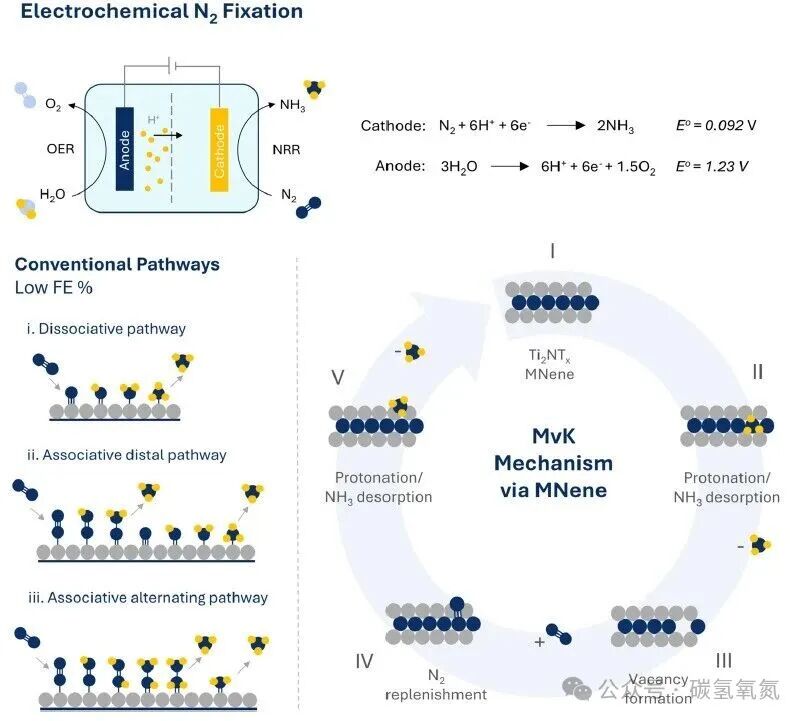
Comparison of the traditional electrochemical surface N₂ adsorption/activation mechanism with the unique MvK pathway exhibited by Ti₂NTₓ MXene.
Research ObjectiveTo verify whether Ti₂NTₓ MXene can achieve high NH₃ selectivity through the MvK pathway in mild aqueous solutions and to quantitatively reveal the formation-regeneration cycle of lattice N vacancies.
Research Methods• Synthesis: Oxygen-assisted molten salt fluorination of Ti₂AlN → acid washing → tetramethylammonium intercalation and ultrasonication, yielding monolayer/few-layer Ti₂NTₓ.• Characterization: XRD, Raman, XANES/EXAFS, in situ Raman, ¹H-NMR ¹⁵N₂ isotope exchange, 100 h continuous electrolysis + Ar↔N₂ cycling.• Theoretical: DFT construction of edge models (Ti₂N(OH)O, Ti₂N(OH)₂, Ti₂NO₂…), comparison of three MvK pathways (MvKas, MvKdis, MvKas-dis); AIMD tracking of N vacancy filling dynamics.
Main Findings
-
Record FE: At 0 V vs RHE in 0.1 M Na₂SO₄, NH₃ FE reached 47.5 ± 2.8%, with significant suppression of HER.
-
Isotope confirmation of lattice N involvement: After replacing ¹⁵N₂ with ¹⁴N₂, the ratio of ¹⁵NH₄⁺/¹⁴NH₄⁺ monotonically increased with cycling, directly proving that the N source comes from the lattice.
-
Edge vacancy-regeneration cycle:– After 68 h in an Ar atmosphere, ~70% of lattice N was converted to NH₃, leaving N vacancies;– Switching back to an N₂ atmosphere for 68 h, EXAFS and Raman showed the recovery of Ti–N characteristic peaks, indicating that vacancies were refilled by N₂.
-
Theoretical-experimental consistency:– DFT predicted that the formation energy of N vacancies on the Ti₂NO₂ surface is the lowest (1.0 eV), and the MvKas pathway has the lowest overall energy barrier;– AIMD revealed that H₃O⁺ rapid protonation in acidic electrolytes prevents complete embedding of N₂, maintaining a “semi-embedded” state, facilitating N≡N bond breaking.
Chart Interpretation
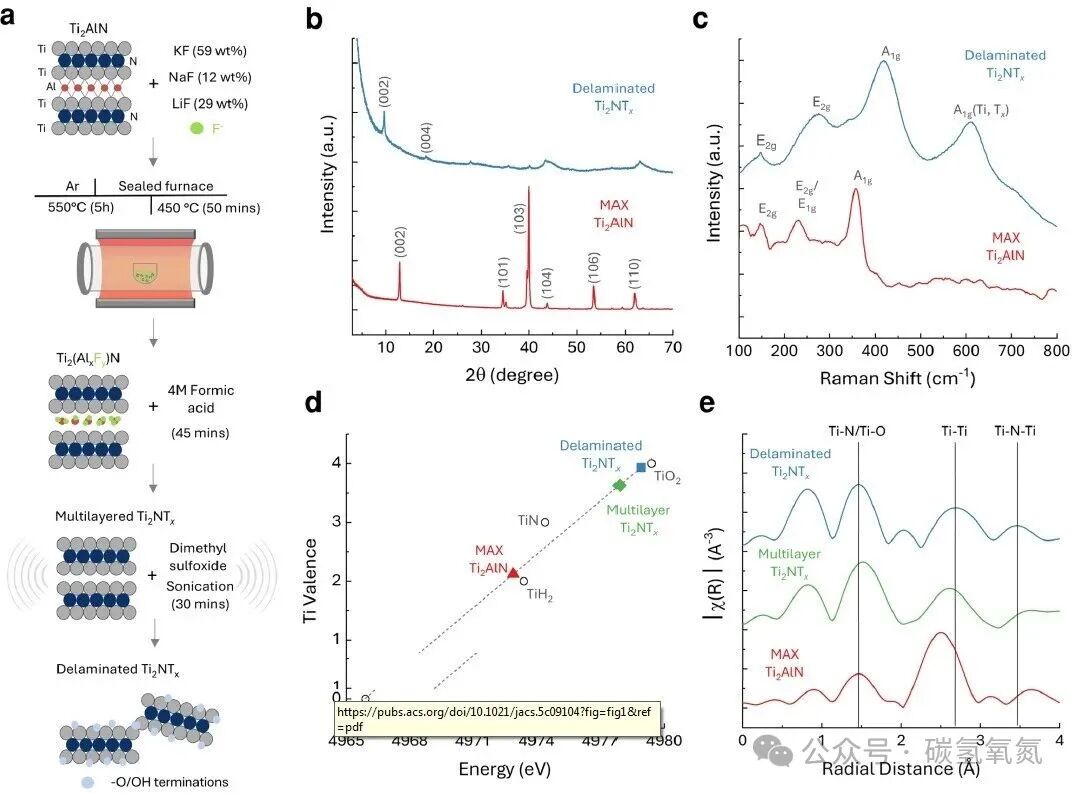
Figure 1 | MXene Synthesis and Structurea Synthesis process: MAX → molten salt etching → acid washing → ultrasonic exfoliation.b XRD: (002) peak shifts from 12.9° to 9.6°, interlayer spacing expands from 0.68 nm to 0.92 nm.c Raman: ~400 cm⁻¹ Ti lattice peak appears, original MAX peak disappears.d XANES: Ti valence state changes from 2.1 (MAX) to 3.9 (monolayer).e EXAFS: 1.5 Å Ti–N/Ti–O, 2.5 Å Ti–Ti, 3.7 Å Ti–N–Ti peaks remain, indicating complete local coordination.
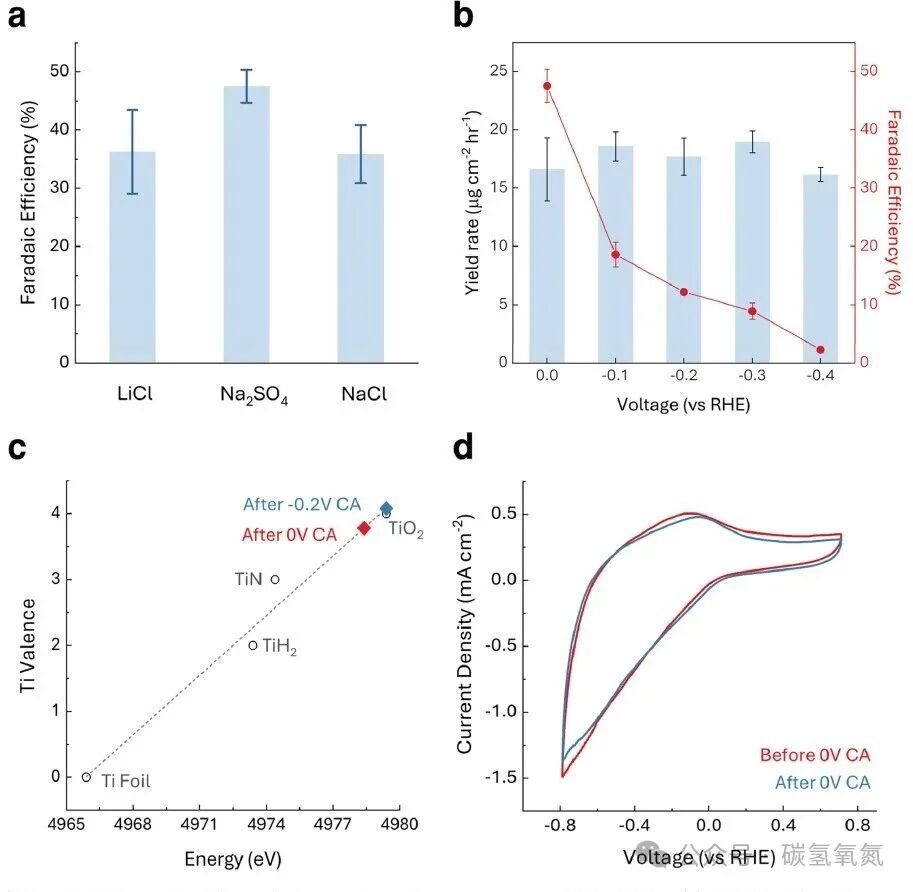
Figure 2 | Electrochemical Performancea FE in three neutral salts is all >40%, with Na₂SO₄ being the highest.b FE decreases with negative potential shift: 0 V 47% → −0.2 V 12%, XANES shows that the Ti oxidation state increases, inhibiting activity.c After 4 h of chronoamperometry, Ti edge energy shifts up (+0.4 eV), corresponding to N vacancy formation.d CV shows NRR starts at ~0 V, HER starts at ~−0.8 V, with a clear window.
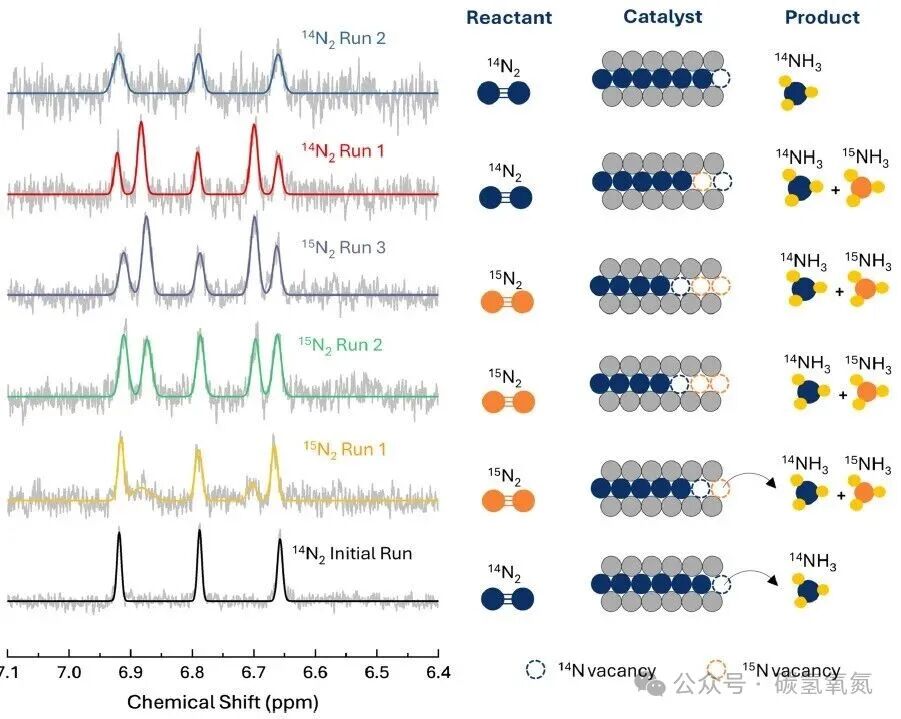
Figure 3 | ¹⁵N₂ Isotope ExchangeAfter four cycles, the ratio of ¹⁵NH₄⁺ increases successively, and after switching back to ¹⁴N₂, it decreases, directly confirming the involvement of lattice N in MvK.
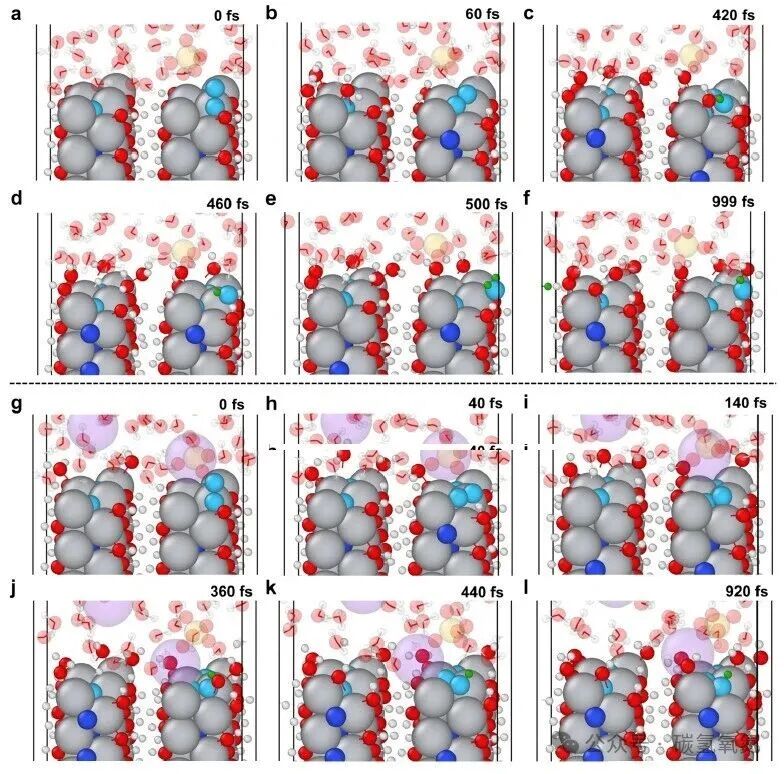
Figure 4 | AIMD Snapshots (1 ps)a–f Under acidic conditions, N₂ semi-embedded vacancies, N≡N breaks at 420 fs, NH₂ forms at 920 fs.g–l In neutral Na₂SO₄, N₂ is fully embedded but continuously breaks, shutting down NRR.
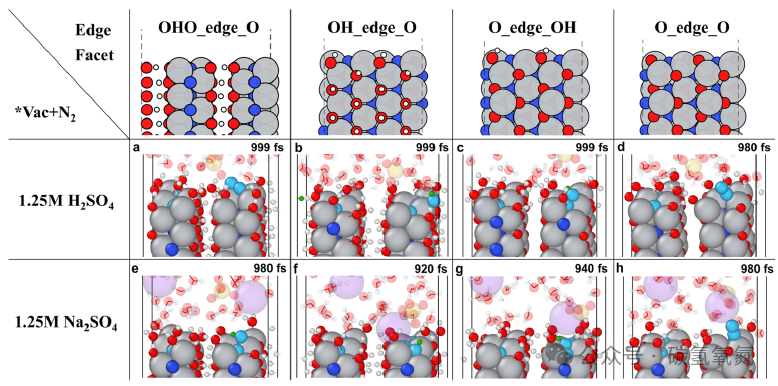
Figure 5 | Edge AIMD Summarya–h Different edge termination surfaces show: O_edge_OH termination promotes N₂ semi-embedding, O_edge_O termination hinders embedding.
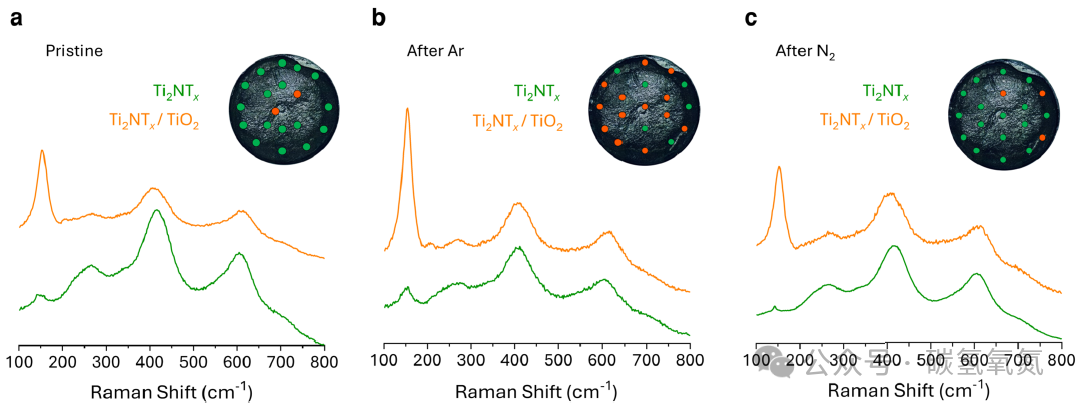
Figure 6 | Raman Cyclinga Original: 17/19 points pure MXene;b Ar 68 h: 13/19 points show Ti–O peak (oxygen filling vacancies);c N₂ 68 h: 16/19 points restore pure MXene spectrum, confirming N vacancy regeneration.
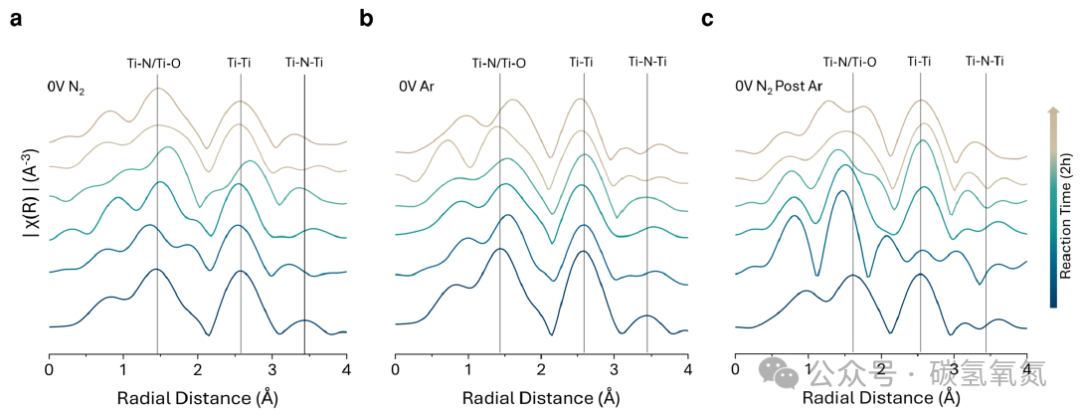
Figure 7 | In Situ EXAFSa N₂ continuous 2 h: Ti–N peak slightly fluctuates, overall structure retained;b Ar 2 h: Ti–O peak enhances (oxidation);c Reintroducing N₂: spectrum returns to a, completing the MvK cycle.
Conclusion and OutlookTi₂NTₓ MXene achieves 47.5% NH₃ FE and stable operation for 100 h through the reversible “lattice nitrogen-vacancy-regeneration” MvK mechanism in neutral aqueous solutions. The edge chemical state, electrolyte pH, and vacancy dynamics jointly determine pathway selectivity. This strategy provides a new paradigm for the rational design of 2D nitride catalysts with vacancy-edge synergistic regulation and lays the material foundation for distributed green ammonia production.
Reference: Yesudoss, D. K., Lai, H.-E., Johnson, D., Lee, M., Reinhart, B., Balbuena, P. B., & Djire, A. (2025). Lattice-Nitrogen-Mediated Chemistry Suppresses Hydrogen Evolution for Record Faradaic Efficiency in Ammonia Synthesis. Journal of the American Chemical Society, 147, 29327–29339. https://doi.org/10.1021/jacs.5c09104