
What role does AI play in retail chain operations?
By Hu Poxin
Edited by Zhang Rui
At Luckin Coffee stores, AI predicts customer flow during different time periods based on 180 days of historical data and 12 real-time indicators (such as foot traffic, equipment status, weather, etc.), automatically generating work schedules;
At Juewei Duck Neck stores, the store manager Agent “Juezhi” transforms the experience of top sales into knowledge for intelligent scheduling, activity strategies, real-time Q&A, and other store scenarios, iteratively updating through daily use by 30,000 staff nationwide, improving overall channel operation efficiency by 39%;
In Zhongguancun, Beijing, a retail pop-up store operated entirely by robots has opened. Inside the 9-square-meter silver capsule, a 1.73-meter tall silver robot moves flexibly, using mechanical arms to serve food and even proactively asking, “Would you like cola or tea?”
As a typical labor-intensive industry, the retail chain sector’s “lean operation” first targets “people”—gathering the experiences of excellent employees to quickly create a super employee Agent that delves into every operational detail of offline stores, assisting or even replacing humans. For example, AI scheduling assists store managers in decision-making (with final approval by the manager), AI training assists training managers in evaluating employees, and AI-generated content assists operational staff in creation. Additionally, AI can monitor stores remotely through cameras, check shelves, analyze customer flow, and monitor the execution of operational standards in real-time.
Is AI an assistant, executor, supervisor, or decision-maker? Different companies have different views on what role AI plays in retail chain operations. Radicals believe that AI possesses all knowledge, data, and processes, enabling it to make more perfect decisions with higher efficiency, with employees merely following orders; conservatives argue that AI is only suitable for positions with clear SOPs (Standard Operating Procedures), and complex decision-making issues must be handled by humans, as only “humans” can provide warm service.
How to choose may not be a technical issue but rather a management philosophy question: do we ultimately trust humans or algorithms?

Radicals: AI is the brain, humans are the hands and feet
“All roles in a company can be transformed into perfect employees using AI, which serves as a benchmark for everyone to learn from. In the future, employees may not even need to learn; they just need to follow what AI says,” summarized Wang Hailong, CTO of Kidswant.
By the end of 2024, the maternal and infant retail brand Kidswant will have 1,046 stores nationwide (506 directly operated by Kidswant, 540 by LeYou International directly operated and franchised), with 94 million members and fewer than 10,000 parenting consultants (sales staff). In terms of AI usage, Kidswant is an “active participant.” It not only provides product information and parenting knowledge support to parenting consultants and sales staff through AI but also applies AI in internal marketing, service, operations, and other areas.
For instance, can AI train a top salesperson?
“We found that the same product given to different parenting consultants results in different conversion rates, which is the difference between a top salesperson and an ordinary salesperson,” Wang Hailong explained. Top salespeople have their own processes and methods for engaging users, but extracting and promoting the methods of top parenting consultants to more salespeople is not easy; many salespeople can sell and talk but cannot extract the essence.
Since breakthroughs in large model multimodal technology, Wang Hailong thought of simulating users through AI to record the reception methods of top salespeople, thereby extracting the working methods of excellent consultants. For example, how they greet customers, how they inquire, how they introduce products, etc. “Currently, there is a term in the large model field called distillation; we jokingly say we are doing brain distillation, extracting the best and most fundamental logic from the human brain.”
This logic applies to all roles in the store; as long as there are standard SOPs (Standard Operating Procedures) and specific functions, AI can create corresponding super employees through recording and distillation.
In fact, the strength of the chain industry lies in its SOPs, with each position having detailed SOP manuals, and employees must undergo standardized training before starting work. However, at the same time, the turnover rate of frontline employees in the retail industry is not low, around 20% per year, meaning that out of 10,000 people, 2,000 leave, and another 2,000 join, resulting in four to five thousand people coming and going each year. Previously, employee training required a lot of effort, but now every employee can quickly learn professional skills under AI guidance.
In April, Juewei Duck Neck held a PK competition between employees and AI Agents. Previously, Juewei was developing three intelligent agents: an ordering Agent, a store manager Agent, and a member Agent.
Juewei’s Chief Growth Officer Chen Pengfei told Yibang Power that during the member operation PK, in the initial rounds, the human group occasionally won, but after the human group performed once, AI learned immediately, and it became a cycle, from goal breakdown, strategy formulation, activity execution, strategy review to knowledge accumulation and intent recognition, AI learned very quickly. By the end of the PK, the AI Agent achieved a complete victory.
The store manager intelligent agent “Juezhi” was trained based on the experiences of thousands of excellent store managers, capable of conveying information from headquarters, solving information loss from headquarters to branches, regions, franchisees, and store managers in a 10,000-store chain, and enhancing the average capability of stores. “What does improving the average mean? We have many excellent store managers, but also a large number of newcomers and store managers who need to grow; how can we bridge this capability gap?” analyzed Chen Pengfei, “The real answers in retail chains are in the stores, where the ‘gods’ are. Headquarters only reshapes, integrates, and amplifies these elements; the real answer is there. Therefore, the store manager is our greatest common divisor.”
In offline retail scenarios, the work content of store managers is more complex compared to frontline staff, including daily store operations, performance (revenue, profit, cost control), personnel management (scheduling, recruitment, training, incentives), inventory ordering, food safety, customer relationship management, and coordination with headquarters. However, AI can already replace store managers in specific, highly structured areas, becoming a junior decision-maker. In marketing, the entire precision marketing process (who to target, what to promote, when to promote, and what channels and content to use) is fully automated by AI; in ordering, algorithm-based automatic ordering systems have replaced manual experience-based judgments.
Juewei’s use of AI store managers has already yielded significant results. “I have 10,000 store managers, and the input-output ratio between those using AI and those not using AI can be calculated clearly and quantitatively,” said Chen Pengfei.
With the support of AI, a new chain model is emerging: through precise predictions, automation, and optimization, AI directly addresses the retail industry’s biggest cost pain points—loss, labor efficiency, inventory turnover, etc., thereby creating new profit margins in the “thin profit era.”

Therefore, optimistic practitioners clearly state that AI is the brain, and humans are the hands and feet.
“Only when humans assist AI, rather than AI assisting humans, can we achieve true productivity transformation.” This viewpoint was also clearly expressed by DingTalk CEO Wu Zhao at the recent DingTalk 10th Anniversary product launch event.

Conservatives: AI cannot deprive store managers of decision-making power
While some brands are pushing for the ultimate operation of unmanned stores, others are removing self-checkout machines used during the pandemic.
“We found that self-checkout is counterproductive to sales; cashier transactions by staff generate, on average, 40% more sales than machine transactions,” said You Renhong, Vice President of Ting Hsin Convenience Catering Group. He has been deeply involved in retail catering for over ten years, responsible for the catering and retail businesses of Dicos fast food and FamilyMart convenience stores, and is currently trying to reshape the position of convenience stores in the community ecosystem through enhanced humanized service.
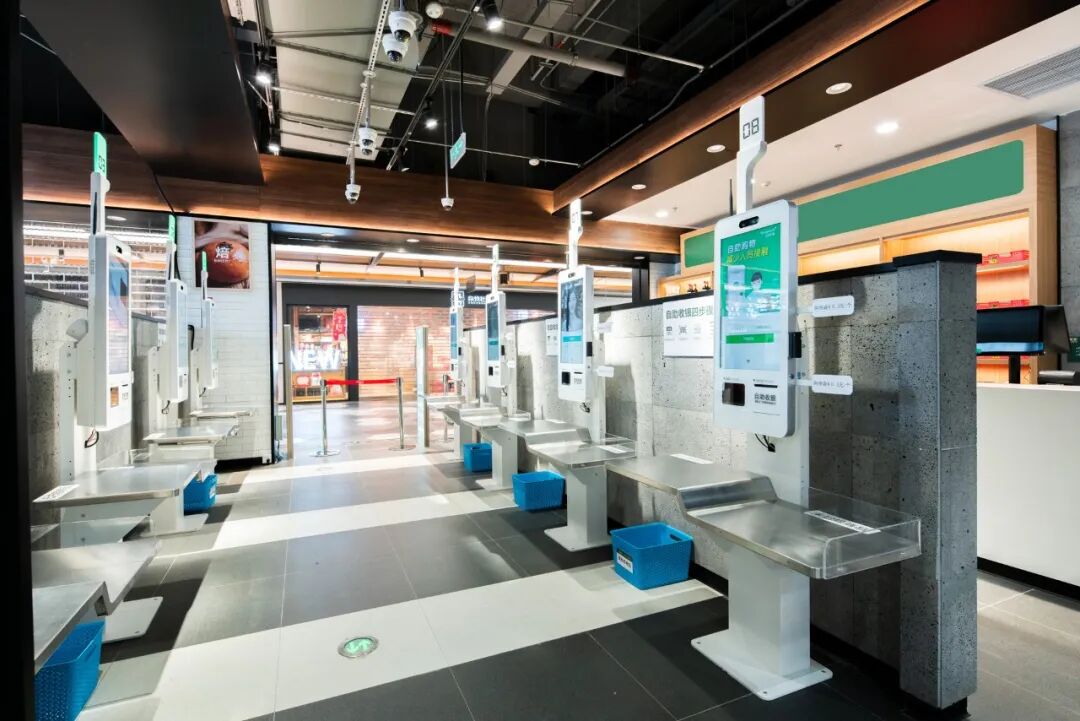
You Renhong pointed out that for FamilyMart, AI applications follow two paths: for positions with SOPs, mainly new employees use new technologies to solve old problems, such as creating graphics, videos, making outbound calls, and managing private domains, utilizing AI large models to complete in one day what previously took a week to produce promotional videos; for positions with ambiguous SOPs, involving resource allocation decision-making, AI is developing towards MoE (Mixture of Experts) to play an assisting role.
The core behind this is simple—AI cannot take the blame. “If you deprive store managers of decision-making power today, who will bear the performance responsibility? We are a franchise, and if there are losses, the store manager will not agree,” You Renhong stated.
In fact, in the operation of offline formats, it is not only necessary to improve efficiency and reduce losses to the extreme but also to remember the names and preferences of regular customers, creating a warm service experience; to facilitate transactions with hesitant customers through observation and verbal skills; especially when facing unexpected complaints or public relations crises, sincerely apologizing and flexibly compensating to restore customer relationships.
In other words, the importance of “emotional value” is becoming increasingly prominent. For example, Pang Donglai invests heavily in employees to serve consumers well because they believe that “happy employees create happy customers,” and the goodwill and creativity of people are the most valuable assets of a company.
“I think the industry is somewhat retracting now; we do not rely entirely on systems but integrate workflows with unstructured data to build an LLM (Large Language Model) to provide store managers with reference suggestions,” You Renhong observed.
Establishing an LLM database requires distilling existing work knowledge and experience, which necessitates the participation and sharing of employees from different positions. This creates a paradox: AI needs employees to provide data nourishment, but AI may replace employees.
“You cannot directly tell employees that you will use AI to replace them; otherwise, they will never share their internal experience system with AI for learning, which is completely against human nature. You can express that digital transformation is to improve work efficiency,” You Renhong said.
For example, a food safety officer responsible for 30 stores needs to work overtime and cannot even go home. With the visual recognition capabilities of multimodal models and the experience data of food safety personnel, a small model for food safety supervision can be trained and deployed in the cameras of various kitchens, replacing food safety employees to supervise staff’s operational standards. With AI support, food safety personnel can not only easily supervise the safety of 30 stores but also leave work on time.
Compared to the efficiency transformation brought by AI, You Renhong is more concerned about the innovative spirit of the convenience store format. “I wonder if the entire convenience store industry needs to rethink what true innovation is; we cannot just ‘reference’ convenience stores from Japan, South Korea, and Taiwan; we have actually reached a level where other ‘advanced’ models can learn from us. I talk with overseas colleagues, and they are still stuck in the television advertising phase. We need to clarify what our consumers want and then provide it to them again.”

The ultimate goal of AI applications: “Unmanned” or “more humanized”?
How to view the relationship between AI and humans varies among companies with different DNA: the internet does not trust employees but trusts algorithms more; however, chain stores must trust their franchise store managers, trust employees, and believe they possess more knowledge and data than algorithms.
A typical representative of offline chain digitalization, Bianlifeng, once experienced digital failure. Zhuang Chenchao stated at a forum that only two people in the entire company could modify the ordering system. When the pandemic occurred, a large amount of dirty data flooded in, and store managers and procurement could not intervene in the model’s operation, leading to the algorithmic empire swallowing the convenience store empire. Zhuang Chenchao later also stated that the data and parameters mastered by offline personnel far exceed what current technology can handle.
“I believe that Bianlifeng and Luckin represent a forward direction that may eventually lead to that point. However, before that, when the entire technology and parameter collection sensors are still inadequate, humans still hold a very important position,” You Renhong believes.

No matter who takes over the stores in the future, the current implementation of Agents is still stuck on the challenges of incomplete data and unclear processes. “We call this digital debt; you must first pay off this debt before you can walk the AI path. If this debt is not paid off, AI is just a castle in the air that can collapse at any moment,” Wang Hailong stated.
In the pursuit of efficiency and service quality, the work intensity in the offline service industry remains a concern. German sociologist Rosa found that for practitioners, “increased efficiency can lead to increased work intensity.”
Many stores manage frontline employees far beyond what is necessary for the job, entering a realm of physical and emotional “performance.” For example, endless standing, not being able to sit down even without customers; mandatory scripted speech (requiring standardized phrases to be repeated regardless of customer presence); and maintaining a constant smile. To sustain this emotional performance, employees must separate their true feelings (fatigue, annoyance, frustration) from their external expressions at work (smiling, enthusiasm, patience).
In the restaurant industry, for example, research shows that the wages of restaurant servers are mostly concentrated in the range of 1,500-2,500 yuan, contrasting sharply with long working hours (generally exceeding 10 hours/day), working six days and resting one. The average tenure of restaurant servers is 6-8 months.
Perhaps cutting through the myth of “efficiency first” is key to finding the critical point of refined human-machine collaboration in operations.
When Galaxy General’s “Galaxy Space Capsule” pop-up store opened in Zhongguancun, Starbucks began to re-emphasize the role of baristas and the importance of interaction with customers.
Looking to the future, You Renhong feels, “Perhaps because our generation still believes in humans and is accustomed to human service, when the next generation of children grows up, they will likely be accustomed to buying things from robots and chatting with AI, at which point human service will no longer be needed. This will be a gradual process over generations.”
As robots and AI gradually become popular in this industry, when most people are accustomed to buying things through robots, human labor will become an expensive production resource. Only expensive and high-end stores will have humans providing services.

END




Like, share, and support~