|
Title |
J Eur Ceram Soc:K0.5Na0.5NbO3-Based Relaxor Ferroelectric Ceramics with High Energy Storage and High-Temperature Performance |
|
Research Background |
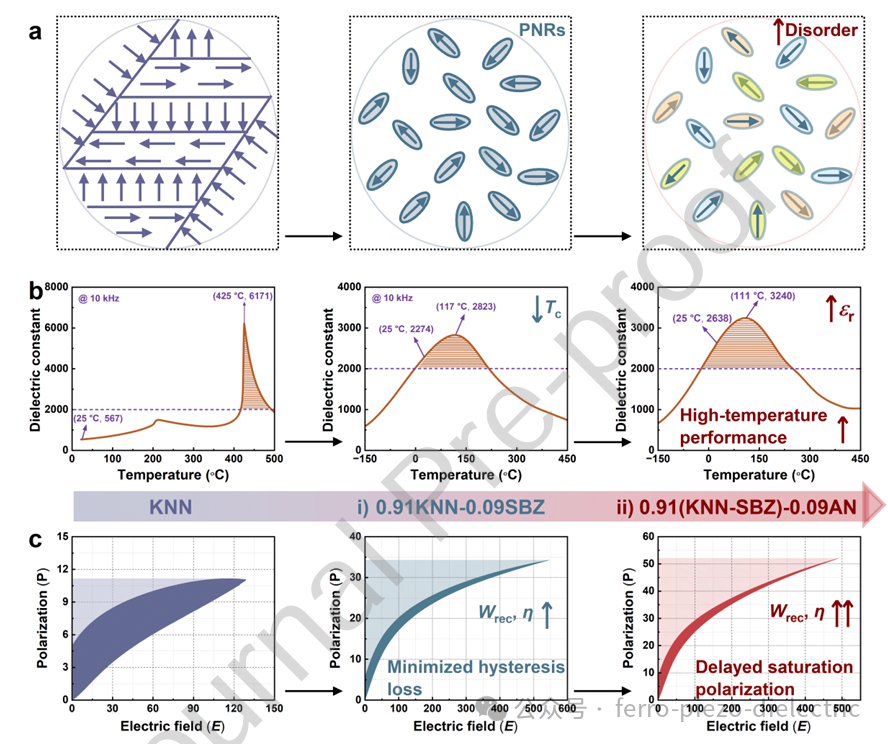
Ceramic dielectric capacitors are widely used in fields such as new energy vehicles and aerospace due to their high power density, rapid discharge, long lifespan, and excellent mechanical properties. However, there is a trade-off between energy storage density (Wrec) and efficiency (η), especially under moderate electric fields, which restricts the miniaturization and integration of devices. Currently, lead-free KNN-based ceramics show potential due to their tunable phase structure and sub-micron grain size, but they suffer from high hysteresis loss and early polarization saturation, with Wrec typically below 4.0 J·cm−3 and η below 75%, necessitating breakthroughs in performance through material design. |
|
Research Content |
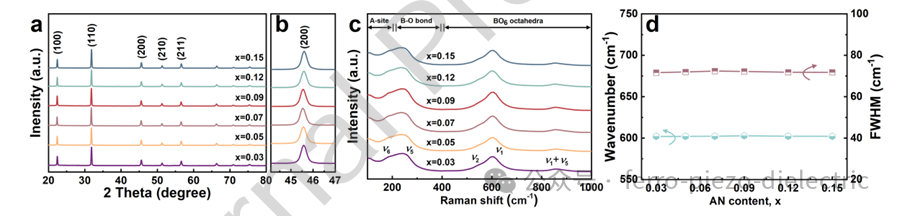
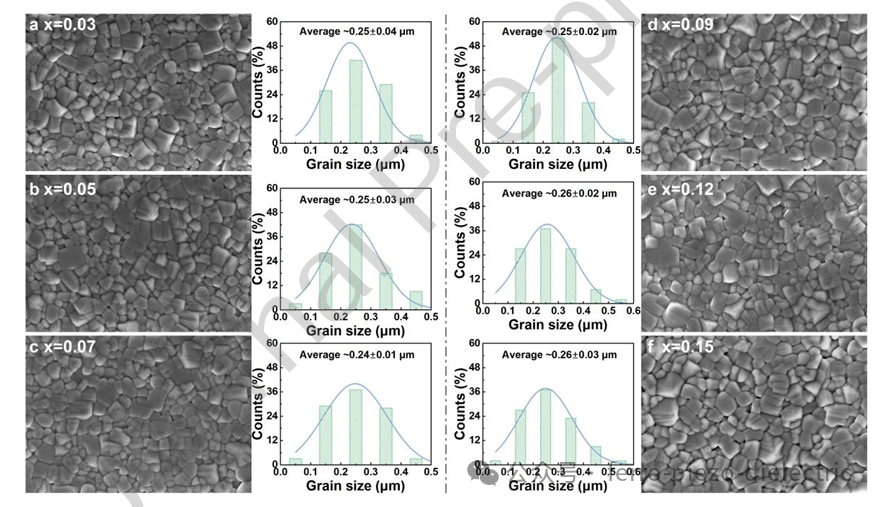
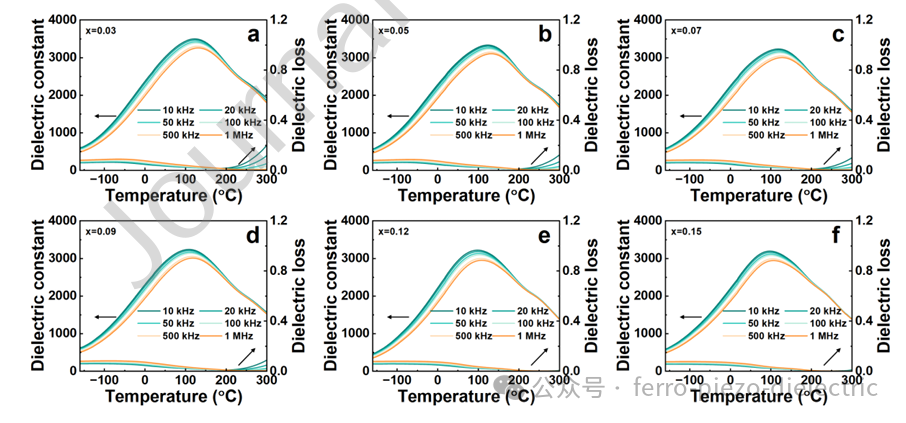
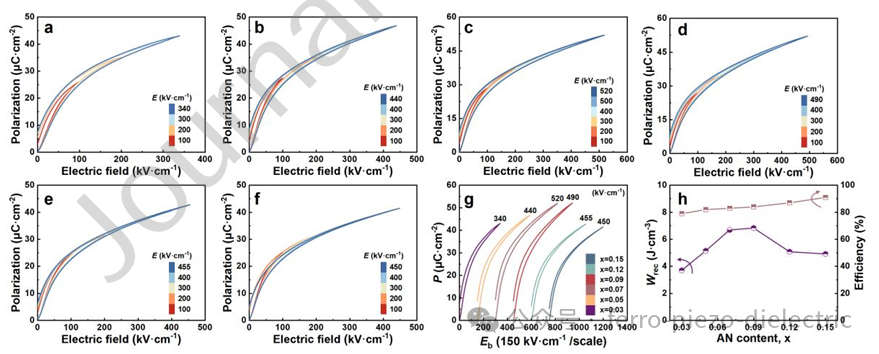
① By constructing a (KNN-SBZ)-AN ternary system and introducing SrZrO3 and AgNbO3, the pseudo-cubic phase structure is induced, enhancing polarization disorder and reducing remnant polarization (Pr). ② Utilizing sub-micron grains (≈250 nm) and a highly dense microstructure to improve breakdown strength (Eb≈490 kV·cm−1), optimizing energy storage performance.
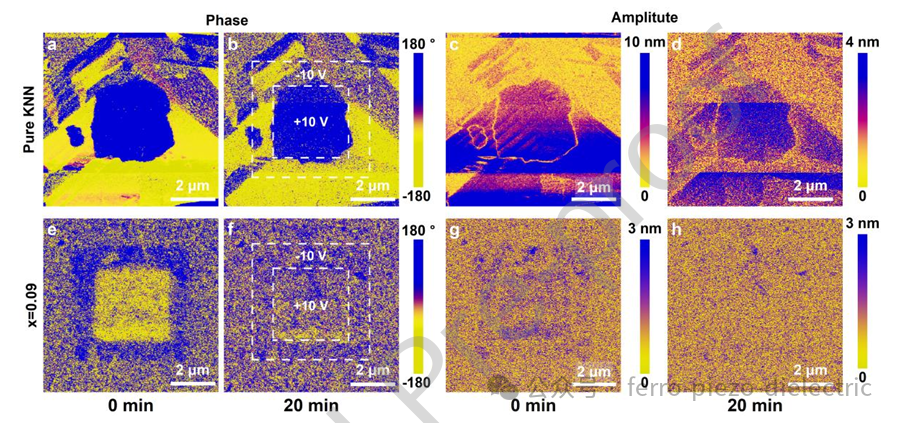
③ PFM and Raman characterization confirm the dynamic behavior of PNRs, delaying polarization saturation and enhancing high-temperature and frequency stability.
④ The best energy storage performance is achieved at x=0.09 composition: Wrec≈6.8 J·cm−3, η≈84%, and high transmittance (67% at 780 nm).
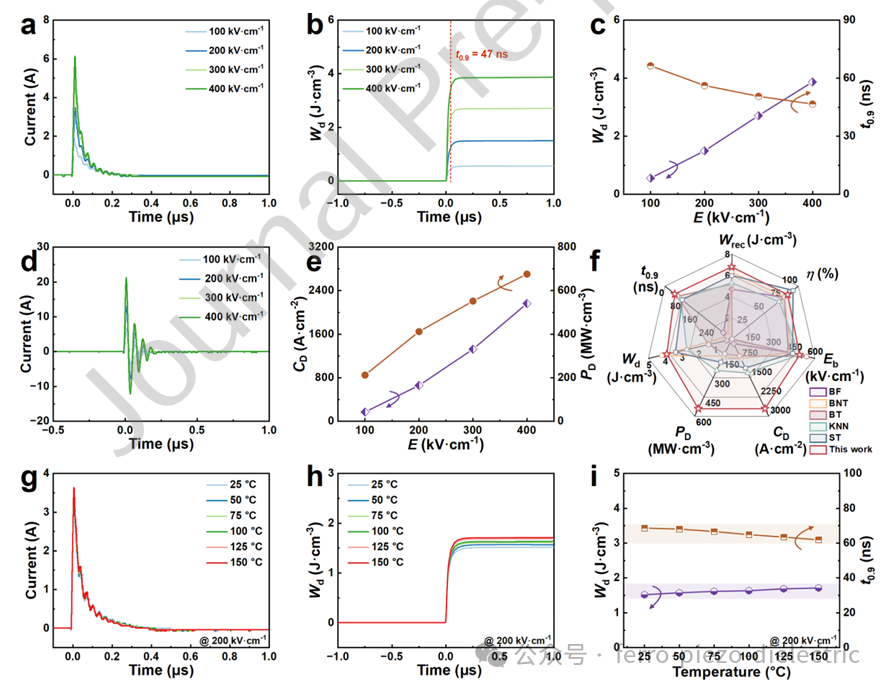
⑤ Charge-discharge tests show high power density (540 MW·cm−3) and ultra-fast discharge time (t0.9≈47 ns), demonstrating excellent cycling and temperature stability.
|
|
Innovations |
① A ternary system design strategy is proposed, synergizing relaxor ferroelectric and antiferroelectric components to achieve a balance of high Pmax, low Pr, and high breakdown strength Eb. ② Enhanced polarization disorder through chemical complexity forms dynamic PNRs, significantly reducing hysteresis loss and delaying polarization saturation.
③ Achieving Wrec≈6.8 J·cm−3 at moderate electric fields (490 kV·cm−1), representing a leading level for KNN-based ceramics.
④ Balancing high transmittance and energy storage performance expands the application potential of multifunctional ceramics in optoelectronic devices. ⑤ The material exhibits excellent high-temperature stability (25–150°C) and fatigue life (105 cycles), suitable for harsh environments.
|
|
Paper Summary |
This study successfully designed 0.91(KNN-SBZ)-0.09AN relaxor ferroelectric ceramics by introducing SrZrO3 and AgNbO3 into the KNN matrix. The material achieves Wrec≈6.8 J·cm−3, η≈84% excellent energy storage performance under moderate electric fields (490 kV·cm−1), while also exhibiting high power density (540 MW·cm−3), ultra-fast discharge (t0.9≈47 ns), excellent cycling stability (105 cycles), and high-temperature adaptability (25–150°C). Its sub-micron grain structure and pseudo-cubic phase synergistically promote high Eb and low loss, with a transmittance of up to 67%, providing a new material solution for high-performance energy storage ceramics under moderate electric fields and high-temperature conditions. |
|
Original Text |
https://doi.org/10.1016/j.jeurceramsoc.2025.118024 |
Disclaimer: This article summarizes information based on publicly available data from relevant academic journals and is not original content. It is intended for academic exchange and does not represent the views of this public account.