📚 Reference InformationTitle: Fluorogenic Covalent Probes for RNAAuthors: Jinwoo Shin, Moon Jung Kim, Eric T. Kool (2025)Journal: Journal of the American Chemical Society|
🔍 Core Issues• Research Objective: To develop a sequence-independent, highly selective, real-time imaging covalent fluorescent probe for RNA.• Existing Limitations: Traditional RNA dyes rely on non-covalent binding, which results in poor selectivity (low RNA/DNA discrimination), high background signals, susceptibility to interference, and most require washing steps.
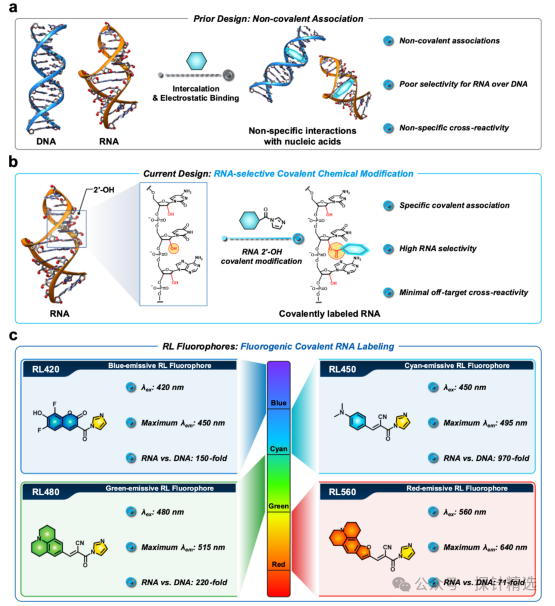
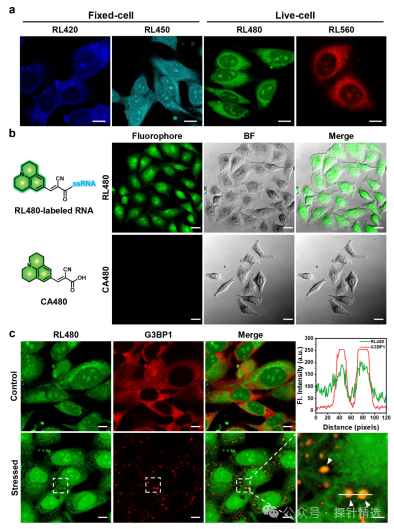
🚀 Innovations• Covalent Labeling Mechanism: Utilizing the unique 2′-OH group of RNA, an acyl imidazole reactive group is designed to achieve RNA-specific covalent labeling, with almost no response from DNA.• Fluorescence Activation Strategy: Based on the TICT (Twisted Intramolecular Charge Transfer) mechanism, fluorescence enhancement after labeling reaches up to 970-fold, far exceeding existing dyes.• Multicolor Imaging Platform: Four probes with different emission wavelengths (RL420/450/480/560) are developed, covering blue to red light, supporting multi-channel RNA imaging.
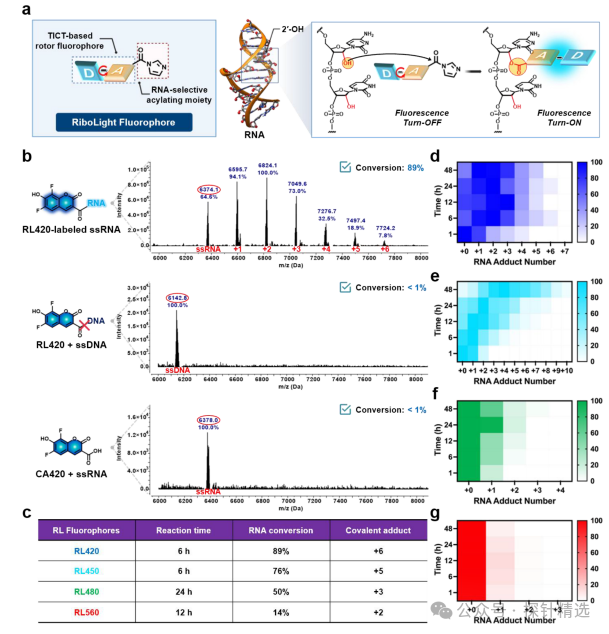
📊 Research Methods• Probe Design: The donor-acceptor fluorophore is combined with acyl imidazole, forming RNA-ester bonds after reaction, while activating fluorescence.• Experimental Validation:
-
In Vitro: MALDI-TOF validates RNA covalent labeling, with spectral analysis showing high selectivity and fluorescence enhancement.
-
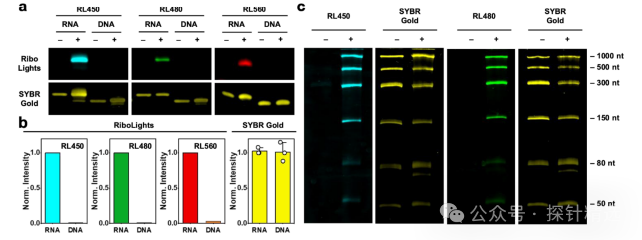
Gel Imaging: RL probes label only RNA in PAGE, while SYBR Gold labels both RNA and DNA.
-
Cell Imaging: RL480/560 can image RNA in live cells directly without washing, localizing nucleoli and stress granules.
-
Real-time Monitoring: RL480 successfully reports the dynamics of RNA synthesis during T7 transcription in real-time.
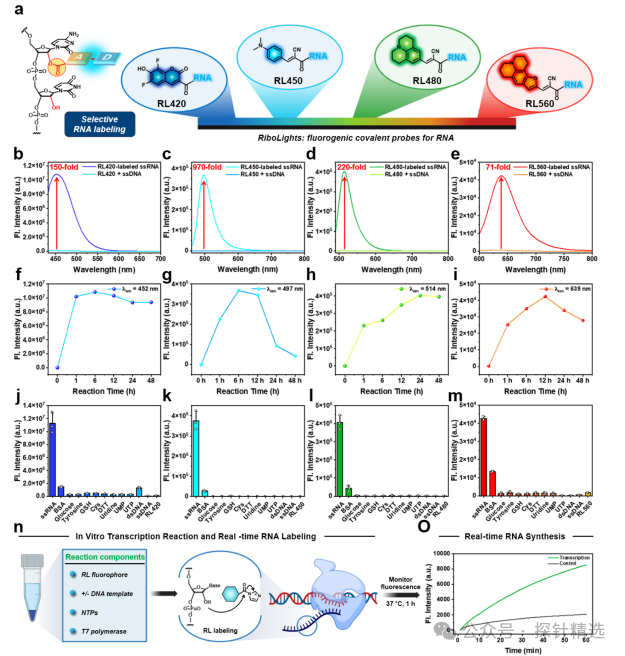
✅ Key Results• Selectivity: The RNA/DNA fluorescence signal ratio reaches up to 970-fold (RL450), far superior to SYTO RNASelect (1.6-fold).• Sensitivity: Detection limit reaches nanomolar levels, suitable for low concentration RNA detection.• Cell Compatibility: RL480/560 has cell permeability and no toxic side effects (cell survival rate >85% at 100 μM).• Photostability: RL probes maintain >80% signal under continuous laser irradiation, better than SYTO RNASelect (50% decay in 5 minutes).• Reversibility: DMAP treatment can remove the label, restoring the original RNA for downstream analysis.
📌 DisclaimerThis article is an academic interpretation and not the original content. Please refer to the original literature:DOI: 10.1021/jacs.5c14938Like ❤️ Save ⭐️ Share to make RNA research “shine”!