
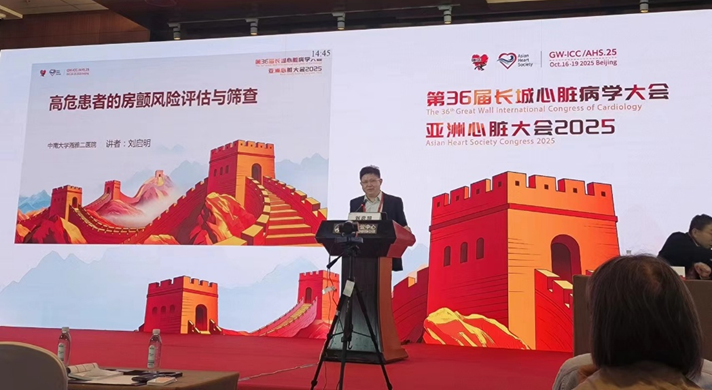
At the 36th Great Wall Cardiology Conference and the Asian Heart Congress 2025 County Session, Professor Liu Qiming from Xiangya Second Hospital of Central South University delivered a systematic explanation on “Risk Assessment and Screening for Atrial Fibrillation in High-Risk Patients,” integrating key updates from the “2024 ESC Atrial Fibrillation Management Guidelines” and proposing a closed-loop strategy from screening identification to long-term management, providing a clear path for atrial fibrillation diagnosis and treatment in grassroots and county hospitals.
Upgraded Management Concept: The AF-CARE Pathway Achieves a Leap from “Treatment” to “Management”
Professor Liu Qiming pointed out that atrial fibrillation management has evolved from the traditional “anticoagulation + symptom control” to a comprehensive management model that includes comorbidity management, stroke prevention, symptom relief, and dynamic reassessment. The AF-CARE pathway proposed in the 2024 ESC guidelines incorporates “assessment and dynamic reassessment (E)” as a core component, reinforcing the modern management concept of “patient-centered, multidisciplinary collaboration, and prevention first.”
Identifying Seven Controllable Factors for Precise Intervention
Professor Liu emphasized that identifying and controlling the following seven key factors is essential to reduce the risk of atrial fibrillation occurrence and recurrence:
-
Hypertension: The target for blood pressure treatment is 120–129/70–79 mmHg, which can significantly reduce the risk of cardiovascular events;
-
Heart Failure: SGLT2 inhibitors are recommended for atrial fibrillation patients with heart failure for improving prognosis and reducing recurrence after ablation;
-
Diabetes: Effective glycemic control can reduce the burden and progression of atrial fibrillation;
-
Obesity/Overweight: A weight loss of ≥10% significantly improves symptoms and atrial fibrillation burden;
-
Obstructive Sleep Apnea (OSA): Although screening tools remain controversial, OSA management is still classified as a Class IIb recommendation;
-
Exercise Capacity and Alcohol Intake: Individualized exercise plans and limiting alcohol intake are equally crucial.
Screening Strategy: Focus on High-Risk Populations with a Dual-Track Approach
Professor Liu suggested combining “opportunistic screening” and “systematic screening” in a dual-track strategy to ensure targeted coverage of the following populations:
-
Age ≥65 years, especially ≥75 years or those with CHA₂DS₂-VA risk factors;
-
Patients with comorbidities such as heart failure, hypertension, diabetes, obesity, and OSA;
-
Individuals with structural heart disease, history of cryptogenic stroke, or cardiac surgery.
New screening methods such as smartwatches, patch-based ECG monitoring, and PPG technology have expanded screening scenarios, but Professor Liu also cautioned against the anxiety and misdiagnosis risks associated with “over-screening.”
Comorbidity Treatment: Individualized Anticoagulation and Rhythm Control
-
Anticoagulation Strategy: NOACs have become the first choice for non-end-stage CKD and most atrial fibrillation patients, especially Xa factor inhibitors, which have a safety advantage in patients with renal impairment;
-
Rhythm Control: Early rhythm treatment can significantly improve prognosis; amiodarone and dronedarone are preferred for patients with CKD due to their minimal impact on renal function and good safety profile;
-
Coronary Heart Disease with Atrial Fibrillation: It is recommended to transition to dual antithrombotic therapy as soon as possible after a short-term triple therapy to balance thrombotic and bleeding risks.
Conclusion: Building a Closed Loop of “Screening-Intervention-Follow-up” for Atrial Fibrillation Management in Counties
In conclusion, Professor Liu emphasized that atrial fibrillation management needs to break the “solo combat” model and establish a comprehensive management system centered around atrial fibrillation centers as the hub, supported by multidisciplinary collaboration, and ensured by information-based follow-up. Especially in county settings, strengthening high-risk identification, standardizing comorbidity management, and implementing dynamic assessments are key pathways to achieving high-quality atrial fibrillation diagnosis and treatment under the goal of “major diseases not leaving the county.”
GW-ICC/AHS 2025
Click to read the original text and follow for the latest news