01
Research Background

To break the limitations of mechanism research and material design, it is necessary to have a comprehensive understanding of the lithium-ion dynamics in batteries. Analyzing the time scale information in batteries, such as ion conduction, charge transfer, diffusion, interface evolution, and other unknown dynamic processes, will provide profound insights into the study of dynamic problems. In this regard, the identification of time scale information can be combined with non-destructive impedance characterization for online battery monitoring. This method utilizes the concept of Relaxation Time Distribution (DRT) and has achieved successful applications in battery diagnostics. In the future, time scale characterization will become a powerful data tool for extraction and construction of datasets for various battery systems.
02
Summary of Achievements
Professor Zhang Qiang from Tsinghua University, Postdoctoral Zhao Chenzi (co-corresponding author) and others have described the fundamentals, specifications, applications, and prospects of analyzing various battery systems such as solid-state batteries, metal-sulfur/oxygen batteries, and metal-ion batteries on a time scale. This review was published under the title The Timescale Identification Decoupling Complicated Kinetic Processes in Lithium Batteries in Joule.
03
Content Details
The time scale effects in batteries mainly arise from four physical processes: electrical double layer, local charge concentration, charge balance, and concentration gradients in the electrolyte or electrode materials. External stimuli (such as current or voltage) can induce relaxation processes under different conditions. Relaxation refers to the recovery process after external disturbance and is an intrinsic property of isolated systems. Therefore, different relaxation properties can be used to distinguish dynamic processes, such as differentiating the conduction, adsorption, and release of lithium ions at the interface. This allows for quantitative analysis of the battery system dynamics and testing of EIS. Accurately defining all time constants is a prerequisite for determining the relaxation time distribution (DRT) in electrochemical systems.
The concept of DRT was first proposed by Schweidler et al. in 1907. The goal of DRT is to perform frequency-based time scale features of EIS transformations over time. This can be accomplished through Fourier transforms, Monte Carlo sampling, maximum entropy, fractional-order algebra recognition, and the most commonly used Tikhonov regularization strategy. Many new solutions, such as Gaussian processes and genetic programming, are effective schemes for achieving DRT deconvolution.
The Relationship Between DRT and Equivalent Circuit Models
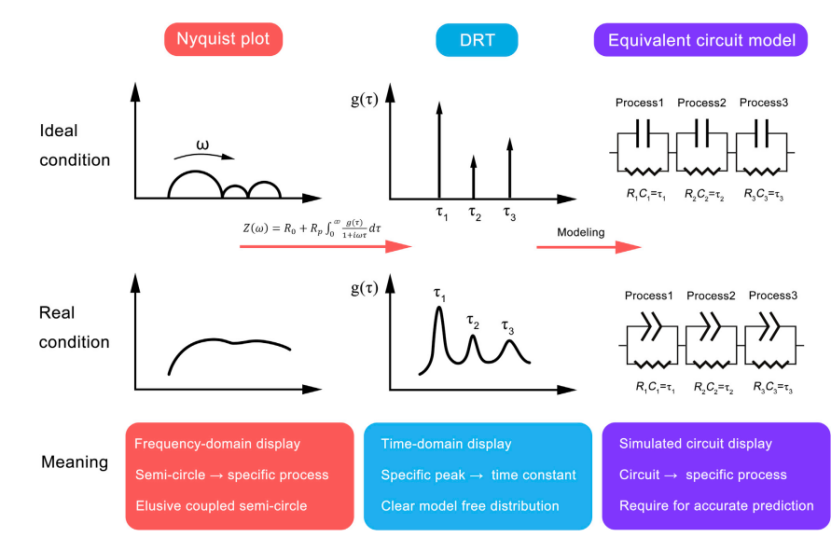
The relationship between Nyquist plots, DRT plots, and equivalent circuit models (ECM) is shown in Figure 1. Ideally, typical EIS consists of separated semicircles. Each semicircle is related to a specific time constant, which appears as isolated lines in the DRT plot corresponding to their respective parallel resistors and capacitors circuits. In reality, the semicircles in the EIS plot are coupled, making it difficult to distinguish them. DRT can transform the coupled semicircles into continuous curves with several specific peaks, whose physical significance corresponds to constant phase elements (CPE). The corresponding ECM model can be obtained based on the deconvolution time constants.
Typical DRT Diagnostic Procedure for Batteries
The time constants of electrochemical processes are the focus of EIS studies. Figure 2 shows the typical workflow of DRT diagnostics in battery research.
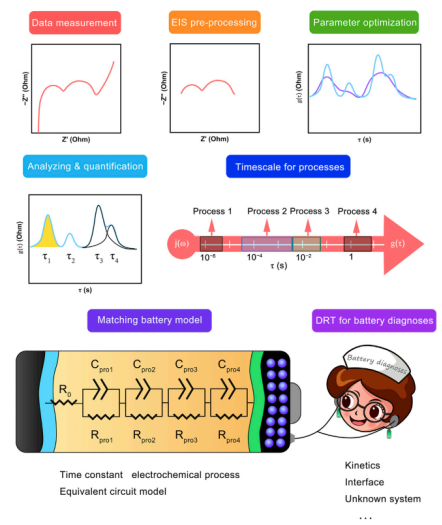
Figure 2 The DRT-based timing diagnostic process for battery systems.
DRT diagnostics begin with EIS testing over a wide frequency range. The accuracy of EIS will determine the results of DRT. Therefore, it is crucial to effectively verify the EIS results. Accurate time-domain analysis using DRT requires high-quality EIS data with a high signal-to-noise ratio. During the DRT regularization process, noise data from EIS can produce spurious peaks, leading to misunderstandings of the electrochemical models. Therefore, the validity of the EIS data should be verified before further analysis. The most commonly used standard is the Kramers-Kronig transformation.
Preprocess the obtained EIS results. For traditional DRT schemes, it is necessary to subtract the capacitance diffusion branch characteristics and inductance from EIS before the DRT transition. The preprocessed EIS will be converted into a DRT plot using specific algorithms. These peaks can be directly identified, indicating specific electrochemical processes.
Optimize DRT parameters. Parameter optimization is key to achieving accurate DRT results and has seen significant development. The Ciucci group proposed real and imaginary cross-validation test functions to select regularization parameters and compared ridge regularization with least absolute shrinkage and selection operator (Lasso) regularization.
Analyze and quantify. The most important step in DRT is to determine the specific electrochemical processes, which requires a physical or chemical meaning image in the battery system. In simple terms, it is to reveal the time scales of electrochemical processes, ensuring independent time constant peaks while obtaining the DRT plot.
Interpret electrochemical processes on a time scale. By distinguishing time scale peaks through the DRT method, different time constants of electrochemical processes can be represented. Therefore, determining the physical significance of different time constants is the core issue of DRT analysis.
Battery modeling and diagnostics. Establishing the relationship between time scale parameters and their real electrochemical processes helps build real battery models based on time scales. Identifying different electrochemical processes on a time scale and quantifying their evolution through the DRT method can enable analysis of unknown battery systems, monitoring of internal evolution, and optimization of ECM models.
Time Scale Properties
Methods for identifying time scale features. Ensuring that the real processes based on time scales is the core issue of DRT analysis. On one hand, the time scale is determined based on relevant theories and experimental results. On the other hand, experiments need to be designed to determine the physical significance of specific time constants. After using appropriate parameters or algorithms, spurious peaks can be suppressed. Then peak identification can be achieved, as shown in the workflow diagram of Figure 3.
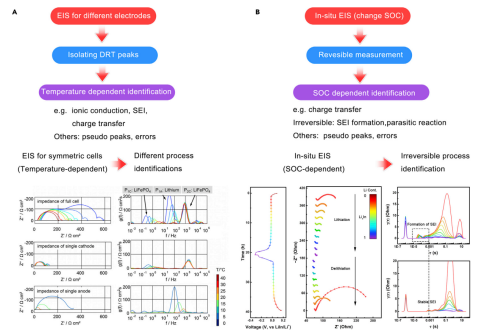
Figure 3 Determining DRT peaks from temperature-dependent and SOC-dependent routes.
Separate electrochemical processes. In batteries, electrochemical processes mainly include electrolyte-based responses, anode-based responses, cathode-based responses, and accessory-based responses. Measuring symmetric batteries assembled only by the anode or cathode is the basis for separating anode, cathode, and electrolyte responses. For example, Schmidt et al. separated the kinetic processes of Li/Li and LiFePO4/LiFePO4 different symmetric battery cells to distinguish the kinetic processes of Li and LiFePO4 from the entire battery (Figure 3A).
Identify static/dynamic and reversible processes. Anode or cathode processes can have both static and dynamic processes. Dynamic processes mean that electrochemical processes can be influenced by charge states. In contrast, static processes remain stable during charging or discharging. The identification of charge state (SOC) requires in-situ EIS or GEIS measurements during reversible cycles to ensure accuracy. During lithiation and delithiation processes, irreversible SEI formation and reversible charge transfer processes can be clearly identified (Figure 3B). Therefore, half-cells are widely used for SOC-dependent analysis. Refer to the time scale dictionary. Time scale analysis based on DRT has gradually accumulated the time constants in battery systems. With the enrichment of the time scale dictionary, EIS derived from DRT can be completed quickly.
The time constants of typical electrochemical processes. The fundamental processes of batteries mainly include conductive processes, charging processes based on transfer, physical contact, and diffusion processes (Figure 4A). The total time scale distribution of different dynamic processes is shown in Figure 4B. Essentially, processes based on conduction are faster and are associated with rapid relaxation. Rapid conduction leads to low concentration differences, resulting in low capacitance. Therefore, processes based on conduction typically have very small relaxation times, such as grain boundary conduction in different solid-state electrolytes.
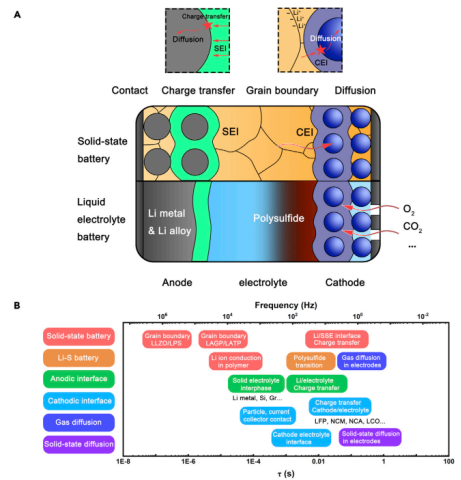
Figure 4 Typical dynamic processes and related time constants of various batteries. (A) Typical dynamic processes in the battery. (B) Time constants of different dynamic processes.
Potential Applications of Time Scale Diagnosis
Building electrochemical models. Rationally deducing EIS requires constructing an accurate electrochemical model. The DRT method can distinguish dynamic processes, significantly avoiding subjective judgments. The DRT method helps deepen the understanding of electrochemistry in specific battery systems (such as Li-S batteries). As shown in Figure 5, Risse et al. analyzed the time constants and resistances of polysulfides. The charge transfer time range is from 10-2 to 1s. The Li-S full battery can also be studied at different SOC states to identify and quantify other processes. In the working Li-S battery, Soni et al. used DRT to ensure the dynamic processes of polarization, which include eight physical processes such as inter-particle contact, double-layer capacitance, SEI, tri-electrode charge transfer, polysulfides, and lithium ion diffusion. Research on DRT in full batteries demonstrates that DRT helps bridge the performance of each time scale with battery state, benefiting both mechanism research and practical applications.
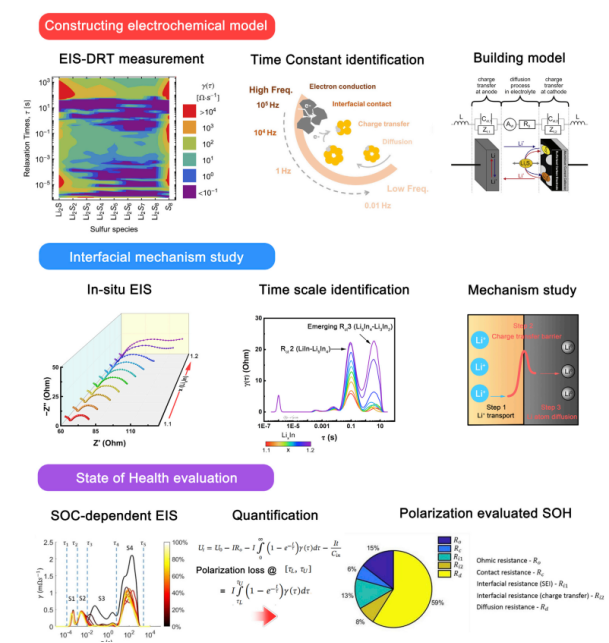
Figure 5 Application of DRT in the electrochemical model of Li-S batteries, interface study, and SOH evaluation based on quantized polarization losses from DRT.
Interface mechanism research. Interface evolution includes SEI, CEI formation, charge transfer evolution, formation of solid-liquid interfaces in mixed batteries, and identification of solid-solid interfaces, all exhibiting different characteristics. Interface evolution is always accompanied by a series of comparative EIS methods. Using EIS, the formation of SEI on graphite anodes can be detected, and DRT can analyze the formation process of SEI. During different SOC stages, the evolution of time scales can be achieved under different half-cell modes. Time scale-based analysis clearly shows SOC-induced evolution in full batteries. However, some time-scale-based properties remain elusive. Time scale identification can provide high-resolution EIS deductions. Solid-solid interfaces can exhibit significant ionic capacitive behavior. Ionic conduction on grain boundaries, bulk, and contact interfaces can be identified on the time scale. Based on the above results, ECM can ultimately be constructed. As shown in Figure 5 (middle image), after in-situ EIS evaluation, the charge transfer evolution caused by phase transitions from LiIn, Li5In4 to Li3In2 becomes prominent. With a clear understanding of charge transfer and diffusion processes, kinetic models of lithiumization processes at the anode can be constructed.
Emerging Applications of Time Scale Analysis
From one-dimensional DRT to multi-dimensional DRT. Conventional DRT is limited by data accuracy and regularization hyperparameters. One major reason is that EIS is only interpreted as a function of frequency (one-dimensional data, only relative to frequency). Therefore, DRT interpreted solely by frequency is called 1D-DRT. If the EIS spectrum is measured under different external environments (such as temperature, different battery stages, and other experimental conditions), forming an EIS dataset, its limitations will be relaxed from a single frequency to multi-dimensional experimental conditions. Furthermore, DRT analysis can connect data with frequency dependencies. Multi-dimensional DRT is expected to improve accuracy and expand new application functionalities. Mertens et al. first proposed 2D-DRT, introducing a new temperature dimension, reducing the uncertainty of EIS, and helping to improve resolution. Quattrocchi et al. constructed deep neural networks (DNNs) to examine, interpret, and clarify the dependencies of EIS from multiple experimental conditions. 2D, 3D, and 4D experimental data were obtained from different SOFC batteries and perovskite solar cells, demonstrating the universality of deep DRT. Deep DRT shows great promise in analyzing impedance in various batteries, supercapacitors, and other complex electrochemical systems. Therefore, multi-dimensional DRT can be used for monitoring and identifying battery states in the battery industry, achieving SOC evaluations, etc.
Data-driven modeling foundation. Time scale deconvolution (DRT) is a physical method for vectorizing EIS data (Figure 6). Different states of batteries (such as SOC, aging time, cycle life, remaining capacity, etc.) will have specific impedance characteristics. These states are viewed as a set of ensured targets. The measured EIS will illustrate two dimensions: a series of time scales and time scale-related impedance strengths. Therefore, specific batteries can be described by vectors of time scales, impedance, and battery states. Many specific batteries can form a dataset, and after data-driven machine learning, appropriate estimation models can be established.
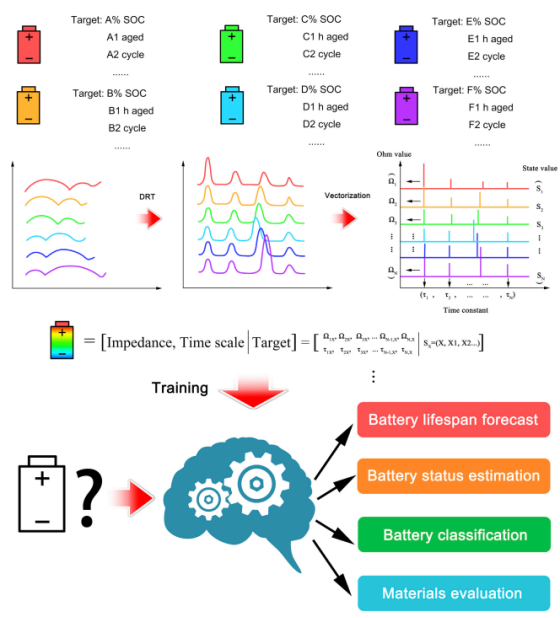
Figure 6 Modeling the battery through DRT, providing a data-driven source for AI predictions based on machine learning..
04
Conclusion and Outlook
Time scale-based analysis provides an opportunity to separate the coupled dynamic information in the battery’s “black box.” Studying its internal dynamic characteristics is a powerful approach.EIS can identify different dynamic processes through integration with DRT. In short, time scale analysis based on DRT can significantly promote fundamental understanding of electrochemistry, with the following unique advantages: efficient and accurate analysis, providing new insights on time scales, offering a strong reference for ECM, accurate measurement of EIS, accuracy of DRT algorithms, determining the true meaning of specific time constants, combining DRT models with DDT and DDC, extending one-dimensional DRT to multi-dimensional DRT, and data-driven battery analysis applications.
05
References
The Timescale Identification Decoupling Complicated Kinetic Processes in Lithium Batteries. (Joule. 2022, DOI: 10.1016/j.joule.2022.05.005)
Original Link:
https://www.sciencedirect.com/science/article/pii/S254243512200232X