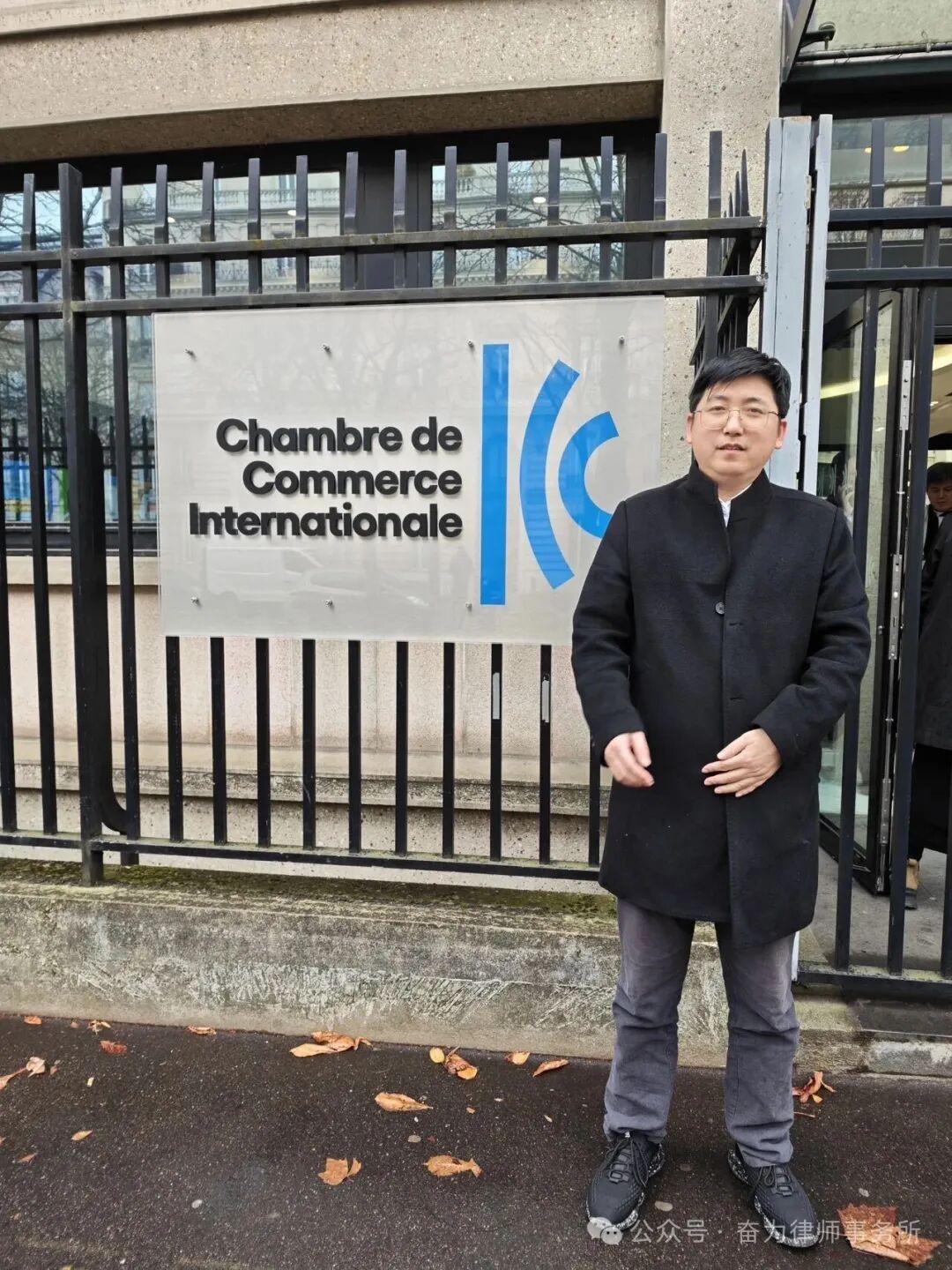
Paris, the capital and economic center of France, is a world cultural city and ranks among the top five international metropolises. It is a city that combines a rich history, brilliant art, modern vitality, and romantic charm.
In the history of international law, Paris also holds a significant position as the signing location for many influential international treaties. For instance, the 1883 Paris Convention for the Protection of Industrial Property was the first international convention to protect industrial property such as patents and trademarks; the 1947 Paris Peace Treaties stipulated territorial adjustments, war reparations, and political and military restrictions for the defeated countries; and the 2015 Paris Agreement on climate change established a new framework for global climate governance post-2020.
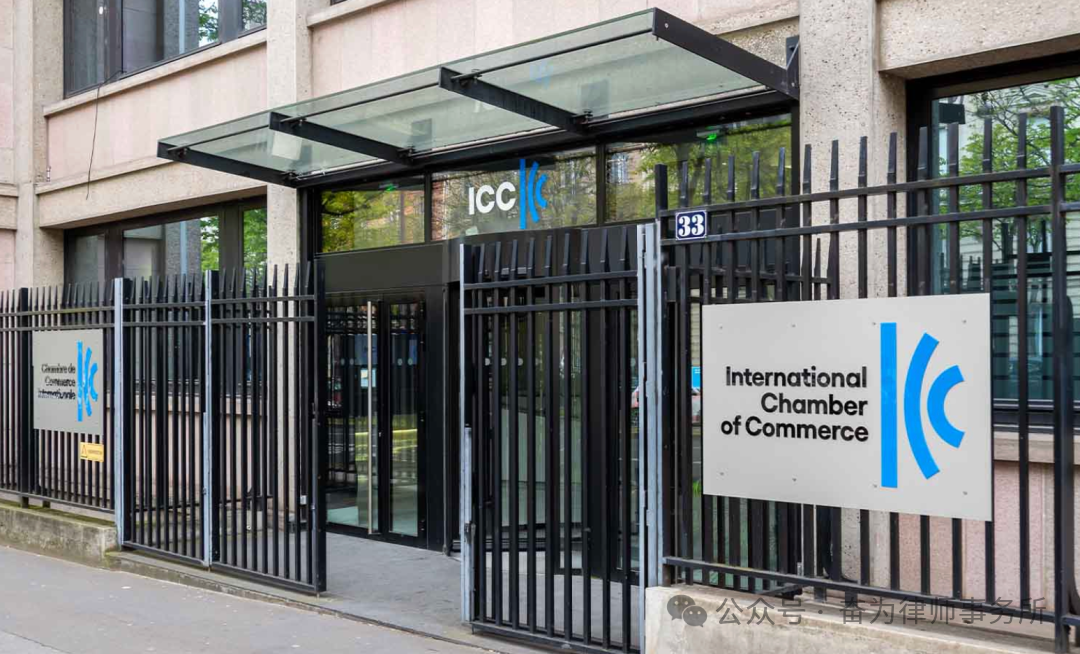
Exterior of the International Chamber of Commerce
According to the plan, this study tour has multiple learning tasks in Paris. On the 19th local time, the study group visited the renowned international arbitration institution—the International Chamber of Commerce (ICC). Dr. Zhang Anran, Deputy Director of the ICC’s North Asia Dispute Resolution Division (China), along with Mr. Wu Shaoqiang, Deputy Legal Advisor of the ICC Arbitration Court (Singapore), and Ms. Zhang Siqi (Taiwan, China), received the study group and jointly delivered a lecture on “ICC Arbitration Rules and Practices”.
Characteristics and Advantages of ICC Arbitration
This exchange involved knowledge in the field of international arbitration, which is not the primary area of practice for the author. Some topics were “beyond the syllabus,” requiring an open mind to absorb as much as possible. The main working languages of the speakers were English or French, but to improve efficiency, they delivered their presentations directly in Chinese. From the discussions, the main characteristics and advantages of the ICC were identified: while maintaining flexibility and party autonomy, it ensures the quality and enforceability of awards through unique institutional oversight.
Global Leading Position and Reputation.Since its establishment in 1923, the ICC has handled over 29,000 cases, with 841 new cases registered in 2024 and a backlog of 1,789 cases by the end of the year. This makes it one of the busiest and most experienced arbitration institutions in the world.
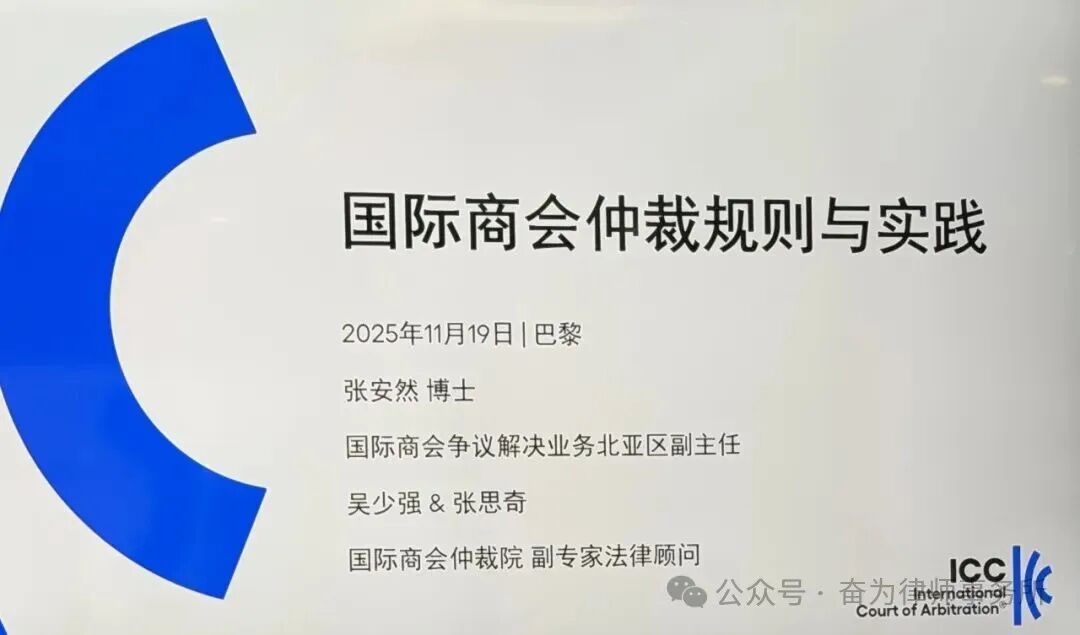
Speakers and Topics
Industry Recognition.The ICC Arbitration Rules have been rated as the preferred arbitration rules globally by authoritative research (such as the joint report by Queen Mary University and White & Case), enjoying a high level of international reputation and recognition, with the authority and enforceability of its awards widely accepted.
Unique Institutional Oversight and Quality Control (Core Feature).The ICC has a clear award scrutiny system, where the ICC International Court of Arbitration reviews the draft award and provides suggestions for amendments before it is signed and delivered to the parties. The review focuses on the form of the award, logical reasoning, and enforceability risks, without interfering with the tribunal’s decisions on substantive issues.
High Flexibility and Party Autonomy.This is reflected in the flexibility of the tribunal composition, where parties can agree on the number of arbitrators (sole or three). If there is no agreement, the ICC will decide based on the complexity of the dispute; procedural arrangements are flexible, and the seat of arbitration and the language of arbitration can be agreed upon by the parties. Various procedural options are available: in addition to the standard procedure, a fast-track procedure is offered for cases with smaller amounts in dispute, concluding within six months and at a lower arbitration cost.
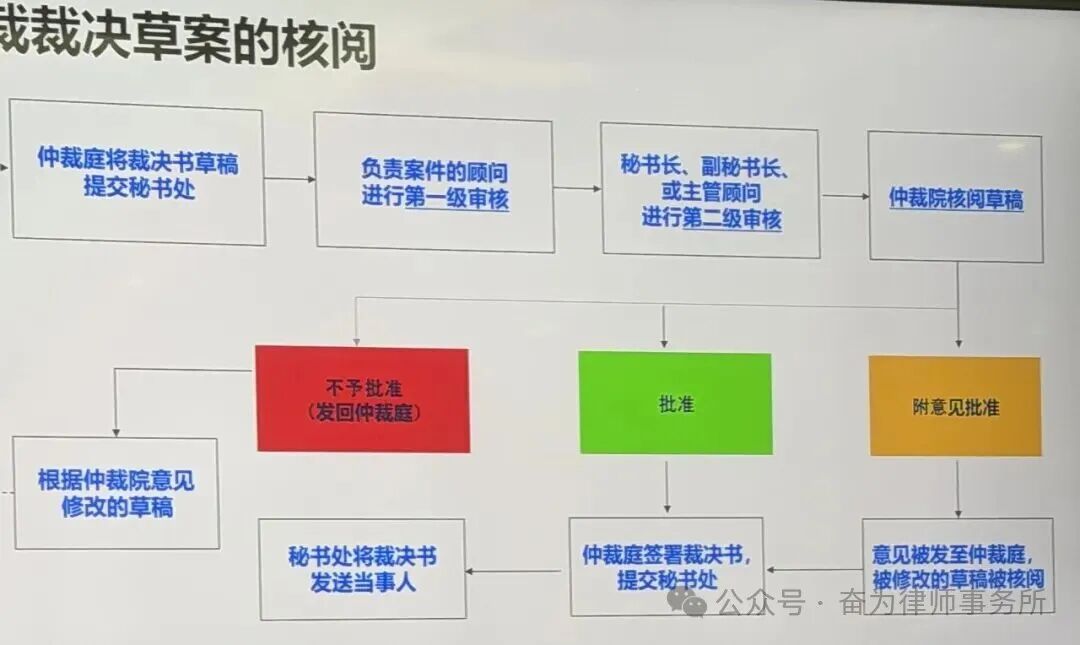
Core Features of ICC: Review of Draft Awards
Internationality and Diversity.The globalization of parties, arbitrators, and seats of arbitration is evident. In 2024, parties came from 136 countries and regions, with 1,020 arbitrators from 91 jurisdictions, and arbitration took place in 107 cities. This diversity ensures that the tribunal has the perspective and capability to handle cross-cultural and cross-jurisdictional disputes.
Ability to Handle Complex High-Value Cases.In 2024, the average amount in dispute for new cases was $130 million, with a total value of pending cases reaching $354 billion by the end of the year. This indicates that large enterprises and state entities highly trust the ICC’s ability to handle significant disputes. In 2024, about 33% of cases involved multiple parties, with one case involving 40 parties, which the ICC managed effectively, demonstrating extensive experience in handling complex situations.
However, Ms. Zhang Siqi mentioned that the belief that the ICC only handles high-value cases is a misconception; the ICC also deals with many small-value cases. In her recollection, one case involved a dispute amount of only $9,500. This aligns with the organization’s slogan, which I noticed upon entering: “we make business work for everyone, every day, everywhere”; if it only accepted high-value cases, it would not be “for everyone”.

ICC’s Mission
Multi-tiered Dispute Resolution Service System.The ICC is not limited to arbitration but provides a “one-stop” dispute resolution service. Supporting services include mediation, expert determination, and dispute review panels. Parties can seek mediation during the arbitration process or utilize dispute review panels to prevent disputes during contract performance. Additionally, there is an emergency arbitrator system that allows parties to apply for urgent interim relief from the ICC before the tribunal is constituted.
Overview of ICC’s Business Operations
During the presentation, the speakers also shared a lot of ICC’s business data, which is publicly available online.
Consistently High Case Volume.In 2024, the ICC International Court of Arbitration (the internal body responsible for managing ICC cases) registered 841 new arbitration cases. By the end of 2024, the total number of cases being managed reached 1,789, setting an unprecedented record with a total case value of $354 billion.
Internationalization and Diversity.The cases handled by the ICC are highly international, with about 69% involving cross-border disputes. Parties come from 136 countries and regions, arbitrators from 91 jurisdictions, and arbitration takes place in 107 cities across 62 countries.
Dispute Amounts.About 50% of new cases have amounts in dispute between $1 million and $30 million. Nearly 37% of cases have amounts not exceeding $3 million (the threshold for the fast-track procedure). The average amount in dispute is $130 million (new cases) and $211 million (pending cases at year-end).
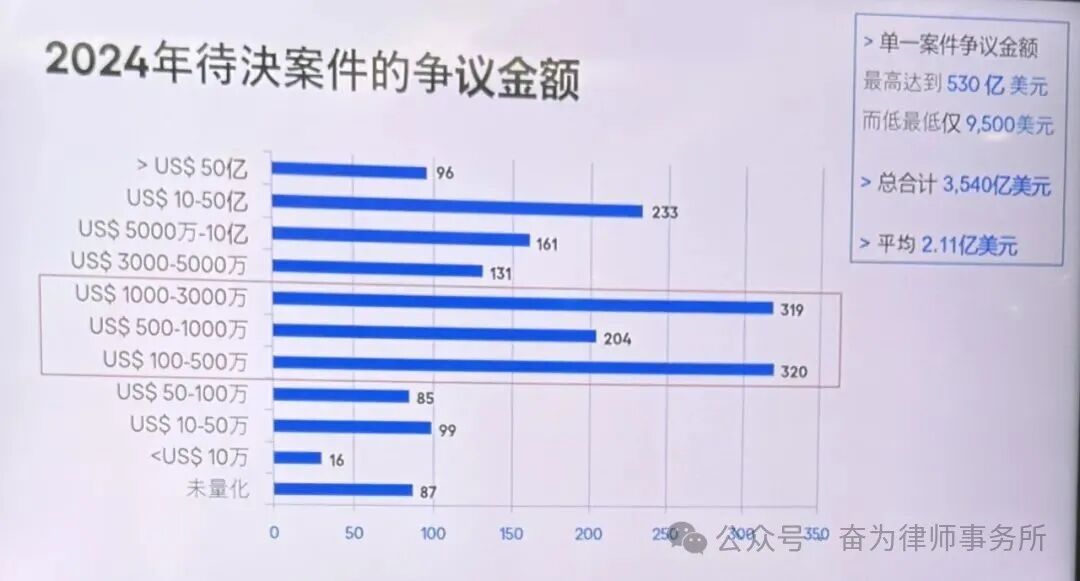
Distribution of Amounts in Dispute
Areas of Dispute.The construction/energy sector is the primary source of cases, accounting for 44% of new cases (193 and 170 cases, respectively). Other major areas include transportation, finance and insurance, telecommunications technology, etc.
Fast-Track Procedures.152 new cases utilized the fast-track procedure (of which 147 were automatically applicable, and 5 were agreed upon by the parties). Since the introduction of this procedure in 2017, the ICC has handled a total of 865 fast-track cases, demonstrating its efficiency.
Party Distribution by Region.European parties account for the highest proportion (nearly 40%), followed by the Americas (30%), Asia-Pacific (22%), and Africa (8%). The leading countries/regions by number of parties include the United States, Brazil, Spain, Mexico, Italy, and China (including Hong Kong). State and state-owned enterprises19% of new cases involved states or state-owned enterprises as parties, totaling 188 (from 45 countries, 143 state-owned enterprises).
Composition of the Tribunal.A total of 1,020 arbitrators participated in cases through 1,427 confirmations or appointments. Among them, 73% were nominated by the parties or co-arbitrators, and 27% were directly appointed by the ICC Court. In 63% of cases, parties chose a three-member tribunal, while 37% opted for a sole arbitrator. When parties could not reach an agreement, the ICC Court appointed a sole arbitrator in 82% of cases.
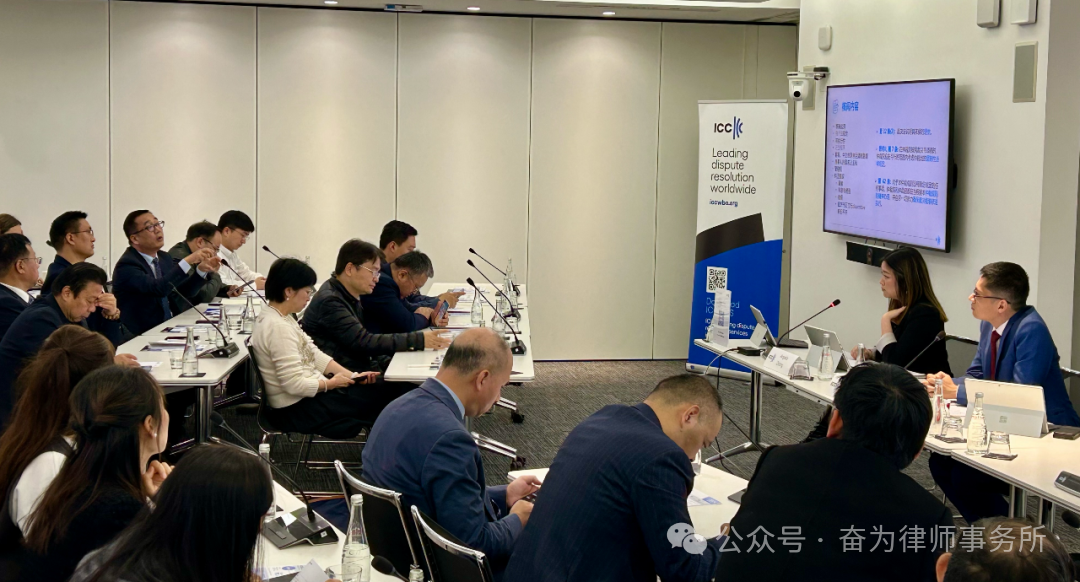
On-Site Exchange Meeting
Seat of Arbitration and Applicable Law.The most commonly chosen seats of arbitration are London, Paris, Geneva, New York, and Zurich. The UAE (Dubai) has entered the top five for the first time. 95% of contracts include a choice of law clause. The most frequently chosen governing law is English law (125 cases), followed by the law of a U.S. state (69 cases), Swiss law (60 cases), Brazilian law (44 cases), and French law (42 cases).
Types and Duration of Awards.The ICC Court approved 577 draft awards in 2024 (including 413 final awards, 112 partial awards, and 52 consent awards). English remains the primary language of awards (77%). The average duration for cases resulting in final awards was 26 months, with a median of 22 months. 391 cases were withdrawn before the award was made.
Insights for Chinese Enterprises
When Chinese enterprises engage in international arbitration, choosing the arbitration institution is a core business decision they must face during international transactions. In practice, most Chinese enterprises most commonly choose Hong Kong and Singapore as arbitration locations, with the corresponding arbitration institutions being the Hong Kong International Arbitration Centre (HKIAC) and the Singapore International Arbitration Centre (SIAC). In recent years, arbitration institutions in mainland China, especially the China International Economic and Trade Arbitration Commission (CIETAC) and the Shenzhen International Arbitration Court (SCIA), have also maintained high usage rates, particularly in transactions involving one or both parties being Chinese enterprises.
For Chinese enterprises aiming for global presence, understanding and effectively utilizing arbitration is essential for enhancing global competitiveness, managing cross-border risks, and ultimately becoming mature multinational enterprises. The choice of international arbitration institutions should consider the specific circumstances of the enterprise and the case, taking into account factors such as cost and convenience.

View of the Eiffel Tower
For Chinese enterprises truly participating in international competition, especially listed companies and large state-owned enterprises, HKIAC and SIAC provide the international credibility, neutrality, and procedural guarantees required by Chinese enterprises, making them standard choices for “going global.” For high-end complex matters, considering ICC is advisable, as it is favored in the highest-end international transactions (such as cross-border mergers and acquisitions, bulk commodity trading) due to its global reputation and ability to handle extremely complex disputes. In transactions between domestic enterprises or where the counterparty is also acceptable, CIETAC and SCIA are solid choices with deep roots.
Regardless of the choice, Chinese enterprises should no longer view international arbitration merely as a “cost” or “trouble” but as a strategic tool for protecting their rights. They should actively learn the rules and participate in a proactive and professional manner, rather than responding passively. When engaging in significant international projects, cross-border mergers and acquisitions, or bulk commodity trading, including arbitration clauses in contracts is best practice internationally. This is not only necessary for legal risk prevention but also a hallmark of enterprise internationalization and professionalism, helping to enhance credibility in international negotiations.
Additionally, there should be a combination of cultivating internal talent and effectively utilizing external experts, developing an internal legal team that understands the business, speaks foreign languages, and is familiar with international arbitration rules. When encountering significant issues, it is essential to hire law firms with rich experience in international case representation early, allowing experts to take charge, ensuring a smooth and efficient process.
Footnote 1: The abbreviation for the International Criminal Court is also ICC,International Criminal Court, please distinguish.
— The End —
This article is sourced from: Wang Qiang’s WeChat public account of Liansheng Law Firm (Financial Dispute Law)