During the 36th Great Wall Cardiology Conference and the Asian Cardiology Conference 2025,the “Left Main Forum” was successfully held. Professor Jiang Jun from the Second Affiliated Hospital of Zhejiang University School of Medicine delivered a keynote report titled “Interventional Treatment of Left Main Lesions: When is Hemodynamic Support Needed?” He pointed out that left main (LM) lesions pose a high risk for interventional treatment (PCI) due to the large myocardial area they supply, and complications can easily lead to hemodynamic collapse. Therefore, accurately identifying high-risk patients who require support and actively implementing hemodynamic support (HMS) strategies is key to ensuring surgical safety.
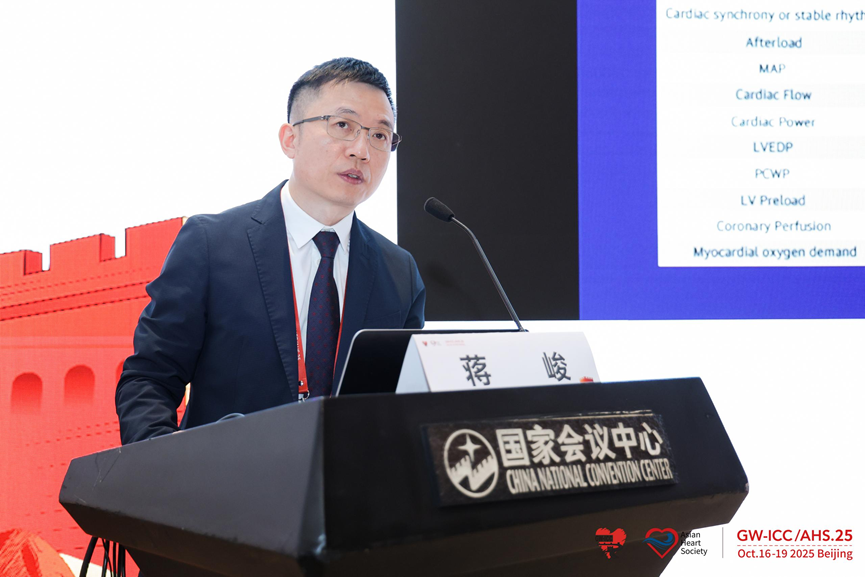
Professor Jiang Jun: Interventional Treatment of Left Main Lesions: When is Hemodynamic Support Needed
Professor Jiang first emphasized the high-risk nature of left main PCI. He reviewed early cases of left main balloon dilation performed by Gruentzig in 1978 (with a patient dying suddenly four months later), and modern studies such as EXCEL, which show that the perioperative major adverse event rate (death, stroke, or myocardial infarction) for left main PCI remains significant, with rates in the interventional group reaching around 5%, highlighting the necessity of hemodynamic support.
Professor Jiang systematically summarized several high-risk situations that require hemodynamic support. First are patients with poor clinical characteristics, such as those with a left ventricular ejection fraction (LVEF) below 35%, electrical instability, cardiogenic shock, or active heart failure, who have very poor tolerance to ischemia. Secondly, patients with severe comorbidities, particularly severe aortic stenosis, mitral regurgitation, or severe COPD. Finally, from a coronary anatomy perspective, left main lesions combined with severe right coronary disease, especially right coronary CTO, pose a very high PCI risk due to the lack of collateral flow, necessitating preemptive support.
He then reviewed the currently available hemodynamic support devices. In addition to the classic intra-aortic balloon pump (IABP), Impella can provide flow support of 3.5 liters per minute. Additionally, left atrial-femoral artery shunt devices via transseptal puncture have been launched domestically. VA-ECMO has become increasingly widespread post-COVID-19, providing flow rates of 3-7 liters per minute and addressing oxygenation issues, but its downside is that it significantly increases left ventricular afterload. Professor Jiang also looked forward to soft rotor technologies (such as Impella ECP and Suzhou Xinqin’s Nucleus), whose 9F sheath size greatly reduces the risk of peripheral vascular complications, and the external reuse of the motor can lower costs.
For patients with extremely poor left heart function, using VA-ECMO alone may lead to left heart overload, often necessitating the combination of IABP or Impella for “unloading.” Professor Jiang proposed a decision-making process: preoperative assessment of the patient’s clinical condition and performing femoral artery CTA or ultrasound. If the femoral artery diameter is greater than 5 mm and there is no severe tortuosity, Impella (if conditions allow) or ECMO combined with IABP should be prioritized; if vascular conditions are poor (less than 5 mm or severely narrowed), other access routes such as the axillary artery should be considered, or fallback to using only IABP.
Professor Jiang vividly demonstrated the practical application of support strategies through three complex cases. One case involved an elderly female with COPD, who successfully underwent LM-LAD double stent implantation under Impella support due to severe calcified left main bifurcation lesions, with normal recovery of heart function postoperatively. The second case was a 90-year-old patient with cardiogenic shock, combined with calcified left main bifurcation lesions and right coronary CTO, who successfully underwent left main rotablation and DK crush under the “strongest support” of IABP combined with VA-ECMO, and has since recovered well at 93 years old. The third case involved a 71-year-old patient with recurrent angina post-CABG, combined with moderate to severe aortic regurgitation, who, despite failing to open the right coronary CTO, successfully completed the high-risk DK crush procedure for left main bifurcation lesions under the support of a new soft rotor device, significantly improving quality of life.
Conclusion
Professor Jiang’s report provides a clear roadmap for the safe implementation of high-risk left main PCI. He emphasized that for patients with unstable clinical conditions (such as LVEF < 35%), severe valvular disease, or extremely complex coronary anatomy (such as left main combined with right coronary CTO, severe calcification requiring rotablation, or complex bifurcation lesions), operators should abandon the notion of “passive waiting.” Actively assessing and preemptively placing hemodynamic support devices is crucial for reducing the risk of perioperative circulatory collapse, improving surgical success rates, and enhancing patient prognosis.
GW-ICC/AHS 2025
Click to read the original text and follow for the latest news