
reference:
4D Bioprinting Shape-Morphing Tissues in Granular Support Hydrogels: Sculpting Structure and Guiding Maturation
https://doi.org/10.1002/adfm.202414559
Xiaoman: I recently came across a fascinating paper that discusses how scientists can now use a technology called “embedded bioprinting” to create complex structures like hearts. It sounds very high-tech; simply put, it involves extruding bioink into a special jelly-like gel for printing.
Yuanye: Exactly, this “embedded” approach is crucial. Just imagine trying to build a complex castle out of very soft jelly; it would surely collapse on itself. Previous bioprinting faced this challenge because both cells and biomaterials are very soft. This technology is like placing the model of the castle into a box filled with transparent gel, and then pouring jelly into the model. This external gel, known as support hydrogel, perfectly supports all the structures.
Xiaoman: Oh, I see, it provides a temporary scaffold. What exactly is the bioink that supports these intricate structures? The paper mentions that its core components are type I collagen and hyaluronic acid.
Yuanye: Yes, this formulation is particularly clever. You can think of type I collagen as the “framework of the house” for the cells. It is the natural growth environment for cells, allowing them to comfortably attach and pull on this framework, preparing for the subsequent “morphing”.
Xiaoman: I understand, collagen plays a functional role. What about hyaluronic acid? What does it do in this context?
Yuanye: Hyaluronic acid, well, it acts more like a lubricant and shaping agent in the “construction team”. It makes the entire bioink thicker, but it has a fascinating property called “shear thinning”. This means that when the ink is extruded from the print head, it instantly becomes thinner and flows better, making the printing process very smooth. However, once printed, it immediately regains its thickness and stays firmly in place. This greatly enhances the precision of the printed structures, preventing them from becoming a mess.
Xiaoman: One is responsible for function, and the other for process; they truly are a golden duo. Earlier, we discussed the precise structures of 3D printing, but what about the “4D” in the title of this paper? Where does that come into play?
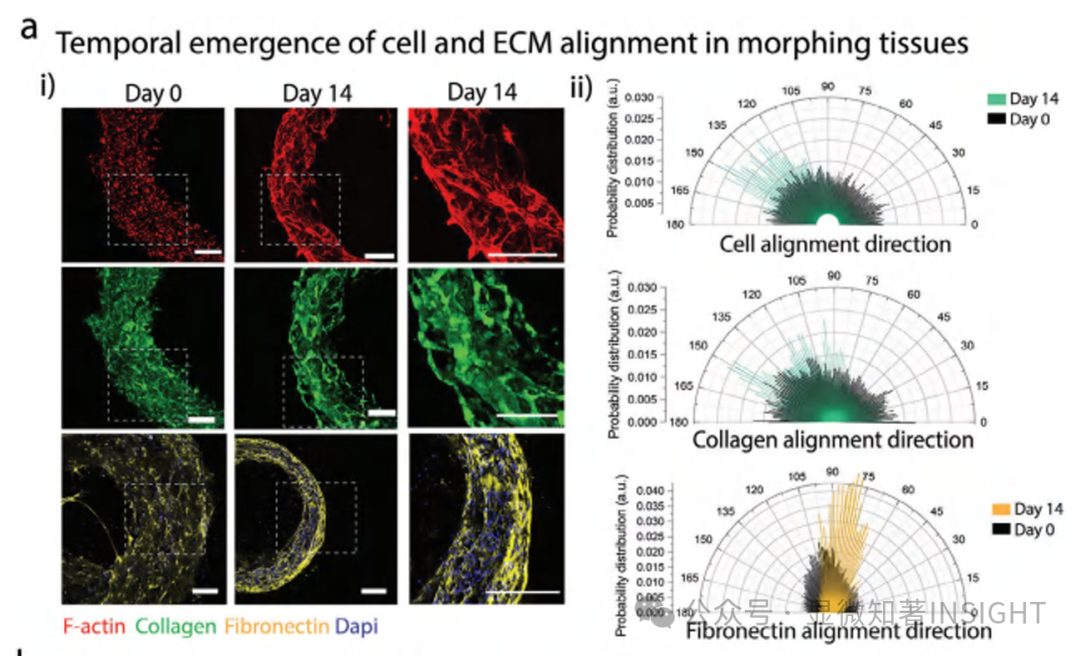
Yuanye: This is the coolest part of the entire technology! The extra “D” represents time, meaning that the printed objects can move and change shape on their own. This ability to morph comes from the cells we mentioned earlier that reside in the “collagen house”. They are not just passively waiting; they actively contract the collagen network, like thousands of tiny workers pulling ropes, ultimately causing the entire printed structure to undergo pre-designed shape changes.
Xiaoman: Interesting. So, we can print a flat object, and after a while, it can fold into a three-dimensional shape?
Yuanye: Absolutely correct! It is no longer a static model but a living, responsive “living” tissue that can change shape according to internal instructions. Cells actively “sculpt” themselves by remodeling their surrounding collagen scaffold, making the entire printed structure more akin to the growth and maturation process of real tissues in our bodies.
Xiaoman: The paper also mentions an interesting detail where they added FITC-labeled collagen to track changes in the collagen network. Is there any special significance behind this?
Yuanye: This detail touches on the core of what makes 4D printing successful. You can think of this FITC label as tiny “fluorescent lights” attached to the collagen. Through a microscope, researchers can see in real-time how these “lights” move and rearrange. This is no longer just “we guess what the cells might be doing”; we can actually see how cells pull and reshape these collagen fibers.
Xiaoman: I see, it visualizes the process of cellular work.
Yuanye: Exactly! This is not just observation; it is key to quantifying and understanding the interactions between cells and materials. It helps us accurately answer questions like “How much force did the cells exert? How do they work together?” This allows us to design and control future printed organ prototypes more precisely.
Xiaoman: So, through this labeling, we can “see” how cells gradually deform the structure, which is crucial for controlling the entire 4D printing process. From what I’ve heard, this technology indeed addresses many core challenges in the field of bioprinting.
Yuanye: That sums it up well. First, embedded printing, through a supportive “jelly”, solves the problem of collapse when printing with soft materials, making it possible to print complex structures. Secondly, the formulation of the bioink is perfect, with collagen responsible for cell function and hyaluronic acid for the printing process. Finally, and most importantly, the “morphing” ability of 4D printing comes from cells actively remodeling the collagen network, and the FITC labeling technology allows us to clearly “see” and understand this process for the first time. These points combined bring us significantly closer to printing a functional, beating heart model.