Hello everyone, this week I am sharing an article published in JACS titled “Direct Editing of Cysteine to Electrophilic Alkyl Halides in Peptides”. The corresponding authors are Professor Jacob M. Goldberg from Colgate University and Professor Fang Wang from the University of Rhode Island, whose research group focuses on peptide chemical modifications and bioorthogonal reactions.

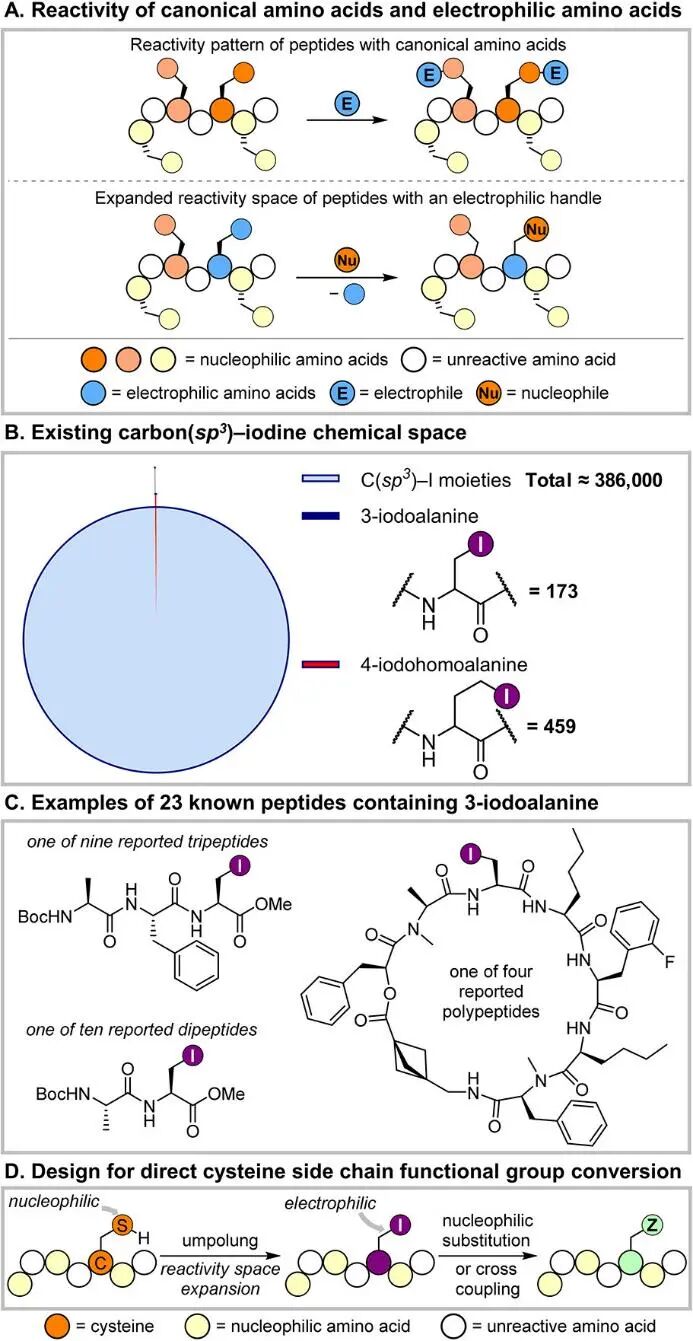
The functional group transformation strategies in traditional organic synthesis are difficult to apply to biomacromolecules such as peptides, primarily due to the nucleophilic nature of natural amino acid side chains and the propensity for side reactions. This study proposes an innovative “side chain editing” strategy: directly converting the thiol group (-SH) of cysteine into electrophilic alkyl halides (e.g., -C-I bonds), thereby reversing the reactivity of the peptide chain and unlocking diverse derivatives that traditional methods struggle to achieve. Currently, only 23 peptides containing 3-iodopropionic acid are known, all of which lack strong nucleophilic groups, highlighting the urgent need for breakthroughs in this field.
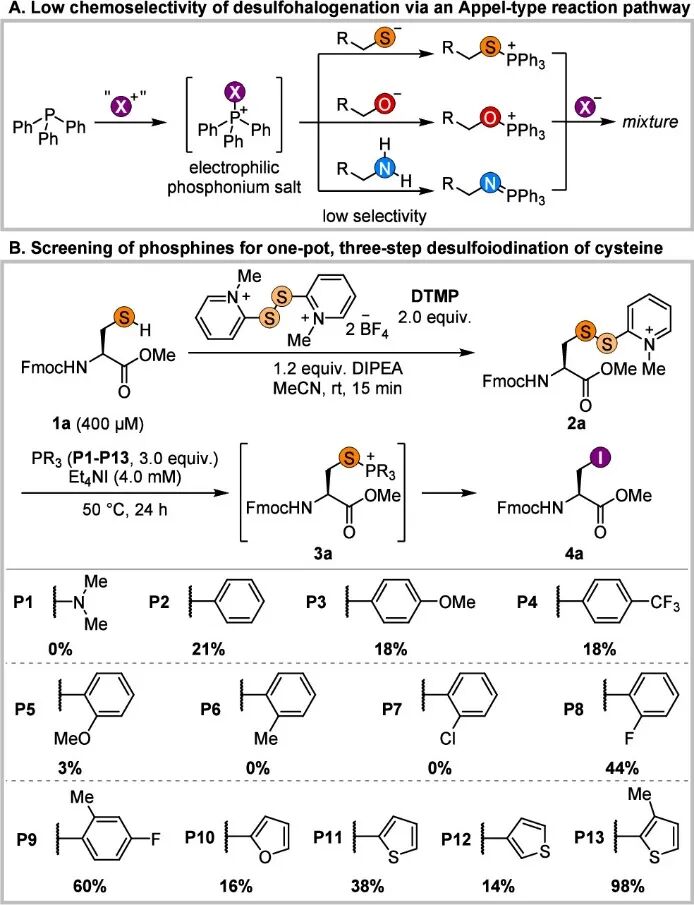
To tackle this challenge, the authors designed a “one-pot three-step” reaction pathway: first, using 2,2′-dithiobis(1-methylpyridinium) bis(tetrafluoroborate) (DTMP) to form a disulfide intermediate with cysteine; then, reacting with an electron-deficient phosphine (such as tri(3-methyl-phenyl-2-yl)phosphine P13) to form a P-S bond; and finally, generating the 3-iodopropionic acid structure through nucleophilic substitution with iodide ions. This pathway avoids the water sensitivity issues of the traditional Appel reaction, with a key breakthrough being the selection of an electron-deficient phosphine with ortho-substituents—P13’s 3-methylphenyl steric hindrance effectively suppresses hydrolysis at the phosphorus center while promoting iodide substitution.
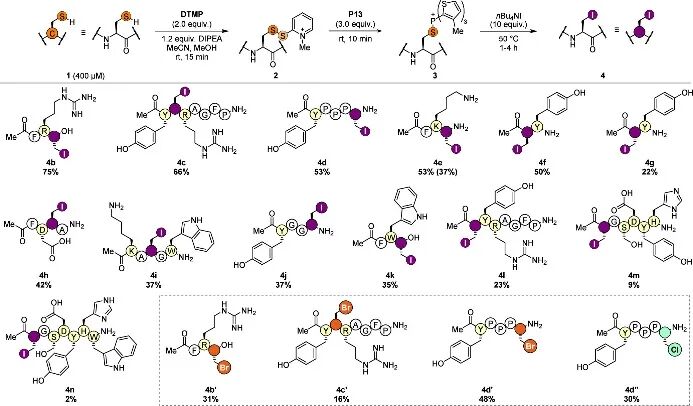
In the verification of peptide substrate applicability, this method demonstrated excellent chemical selectivity. It achieved efficient conversion of acetylated N-terminal peptides (such as peptide 1b-1l) containing multiple nucleophilic side chains like arginine, lysine, and aspartic acid under mild conditions. Notably: 1) the reaction maintained the configuration of the α-carbon chiral center (4f and 4g), overcoming the racemization issue of traditional dehydroalanine pathways; 2) it successfully extended to bromination (4b’) and chlorination (4d”), with a half-life of 20 hours under physiological conditions (4e and 4j); 3) the C-terminal amide/carboxylic acid groups were compatible. The limitation is that hydrolysis side reactions are likely to occur when histidine is adjacent to cysteine (4m and 4n).
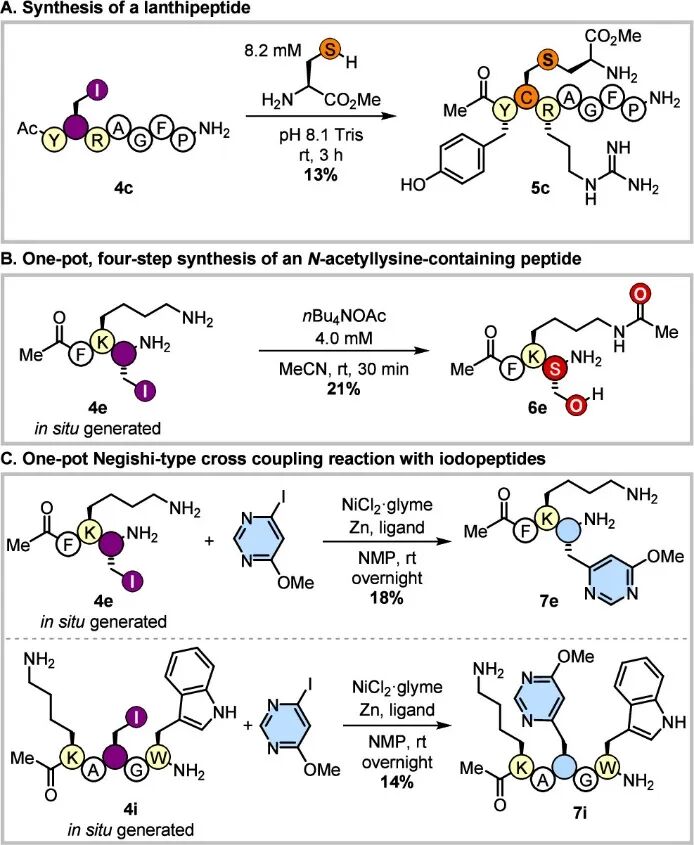
To demonstrate the synthetic potential of alkyl halide-modified peptides, the authors conducted three types of derivatization experiments. In a Tris buffer at pH 8.1, the iodinated peptide 4c underwent nucleophilic thioether formation with cysteine methyl ester, generating a wool sulfur peptide analogue 5c within 3 hours. More remarkably, iodinated peptide 4e achieved “one-pot dual modification” in the presence of acetate: simultaneous acetylation of the lysine side chain and serine mutation at the cysteine site. Finally, under nickel catalysis, the construction of carbon-carbon bonds in peptide chains was achieved—iodinated peptides 4e, 4i reacted with aryl zinc reagents in a Negishi coupling, marking the first instance in complex peptides with multiple unprotected side chains.
This research breakthrough transforms nucleophilic cysteine into electrophilic alkyl halide “synthetic hubs”, providing new tools for expanding the peptide chemical space. The developed chemical selectivity editing strategy not only overcomes the inherent challenges of biomacromolecule modifications but also unlocks reaction types such as nucleophilic substitution and cross-coupling that traditional peptide chains cannot achieve. Future optimizations of halogen stability and the expansion of coupling reaction types are expected to promote the development of new peptide drugs and biomaterials.
Author: TZS
Editor: WYQ
DOI: 10.1021/jacs.5c06200
Original link: https://doi.org/10.1021/jacs.5c06200