The “14th Five-Year Plan” for the development of the construction industry clearly states that during the “14th Five-Year” period, China aims to initially form a framework for high-quality development in the construction industry, with a more refined construction market operation mechanism, a basically sound engineering quality and safety assurance system, and a significant improvement in the level of industrialization, digitalization, and intelligence in construction. The green transformation of construction methods has achieved remarkable results, accelerating the transition of the construction industry from large to strong. Given that 3D printing technology exhibits advantages such as high automation, high precision, strong consistency, and fast work efficiency, its application prospects in the construction field are very broad. To deepen the understanding of concrete 3D printing technology, this article starts from 3D printing technology and provides a detailed introduction to concrete 3D printing technology, listing the research results of scholars at home and abroad on 3D printed concrete. It has been found that through technological innovation, the material strength and water resistance of 3D printed concrete have been significantly improved. Corresponding improvement suggestions for the shortcomings of concrete 3D printing technology are proposed, aiming to promote the further development of concrete 3D printing technology.
With the development of cities, the demand for concrete in engineering construction continues to increase, with over 4 billion tons of concrete produced globally each year. According to the 2022 report on building energy consumption and carbon emissions statistics from the China Building Energy Efficiency Association, the energy consumption for concrete material production is 490 million tons of coal equivalent (tce), and carbon emissions are 1.23 billion tons of CO2, accounting for 44% of energy consumption and carbon emissions during the construction phase. There are problems such as high energy consumption and material waste in the production and application of concrete. To solve these problems, researchers have applied the advantages of 3D printing technology to traditional concrete construction techniques.
As a hallmark technology of the “third industrial revolution,” 3D printing is widely used in industrial design, aerospace, engineering construction, and other fields, impacting traditional production techniques. Meng Qingcheng and others evaluated concrete 3D printing technology using a life-cycle approach, and the results showed that compared to traditional construction methods, concrete 3D printing technology not only saves labor but also reduces total carbon emissions by 15.97%. This article introduces the principles, equipment, and materials of concrete 3D printing technology, lists the applications of 3D printing technology in the construction field, and compares it with traditional construction techniques to analyze its shortcomings, aiming to further promote the development of concrete 3D printing technology.
1

3D Printing Technology
3D printing is based on a three-dimensional digital model (CAD), treating three-dimensional objects as two-dimensional layered structures, and manufacturing objects through layer-by-layer material accumulation. Therefore, 3D printing is also known as additive manufacturing.
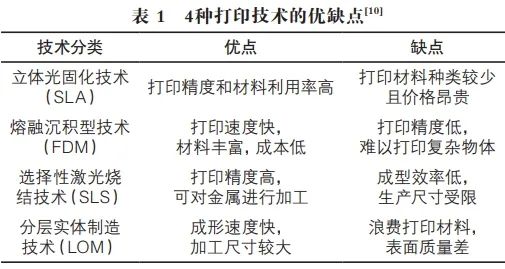
The development process of 3D printing technology is as follows: In 1986, Charles Hull from the United States proposed stereolithography (SLA) technology and launched the world’s first stereolithography printer through 3D Systems. This technology controls ultraviolet beams and a lift platform to irradiate the surface of light-curing materials, allowing them to form in an orderly manner. In 1988, Scott Crump from the United States proposed fused deposition modeling (FDM) technology, which utilizes the thermal melting and adhesion of materials to control the movement of the print head in the X and Y coordinates and extrude printing materials, which are quickly cured on the printing platform. After forming one layer, the height of the printing platform is adjusted to cure layer by layer, resulting in the printed object. In 1989, C. R. Dechard from the United States proposed selective laser sintering (SLS) technology, which uses lasers to selectively sinter solid powders layer by layer, allowing the sintered layers to stack to create the desired object. In the same year, engineer Michael Feygin developed the first layered object manufacturing printer, using layered object manufacturing (LOM) technology, which uses sheets as raw materials, applies hot melt adhesive on the surface, and presses the materials together with heated rollers. Then, laser scanning is used to cut the material profiles, ultimately achieving the formation of the object. Table 1 summarizes the advantages and disadvantages of the above four printing technologies.
2
Concrete 3D Printing Technology
With the continuous improvement of architectural design and construction technology levels, and the ongoing development of prefabricated buildings, the traditional method of on-site mixing and pouring concrete has largely been replaced by prefabricated components and modular construction. Applying 3D printing technology in the construction industry can open up new development spaces for future design and manufacturing.
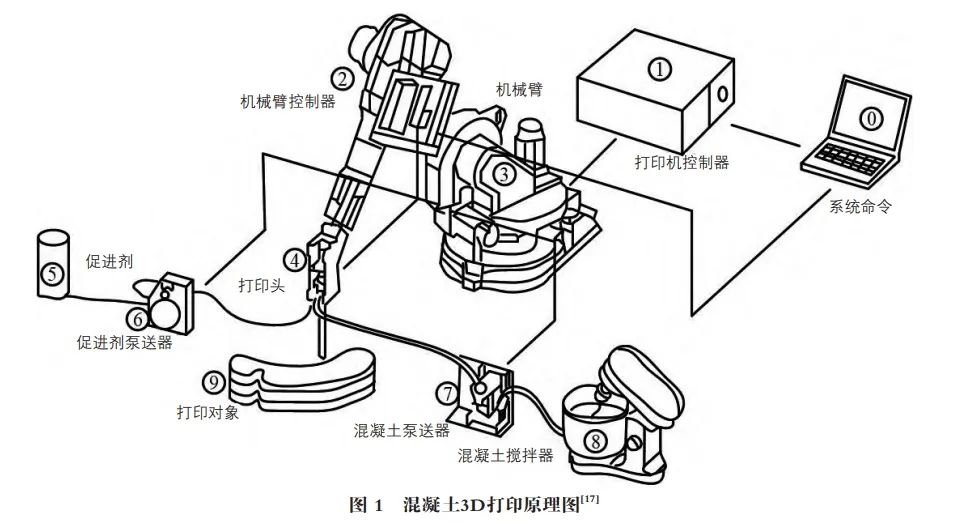
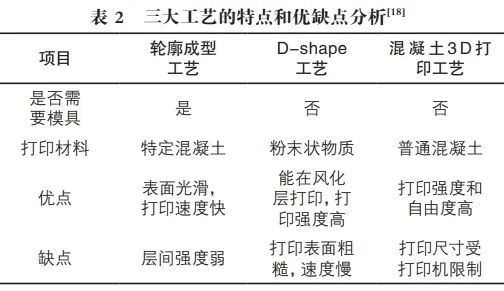
The contour forming process, D-shape process, and concrete 3D printing process are the three main processes of building 3D printing. In 1997, Behrokh Khoshnevis from the United States proposed the contour forming process, which uses computer control to extrude materials, and a nozzle attached with a trowel to refine the printed contour, creating smoother buildings. Enrico Dini proposed the D-shape process in 2004 and invented the world’s first large-scale construction 3D printer in 2010. Its working principle involves alternating spraying of particles and deposition, such as first spraying a magnesium binder and then sand, alternating to form solid buildings. In 2008, Richard Buswell from the UK proposed the concrete 3D printing process, based on the FDM process, using concrete materials instead of thermoplastic materials. Its working principle is illustrated in Figure 1. Concrete is prepared by adding appropriate proportions of binding materials, aggregates, water, or additives in a concrete mixer, and a computer is used to design and model the object, issuing system commands to control the robotic arm to extrude concrete, ultimately producing the designed concrete component. Table 2 summarizes the characteristics of the above three major processes.
Compared with traditional concrete construction methods, concrete 3D printing technology has many advantages. In terms of construction freedom, concrete 3D printing technology offers a high degree of design freedom. Traditional concrete construction requires the use of molds, which constrain its shape, whereas concrete 3D printing technology does not require mold constraints, directly accumulating concrete according to the design model, enabling the construction of various complex geometric shapes. In terms of construction precision, for parts that require high precision during construction, concrete 3D printing technology can reduce or even eliminate the use of manual labor, bypassing manual operation steps, and directly controlling mechanical equipment with a computer, which can effectively control dimensional errors. Regarding construction speed, 3D printing technology not only has higher work efficiency compared to traditional construction but also allows printing equipment to operate continuously for 24 hours. Additionally, the printed concrete materials can achieve rapid forming, effectively reducing construction time. In terms of material utilization, the materials used in concrete 3D printing technology are strictly controlled according to computer instructions, reducing concrete material waste and increasing material utilization, thereby reducing construction waste and environmental pollution. Regarding construction costs, concrete 3D printing technology reduces labor usage and material waste, shortens construction time, and significantly lowers construction costs.
3
Concrete 3D Printing Equipment
3D printing equipment is the cornerstone of achieving concrete 3D printing and is an important carrier for constructing CAD models. The printer mainly consists of mechanical systems, injection systems, and numerical control subsystems. Based on parameters such as printer size, effective printing range, printing speed, and printing control accuracy, 3D printers can be classified into three levels: desktop, laboratory, and industrial. Domestic printing equipment is classified by structural form, mainly divided into gantry, frame, and robotic arm printers, as shown in Figure 2.
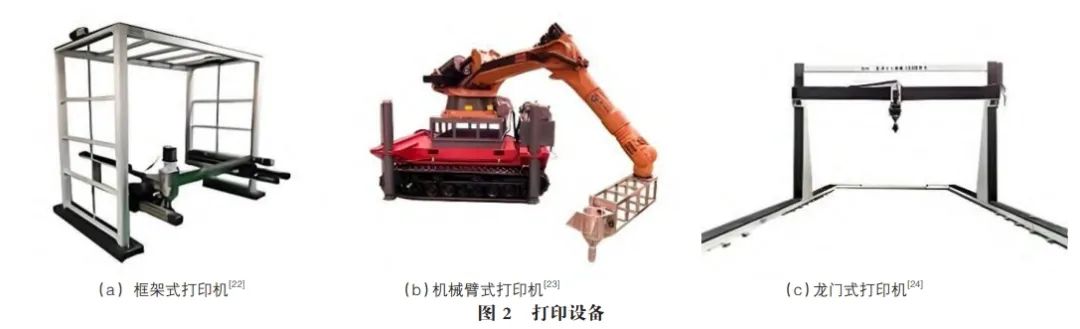
Gantry printers are surrounded by rigid supports, and the extruding nozzle moves along the X, Y, and Z coordinate axes. Theoretically, the Y-axis direction can be extended as needed, making it convenient for disassembly and transportation, commonly used in large building construction. The structure of frame printers is similar to that of gantry printers, but they possess higher precision and stability. Due to size limitations of the printing frame, frame printers are suitable for printing small building components and municipal decorations. Robotic arm printers, also known as robotic printers, have nozzles that follow the movements of robotic arms, which are mounted on movable bases, offering greater flexibility and not being limited by printer size. Based on the characteristics and advantages of different types of printers, a reasonable choice of printer type should be made during construction based on site conditions and architectural requirements.
4
Concrete 3D Printing Materials
The key to realizing 3D printed concrete technology lies in selecting high-quality printing materials, which must possess excellent plasticity and high strength. During the 3D printing process, concrete materials need to have excellent extrudability and fluidity, as well as controllable setting times. Only when concrete materials can be extruded continuously and uniformly can the construction of building structures proceed smoothly. Furthermore, special attention must be paid to the early strength of the material after extrusion, i.e., the constructability of the material, to ensure the safety and stability of the building. To this end, scholars at home and abroad have conducted extensive research on concrete printing materials.
WEI Y et al. proposed a method to measure the printability of concrete materials using the slump and spread of concrete. When the slump is between 4-8 mm and the spread is between 150-180 mm, 3D printed concrete exhibits good constructability. HENG G T A et al. found through experiments that when the ratio of glass aggregate to binder, the nano-clay content, and the limit value of the fineness modulus are 0.9, 0.2%, and 2.4 respectively, concrete materials can be continuously extruded within the limit range. LEONID D et al. found that adding polymer additives to fly ash cement improves the tensile strength of printed concrete, which not only increases the adhesion between printed concrete layers but also eliminates the disadvantages of fly ash cement. Feng Pan et al. used acrylamide to manufacture printed concrete through in-situ polymerization, which not only improves the fluidity of 3D printed concrete but also increases its 28-day flexural strength and bonding strength. Yang Qianrong et al. researched underwater 3D printed concrete and found that when 0.5% latex powder, 0.1% cellulose ether, and 0.025% starch ether are added simultaneously, the printed concrete exhibits good workability, mechanical properties, and anti-dispersion performance. Sun Xiaoyan et al. optimized the mix ratio of underwater 3D printed concrete and found that the optimal dosage of the underwater concrete flocculant is 2% of the mass of the binding material.
With the acceleration of urban construction, construction waste is also gradually increasing. Using 3D printed concrete can improve the recycling rate of construction waste resources, which is of great significance for environmental protection. Liu Chao et al. found that 3D printed recycled aggregate concrete exhibits significantly poorer frost resistance compared to natural aggregate after 200 freeze-thaw cycles. However, concrete with 100% recycled aggregate shows better frost resistance after 600 freeze-thaw cycles than concrete with 50% recycled aggregate. Bai Meiyan et al. added clay and recycled powder to construction waste to make printed concrete and found that when the clay proportion reaches 50%, the printing effect of the concrete improves significantly. When the recycled powder content is 5%, the unconfined compressive strength of the printed concrete can increase by 22.5%. Li Weihuan discovered in his research on 3D printed construction waste micro-powder geopolymer cement that when the micro-powder content is 0.5%, it can improve the extrudability of the cement; when the micro-powder content does not exceed 20%, it can enhance the constructability of the geopolymer cement. Wang Bolin et al. determined that when the optimal dosages of fly ash, silica powder, and blast furnace slag are 20%, 15%, and 10% respectively, the compressive strength of printed concrete is significantly improved.
In summary, with technological advancements, concrete 3D printing materials are developing towards good printing performance, high material strength, and excellent water resistance. The improvement of printing material performance will undoubtedly promote the development of concrete 3D printing technology.
5
Practical Applications
Concrete 3D printing technology was first used in small building printing. After Enrico Dini invented the D-Shape printer, he made a bold attempt to print a lunar base, as shown in Figure 3. Subsequently, the technology was gradually applied to house construction, prefabricated component production, as well as landscaping and garden scenes. Currently, concrete 3D printing technology mainly serves as a supplementary method to traditional building construction.
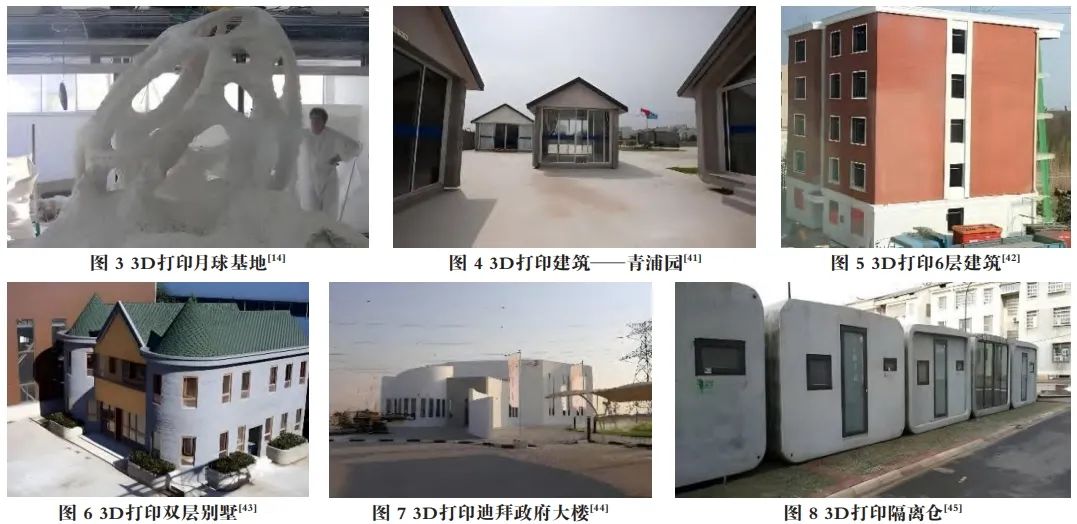
Currently, in house construction, 3D printed concrete is widely used. In 2014, Shanghai Yingchuang Building Company printed 10 buildings of 200 m2 in Qingpu Garden, as shown in Figure 4. This was one of the first batches of 3D printed building complexes in China, made from recycled concrete 3D printing, and the entire printing process took only 24 hours. In 2015, the company printed a frame structure building with 5 floors above ground and 1 below, which was the tallest 3D printed building in the world at that time, breaking the notion that 3D printing technology cannot construct high-rise buildings, as shown in Figure 5.
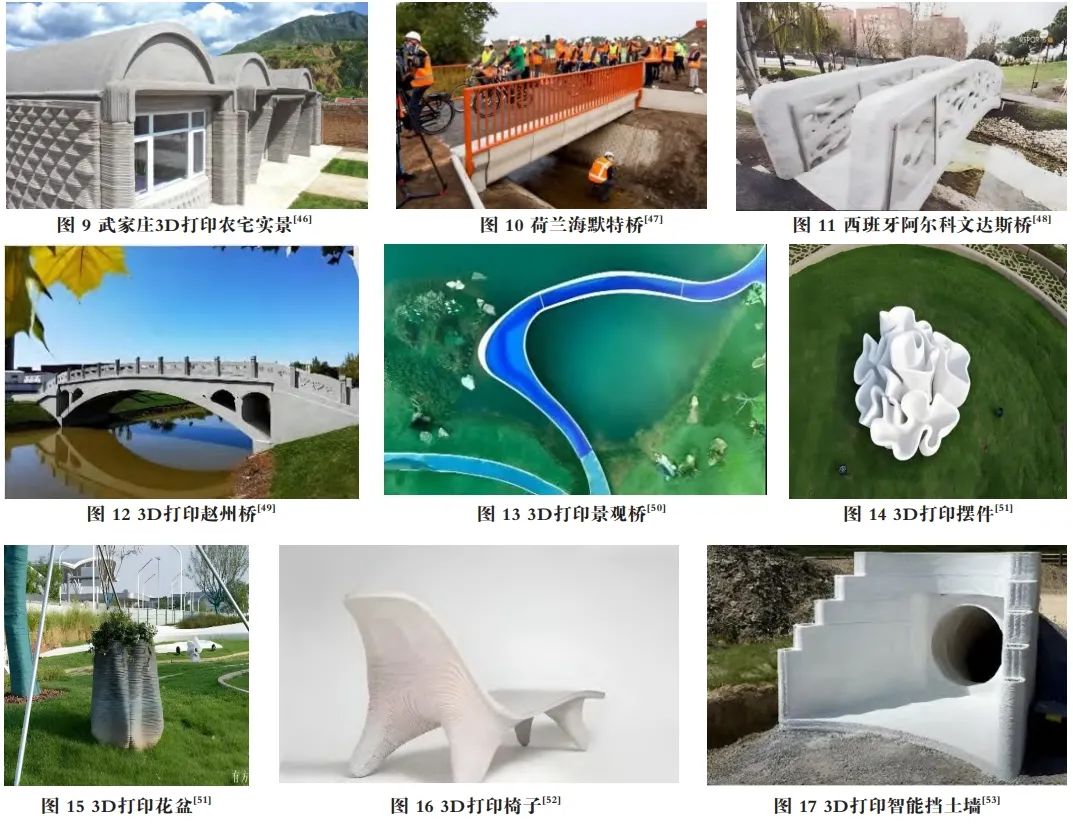
In 2016, a two-story 3D printed villa, 6 m high, 15 m long and wide, with wall thickness of 25 cm and seismic rating above level 8, was completed by Huashang Tengda Industrial Co., Ltd. in 45 days, as shown in Figure 6. During the printing process, this two-story 3D printed villa required only technical experts to supervise the construction, with almost no other human intervention. Its characteristic of being formed in one go attracted widespread attention. In 2019, Apis Cor printed a two-story administrative building for the Dubai government, with a height of 9.5 m and an area of 640 m2, which was the largest 3D printed building at that time, as shown in Figure 7. In 2020, Shanghai Yingchuang Building Company used concrete 3D technology to build an epidemic prevention isolation cabin, which measures 3.8 m long, 2.4 m wide, and 2.8 m high, as shown in Figure 8. The building was printed in a factory, only needing to be transported to the site, and could be used normally after being powered on. It took only 2 hours to print one isolation cabin, and it can be moved and reused in the future. In 2021, Professor Xu Weiguo’s team from Tsinghua University built a 106 m2 farmhouse in Wujiazhuang, Henan, with furniture such as seats also made from 3D printed concrete, making it the first house in the country completely built from 3D printed concrete. This house won the “Top Ten Beautiful Homes” award in Henan Province in 2023, as shown in Figure 9. The increasing number of 3D printed houses and the continuous breaking of previous records in building size and height promote the development and improvement of concrete 3D printing technology, laying the foundation for the commercialization and promotion of 3D printed buildings in the future. In bridge construction, concrete 3D printing technology has also been applied in a considerable number of cases. In 2017, Eindhoven University of Technology built a prestressed concrete bridge in Heimer, Netherlands, which is 8 m long and 3.5 m wide, printed in 6 segments, and then assembled on-site, with prestressing tendons pulled to make the bridge a whole. Its construction speed is three times that of traditional construction, as shown in Figure 10. In 2018, Spain built the world’s first 3D printed concrete bridge—Alcobendas Bridge, which is 12 m long and 1.75 m wide, assembled from 8 prefabricated 3D printed concrete segments, taking more than half a month to complete. The construction of this bridge saved costs and reduced construction waste, as shown in Figure 11. In 2019, a team from Hebei University of Technology utilized prefabricated concrete 3D printing to create the Zhao Zhou Bridge, which is 28.10 m long, with a single arch span of 18.04 m and a width of 4.20 m, making it the longest 3D printed bridge in the world at that time, as shown in Figure 12. In 2021, Shanghai Cool Eagle Company printed a large concrete 3D printed bridge in Chengdu Yima River Park, which is 66.58 m long, with the 3D printed portion measuring 22.5 m long and 2.6 m wide, as shown in Figure 13. The construction method of 3D printed bridges is simple, requiring only prefabrication in the factory and assembly on-site, and has advantages such as short construction time and material savings, making it widely applicable in the future for small bridges and landscape bridges.
In addition to applications in house and bridge construction, 3D printed concrete technology also has broad application prospects in landscape construction. Figures 14-16 show 3D printed ornaments, flower pots, and chairs. Moreover, the integration of concrete 3D printing technology with information technology has become a new application trend. In 2023, researchers from Cambridge University collaborated with enterprises to develop a 3D concrete intelligent retaining wall that is 2 m high and 3.5 m wide. They embedded sensors in the retaining wall structure, capable of providing real-time data on temperature, strain, and pressure, which can effectively detect potential faults, as shown in Figure 17.
6
Existing Issues and Suggestions
(1) Lack of relevant standards. Although the China Engineering Construction Standardization Association issued the T/CECS 786-2020 “Technical Regulations for Concrete 3D Printing Technology” in 2020, it has a narrow scope and cannot form a complete normative system.
(2) High requirements for printing materials. The selection of concrete 3D printing materials is limited; not only must the printed concrete possess good fluidity and extrudability, but also the material’s own strength and the bonding strength between layers must be considered during the printing process.
(3) Construction size limitations. In the horizontal direction, the construction size of concrete 3D printing is limited by the printer’s printing range and mobility; in the vertical direction, due to material constraints, concrete 3D printing currently cannot print high-rise and super high-rise buildings in one go.
(4) Limitations of printing equipment. Although concrete 3D printing technology can reduce costs during construction, a large amount of investment is needed for high-precision printing equipment in the early stages of research. When building the printer in situ, concrete 3D printing may also be affected by weather, site conditions, and other factors, making production activities impossible. If the concrete 3D printer is damaged, funds will also be required for repairs.
(5) Lack of technical personnel. Currently, research on concrete 3D printing technology mainly focuses on the development of printing equipment and new materials, with little emphasis on the training of technical personnel, which is not conducive to the application of concrete 3D printing technology in practical engineering. Before the large-scale commercial application of concrete 3D printing technology can be realized, it is urgent to establish a complete set of industry standards. The research results of experts and scholars should be transformed into detailed technical regulations covering material requirements, acceptance standards, seismic resistance, and other aspects, to build a comprehensive standard system. In addition, the application of concrete 3D printing technology is closely related to printing equipment, and the printing size of buildings is directly limited by printer specifications. Therefore, it is necessary to accelerate the research and development of large-scale printing equipment and improve the mechanical performance of printers, such as waterproofing and mobility, to adapt to various complex construction environments. In terms of printing material development, it is essential to ensure that materials possess basic printability while pursuing higher strengths, even surpassing traditional concrete. Therefore, in the development of new materials, incorporating solid waste materials, alloy materials, and other diverse materials is necessary to enrich the material options for concrete 3D printing technology.
Although concrete 3D printing technology helps to reduce manual labor, the quality of printing largely depends on the skill level of technical personnel. From printer installation, operation, adjustment, to maintenance, each step requires careful control by professionals. Therefore, standardized training for printing technicians is particularly important, and training efforts should be increased to enhance the professional skills of operators. At the same time, considering the trend of the Internet of Everything, concrete 3D printing technology should be integrated with internet technology, fully utilizing the advantages of the internet’s convenience, efficiency, and precision to promote concrete 3D printing technology towards a more practical and intelligent direction.
7
Conclusion
Compared to traditional construction methods, concrete 3D printing technology exhibits numerous advantages, significantly saving labor costs, improving construction efficiency, shortening construction periods, reducing waste generation and emissions, ensuring the precision of building structures, and lowering overall construction costs. However, concrete 3D printing technology is still in its infancy, and the development and application of the technology face several challenges. It is believed that with continuous advancements and breakthroughs in printing equipment and materials, concrete 3D printing technology is expected to replace traditional construction practices, becoming a mainstream technology in national construction, promoting the sustainable development of the construction industry, and contributing to environmental protection and pollution reduction.
Article authors: Xiao Yu, Liu Wenfeng
Source: Concrete World
Edited by: Metallurgical Slag and Tailings
This article is for communication and sharing only. Copyright belongs to the original author. If there are any offenses, please contact us for deletion. Thank you for your understanding.
Industry Standard Solicitation Letter
We warmly welcome concrete production, design, equipment, construction, and application units; 3D printing equipment companies, solid waste utilization companies, additive companies, related research institutions, and relevant upstream and downstream units to actively participate in the development of the industry standard “2024-0758T-JC 3D Printing Concrete Formwork Application Technical Specification”, improving the technical level of enterprises, enhancing their visibility and influence, and jointly promoting the progress of concrete 3D printing technology in China!
Solicitation Letter
Click the image to view details



Institute of Building Materials Industry Technology Information Research
Research Center for Solid Waste Utilization and Low-Carbon Building Materials
Public Account | Metallurgical Slag and Tailings
Contact Person | Liao Shucai 13651164324
Wang Xuerui 18201399321
Wang Mengyu 13051321995
Wang Xin 19921314665