|
Title |
J Eur Ceram Soc:Bi³⁺Doping and Charge Compensation Effects on the Dielectric Properties of CaTiSiO₅ Antiferroelectric Ceramics |
|
Research Background |
The demand for high-voltage multilayer ceramic capacitors (MLCCs) in power electronic circuits for electric vehicles is urgent, requiring dielectric materials to maintain stable performance under high voltage. Traditional BaTiO₃-based ferroelectric materials exhibit a significant decrease in dielectric constant under DC bias, while lead-containing PLZT antiferroelectric materials are commercially available but environmentally unfriendly. The lead-free antiferroelectric material CaTiSiO₅ (CTS) has a high breakdown field strength (>1000 kV/cm) but a low dielectric constant (~40) and poor temperature stability. The strategies for tuning its dielectric properties through element substitution are limited, especially the effects of introducing Bi³⁺ with lone pair electrons and its charge compensation mechanisms remain unclear. |
|
Research Content |
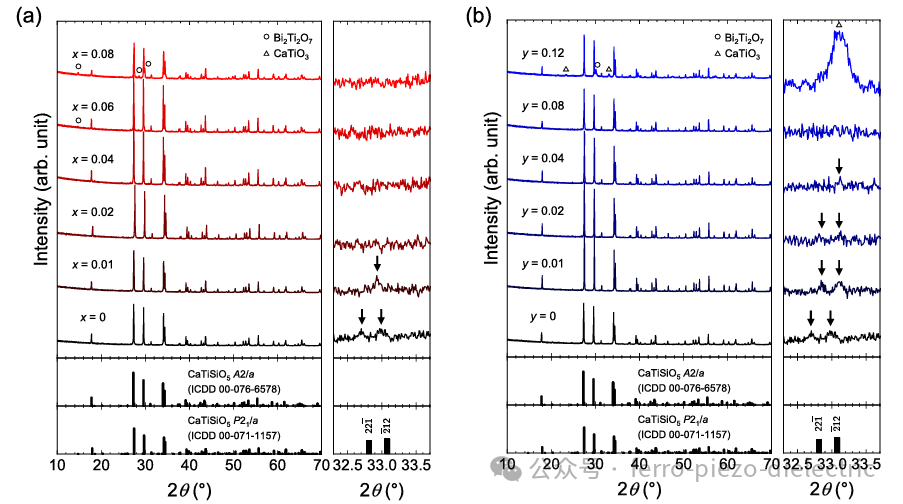
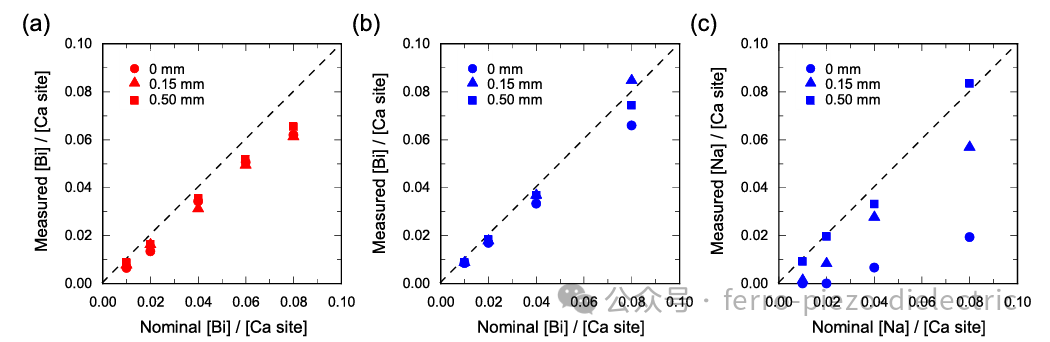
① Design two Bi³⁺doping strategies: Synthesize Ca₁₋ₓBiₓTiSi₁₋ₓAlₓO₅ (Bi-Al co-doping) and Ca₁₋₂y(Bi₁/₂Na₁/₂)₂yTiSiO₅ (Bi-Na co-doping) ceramics to study the effects of different charge compensation mechanisms. ② Systematically characterize the structure and composition: Use XRD, XRF, SEM, and other methods to analyze phase, solubility, element volatility (especially Na), and microstructure (e.g., Bi-Na doping promotes liquid phase sintering and grain growth).
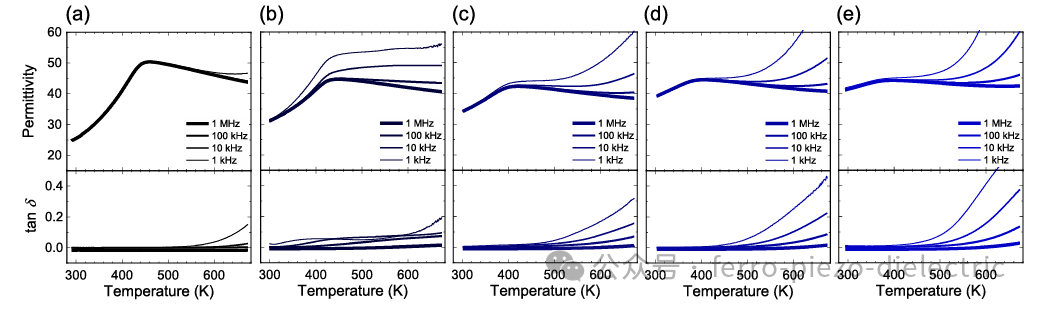
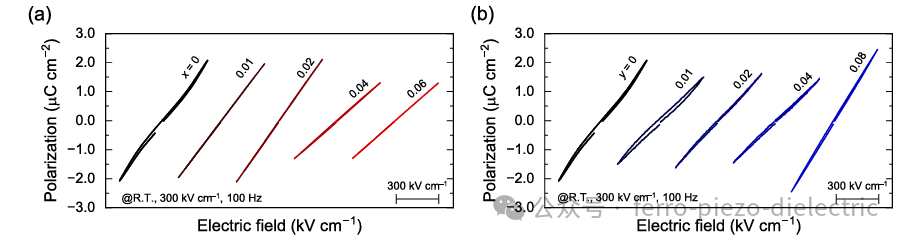
③ Analyze dielectric and ferroelectric properties in detail: Measure dielectric temperature spectra and hysteresis loops, finding that Bi-Al doping at x=0.01 destroys long-range antiferroelectric order, while Bi-Na doping at y=0.04 maintains the antiferroelectric structure.
|
|
Innovations |
① Propose and compare two charge compensation strategies: For the first time, systematically study the distinctly different effects of M-site (Al³⁺) compensation versus A-site (Na⁺) compensation on material properties when Bi³⁺ is incorporated into CTS. ② Reveal the key role of charge compensation ions: It is found that the main cause of the destruction of long-range antiferroelectric order is the introduction of Al³⁺, rather than Bi³⁺ itself, clarifying the dominant mechanism of ionic substitution on performance regulation.
③ Achieve controllable tuning of dielectric properties: By selecting compensation ions, one can obtain either a high-temperature stable quasi-ferroelectric linear response (Bi-Al) or a nonlinear response with a high room temperature dielectric constant (Bi-Na), providing flexibility for application design.
|
|
Paper Summary |
This study shows that by doping with Bi³⁺ and combining specific charge compensation methods, the dielectric properties of CTS-based ceramics can be effectively regulated. Bi-Al co-doping (x=0.01) significantly broadens the phase transition peak, increasing the room temperature dielectric constant from 25 to a peak value (which then decreases due to phase structure changes), and endows the material with excellent temperature stability (the dielectric constant varies monotonically with temperature) and linear polarization response. In contrast, Bi-Na co-doping (y=0.04) can increase the room temperature dielectric constant from 25 to about 35 while retaining the nonlinear polarization response (positive bias dependence) of the antiferroelectric structure. These two strategies provide valuable guidance for developing environmentally friendly high-performance dielectric materials for high-voltage MLCCs. This material system consists of inexpensive, non-toxic elements such as Ca, Ti, and Si, demonstrating significant application potential. |
|
Original Text |
https://doi.org/10.1016/j.jeurceramsoc.2025.117984 |
Disclaimer: This article summarizes information based on publicly available data from relevant academic journals and is not original content. It is intended for academic exchange and does not represent the views of this public account.