✅ Author Profile: A Matlab simulation developer passionate about research, skilled in data processing, modeling simulation, program design, complete code acquisition, paper reproduction, and scientific simulation.
🍎 Previous Review: Follow my personal homepage:Matlab Research Studio
🍊 Personal Motto: Investigate to gain knowledge, complete Matlab code and simulation consultation available via private message.
🔥 Content Introduction
With the global energy structure transformation and the increasing demand for sustainable development, wind and solar energy, as major clean energy sources, require accurate power output forecasting for the stable operation and optimal scheduling of power systems. This article explores the application of the Monte Carlo method in wind power and photovoltaic power output modeling. The Monte Carlo method, with its unique advantages in handling uncertainty and randomness, provides an effective tool for wind and solar output forecasting. The article first introduces the stochastic characteristics of wind and solar energy and the challenges they pose to power systems, followed by a detailed explanation of the basic principles of the Monte Carlo method and its specific implementation steps in wind and solar output models, including random variable sampling, probability distribution construction, and output scenario generation. Finally, through case analysis, the effectiveness of the Monte Carlo method in improving the accuracy of wind and solar output forecasting and assessing the operational risks of power systems is validated, and future research directions are discussed.
Keywords
Monte Carlo method; wind power generation; photovoltaic power generation; output forecasting; randomness; uncertainty
1. Introduction
The global climate change and energy crisis have prompted countries to actively seek renewable energy alternatives to traditional fossil fuels. Wind and solar energy, due to their cleanliness and abundant resources, have become important components of power systems. However, the intermittency, volatility, and uncertainty of wind speed and solar irradiance pose significant challenges to the planning, scheduling, and operation of power systems. Accurately forecasting wind and photovoltaic output is key to ensuring the safe and stable operation of the grid and improving the absorption level of renewable energy.
Traditional methods for forecasting wind and solar output mainly include physical methods, statistical methods, and artificial intelligence methods. Physical methods model based on meteorological forecast data and the characteristics of wind and solar units; statistical methods establish forecasting models through historical data mining and regression analysis; artificial intelligence methods utilize advanced algorithms such as neural networks and support vector machines to learn complex nonlinear relationships. These methods have improved forecasting accuracy to some extent, but there are still limitations in describing the inherent randomness and probability distribution of wind and solar output.
The Monte Carlo method, as a numerical computation method based on random sampling, demonstrates unique advantages in handling complex systems with random variables. It simulates random processes through a large number of random samples to estimate the probability distribution of system outputs. Applying the Monte Carlo method to wind and solar output forecasting can fully consider the random fluctuations of wind speed and solar irradiance, generating a large number of possible output scenarios, thereby providing a more comprehensive assessment of the operational risks and output uncertainties of power systems.
2. Stochastic Characteristics of Wind and Solar Energy
Wind and solar energy are typical stochastic renewable energy sources, and their output volatility mainly arises from the following aspects:
2.1 Randomness of Wind Power Generation
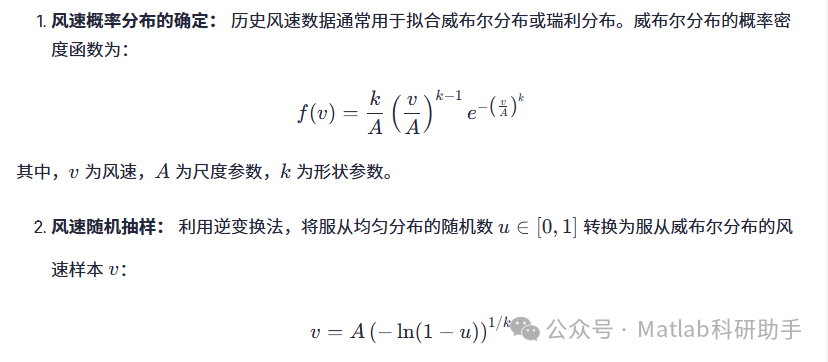
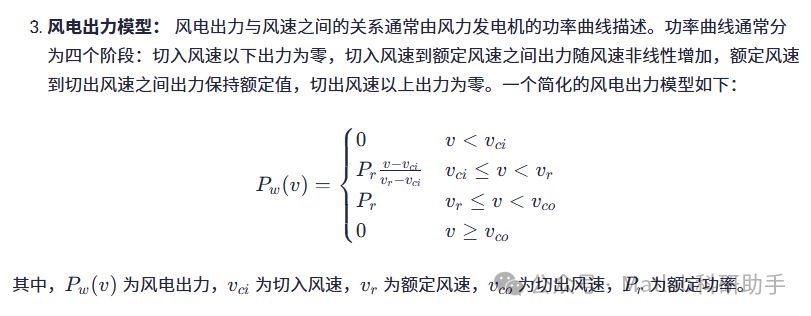
The output of wind power generation is closely related to wind speed, which exhibits significant randomness and intermittency. Factors affecting wind speed include geographical location, terrain, season, diurnal changes, and weather systems. The fluctuations in wind speed lead to nonlinear and random characteristics in wind power output. In a short period, wind speed can change dramatically, causing significant fluctuations in wind power output, which can impact grid frequency and voltage stability. From a statistical perspective, wind speed typically follows a Weibull distribution or Rayleigh distribution, while wind power output is approximately related to the cube of wind speed, making its probability distribution more complex.
2.2 Randomness of Photovoltaic Power Generation
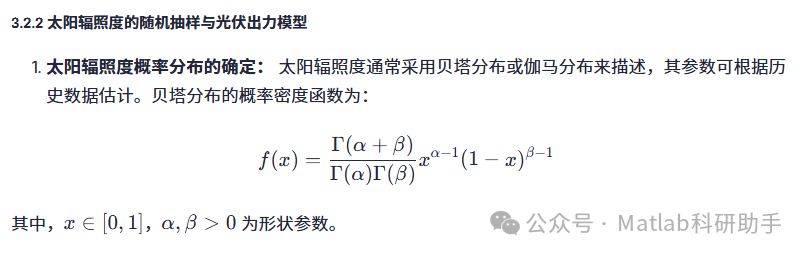
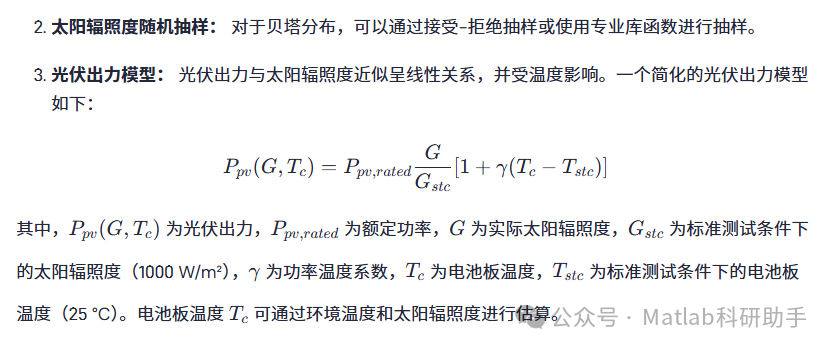
The output of photovoltaic power generation mainly depends on solar irradiance, ambient temperature, and the characteristics of photovoltaic cells. Solar irradiance is influenced by various factors such as weather conditions (e.g., cloud cover, haze), diurnal changes, seasonal variations, and geographical location. Rapid movement of cloud cover can lead to sudden changes in solar irradiance, resulting in rapid fluctuations in photovoltaic output. Additionally, shading effects can further increase the randomness of photovoltaic output. Solar irradiance is typically described using beta distribution or gamma distribution, while photovoltaic output is approximately linearly related to solar irradiance but is also affected by temperature coefficients and other factors.
2.3 Challenges of Randomness to Power Systems
The randomness and uncertainty of wind and solar output pose several challenges to the operation of power systems:
- Scheduling Difficulties: The unpredictable nature of wind and solar output makes it challenging for power system operators to formulate optimal unit combinations and power balance plans.
- Increased Reserve Capacity Demand: To cope with fluctuations in wind and solar output, power systems need to configure more reserve capacity, increasing operational costs.
- Frequency and Voltage Stability Issues: Significant fluctuations in wind and solar output may cause grid frequency and voltage to exceed allowable limits, affecting grid safety.
- Wind and Solar Curtailment Issues: In scenarios where wind and solar resources are abundant but grid absorption capacity is insufficient, curtailment may occur, leading to energy waste.
Therefore, developing forecasting methods that can effectively handle the randomness of wind and solar output is crucial for addressing the above challenges and promoting the healthy development of renewable energy.
3. Monte Carlo Method and Its Application in Wind and Solar Output Models
The Monte Carlo method simulates actual processes through a large number of random samples of random variables and approximates solutions based on statistical results. Its core idea is to use random number generation to create samples with specific probability distributions, thereby estimating the expected value of the target function.
3.1 Basic Principles of the Monte Carlo Method
The basic steps of the Monte Carlo method are as follows:
- Define Random Variables and Their Probability Distributions: Identify key random variables affecting system output and determine their probability distribution function (PDF) or cumulative distribution function (CDF).
- Generate Random Numbers: Use a pseudo-random number generator to produce a large number of random numbers that follow a uniform distribution.
- Sampling: Convert the uniformly distributed random numbers into random variable samples that follow the desired probability distribution using inverse transform or other sampling methods.
- Simulation: Substitute the generated random variable samples into the system model to calculate the corresponding outputs.
- Statistical Analysis: Perform statistical analysis on a large number of simulation results to obtain statistical characteristics such as the probability distribution, expected value, and variance of system outputs.
3.2 Implementation of the Monte Carlo Method in Wind and Solar Output Models
In the Monte Carlo-based wind and solar output model, the focus is on the following aspects:
3.2.1 Random Sampling of Wind Speed and Wind Power Output Model
3.2.3 Joint Output Scenario Generation
When considering wind-solar complementary or joint operation, the correlation between wind speed and solar irradiance must be taken into account. Joint output scenarios can be generated using the following methods:
- Independent Sampling: If wind speed and solar irradiance are considered independent, they can be sampled separately and then combined.
- Copula Function: When there is a correlation between wind speed and solar irradiance, a Copula function can be used to model their joint probability distribution. The Copula function connects the marginal distributions to form a joint distribution, thereby preserving the correlation between variables during sampling.
By performing a large number of samples and simulations using the Monte Carlo method, thousands or even tens of thousands of wind and photovoltaic output scenarios can be generated, reflecting various possible states of wind and solar output and their probabilities of occurrence.
4. Case Analysis
To validate the effectiveness of the Monte Carlo method in wind and solar output forecasting, we consider a power system that includes wind farms and photovoltaic power stations.
4.1 Data Preparation
- Wind Speed Data: Collect historical wind speed data for a year in a specific region, perform statistical analysis, and fit a Weibull distribution to obtain the scale parameter
A k - Solar Irradiance Data: Collect historical solar irradiance data for the same region over a year, fit a beta distribution to obtain shape parameters
α β - Wind Turbine and Photovoltaic Panel Parameters: Obtain rated power, cut-in/cut-out/rated wind speeds, power temperature coefficients, and other parameters for wind turbines and photovoltaic panels.
4.2 Monte Carlo Simulation Steps
- Sampling Count Setting: Set the number of samples for the Monte Carlo simulation
N - Sampling Wind Speed and Solar Irradiance:
- In each simulation, randomly draw a wind speed value based on the Weibull distribution.
- Randomly draw a solar irradiance value based on the beta distribution.
- If considering correlation, use the Copula function for joint sampling.
4.3 Result Analysis
By performing statistical analysis on the generated
- Probability Distributions of Wind, Photovoltaic, and Total Output: The probability density functions (PDF) or cumulative distribution functions (CDF) of wind, photovoltaic, and total output can be plotted. These distributions visually reflect the range and likelihood of wind and solar output uncertainties.
- Output Fluctuation Range and Risk Assessment: By analyzing the extremes and quantiles of the output distribution, the fluctuation range of wind and solar output can be assessed, and the probabilities of output insufficiency or excess can be calculated, providing a basis for risk assessment in power systems. For example, the minimum and maximum values that wind and solar output may reach at a specific confidence level can be calculated.
- Assessment of System Reserve Capacity Demand: The output scenarios generated by the Monte Carlo simulation can be used to assess the demand for reserve capacity in power systems. By analyzing the additional power that traditional units need to provide under different output scenarios, reserve capacity can be determined more accurately.
- Optimized Scheduling and Market Trading: In the electricity market, the output scenarios generated by the Monte Carlo method can provide more comprehensive information for electricity traders, helping them formulate better bidding strategies and reduce trading risks.
5. Conclusion and Outlook
This article elaborates on the application of the Monte Carlo method in wind and photovoltaic power output models. The Monte Carlo method effectively handles the randomness of wind speed and solar irradiance, generating a large number of statistically significant output scenarios, providing more accurate and comprehensive information for power system planning, scheduling, and operation. Through case analysis, the advantages of the Monte Carlo method in assessing wind and solar output uncertainty, risk, and reserve capacity demand have been validated.
Although significant progress has been made with the Monte Carlo method in wind and solar output models, there are still challenges and future research directions:
- Computational Efficiency: Large-scale power systems or long-term simulations require a significant amount of Monte Carlo sampling, which may lead to substantial computational loads. Future research can explore more efficient sampling methods (e.g., Latin hypercube sampling, importance sampling) or combine machine learning methods to improve computational efficiency.
- Correlation Modeling: Accurately modeling the complex correlations between wind speed, solar irradiance, and other meteorological variables is crucial for improving output forecasting accuracy. Future studies can investigate more advanced Copula function models or multivariate statistical methods to describe these correlations.
- Multi-Time Scale Forecasting: Applying the Monte Carlo method to ultra-short-term, short-term, and medium-long-term multi-time scale forecasting while considering the characteristics and correlations of random variables at different time scales.
- Integration with Deep Learning: Exploring the combination of the Monte Carlo method with deep learning techniques, leveraging the powerful feature extraction capabilities of deep learning and the randomness handling capabilities of Monte Carlo to build more robust and accurate forecasting models.
- Extreme Event Forecasting: The Monte Carlo method still has room for improvement in predicting extreme events of wind and solar output (e.g., sudden power drops or significant fluctuations). Future research can study the combination of extreme value theory and the Monte Carlo method to more accurately assess extreme risks.
- Energy Storage System Optimization: Applying the wind and solar output scenarios generated by the Monte Carlo method to optimize the configuration and operation scheduling of energy storage systems to maximize the absorption of renewable energy and enhance grid flexibility.
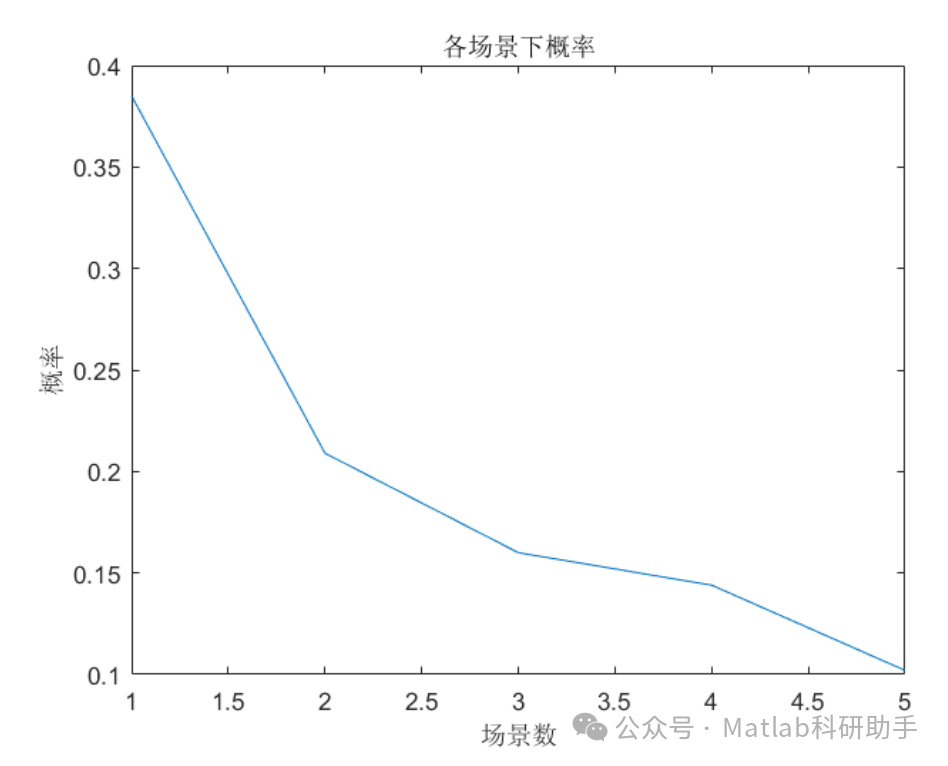
⛳️ Operational Results
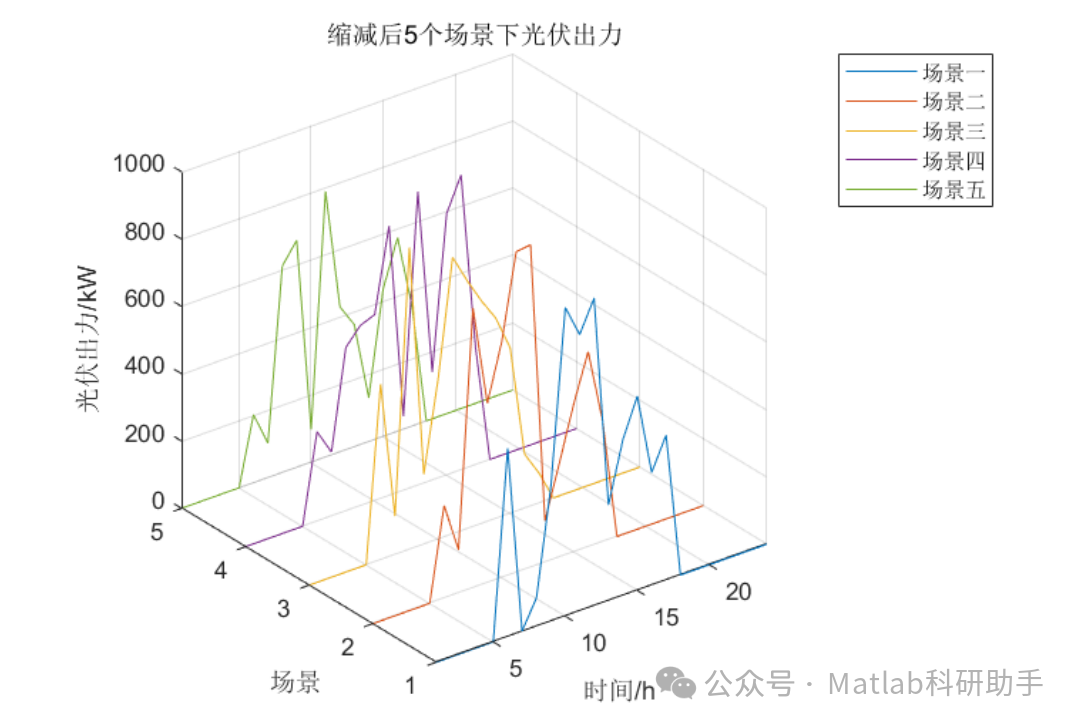
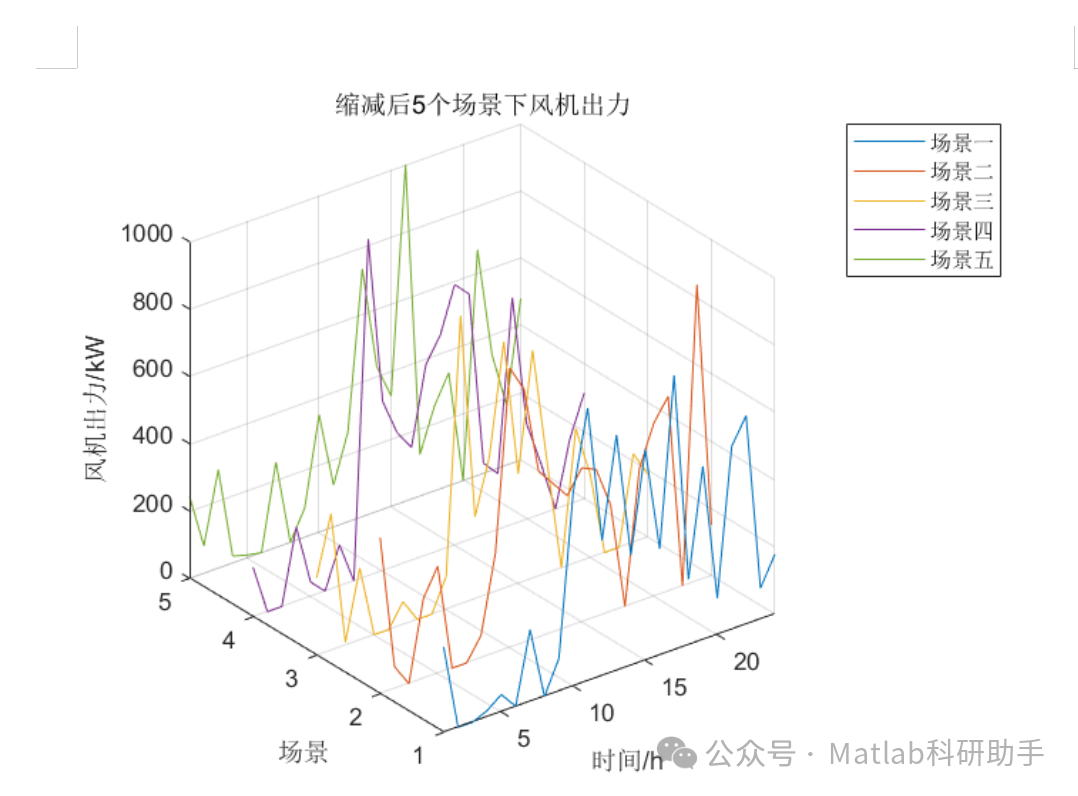
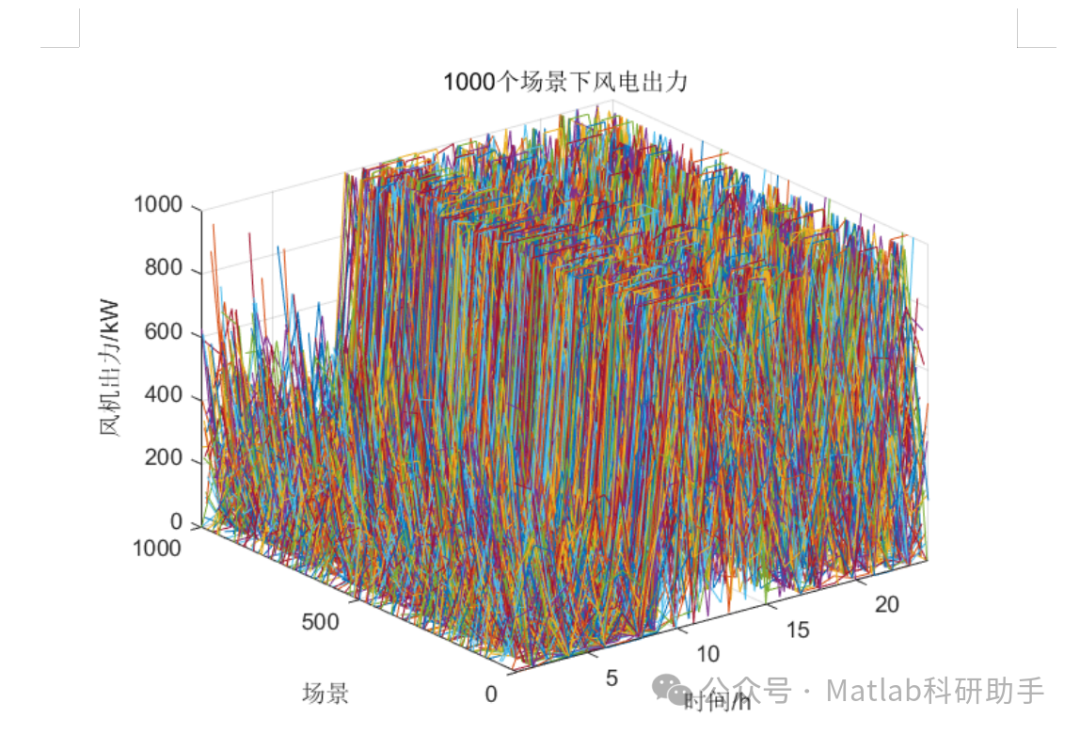
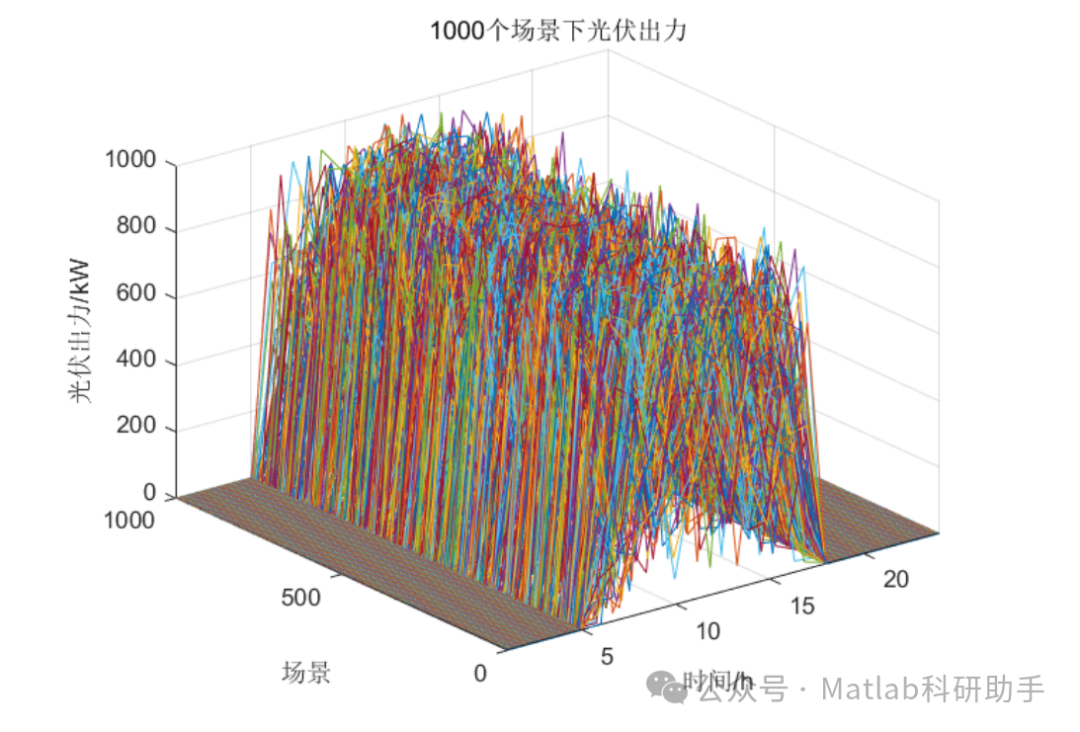
🔗 References
[1] Yu Dong, Sun Xin, Gao Bingtuan, et al. Coordinated Optimization Model for Wind Power Grid Connection Considering Wind Power Uncertainty [J]. Transactions of China Electrotechnical Society, 2016, 31(9):8. DOI:10.3969/j.issn.1000-6753.2016.09.005.
[2] Wang Zhenhao, Kang Jia, Pei Zheyi, et al. Research on the Fluctuation Characteristics of Photovoltaic Output Based on Multi-Weight Mixed Distribution Model [J]. Journal of Solar Energy, 2020, 41(6):10.
[3] Zhu Zhijie, Yang Daogang. Research on the Thermal Performance Optimization of IGCC Gas Turbine Subsystem Based on MATLAB [C]// Proceedings of the 4th Youth Conference of the China Power Engineering Society. 2009.
📣 Partial Code
🎈 Some theoretical references are from online literature; if there is any infringement, please contact the author for deletion.
👇 Follow me to receive a wealth of Matlab e-books and mathematical modeling materials.
🏆 Our team specializes in customized MATLAB simulations in various research fields to support your research dreams:
🌈 Various intelligent optimization algorithm improvements and applications
Production scheduling, economic scheduling, assembly line scheduling, charging optimization, workshop scheduling, departure optimization, reservoir scheduling, 3D packing, logistics site selection, cargo location optimization, bus scheduling optimization, charging pile layout optimization, workshop layout optimization, container ship loading optimization, pump combination optimization, medical resource allocation optimization, facility layout optimization, visual domain base station and drone site selection optimization, knapsack problem, wind farm layout, time slot allocation optimization, optimal distribution generation unit allocation, multi-stage pipeline maintenance, factory-center-demand point three-level site selection problem, emergency supply material distribution center site selection, base station site selection, road lamp post arrangement, hub node deployment, transmission line typhoon monitoring devices, container scheduling, unit optimization, investment portfolio optimization, cloud server combination optimization, antenna linear array distribution optimization, CVRP problem, VRPPD problem, multi-center VRP problem, multi-layer network VRP problem, multi-center multi-vehicle VRP problem, dynamic VRP problem, two-layer vehicle routing problem (2E-VRP), electric vehicle routing problem (EVRP), hybrid vehicle routing problem, mixed flow shop problem, order splitting scheduling problem, bus scheduling optimization problem, flight shuttle vehicle scheduling problem, site selection path planning problem, port scheduling, port bridge scheduling, parking space allocation, airport flight scheduling, leak source localization.
🌈 Machine learning and deep learning time series, regression, classification, clustering, and dimensionality reduction
2.1 BP time series, regression prediction, and classification
2.2 ENS voice neural network time series, regression prediction, and classification
2.3 SVM/CNN-SVM/LSSVM/RVM support vector machine series time series, regression prediction, and classification
2.4 CNN|TCN|GCN convolutional neural network series time series, regression prediction, and classification
2.5 ELM/KELM/RELM/DELM extreme learning machine series time series, regression prediction, and classification
2.6 GRU/Bi-GRU/CNN-GRU/CNN-BiGRU gated neural network time series, regression prediction, and classification
2.7 Elman recurrent neural network time series, regression prediction, and classification
2.8 LSTM/BiLSTM/CNN-LSTM/CNN-BiLSTM long short-term memory neural network series time series, regression prediction, and classification
2.9 RBF radial basis function neural network time series, regression prediction, and classification
2.10 DBN deep belief network time series, regression prediction, and classification
2.11 FNN fuzzy neural network time series, regression prediction
2.12 RF random forest time series, regression prediction, and classification
2.13 BLS broad learning system time series, regression prediction, and classification
2.14 PNN pulse neural network classification
2.15 Fuzzy wavelet neural network prediction and classification
2.16 Time series, regression prediction, and classification
2.17 Time series, regression prediction, and classification
2.18 XGBOOST ensemble learning time series, regression prediction, and classification
2.19 Transform various combinations of time series, regression prediction, and classification
Directions cover wind power forecasting, photovoltaic forecasting, battery life prediction, radiation source identification, traffic flow forecasting, load forecasting, stock price forecasting, PM2.5 concentration forecasting, battery health status prediction, electricity consumption forecasting, water optical parameter inversion, NLOS signal identification, subway stop precise prediction, transformer fault diagnosis.
🌈 Image processing aspects
Image recognition, image segmentation, image detection, image hiding, image registration, image stitching, image fusion, image enhancement, image compressed sensing.
🌈 Path planning aspects
Traveling salesman problem (TSP), vehicle routing problem (VRP, MVRP, CVRP, VRPTW, etc.), drone 3D path planning, drone collaboration, drone formation, robot path planning, grid map path planning, multimodal transport problems, electric vehicle routing problem (EVRP), two-layer vehicle routing problem (2E-VRP), hybrid vehicle routing problem, ship trajectory planning, full path planning, warehouse patrol.
🌈 Drone application aspects
Drone path planning, drone control, drone formation, drone collaboration, drone task allocation, drone secure communication trajectory online optimization, vehicle collaborative drone path planning.
🌈 Communication aspects
Sensor deployment optimization, communication protocol optimization, routing optimization, target localization optimization, Dv-Hop localization optimization, Leach protocol optimization, WSN coverage optimization, multicast optimization, RSSI localization optimization, underwater communication, communication upload/download allocation.
🌈 Signal processing aspects
Signal recognition, signal encryption, signal denoising, signal enhancement, radar signal processing, signal watermark embedding and extraction, electromyography signals, electroencephalography signals, signal timing optimization, electrocardiogram signals, DOA estimation, encoding and decoding, variational mode decomposition, pipeline leakage, filters, digital signal processing + transmission + analysis + denoising, digital signal modulation, bit error rate, signal estimation, DTMF, signal detection.
🌈 Power system aspects
Microgrid optimization, reactive power optimization, distribution network reconstruction, energy storage configuration, orderly charging, MPPT optimization, household electricity.
🌈 Cellular automata aspects
Traffic flow, crowd evacuation, virus spread, crystal growth, metal corrosion.
🌈 Radar aspects
Kalman filter tracking, track association, track fusion, SOC estimation, array optimization, NLOS identification.
🌈 Workshop scheduling
Zero-wait flow shop scheduling problem (NWFSP), permutation flow shop scheduling problem (PFSP), hybrid flow shop scheduling problem (HFSP), zero idle flow shop scheduling problem (NIFSP), distributed permutation flow shop scheduling problem (DPFSP), blocking flow shop scheduling problem (BFSP).
👇