👨🎓 Personal Homepage
💥💥💞💞 Welcome to this blog ❤️❤️💥💥
🏆 Blogger’s Advantage: 🌞🌞🌞 The blog content aims to be logically clear and coherent for the convenience of readers.
⛳️ Motto: A journey of a hundred miles begins with a single step.
💥1 Overview
With the increasing depletion of global energy resources and environmental pollution, improving energy efficiency and reducing emissions have always been key issues. This provides new ideas for solving current microgrid problems. A microgrid is a new type of distributed energy organization structure, regarded as an effective platform for integrating renewable energy, facilitating the connection of renewable energy systems to the distribution network, improving energy efficiency, reducing pollutant emissions, and achieving integrated operation of distributed generation and load. Currently, scholars both domestically and internationally have conducted extensive research on microgrids and have made significant breakthroughs. Ji Ying et al. [3] proposed a deep learning method for microgrid scheduling, establishing a cost minimization objective function and verifying the effectiveness of the proposed method through simulation. Shan Xinwen et al. [4] used an improved particle swarm algorithm to optimize the remaining battery capacity, thereby improving overall energy utilization. Lin Yongjun et al. [5] proposed a distributed bi-level optimization scheduling method for a main distribution network containing multiple microgrids, with the upper level aiming to minimize network losses and the lower level focusing on economic and environmental objectives. Chen Ruke et al. [6] established a mathematical model with the objective of minimizing economic costs and solved it using an improved internal search algorithm. Li Haitao et al. [7] considered power balance and power constraints of each micro-source, using an improved particle swarm to solve the objective function, and finally verified the effectiveness of the improved particle swarm algorithm through examples.
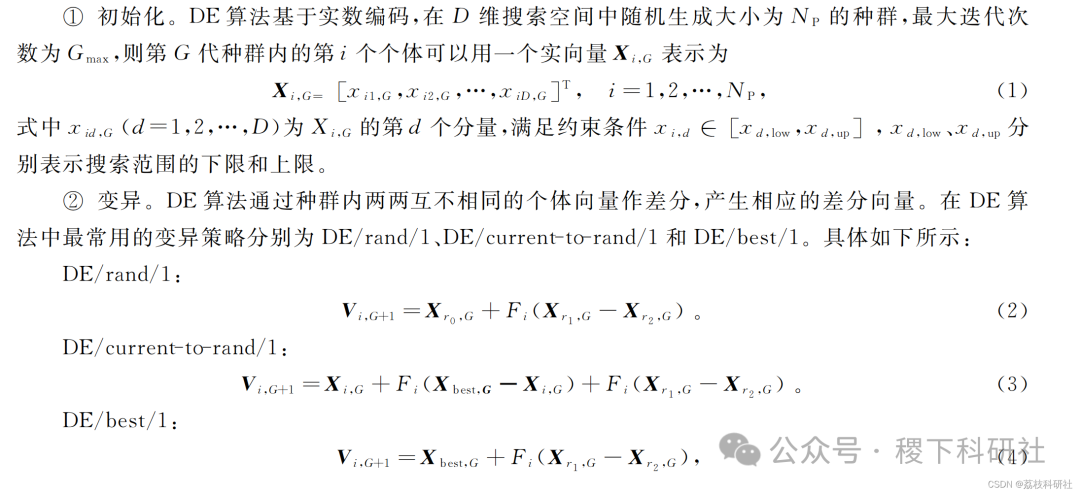
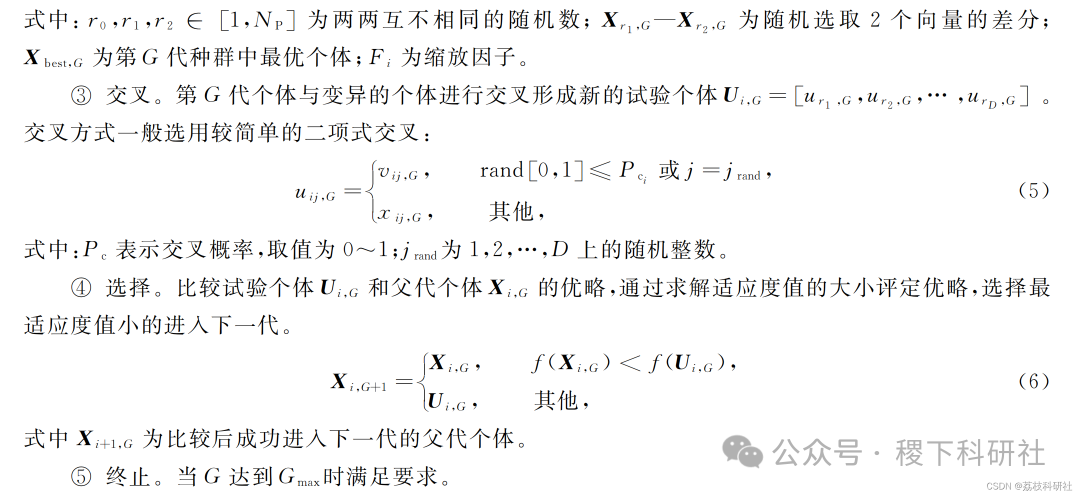
The Differential Evolution Algorithm (DE) [1] was proposed by Rainer Storn and Kenneth Price in 1997. Compared to genetic algorithms, it has fewer parameters and is relatively simple to compute, making it widely used in power optimization scheduling problems. Its main process includes five steps: initialization, mutation, crossover, selection, and termination.


1. Basic Principles and Characteristics of Differential Evolution Algorithm
The Differential Evolution Algorithm (DE) is a global optimization algorithm based on swarm intelligence, proposed by Storn and Price in 1995, suitable for continuous parameter optimization problems. Its core mechanism achieves efficient search by simulating mutation, crossover, and selection operations in biological evolution.
-
Algorithm Process
Initialization: Randomly generate an initial population in the solution space, where each individual is a real-valued vector representing candidate solutions to the problem (e.g., output of each generation unit in the microgrid).
Mutation: Generate new individuals through differential vectors. A typical strategy is DE/rand/1: randomly select three different individuals 

where FF is the scaling factor that controls the influence of the differential vector.
Crossover: The mutation vector is crossed with the target vector probabilistically to generate trial vector Ui, enhancing population diversity.
Selection: Compare the fitness of the trial vector with the target vector (e.g., operating cost of the microgrid) and retain the better individuals for the next generation.
-
Core Advantages
Global search capability: Parallel search from multiple initial points avoids getting trapped in local optima.
No gradient information required: Suitable for complex optimization problems that are non-continuous and non-differentiable (e.g., microgrid scheduling with renewable energy).
Few parameters and easy to tune: Only the population size, scaling factor FF, and crossover probability CR need to be set.
Intrinsic parallelism: Suitable for distributed computing, reducing time costs.
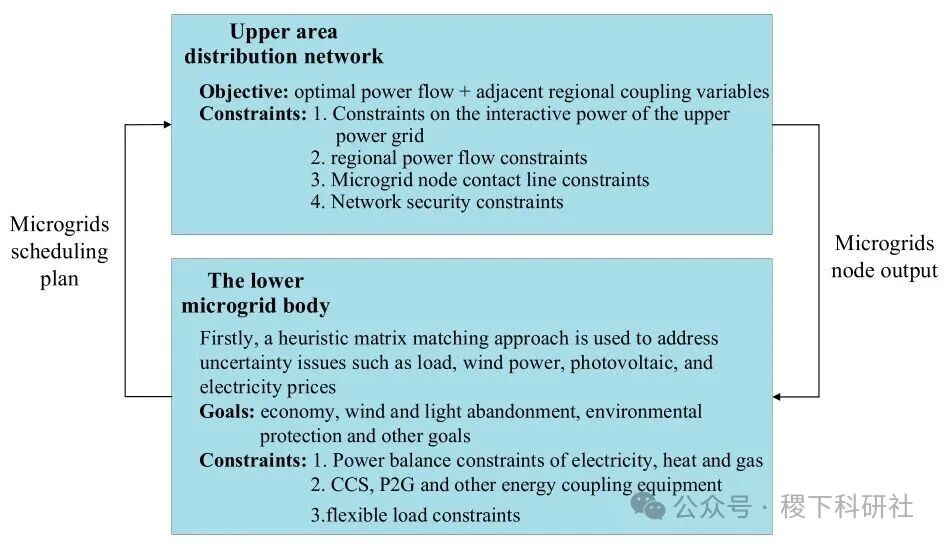
2. Main Objectives and Constraints of Microgrid Scheduling
-
Optimization Objectives
Economy: Minimize operating costs, including generation costs, purchase costs, and storage losses.
Environmental protection: Reduce pollutant emissions (e.g., CO₂).
Reliability: Balance supply and demand, reduce curtailment rates, and improve renewable energy utilization.
Multi-energy coordination: Coupled optimization of multiple energy flows such as electricity, heat, and gas.

-
Constraints
Power balance: Real-time balance of generation, storage, load, and grid interaction.
Equipment operation limits:
Upper and lower limits of distributed generation output and ramp rates.
Storage charging and discharging power and capacity constraints.
Grid interaction power limits (e.g., interconnection line capacity).
Safety constraints: Voltage and frequency stability, network security.
User demand: Preferences and satisfaction of adjustable load.
3. Current Research Status of Microgrid Scheduling Based on Differential Evolution Algorithm
-
Multi-objective Optimization
Case: Literature [21] proposed a DE-PSO hybrid algorithm that combines the global search of particle swarm with the local optimization of DE, achieving a 12% cost reduction and an 18% reduction in carbon emissions in the dual-objective optimization of microgrid economy and environment.
Method: Non-dominated sorting (NSGA-II) or weighted aggregation is used to handle multi-objective conflicts.
-
Uncertainty Handling
Scenario analysis: Literature [28] used scenario analysis to generate typical scenarios of renewable energy output and load, combined with DE to optimize dynamic scheduling schemes, reducing curtailment rates by 9%.
Robust optimization: Literature [24] improved the DE algorithm for robust scheduling of CCHP-type microgrids with two-stage random demand, improving resource utilization by 15%.
-
Dynamic Scheduling
Time scales:
Day-ahead scheduling: Optimize 24-hour output plans, considering peak and valley electricity prices.
Intra-day rolling scheduling: 15-minute adjustments of supercapacitor and diesel generator outputs to respond to real-time fluctuations.
Case: In a microgrid with electric vehicles, DE optimized the V2B2 mode, increasing the self-consumption rate of photovoltaics to 82% and reducing the peak-valley difference by 30%.
-
Improvement Strategies
Hybrid algorithms: Combining DE with PSO, quantum particle swarm, etc., to improve convergence speed and accuracy.
Parameter adaptation: Dynamically adjusting FF and CR to avoid premature convergence.
Disturbance strategies: Introducing chaotic initialization or immigration operations to maintain population diversity.
4. Advantages and Limitations
-
Advantages
Global search capability: Superior to traditional gradient methods in complex non-convex problems.
Flexibility: Can handle mixed problems with discrete and continuous variables (e.g., state of charge/discharge of storage).
Parallelism: Suitable for large-scale microgrid cluster optimization.
-
Limitations
Parameter sensitivity: Improper settings of FF and CR can lead to stagnation in convergence.
Risk of local optima: In high-dimensional problems, it may get trapped in suboptimal solutions, requiring disturbance strategies.
Computational efficiency: Large-scale problems require many iterations, necessitating distributed computing for acceleration.
5. Typical Experimental Data and Results
Research Cases
Optimization Objectives
Improvement Methods
Results (Compared to Baseline)
Citation
DE-PSO hybrid algorithm Economy, Environmental protection Multiple mutation strategies Cost reduced by 12%, carbon emissions reduced by 18%
V2B2 mode scheduling Electricity cost, photovoltaic self-consumption rate Multi-objective DE Self-consumption rate 82%, peak-valley difference reduced by 30%
CCHP two-stage scheduling Resource utilization, stability Improved DE + scenario reduction Resource utilization improved by 15%
Continuous time scheduling with carbon trading Economy, Carbon emissions Composite price model + improved DE Algorithm convergence speed improved by 25%
6. Future Research Directions
Intelligent parameter adjustment: Dynamically optimizing DE parameters using reinforcement learning.
Multi-time scale coupling: Coordinated optimization of day-ahead, intra-day, and real-time scheduling.
Heterogeneous energy integration: DE models for coupled energy flows of electricity, heat, and hydrogen.
Edge computing applications: Deployment optimization of DE algorithms at distributed edge nodes.
📚2 Operating Results
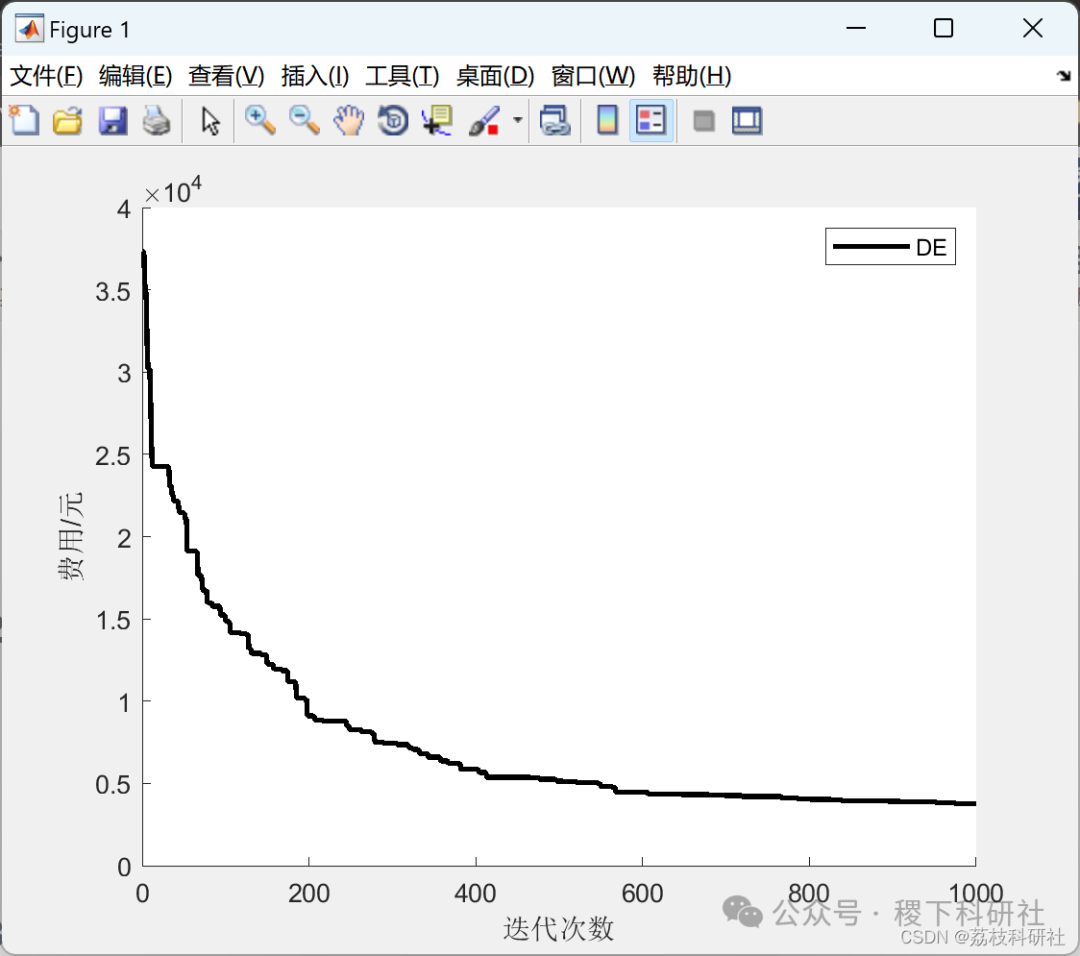

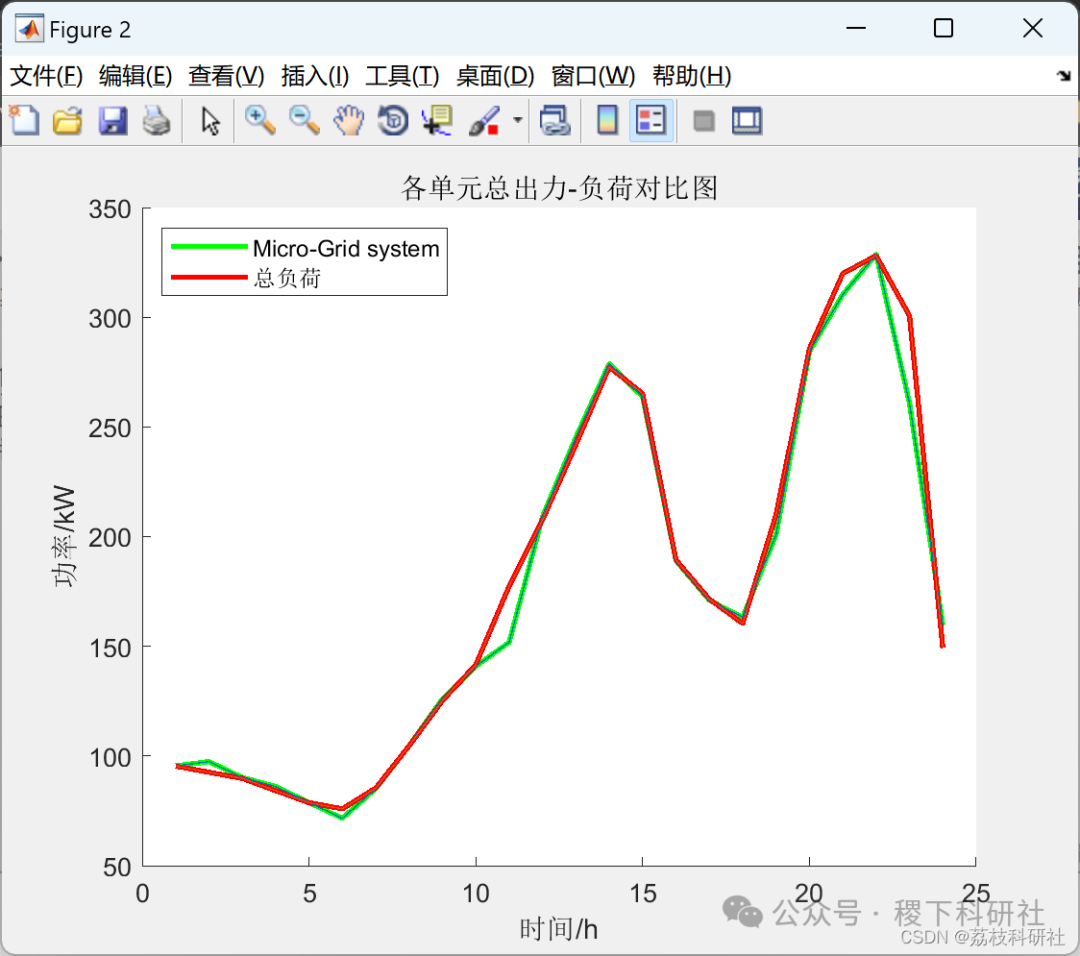

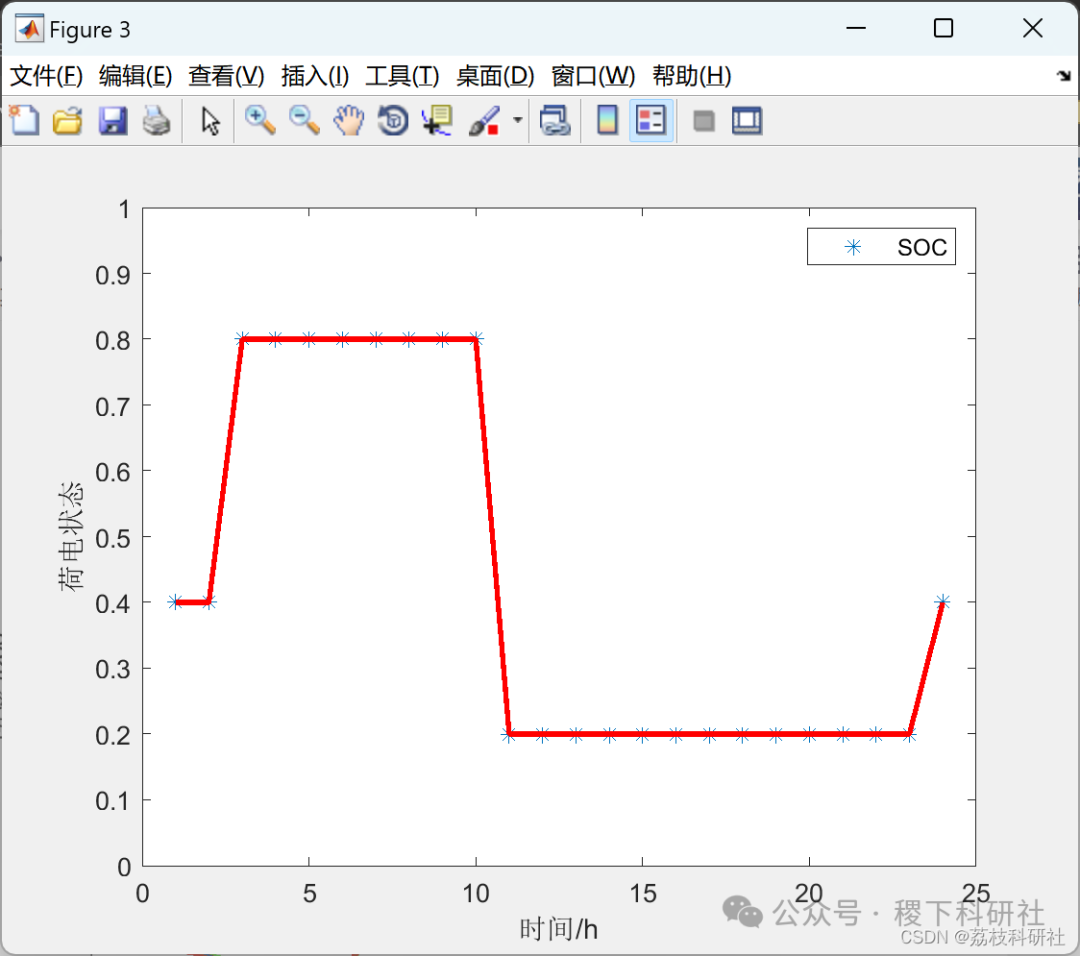

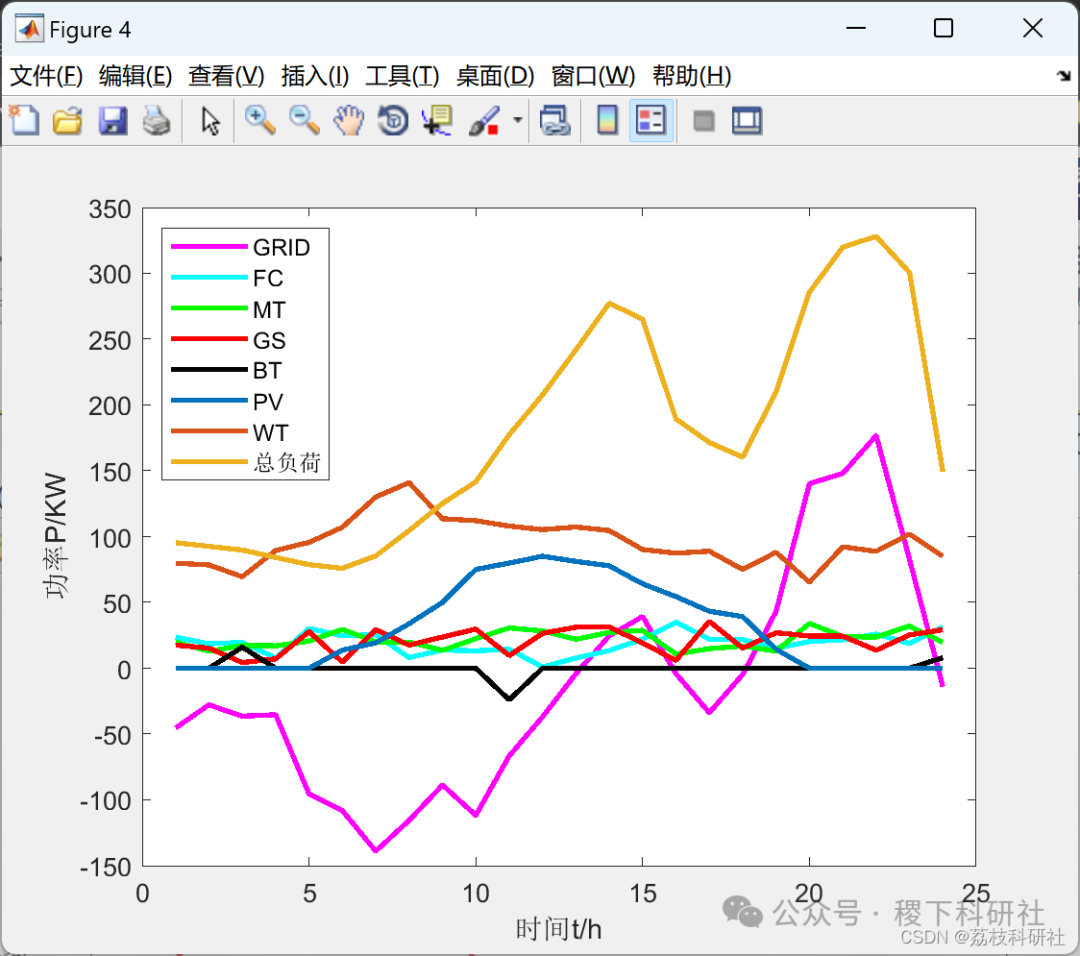

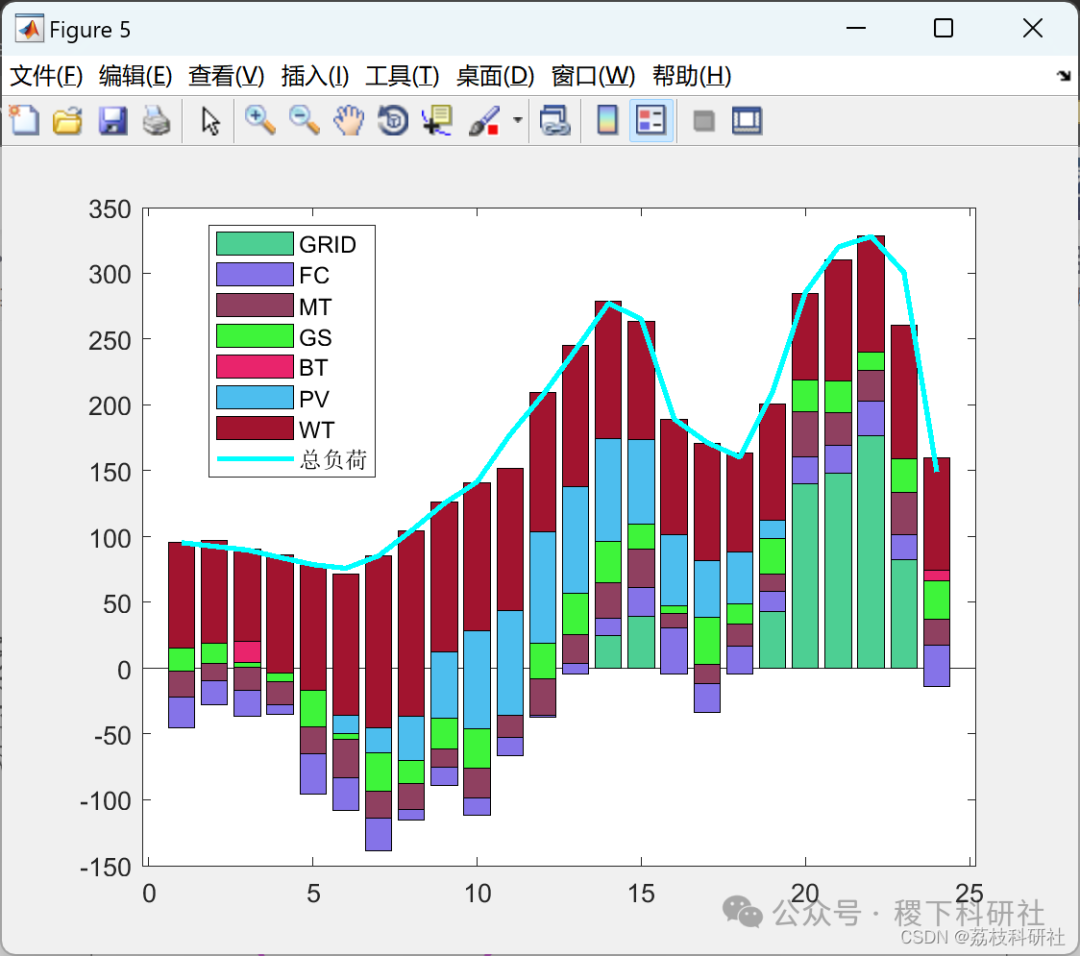

Part of the code:
%% Cost Calculation
% Calculate the fuel costs for fuel cells, micro gas turbines, and small internal combustion engines
F_FuelCost= sum(x(1:24))data.parameter(3,4)data.c+sum(x(25:48))data.parameter(4,4)data.c+sum(x(49:72))data.parameter(5,4)data.c;
% Calculate equipment operating costs
F_YunweiCost=data.parameter(1,3)sum(data.PV)+data.parameter(2,3)sum(data.WT)+data.parameter(3,3)sum(x(1:24))+data.parameter(4,3)sum(abs(x(25:48)))+data.parameter(5,3)sum(x(49:72))+data.parameter(6,3)sum(abs(x_BT));
% Calculate pollution costs
F_PollutionCost=sum(data.pollution(:,1).data.pollution(:,2).sum(x(1:24)))+sum(data.pollution(:,1).data.pollution(:,4).sum(x(25:48)))+sum(data.pollution(:,1).data.pollution(:,3).sum(x(49:72)))+sum(data.pollution(:,1).data.pollution(:,5).sum(x(73:96)));
% Large grid interaction costs
Grid=x(73:end);
tempa=find(Grid>0);
tempb=find(Grid<0);
F_GridChange= sum(Grid(tempa).data.Price(tempa))+sum(Grid(tempb).data.Price(tempb));
🎉3 References
Some theories are sourced from the internet; please contact for removal if there is any infringement.
[1] Chen Danfeng, Zhao Cai, Zhang Zhifei, Zhou Yan. Research on Microgrid Scheduling Based on Improved Differential Evolution Algorithm [J]. Journal of Guangxi University (Natural Science Edition), 2022, 47(04): 1018-1029. DOI:10.13624/j.cnki.issn.1001-7445.2022.1018.
[2] Huang Shuyuan, Xiao Jianmei. Multi-objective Optimization Scheduling of Microgrid Based on Differential Evolution Algorithm [J]. Ship Electrical Technology, 2018, 38(07): 57-61. DOI:10.13632/j.meee.2018.07.014.
🌈4 Matlab Code Implementation