
Click the blue text to follow us
In the PCBA manufacturing process, people often ask: “Should we use SMT technology or DIP technology?” In fact, neither is absolutely better; they just have different application scenarios and process requirements. For many customers with electronic product outsourcing needs, understanding the differences and selection logic between SMT and DIP processes can help you advance your project more efficiently.1. What is SMT processing technology?SMT (Surface Mount Technology) is what we commonly refer to as “surface mount processing.” Simply put, it involves directly mounting electronic components on the surface of the PCB and then securing them through reflow soldering.The advantages of SMT processing include:– High efficiency: Fully automated pick-and-place machines operate quickly, suitable for mass production;– High density: Components can be mounted on both sides of the circuit board, significantly increasing integration;– Stable and reliable: The consistency of reflow solder joints is good, with strong resistance to shock and interference.SMT is commonly used in products such as mobile phones, computers, smart home devices, and automotive electronics. According to data from the China Electronics Information Industry Development Research Institute (2023 industry white paper), over 80% of electronic product processing stages use SMT technology.2. What is DIP processing technology?DIP (Dual In-line Package) is also known as through-hole technology. It involves inserting electronic components with leads into the reserved holes on the PCB and then securing them through wave soldering or manual soldering.The advantages of DIP processing include:– Strong load capacity: The solder joints of through-hole components are solid, capable of withstanding larger currents and mechanical stress;– Wide applicability: Components such as electrolytic capacitors, high-power transistors, and transformers that are not suitable for surface mounting often use DIP processing;– High maintainability: Through-hole components are relatively easy to replace and repair.DIP is commonly found in power boards, power circuits, and industrial equipment control boards.3. How to choose between SMT and DIP processes?In actual PCBA processing, it is not a matter of either/or, but rather a flexible combination based on product characteristics. For example:– Miniaturized and lightweight products (such as mobile phones and wearable devices): SMT processing is preferred;– High current and high power devices (such as power modules and industrial control boards): DIP processing is required;– Comprehensive circuit boards: Typically a combination of SMT and DIP processes, first SMT then DIP, followed by unified testing.If you are looking for a factory for the first time, it is recommended to provide the circuit board BOM and samples to an experienced PCBA manufacturer, where engineers can evaluate and recommend suitable processes.
In summary: SMT processing is suitable for high-density, miniaturized electronic products, while DIP processing is suitable for high-power and mechanically robust components. In practice, a combination of both is often used. To save time and costs, the best approach is to find an experienced PCBA manufacturer to help you make the optimal process choice.
Summer, loading…


Intelli Electronics production line scale
(1) 24 high-end SMT lines from ASM
(2) 8 Panasonic automatic insertion machines
(3) 4 lead-free wave soldering lines, expandable to 8 lines
(4) 8 assembly lines, expandable to 16 lines, 4 packaging lines, expandable to 8 lines
(5) Actual placement capacity of about 3 million points per hour, with a monthly capacity of up to 1.7 billion points
(6) All equipment can connect to the MES system
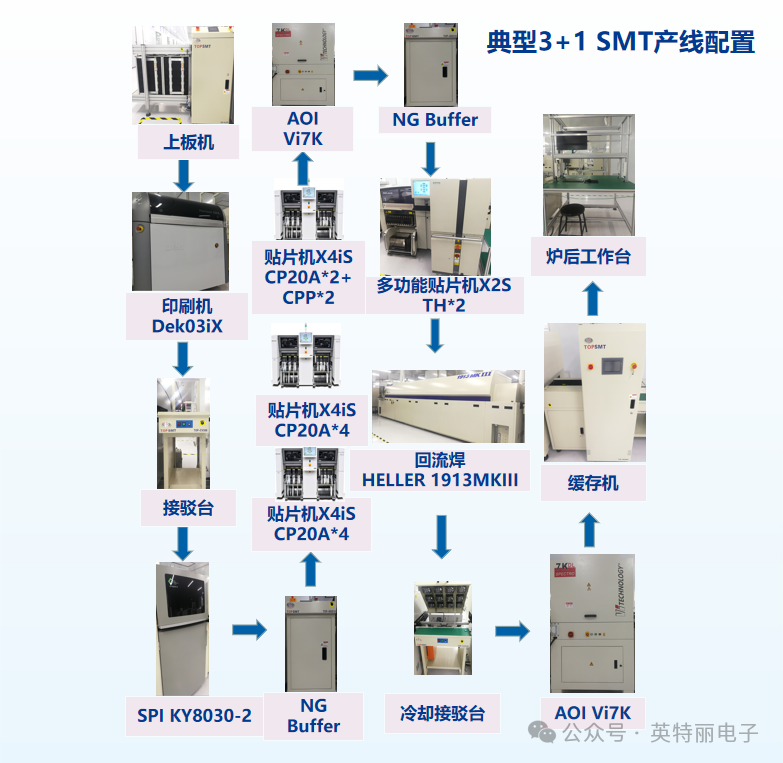
(7) Each SMT line is equipped with SPI/AOI inspection equipment
(8) Each SMT line is equipped with SPI/AOI post-NG buffer for fully automated connected production
(9) 1+1, 2+1, 3+1, dual-track production line layout can meet different product production needs and optimize reasonably
(10) Reflow soldering with 13 temperature zones, nitrogen filling available


Business inquiries: Mr. Li 17870016160
Company phone: 0794-7878288Company fax: 0794-7878288Email: [email protected]
Company website: www.intelli40.comAddress: Building 8-9, Linchuan High-tech Industrial Park, Fuzhou, Jiangxi Province

Long press to recognize the QR code and follow us