PCB prepreg, short for “pre-impregnated,” is a dielectric material composed of glass fiber and resin, providing the necessary insulation properties and serving as a bonding material. It is an essential material in PCB manufacturing, typically sandwiched between two core materials or between a core material and copper foil. This article will delve into the characteristics, types, and key selection factors of PCB prepreg to help you better understand and make informed decisions.
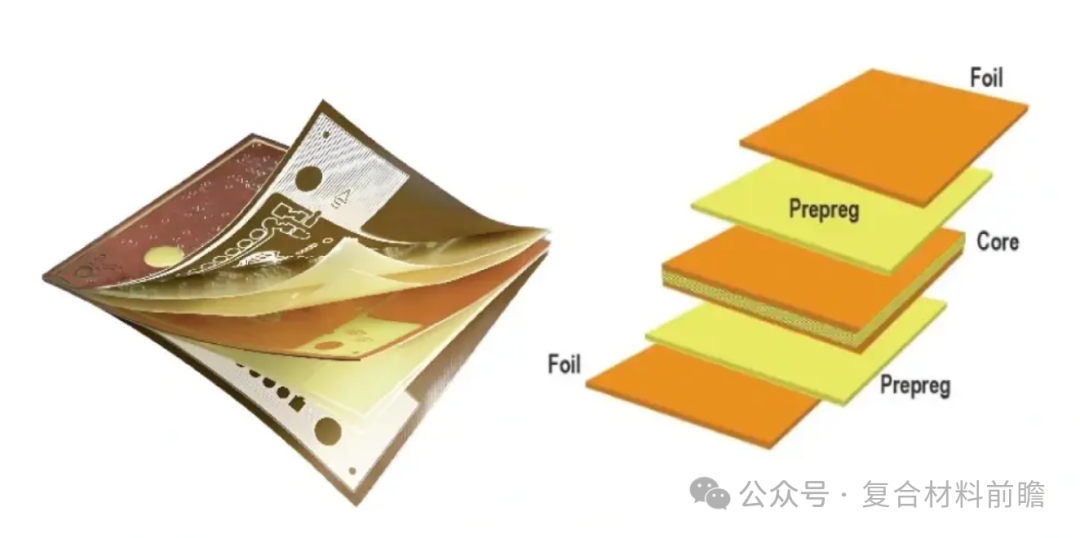
PCB Prepreg
Characteristics of PCB Prepreg
In this section, we will discuss the key characteristics of PCB prepreg that may affect the performance of the final circuit board.
Dielectric ConstantThe stable dielectric constant and low loss factor of PCB prepreg are crucial for high-frequency performance. The dielectric constant of glass fiber and epoxy resin is around 3.5 to 5, which is acceptable for typical PCBs.
Bonding Strength
Bonding strength refers to the adhesion between the copper foil and the PCB prepreg layer. Values greater than 2.5 N/mm indicate good adhesion between the two layers, capable of withstanding significant external forces and temperature changes without delaminating.
Dimensional Stability
Under temperature cycling, the low Z-axis shrinkage and expansion rates of the prepreg can prevent PCB via failures caused by thermal expansion and contraction. The shrinkage rate in the X-Y direction is typically within 0.5%, maintaining the overall stability of the circuit board.
Decomposition Temperature
This is the temperature at which the material begins to chemically decompose or degrade upon heating. A high Td (> 300°C) indicates that the material can resist decomposition at high temperatures without carbonization.
Moisture Absorption
Low moisture absorption indicates that the material is not prone to absorbing moisture, avoiding electrical leakage and reliability issues caused by vapor pressure. The typical moisture absorption rate is usually <0.5%.
Flowability and Fillers
It is essential to have sufficient resin flowability to fill irregularities on the board while avoiding excessive flow. The filler content is typically 15-40%.
Flame Retardancy
High flame-retardant PCB prepreg can completely prevent the circuit board from catching fire, burning, or producing harmful smoke. Materials rated UL 94 V-0 meet high flame-retardancy standards, providing better safety.
Types of PCB Prepreg
Different types of PCB prepreg are suitable for various circuit board needs. Below are four of the most commonly used prepreg materials.
FR-4 Prepreg
FR-4 prepreg is a versatile material that strikes a balance between cost and performance. It is a composite of glass fiber and epoxy resin, featuring flame retardancy (UL 94 V-0 rating) and a Tg of 130-170°C (depending on composition). This PCB prepreg is suitable for low-frequency digital and analog PCB applications up to several GHz. Due to its stable electrical and thermal properties, FR-4 prepreg is widely used in automotive electronics, consumer electronics, industrial control systems, and telecommunications.
High Tg Prepreg
High Tg prepreg is particularly suitable for applications requiring high-temperature resistance and thermal stability. Its glass transition temperature exceeds 170°C, reaching up to 200°C. This PCB prepreg uses advanced epoxy resin systems, such as bismaleimide triazine or polyimide, and is often halogen-free and environmentally compliant. With its excellent thermal stability, high Tg prepreg maintains stability during lead-free soldering, component mounting, and quality inspection processes, avoiding warping or delamination issues.
PTFE Composite Prepreg
This is a high-performance dielectric material with a very low dielectric constant while maintaining good electrical and physical properties. Compared to standard FR-4, signal loss is significantly reduced, making it an ideal choice for high-frequency circuits. Its ultra-low dielectric constant allows for thinner dielectric layers and smaller trace spacing, optimizing propagation delay, signal integrity, and impedance control. With these characteristics, this PCB prepreg is ideal for high-performance microwave and RF applications.
Polyimide Prepreg
Polyimide prepreg has ultra-high temperature resistance (Tg > 250°C) and excellent dimensional stability. It can withstand high-temperature soldering (such as lead-free soldering) and high-temperature PCB assembly. With a lower Z-axis thermal expansion coefficient (about 20-30 ppm/°C), this prepreg material effectively reduces PCB via failures caused by temperature changes. Polyimide prepreg also exhibits excellent bending fatigue resistance, capable of withstanding repeated mechanical bending, making it suitable for dynamic bending applications. Although the material cost is higher, this PCB prepreg is the preferred choice for aerospace and other high-demand and extreme environments.
How to Choose Prepreg Material in PCB Manufacturing?
When selecting prepreg materials, several key factors must be considered. Detailed information is provided below to help you make the right choice.
Fiber Type
Each type of fiber has different characteristics suitable for various applications. Glass fiber is the most popular material, offering good mechanical and dielectric properties at a low cost. Aramid is a strong synthetic fiber commonly used for high-strength circuit boards. Ceramic fiber is mainly used for high-frequency applications, with a stable dielectric constant but is expensive.
Weaving Style
The arrangement of glass fibers (i.e., woven or non-woven structure) determines some important characteristics of the prepreg, such as dimensional stability, resin absorption rate, and anisotropy (the difference in properties in different directions).
Resin Type
Epoxy resin is the most common type, while other types include polyimide, cyanate ester, and PTFE composites. The choice of resin type depends on thermal performance, electrical performance, cost, and other factors.
Fiber Areal Density
This refers to the weight of fiber per unit area. A higher areal density can increase mechanical strength but may increase material cost and thickness.
Resin Content
Based on resin content, prepregs can be classified into standard resin, medium resin, and high resin. The higher the resin content, the higher the cost. Resin content affects dielectric constant, thermal expansion, drilling accuracy, and etching precision.
Curing Method
Curing determines the final strength and quality of the prepreg. Proper curing ensures that the PCB has optimal adhesion, thermal stability, and long-term reliability.
Dielectric Constant and Loss Factor
When selecting prepreg, the dielectric constant and loss factor are characteristics that must be particularly focused on for high-frequency applications. Low Dk and low Df materials (such as PTFE) are used for high-frequency and microwave applications.
CTE
The thermal expansion coefficient of the prepreg should match that of the substrate and copper foil to reduce warping and delamination of the PCB at high temperatures.
What is Resin Flowability in Prepreg? How to Measure Resin Content?
Resin flowability refers to the characteristic of the prepreg resin melting and flowing during heating and pressurization. The resin flow rate is influenced by the pressure and heating rate. Resin content is the percentage of resin in the entire prepreg, determining the thickness of the laminate. Resin content is typically measured by the combustion method, using the following formula for calculation. Weight loss is obtained by subtracting the final weight after combustion from the initial weight.
Resin Content (%) = Weight Loss / Initial Weight × 100%
Best Practices for Storing and Maintaining Prepreg
Proper storage and handling of prepreg are crucial for maintaining its performance and extending its shelf life. In this section, we explore some best practices to ensure that the material maintains optimal performance throughout its lifecycle.
Original Packaging: PCB prepreg should be stored in its original packaging, which must be sealed to prevent moisture absorption and volatilization.Placement Orientation and Cleanliness: When placed, it should be stored horizontally or vertically to prevent material creasing. The storage area should also be free of potential contaminants.Temperature and Humidity: Prepreg is typically stored in a dry, cool place, with a temperature range of 15-30°C and relative humidity of 30-60%.Avoiding Light: PCB prepreg should be protected from UV and sunlight during storage and use, as this may trigger polymerization reactions.Inventory Turnover: PCB prepreg has a shelf life and degrades over time. Regularly rotating PCB prepreg inventory can be managed using a first-in, first-out inventory system. It is generally best to use it within six months of purchase.
Prepreg vs Core Material: What’s the Difference?
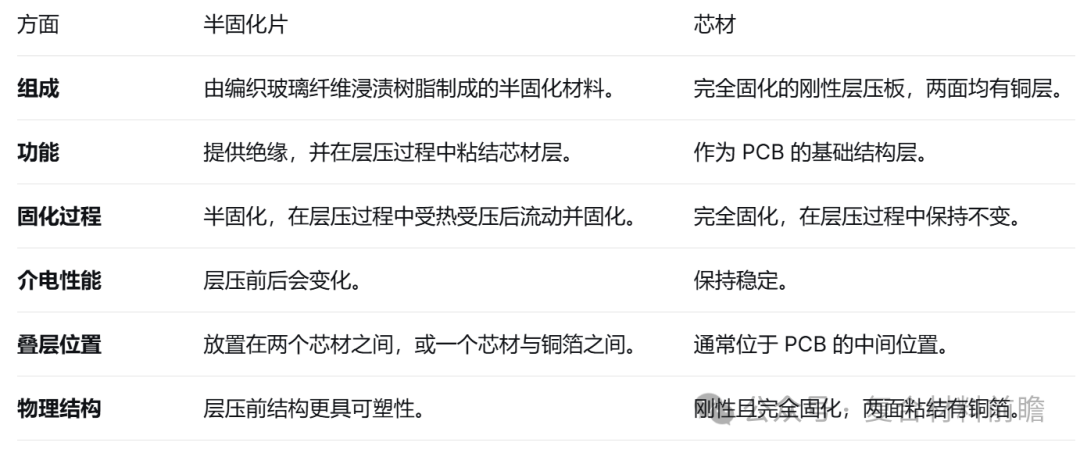
Due to the similarities between prepreg and core materials, the two are often confused. Prepreg is a semi-cured material made of glass fiber and resin, used as a binder to bond core materials during lamination. Core material is a fully cured rigid laminate formed by pressing, hardening, and thermosetting one or more layers of prepreg, with copper layers on both sides, providing mechanical strength and electrical connectivity as the foundation of the PCB. In short, core material is the laminated finished product of prepreg, which is more rigid than prepreg. The comparison table below can help distinguish between them.
Conclusion
The choice of PCB prepreg profoundly affects the performance and manufacturability of the circuit board, especially for multilayer PCBs. Key parameters such as resin type, resin content, and weaving style directly influence the mechanical, electrical, and thermal properties of the prepreg material. By fully understanding prepreg and its characteristics, PCB designers can make better decisions tailored to specific application needs and manufacturing processes while minimizing potential issues during production.