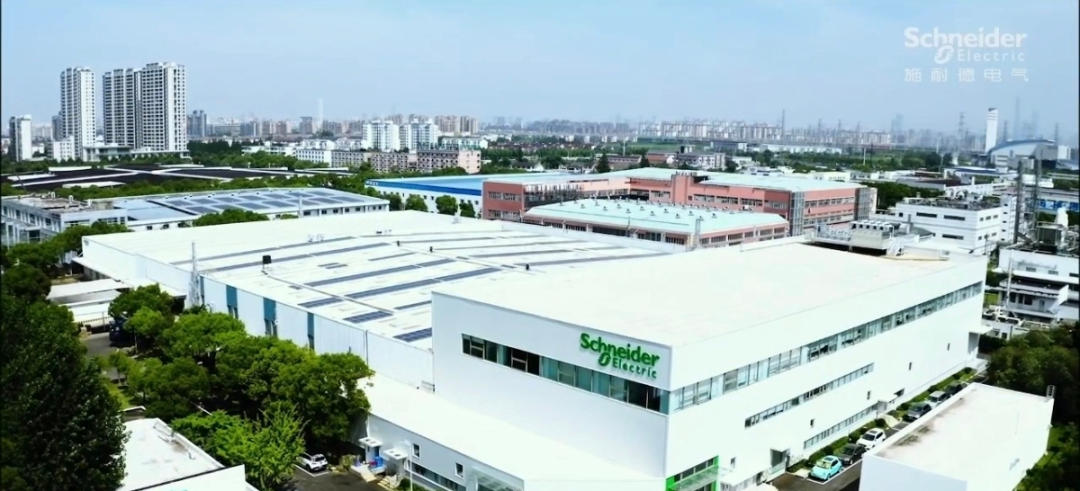
Located in the Kangqiao Industrial Zone of Pudong New District, Shanghai, Schneider Electric’s Kangqiao factory is not only the largest production base for air circuit breakers globally but also a benchmark for a “zero carbon factory” that integrates digital and automation technologies.
Entering this futuristic smart manufacturing base, one can feel the perfect fusion of the two core qualities of “intelligence” and “greenness”. Stepping into the production workshop, the scene of smart manufacturing gradually unfolds: workers perform their duties, while logistics robots assist by using optimal path algorithms to help employees reduce ineffective energy consumption. Even more impressive is the deep implementation of its green philosophy—the solar panels installed on the roof shine brightly under the sun, absorbing energy to meet part of the power needs at night.
In this comprehensive digital transformation, the innovative application of industrial cloud computing is groundbreaking. The first industrial cloud computing production line practice in the country, jointly created by Shanghai Telecom and Schneider Electric based on Tianyi Cloud Computing, not only fills the gap in domestic industrial cloud computing applications but also redefines digital workflows, providing a new paradigm for building a smart, interconnected, and sustainable industrial ecosystem.
Dual “Slimming” of Equipment and Energy Consumption
The cloud computing technology migrates all core functions such as computing and storage to the cloud, allowing users to obtain high-performance computing experiences and improved management and security services through lightweight terminals.
In Schneider Electric’s “Zero Carbon Blueprint”, cloud computing is a key support point, and this transformation stems from the existence of real pain points. In recent years, the number of production line computers at Schneider Electric has surged from over 1400 in 2019 to over 3500 currently.
The significant increase in the number of production line computers has brought about many deep-seated challenges. The digitalization leader of Schneider Electric’s Kangqiao factory, Lv Yajie, feels particularly concerned about two aspects: first, security issues. With the increase in the number of computers, the production line window time is limited. If patches or system upgrades cannot be installed in time, production line computers face security risks. Moreover, since the original IPC (Inter-Process Communication) was an independent terminal without redundancy mechanisms, coupled with the complexity of data backup, it amplified security risks. Second, there is the issue of data silos. Due to data being scattered across various terminals, challenges arise such as high extraction costs, low extraction efficiency, and difficulties in unified data management.
To overcome these difficulties, Schneider Electric decided to adopt an industrial-grade virtualized cloud desktop solution as a pivot for digital transformation. By building a virtualized resource pool based on hyper-converged architecture (HCI), it achieves elastic scheduling of computing resources, centralized deployment of industrial applications, and dynamic orchestration of security policies. After intense competition and multiple rounds of rigorous testing, Shanghai Telecom emerged as the partner, successfully collaborating with Schneider Electric.
“Like many IT technologies used in industrial scenarios, VDI technology (Virtual Desktop Infrastructure) cannot be applied to all industrial scenarios covered by IPC. We must selectively filter scenarios under conditions where hardware, software, and employee experience meet the requirements for deployment,” Lv Yajie stated. Overall, VDI can adapt to about 60% of industrial scenarios.
After this “revolution”, the effects were “immediate”. The first change was the “slimming” of the operation stations. The bulky industrial control machines and heavy computer cases that once occupied large workstation spaces have disappeared, replaced by cloud computers the size of display screens. A set of data clearly illustrates the advantages of this solution—one traditional industrial control machine consumes 420W in one hour; a regular desktop computer consumes 65W in one hour; while a Tianyi cloud computer consumes only 12W in one hour.
It is clear that not only the equipment has been “slimmed down”, but also energy consumption. By combining cloud computing with dynamic load balancing technology, after all devices were updated, the Shanghai Kangqiao factory saved 76% compared to standard industrial PCs, and saved 97% compared to maximum load.
Building a New Ecosystem for Smart Manufacturing
On the production line, workers need to interact in real-time with the MES (Manufacturing Execution System) to obtain production tasks, process parameters, and other information, while also providing timely feedback on production progress and equipment status. In the traditional model, local computer performance varies, and data transmission is easily disrupted. Based on this, Schneider Electric chose industrial thin clients and industrial all-in-one machines from the VDI solution, using either a 5G network or wired network. Through these terminals, workers can quickly and stably connect to the system.
In the new model, operating systems, application tools, and industrial MES system applications run on private cloud servers, and terminal devices only need to connect to the network to access cloud resources. This centralized management model transforms traditional decentralized IT management into a centralized, platform-based management approach, which not only improves management efficiency but also builds a digital management architecture for the future.
“The production line cannot stop,” as the lifeblood of the manufacturing industry is “continuous operation.” In the past, when a terminal malfunctioned or during monthly system upgrades and patch installations, each device would be down for at least half an hour, which was a significant loss for the production line. Now, if a cloud computer encounters a problem, it only needs to replace the new device and connect to the network, without reinstalling or configuring software, greatly reducing operational complexity. This “plug-and-play” feature allows the production line to have almost no downtime during equipment replacement or maintenance, significantly improving production efficiency.
“This is a disruptive management revolution,” Lv Yajie stated. Through real-time data monitoring from the cloud platform, material shortages or backlog issues are effectively avoided, optimizing the allocation of production resources. Additionally, it successfully transforms the passive response model in traditional discrete manufacturing scenarios into a proactive control model of predictive maintenance and preventive scheduling, pushing the utilization rate of production resources beyond industry benchmarks and achieving lean operations.
What makes Lv Yajie and the entire project team happy and proud is that this practice has triggered a butterfly effect, with other leading companies in the industry seeking similar solutions. Earlier, to promote the standardized application of industrial cloud computing, Schneider Electric, in collaboration with Shanghai Telecom and the China Academy of Information and Communications Technology, released the first domestic “Technical Specifications for Industrial Cloud Computing Scenarios.” This specification provides a standardized technical framework for deploying cloud desktops in industrial scenarios, covering key aspects such as network architecture, security design, and device adaptation, providing a reference model for other companies to replicate this model.
In the future, all parties plan to further explore innovative technologies such as hyper-converged platforms to build an intelligent and interconnected industrial ecosystem, injecting new momentum into the digital transformation of manufacturing.
Source: Yuan Shengyan
Editor: Wu Zebin