The real-time clock (RTC) chip serves as the “time hub” for embedded devices, ensuring data timing and device controllability. In the rapidly evolving fields of industrial IoT, medical electronics, and smart consumer terminals, its reliability, low power consumption, and integration level have become key indicators determining product competitiveness. However, traditional RTC chips face three core challenges: timing inaccuracies in extreme environments, insufficient battery life for powered devices, and the risk of losing critical data during power outages, making it difficult to meet the stringent demands of high-end embedded devices..
Coreba Electronics has launched the CBM13S38 series serial RTC chip, positioning itself with “industrial-grade reliability, ultra-low power consumption, and full functional integration” to precisely address these pain points, becoming the “preferred time management solution” in industrial IoT, medical devices, and mid-to-high-end consumer electronics.Ultra-low power design at the nanoamp level: Testing under constant temperature and humidity conditions shows that when the CBM13S38 oscillator is on and the square wave output is off, the standby current is as low as 800-1200nA; in standby power mode (data retention), the current is only 10-100nA; in active working state, the typical current for the 1.8V version is only 75μA, and for the 3.3V version, it is 120μA. Even under high voltage conditions of 5.5V, the maximum current is still controlled within 325μA.Industrial-grade wide temperature and intelligent power protection: The chip operates stably over a temperature range of -40℃ to +85℃, with a storage temperature of -55℃ to +125℃, meeting the demands of extreme temperature variations; the built-in power failure detection circuit responds quickly, automatically switching to the backup power (VBAT compatible with 1.3 to 3.7V) when the main power (VCC) falls below the fault voltage (VPF) (measured at 1.51-1.71V for the 1.8V version and 2.70-2.97V for the 3.3V version); simultaneously, the oscillator stop flag (OSF) can accurately monitor the clock operation status, providing timely feedback on data validity after a power anomaly.
Scan to inquire about more information on CBM13S38A
Data safety during power outages: Tests show that the chip’s built-in 56-byte NVSRAM (address range 08H~3FH) reads and writes at I²C bus speed, maintaining power from VBAT after the main power failure, ensuring that stored transaction records, measurement parameters, and other critical information remain intact without corruption or loss.Multi-voltage and multi-package compatibility reduces design costs: The CBM13S38 supports a supply voltage range of 1.71V to 5.5V, with 1.8V, 3.0V, and 3.3V versions precisely matching low-power, standard, and high-voltage power systems; packaging options include SOP-8, SOP-16, and MSOP-8; the I²C interface supports fast mode with a maximum clock frequency of 400KHz, ensuring compatibility with mainstream chips like STM32 and MCU without the need for additional level shifting.Programmable square wave output: The CBM13S38 can stably output four square wave frequencies: 1Hz, 4.096kHz, 8.192kHz, and 32.768kHz, easily switched by controlling the SQWE bit (square wave enable) and RS1/RS0 bits (rate selection) in the control register (07H). Its open-drain output is compatible with 3.3V/5V systems, with a duty cycle error of no more than 5%.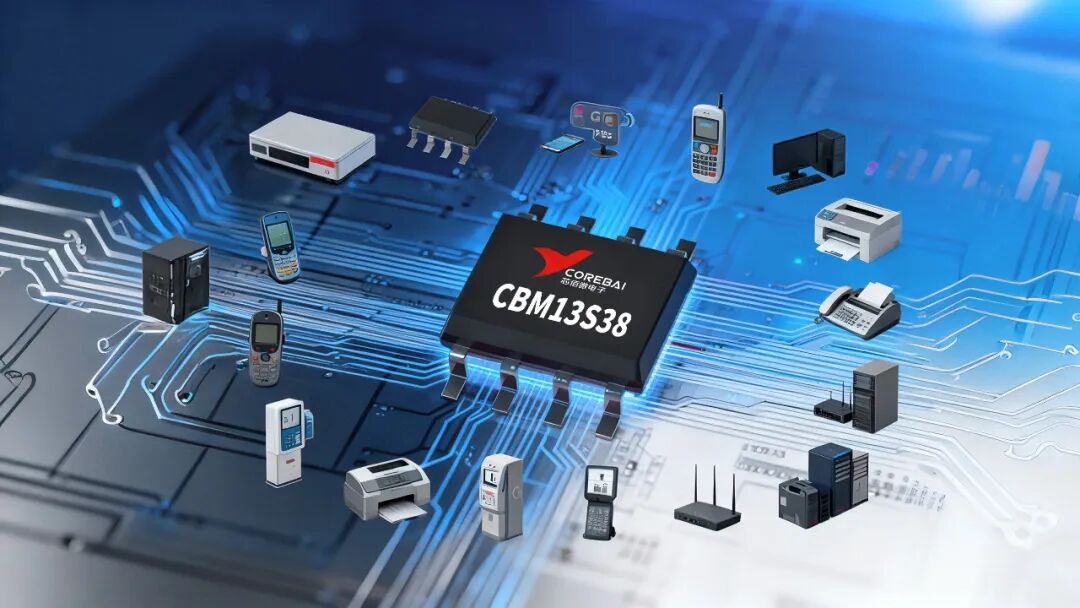
Application scenarios: Widely covering core needs across multiple industries
Industrial IoT and metering fields: Devices such as electric meters, water meters, temperature monitors, and vending machines—leveraging industrial-grade temperature range, ultra-low power consumption, and NVSRAM—can achieve long-term stable timing functions and effectively protect metering data, suitable for harsh environments like outdoors and workshops;
Handheld portable devices: Devices such as GPS terminals, POS terminals, and portable blood glucose meters—low power characteristics can extend battery life, and compact packaging design fits into tight spaces, while NV SRAM ensures the safety of transaction and measurement data;
Medical electronics: Blood glucose meters, medication dispensers—wide voltage compatibility with medical power systems, data retention functionality ensures continuity in treatment processes, and high reliability meets the stringent requirements of medical devices;
Consumer and office equipment fields: Devices such as set-top boxes, routers, and printers—flexible packaging design and square wave output functions support scheduled recording, task queuing, and help reduce design costs;
Telecommunications equipment fields: Devices such as routers, switches, and servers—automatic power switching functionality and OSF flag ensure the accuracy of network log timing, while high-speed I²C can adapt to high-performance systems.
Author: Xiao FangSource: Coreba Electronics
👇 Click “Read Original” to visit the Coreba official website for more product information