On September 24, 2025, at 15:56, our country’s Taiyuan Satellite Launch Center successfully launched the sixth satellite of the Geely Constellation using the Jielong-3 rocket in the waters near Rizhao, Shandong. A total of 12 satellites successfully entered their designated orbits, marking the mission’s complete success.
With this launch, the global low Earth orbit satellite Internet of Things constellation—Geely Constellation, designed, developed, constructed, and operated entirely by the private commercial space company Zhejiang Space-Time Daoyu Technology Co., Ltd. (referred to as ‘Space-Time Daoyu’)—has completed its first phase of network deployment. Including the experimental satellites deployed in the previous orbital plane, Space-Time Daoyu now has 64 satellites in orbit, with a reliability of 100% for all satellites and network reliability of 100%, achieving real-time communication coverage across the globe, except for the polar regions.

This marks a significant breakthrough for our country in the field of next-generation space and sky information infrastructure and is another milestone achievement for the commercial space sector since the implementation of the national new infrastructure strategy.
As the first low Earth orbit satellite Internet of Things constellation in our country, fully led by private enterprises and achieving global real-time communication coverage, the completion of the Geely Constellation network not only reflects the comprehensive enhancement of China’s commercial space high-end manufacturing and system innovation capabilities but also serves as a typical representative of the ‘Chinese solution’ participating in global digital transformation and assisting multiple countries in upgrading their infrastructure.
National Strategy Guides Private Space Industry, Autonomous and Controllable Space Infrastructure
The low Earth orbit satellite Internet of Things constellation is an important component of the national space infrastructure, playing a significant role in building an integrated ‘space-ground’ information network, promoting the development of the digital economy, and ensuring national strategic security.
In recent years, the government has continuously introduced various policies to support the development of the commercial space industry, encouraging social capital to participate in satellite research and development, launch operations, and application development. In August 2025, the Ministry of Industry and Information Technology issued the ‘Guiding Opinions on Optimizing Business Access to Promote the Development of the Satellite Communication Industry,’ marking an important milestone in the development of China’s satellite communication industry. Its core significance lies in promoting satellite communication from a ‘supplementary technology’ to a ‘strategic infrastructure’ and activating the potential of the entire industry chain through policy innovation.
Li Guoping, Chief Engineer of the National Space Administration, stated that they are working with relevant departments to draft the ‘National Civil Space Infrastructure Medium and Long-term Development Plan (2026-2035),’ which will clearly ‘leave space for the development of commercial space in the plan’ and ‘encourage and support commercial space enterprises to participate equally in national engineering projects.’
The completion of the Geely Constellation coincides with a critical phase of rapid growth in this industry. Space-Time Daoyu actively responds to the strategies of ‘Manufacturing Power,’ ‘Network Power,’ and ‘Digital China,’ fully integrating aerospace and automotive manufacturing capabilities, expanding satellite application scenarios, and achieving full-link independent research and development and mass production from constellation system design verification, payload platform self-research, satellite mass production, to autonomous management of constellation measurement and control, as well as self-developed satellite communication chips, modules, terminals, and services. Additionally, relying on the world’s first intelligent satellite super factory in Taizhou, Zhejiang, which deeply integrates aerospace manufacturing and automotive manufacturing capabilities, it has the capacity to produce 500 satellites annually, reducing costs by approximately 45%, laying a solid production capacity foundation for rapid constellation networking.
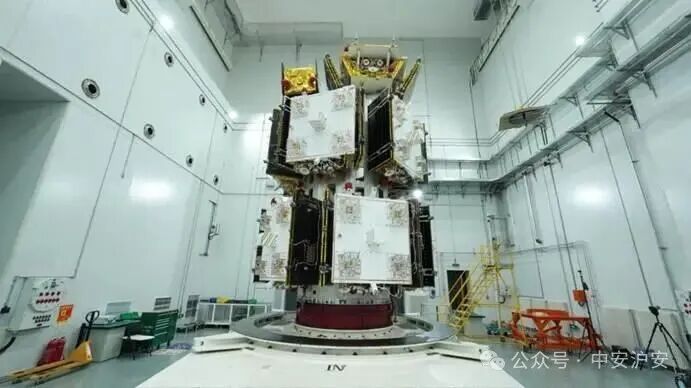
The successful completion of the first phase of the constellation network marks a new level in the construction of our country’s low Earth orbit satellite Internet of Things and demonstrates the innovative capabilities of China’s private commercial space industry in system engineering and global operations, achieving a significant leap from ‘constellation construction’ to ‘global scaled commercial application,’ providing important support for building an autonomous, controllable, safe, and reliable national space information network.
Chinese Constellation Serves the World, ‘Aerospace+’ Ecosystem Outputs Digital Transformation Solutions
With high reliability, global real-time communication coverage, and low-cost service advantages, the Geely Constellation has not only completed large-scale commercial verification tests in various domestic industries but is also accelerating its entry into international markets, becoming a new business card for China’s commercial space ‘going global.’ Currently, Space-Time Daoyu has established partnerships with local operators in over 20 countries worldwide, with application directions covering marine fisheries, smart transportation, energy management, emergency communication, and more, promoting the overseas implementation of Chinese satellite communication technology, terminal products, and solutions.

In Malaysia, Space-Time Daoyu has established a joint venture with local telecom operator ALTEL to expand the application scenarios of the Geely Constellation in Southeast Asia; in the Middle East, the company has completed commercial deployment testing with Azyan Telecom in Oman, which will provide communication support for over 10,000 fishing boats in the region; in countries such as Saudi Arabia, Argentina, Morocco, and Kenya, relevant cooperation has also entered the technical verification and commercial deployment stages, covering smart energy, cross-border transportation, emergency disaster prevention, and other fields.
The successful promotion of the Geely Constellation not only reflects the international recognition of the overall strength of China’s commercial space industry but also explores a new model of international cooperation in aerospace led by enterprises and oriented by market demand. By exporting a system-level service of ‘Chinese manufacturing + Chinese solutions + local operations,’ China is gradually forming an overall advantage in technology, industry, and standards in the global low Earth orbit satellite communication field.
The completion of the first phase of the global network of the Geely Constellation is a vivid practice of our country vigorously developing commercial space and promoting the deepening of new infrastructure. It showcases the innovative vitality of private technological forces under the guidance of national strategy and confirms the feasibility and immense potential of the Chinese solution in serving global digital transformation.
In the future, as the constellation application ecosystem continues to improve and the scope of international cooperation expands, China’s commercial space will achieve greater value in technological iteration, application innovation, and global service, contributing more to our country’s transition from a major space power to a strong space power and promoting the construction of a community with a shared future for mankind.