Click the blue text to follow us
This year, technology is undoubtedly the hottest topic in the market, with terms like CPO, PCB, and liquid cooling dazzling everyone, and related stocks soaring.
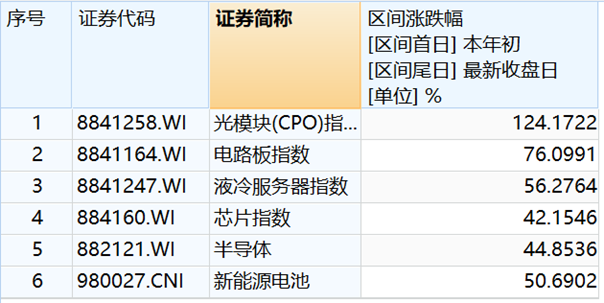
Data Source: Wind, data as of 2025-09-23
The hot sectors we often see, such as chips, liquid cooling, and optical communication, actually belong to the upstream of the AI computing power industry chain, which is the core hardware and software infrastructure. Let’s first understand what these main concepts are:
First is computing power, which refers to the ability of a computer or system to execute tasks and process data. To illustrate, if we compare an AI model to a factory, then computing power is similar to the production capacity of this factory. The strength of the model largely depends on the level of computing power. Chips are like the machines in the “model factory”; the so-called computing power relies on these tangible hardware facilities to be realized.
For a model to run, it cannot rely solely on chips; it also involves the interconnection of various components, which is where PCBs come into play. PCB (Printed Circuit Board) is like the transportation network in the world of electronic devices, connecting chips, resistors, capacitors, and other electronic components together, allowing information and data to be transmitted smoothly.
However, as the demand for data exchange increases, the PCB transportation network can become congested. This is where CPO (Co-packaged Optics) comes into play. It is a photonic-electronic co-packaging technology that packages optical modules together with chips, using optical signals instead of electrical signals, similar to upgrading traditional transportation routes to super-speed routes, thus achieving higher energy efficiency and lower latency in data transmission.
As chip power increases, heat generation becomes a challenge. High temperatures can lead to decreased chip performance and even reduced lifespan, while traditional cooling methods like air cooling are far from sufficient to support stable server operation. Liquid cooling technology perfectly addresses this issue, using cooling liquid and cold plates to achieve point-to-point rapid heat dissipation from the chips, thereby ensuring the stability of computing power.
The above-mentioned aspects are just a small part of the computing power industry chain; related sectors also include new energy batteries, semiconductors, and more. After clarifying these concepts, we can roughly understand what the market is buzzing about. This year, countries are vigorously building AI computing power reserves, and the demand for computing power in downstream applications (such as large model training, autonomous driving, etc.) is experiencing explosive growth, leading to a supply-demand imbalance in core hardware. Coupled with domestic substitution and overseas expansion logic (such as the US supply chain, T supply chain, Apple supply chain, etc.), these sectors naturally lead the market heat in a bull market.

– END –
Little Jin Li, a small transparent person learning hard in the secondary market.
Risk Warning: This article is merely a personal essay and does not constitute any investment advice. Any similarities are purely coincidental.