Currently, there is a consensus in the industry: the competition of national strength is also a competition of computing power. Huang Renxun proposed the concept of “Sovereign AI” in 2023, advocating for national-level AI autonomy through control over key elements such as computing power, algorithms, and data. This viewpoint has garnered widespread attention.
On November 23, Xu Yun, General Manager of Shanghai Hejian Industrial Software Group Co., Ltd., stated at the 22nd China International Semiconductor Expo (IC China 2025) held concurrently with the 7th Global IC Entrepreneurs Conference that in the Sino-U.S. intelligent computing competition, Chinese chips can achieve performance breakthroughs through supernode networking, and multi-level interconnection will promote the rapid development of Chinese intelligent computing chips.
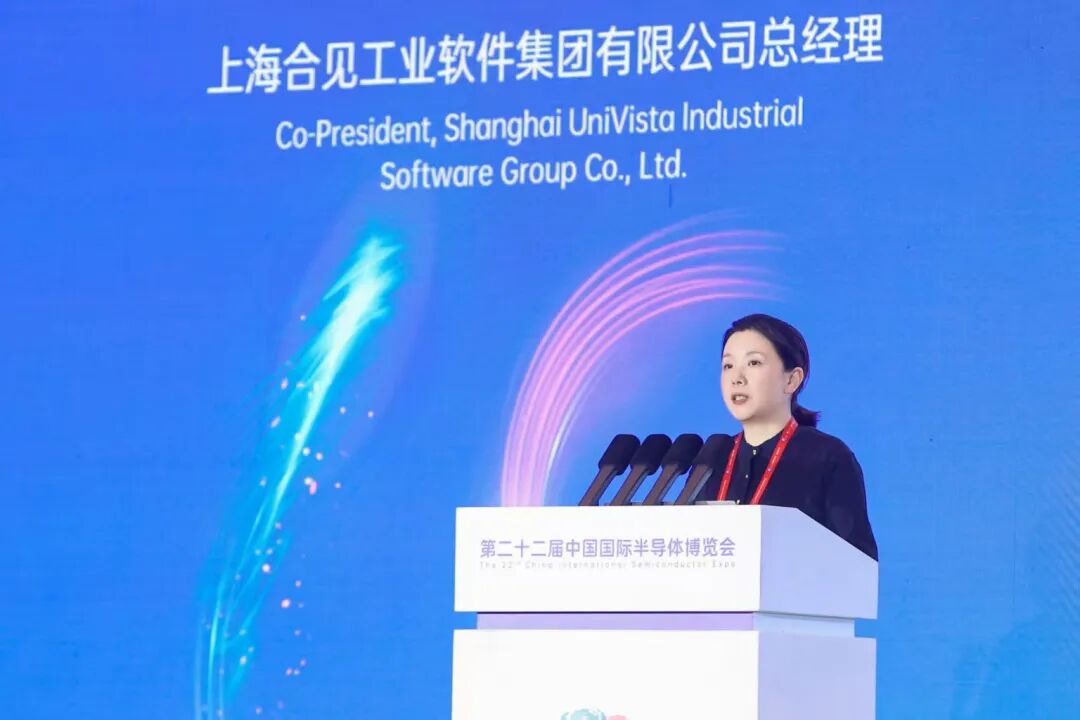
“In fact, the development of intelligent computing in China still faces many challenges. Affected by geopolitical factors, domestic semiconductor companies are restricted in advanced processes, high bandwidth memory (HBM), design tools, and chips for supercomputing and intelligent computing,” Xu Yun admitted. “The solution mainly lies in achieving greater computing power through stacking and interconnection.”
There are many differences between Sino-U.S. intelligent computing chips. From the perspective of representative companies, North American intelligent computing chip players are led by NVIDIA, AMD, and Intel, while domestic players include Huawei, Cambricon, and Haiguang, each having their own advantages in chips or algorithms; in terms of process technology, China and the U.S. are about two generations apart, with U.S. process technology even reaching 2nm; in terms of single chip computing power, domestic chips have about 30% of the computing power of North American chips, and due to process limitations, the memory and bandwidth capacity of domestic chips can only reach 40%—70% of that of North American chips. However, in the performance comparison after supernode networking, Chinese chips have achieved performance breakthroughs—after networking 384 cards, the computing power (FP16) can reach 300 PFLOPS, which is 1.7 times that of the North American 72-card networking solution; the memory capacity after networking has reached 3.6 times that of the North American solution, and the Scale-Up bandwidth (Tb/s) has reached 2.1 times.
Xu Yun pointed out that currently, the design of Chinese intelligent computing chips mainly faces three major pain points: first, advanced processes are limited, affecting chip area, storage granularity, etc.; second, intelligent computing Scale-Up networking design, verification, and ecosystem need support, especially the rapid development and complexity of standards and protocols related to intelligent computing interconnection, which adds considerable difficulty to the networking design, verification, and future chip cluster ecosystem adaptation for intelligent computing chip customers; third, chip yield urgently needs improvement, as the breadth and complexity of the toolchain involved in intelligent computing chip development lead to immense pressure on achieving successful tape-out and improving chip yield.
“Chinese chips can achieve performance breakthroughs through supernode networking, and multi-level interconnection will promote the rapid development of Chinese intelligent computing chips,” Xu Yun stated. She noted that multi-level interconnection includes interconnection within the chip, Die-to-Die, interconnection within the board, Chip-to-Chip, multi-card interconnection within servers, and supernode interconnection, etc. “For example, in supernode interconnection, there are various protocols both domestically and internationally, and we are currently trying to support various protocols,” Xu Yun said.
Hejian Industrial Software provides a one-stop solution for intelligent computing chips in design, building a complete multi-process platform IP solution; in verification, it has created a comprehensive verification platform for intelligent computing supernode interconnection networking, from chip-level to system-level; in packaging and testing, it can provide yield improvement and advanced packaging collaborative design services, as well as customized services such as system-level services from prototype to production, testability design services, back-end implementation services, and networking testing and certification.
It is reported that Hejian Industrial Software is the first domestic tool supplier to provide a “EDA+IP+system-level” joint solution for high-performance intelligent computing chip design. The innovative products released by the company cover various fields, including a new hardware platform for digital verification, DFT full-process tools, PCB board-level design tools, and high-speed interface IP solutions, among others. In the field of UCIe technology, Hejian Industrial Software has achieved the first domestic cross-process node interconnection verification. In the field of Chiplet interconnection IP, Hejian Industrial Software has focused on developing UCIe (Universal Chiplet Interconnect Express) and HiPi (High Performance IP) interface IP, supporting multi-chip stitching technology. This layout addresses the current situation of limited domestic advanced process technology by enhancing single-chip computing power through Chiplet technology while meeting high-performance interconnection needs.
In just five years since its establishment, Hejian Industrial Software has accumulated over 300 clients in China, with most major domestic AI clients in the intelligent computing field, including HPC, GPU, 5G, AUTO and others, have adopted Hejian Industrial Software’s products. Currently, Hejian Industrial Software has begun to enter the Asia-Pacific market, with product performance approaching international benchmarks.
“Hejian Industrial Software has entered the right field at the right time. It can be seen that in the era of AI, the Chinese intelligent computing industry has accelerated. We hope to do a better job in supporting work in the future, fully supporting the rapid development of domestic intelligent computing chips and systems,” Xu Yun stated.
 Further Reading:AI + Semiconductors: A Mutual AchievementThe First Quark AI Glasses Launched, Alibaba Strikes Again in the Smart Hardware ArenaAuthor丨Song JingEditor丨Zhao ChenArt Editor丨MariaSupervisor丨Lian Xiaodong
 Click “Looking” to Stay Connected