> The birthday photos taken by the neighbor’s child can appear on grandparents’ TVs in the blink of an eye; family health data is automatically shared with relatives who are doctors; friends can build a shared media library, saving on multiple subscription fees.…… All of this is becoming a reality through China Mobile’s multi-address networking technology.
In the past, smart devices in different households were like isolated islands, disconnected from each other. Now, China Mobile’s home broadband edge computing gateway multi-address networking technology is breaking down these barriers. This technology allows different households and shops to establish a secure and reliable local area network while maintaining normal access to the internet.
Compared to traditional technologies like internal network penetration and VPN, multi-address networking does not require users to download additional applications or perform complex network configurations, enabling them to easily build a true local area network. This means that file sharing, interactive entertainment, remote control, and many other functions become easily accessible.
——What is Multi-Address Networking? A Breakthrough Beyond Traditional Limitations
Multi-address networking technology is an innovative service launched by China Mobile, which refers to the establishment of a secure and reliable local area network between different households and shops, utilizing the forwarding capabilities of edge computing gateways.
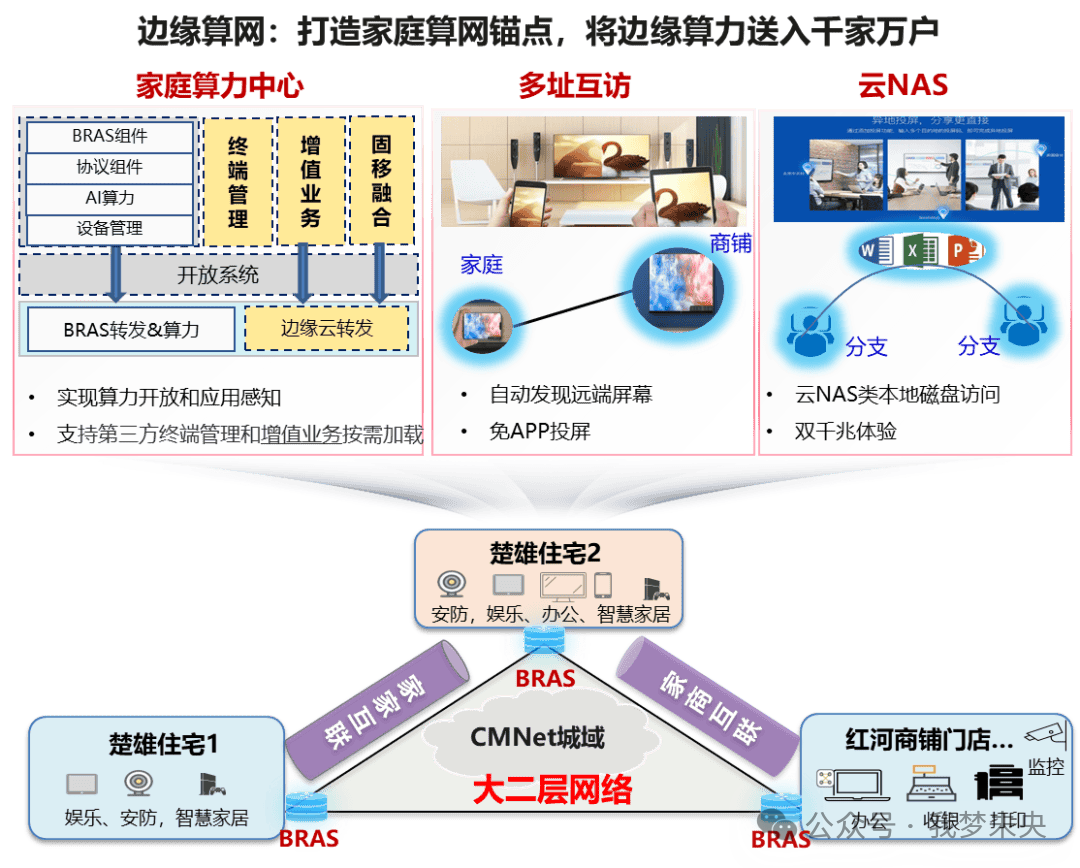
Under traditional network architecture, different households need to achieve data intercommunication through internal network penetration and VPN, which not only incurs high costs and low success rates but also limits application scenarios.
The advantage of multi-address networking technology lies in its simplification of all these processes. Users can easily build a true local area network without downloading additional applications or performing complex network configurations.
Yunnan Mobile has completed functional verification of multi-address networking and other business scenarios in Chuxiong, Honghe, and Qujing, injecting new momentum into the high-quality development of home broadband services.
——Interconnected Homes, A New Experience of Smart Living
The most direct change brought by multi-address networking technology is the intelligent collaboration between households. Through this technology, multiple families can set up a shared file server to centrally store important files such as photos, videos, and documents.
For example, photos and videos taken by children in Family A can automatically sync to devices in Family B, allowing all members within the local area network to instantly access the latest content, whether on smartphones, tablets, or computers.
In addition to file sharing, multiple families can also jointly own a large multimedia content library, covering movies, music, TV shows, and other entertainment resources, and stream them over the local area network, saving storage space for each family.
Smart home interactivity has also become more intelligent. By interconnecting through multi-address networking, smart devices in different households can achieve interoperability and centralized control, even enabling cross-household collaboration.
——Connecting Homes and Shops, Enhancing Operational Efficiency
Multi-address networking technology not only connects households but also connects homes with shops, greatly enhancing operational efficiency. One of the most common and valuable application scenarios is remote security and monitoring between households and shops.
Household users can view real-time conditions through surveillance cameras installed in shops, monitoring potential security risks. Similarly, shop personnel can access the household’s monitoring system through the home network to check the status of security devices.
This remote linkage of security monitoring also includes alarm systems, smart locks, and sensors. When a shop’s alarm system is triggered, family members can receive alerts through their home devices and take action.
Interconnected control of smart devices also makes management more efficient. When family members are away, home smart devices can link with shop devices to automatically turn off air conditioning, lights, and other equipment, achieving energy savings.
Smart systems in shops, such as lighting, POS systems, and temperature and humidity sensors, can be remotely controlled through the home network, ensuring that the shop environment always meets customer needs.
——Remote Collaboration, A New Mode of Work and Entertainment
Multi-address networking technology has also spawned various new scenarios for remote collaboration. The remote screen sharing feature allows users to watch movies and videos across households without downloading any APP, enabling a shared viewing experience.
Different family members can share the same movie or video viewing experience even if they are not in the same location, engaging in real-time discussions and comments, increasing interactivity.
In the education sector, parents or teachers can share educational resources across households to help children learn specific knowledge or skills.
Whether it’s a study group organized by parents or sharing teaching materials with teachers, cross-household sharing of educational resources can enhance learning outcomes.
Children from multiple families can also participate in the same virtual classroom through remote screen sharing, with teachers conducting lessons remotely, while parents can supervise and assist.
LAN gaming is also a significant application scenario for multi-address networking. Multiple families can connect and share gaming resources in a local area network environment, enjoying lower latency, more stable connections, and faster response times.
——The Core Technology: Innovative Practice of Computing and Networking Integration
Behind multi-address networking technology is the innovative practice of computing and networking integration. Yunnan Mobile is responsible for the sub-project of the “Intelligent Broadband Network Gateway” under the research project of China Mobile Group on the evolution of IP network architecture and key technologies for computing and networking integration.
This project aims to upgrade traditional home broadband networks to a diversified integration scenario of “connection + computing + capability,” further expanding the value space of fixed network services.
The pilot adopts the “intelligent broadband network gateway + computing module” solution, which is based on the existing network architecture, is easy to deploy, and does not require additional network elements or traffic rerouting.
This solution greatly enhances the capabilities of intelligent perception of broadband network services, differentiated computing services, and intelligent quality management, accelerating the evolution of traditional BRAS towards intelligence.
Specifically, the solution includes three key technological innovations: computing enhancement, multi-address intercommunication, and cloud NAS. By utilizing computing board technology and constructing layer 2 SRv6 tunnels, it successfully connects multiple addresses within a household, enabling convenient intercommunication between household terminal devices.[citation:3.
——The Future Outlook: A New Chapter in Smart Home Development
The emergence of multi-address networking technology opens a new chapter for the development of smart homes. It is predicted that the market size of the digital home industry will grow rapidly, reaching 1.8468 trillion yuan by 2025.
As a major force in building a strong network nation, digital China, and a smart society, China Mobile is leading the transformation and upgrading of home information solutions with “full gigabit” as the guiding principle.
They focus on intelligent networking, smart homes, home entertainment, home security, and other multi-scenario services, bringing a richer and more colorful smart home life to thousands of households.
“Mobile Love Home,” as China Mobile’s smart home brand, centers on “full gigabit + cloud life,” providing users with three product systems: “Smart Connection – TV – Life.”
A stable gigabit broadband network allows users to easily enjoy diversified services such as online education, telemedicine, smart homes, and entertainment.
With the comprehensive application of 5G and the Internet of Things, smart homes are gradually transitioning from individual products to intelligent interconnected stages, and will further advance towards an AI-driven smart home system.
It is expected that by 2025, the market size of the digital home industry will reach 1.8468 trillion yuan. As more families adopt multi-address networking technology, this figure may continue to grow.
In the future, we will see not only connections between devices but also the digital bonds of affection between people. Grandparents can see their grandchildren’s growth moments in real-time, family members can remotely care for elderly relatives living alone, and friends can share entertainment resources.
China Mobile’s multi-address networking technology is quietly changing the way we interact with our homes, loved ones, and friends, making smart homes truly serve the concept of “home.”