Coronary artery bypass grafting (CABG) is recognized as an effective treatment for coronary artery disease. However, routine antiplatelet therapy post-surgery is necessary to ensure graft stability and reduce complications. Optimizing antiplatelet regimens and further reducing the risk of adverse cardiovascular events after surgery is closely related to patients’ survival. To achieve this goal, Professor Zhao Qiang, Vice President of Ruijin Hospital affiliated with Shanghai Jiao Tong University School of Medicine, and Director of the Cardiac Center and Cardiovascular Surgery, proposed a dual antiplatelet therapy (DAPT) regimen (ticagrelor + aspirin) after CABG surgery, and conducted a multicenter prospective randomized controlled trial—DACAB study—together with six domestic centers.
After five years of follow-up, the results of the DACAB-FE study led by Professor Zhao Qiang were recently published in the prestigious journal The British Medical Journal (BMJ). Through high-quality follow-up and scientific statistical analysis of the research data, it was concluded that dual antiplatelet therapy (ticagrelor + aspirin) is more beneficial for patients compared to monotherapy with aspirin or ticagrelor, providing a high-quality theoretical basis for dual antiplatelet therapy after CABG. Let us delve into the research conducted by Professor Zhao Qiang’s team.
Analysis of Dual Antiplatelet Therapy Results After Coronary Artery Bypass Surgery: Five-Year Follow-Up Results of the DACAB Trial (DACAB-FE)
Original Title: Antiplatelet therapy after coronary artery bypass surgery: five year follow-up of randomised DACAB trial (DACAB-FE).
DACAB-FE Researchers:
Zhao Qiang (PI)1 Mario Gaudino (Co-PI)2 Zhu Yunpeng (Research Director)1 Zhang Wei (Statistician)3 Arnaldo Dimagli2 Han Lin4 Cheng Zhaoyun5 Mei Ju6 Chen Xin7 Wang Xiaowei8 Zhou Yanzai1 Xue Qing4 Hu Junlong5 Tang Min6 Wang Rui7 Song Yuanyuan8 Kang Lei1 Bjorn Redfors9
1 Ruijin Hospital affiliated with Shanghai Jiao Tong University School of Medicine, Cardiovascular Surgery
2 Weill Cornell Medicine, Cardiovascular Surgery
3 Fudan University School of Public Health, Biomedical Statistics Center
4 First Affiliated Hospital of Naval Medical University (Shanghai Changhai Hospital), Cardiovascular Surgery
5 Fuwai Huazhong Cardiovascular Hospital (Henan Provincial People’s Hospital Heart Center), Cardiac Surgery
6 Xinhua Hospital affiliated with Shanghai Jiao Tong University School of Medicine, Thoracic Surgery
7 Nanjing First Hospital, Cardiovascular Surgery
8 Jiangsu Provincial People’s Hospital, Cardiovascular Surgery
9 Sahlgrenska University Hospital, Sweden
01Background
Dual antiplatelet therapy (DAPT) is more effective than monotherapy with aspirin (SAPT) in preventing graft vessel disease. However, the impact of DAPT on clinical outcomes remains unclear. In the DACAB trial, compared with aspirin alone, dual antiplatelet therapy (ticagrelor + aspirin) significantly improved the patency rate of graft vessels within one year, but the previously low incidence of adverse events within one year made the statistical difference in trial results not significant.
02Study Objectives
The DACAB-FE study aims to compare and evaluate the clinical efficacy of antiplatelet therapy between one year of DAPT after CABG and five years of SAPT.
03Study Population
Key Inclusion Criteria:
1. Male or female, aged 18-80;
2. Undergoing first elective isolated CABG.
Key Exclusion Criteria:
1. Cardiogenic shock;
2. Concurrent other cardiac surgeries;
3. Guidelines indicate the need for DAPT or VKA therapy post-surgery;
4. High bleeding risk (e.g., history of intracranial hemorrhage, major bleeding within the last three months);
Presence of contraindications for the study medication.
04Methods
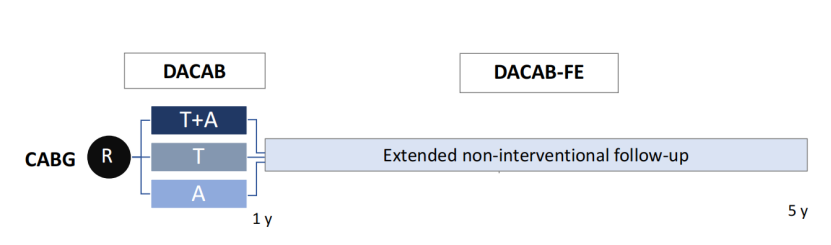
The DACAB study: 500 patients were randomized to groups one year after CABG, with the T+A group receiving ticagrelor 90mg bid + aspirin 100mg qd; the T group receiving ticagrelor 90mg bid (T); and the A group receiving aspirin 100mg qd (A).
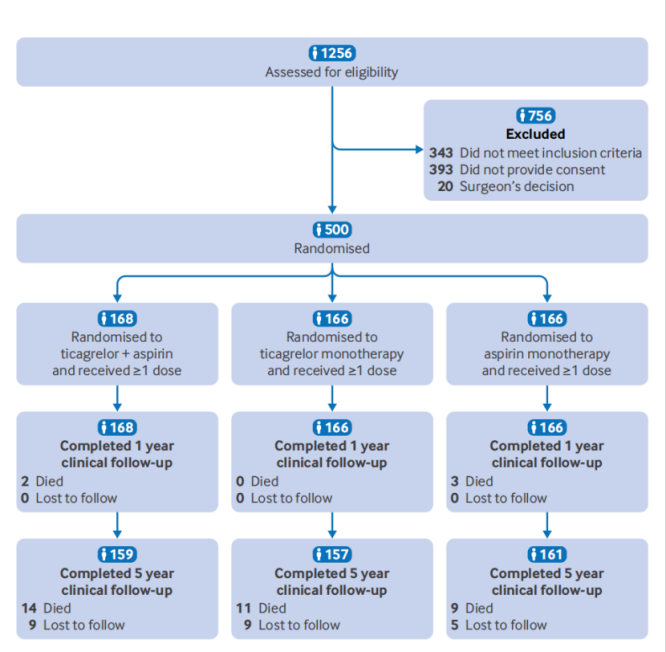
The DACAB-FE study: 477 patients (95.4%) completed the five-year follow-up after surgery (median follow-up time 62±11 months).
05Results
Summary of Research Data:
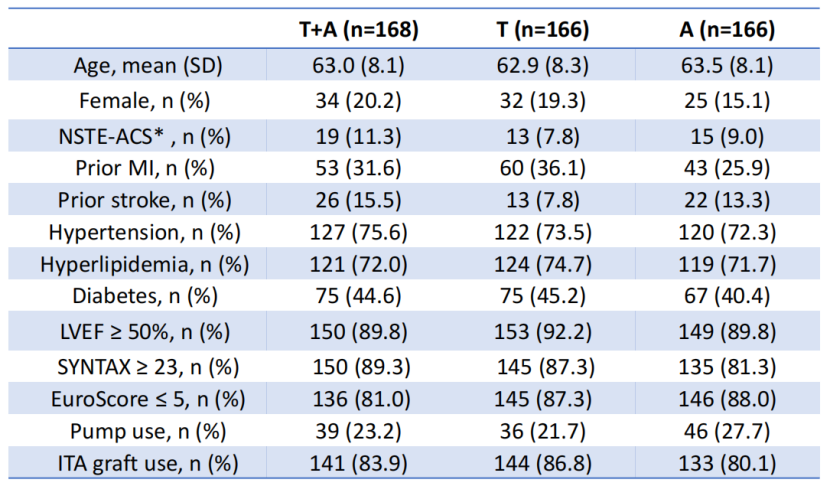
Flowchart of different antiplatelet treatment strategies in the DACAB post-operative follow-up population:
KM Analysis of MACE-4 Events (Death, Myocardial Infarction, Stroke, Coronary Revascularization):
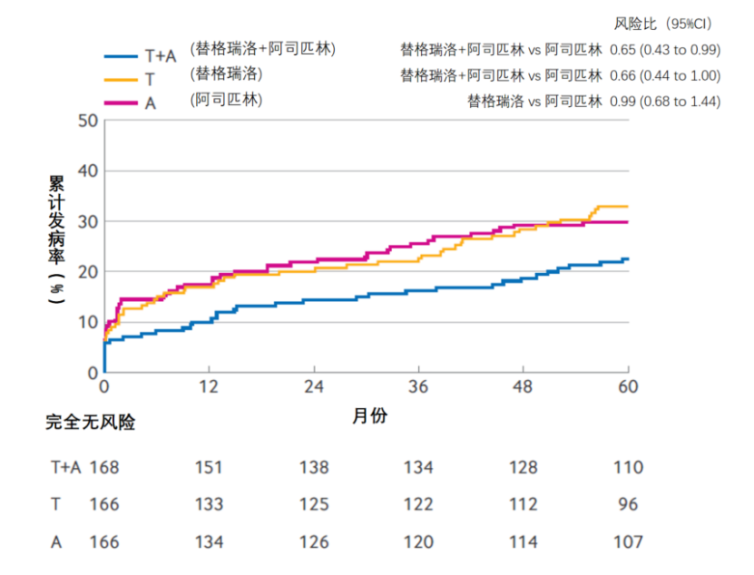
Five-Year MACE-4 Incidence:
Ticagrelor combined with aspirin group 22.6%, ticagrelor monotherapy group 32.9%, aspirin monotherapy group 29.9%.
The T+A group significantly reduced the MACE-4 risk compared to the A group and T group (HR estimates of 0.65 and 0.66, respectively).
KM Analysis of MACE-5 (All-Cause Mortality, Myocardial Infarction, Stroke, Coronary Revascularization, Unstable Angina Rehospitalization):
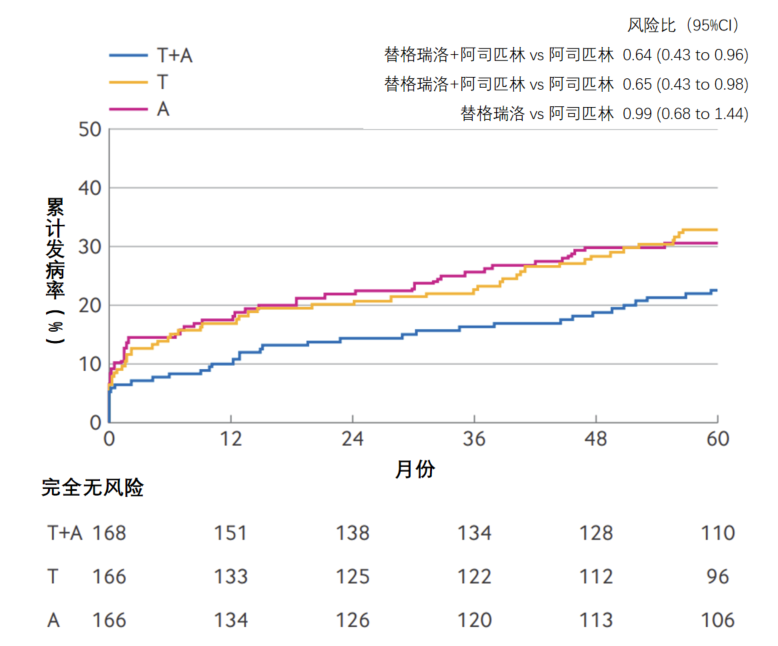
Five-Year MACE-5 Incidence:
Ticagrelor combined with aspirin group 22.6%, ticagrelor monotherapy group 32.9%, aspirin monotherapy group 30.5%.
The T+A group significantly reduced the MACE-4 risk compared to the A group and T group (HR estimates of 0.64 and 0.66, respectively).
KM Analysis of MACE-3 (Cardiovascular Death, Myocardial Infarction, Stroke):
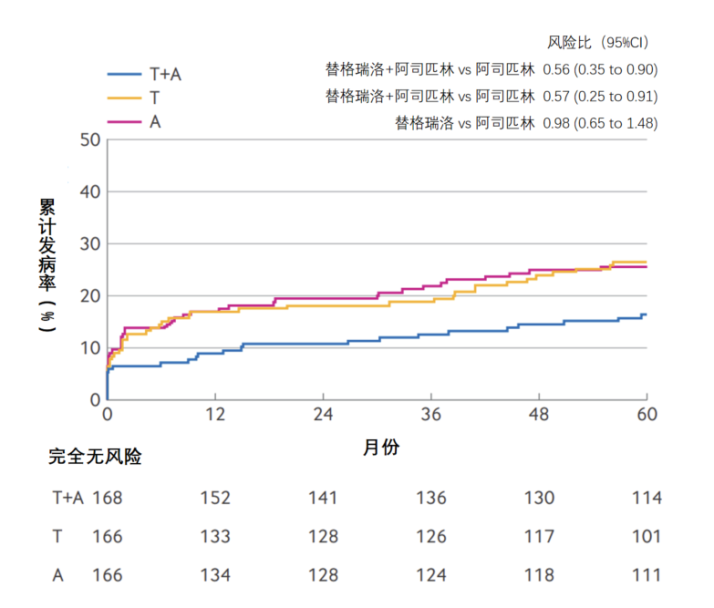
Five-Year MACE-3 Incidence:
Ticagrelor combined with aspirin group 15.8%, ticagrelor monotherapy group 26.2%, aspirin monotherapy group 26.6%.
The T+A group significantly reduced the MACE-4 risk compared to the A group and T group (HR estimates of 0.56 and 0.57, respectively).
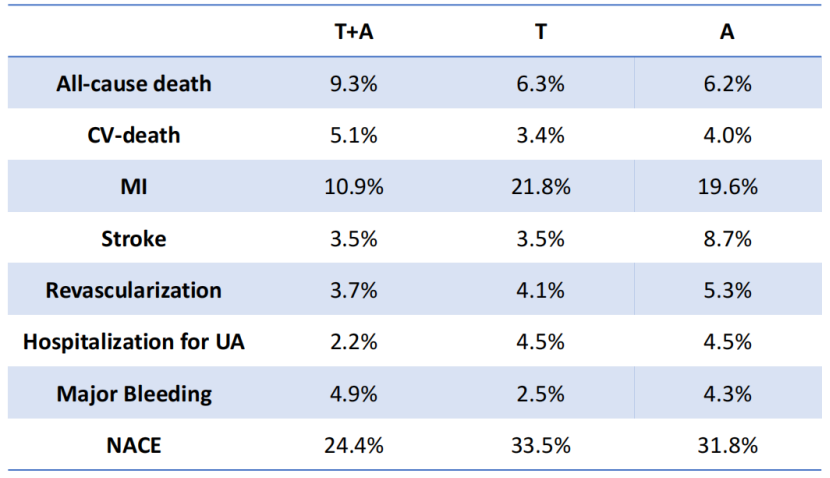
Cumulative Incidence of Clinical Adverse Events at Five Years
Association Between Clinical Adverse Events and Different Treatment Methods
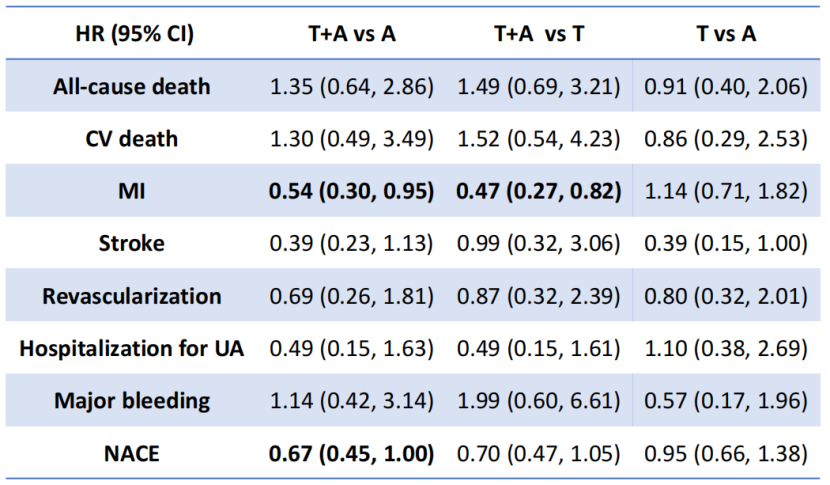
The T+A group significantly reduced the risk of myocardial infarction compared to the A group and T group (HR point estimates of 0.54 and 0.47, respectively); the T+A group significantly reduced the risk of net clinical adverse events (NACE) compared to the A group (HR=0.67).
Conclusion
The DACAB-FE study is the first to show benefits of combining ticagrelor with aspirin in patients one year after CABG. The results suggest that using DAPT in the first year after CABG can significantly benefit patients over the next five years compared to monotherapy with aspirin or ticagrelor. Based on these results, future research can further explore the optimal duration of DAPT and its clinical efficacy in specific patient populations (e.g., diabetics, elderly patients, or those taking other medications).
References: Zhu Y, Zhang W, Dimagli A, et al. Antiplatelet therapy after coronary artery bypass surgery: five year follow-up of randomised DACAB trial. BMJ. 2024;385:e075707.