Most readers of the Electronic Engineering Magazine would not doubt the importance of Ceva’s role as an IP company in the industry. Ceva’s Chief Strategy Officer, Iri Trashanski, stated at a recent press conference that from mobile phones to televisions, from wireless base stations to headphones, “especially in the consumer electronics sector, I believe there is no type of product that does not utilize Ceva IP.”
Ceva is a dominant player in the wireless IP market: Iri presented data indicating that Ceva holds a 68% market share in this field; Wang Xuehai, Vice President of Ceva and General Manager of China, added, “Excluding some large chip companies that develop their own solutions, there is no other IP company in the market that can compete with us in any meaningful way.” From the perspective of downstream customers, the shipment volume of devices from over a hundred active customers of Ceva has reached 20 billion units…
However, Iri mentioned that the 20 billion units shipped is just the foundation for Ceva to move to the next step, as Ceva sees the driving force of AI technology: not only the strength in connectivity technology, but also the integration of connectivity, perception, and reasoning as the pillars for the company’s future sustainable development. This gives us an opportunity to understand what AI opportunities look like from Ceva’s perspective.
Three Opportunities in the Edge AI Market
Iri presented a real-life scenario during his speech: during a meeting with clients while wearing TWS headphones, current AI technology can enable functions such as transcribing meeting content, AI minutes, and even foreign language translation. This process first involves Bluetooth data transmission between the headphones and the phone—if the meeting content is very specialized and complex, cloud computing may be required, necessitating wireless transmission between the phone and the cloud via WiFi or 5G.
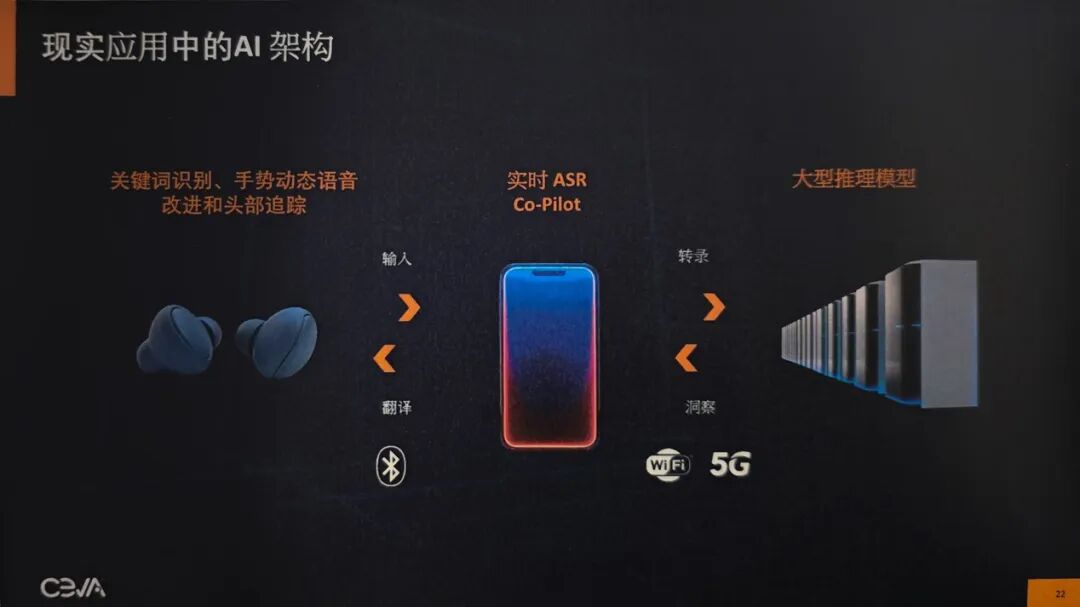
In addition to connectivity, there is also perception, which involves not only the TWS headphones perceiving sound signals but also recognizing user gestures and tracking head movements; furthermore, this process relates to local AI reasoning, whether through ASR model reasoning on the phone or small model reasoning built into the headphones to enhance perception functions or preprocess data.
Ceva’s business encompasses all three areas, naturally choosing to expand its narrative around AI into these three business directions. Additionally, in this scenario, Ceva emphasizes the market opportunities in edge AI—hence Iri mentioned at the beginning of his speech, “We believe the next decade of AI will be at the edge,” because edge AI offers lower latency, data privacy, lower costs, and lower power consumption. From the perspective of IP suppliers, the edge market has a higher volume of chip and device shipments, which is more conducive to revenue generation.
Ceva sees specific edge AI markets including: consumer, industrial, infrastructure (with infrastructure referring to edge applications such as security and public safety monitoring and analysis), automotive, and Physical AI—not limited to robotics, as various edge devices with intelligent attributes can be seen as Physical AI to some extent. “They can all make decisions and have self-awareness and understanding of their surrounding environment.”
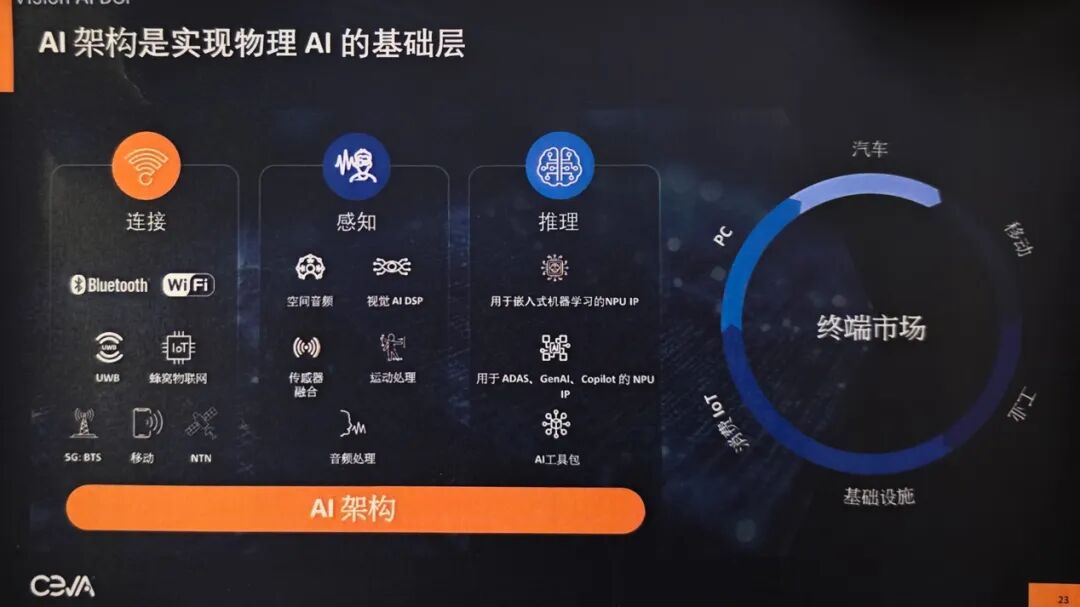
Regarding Physical AI, “as Jensen said, this could become the largest industry to date.” Iri provided specific data indicating that the number of smart devices with connectivity capabilities is expected to reach approximately 22 billion by 2025, and this number will grow to 40 billion by 2030; the market for Physical AI is currently around $75 billion, projected to grow to $170 billion by 2030. “In fact, application scenarios range from AR/VR, autonomous driving, logistics robots, to infrastructure, security, automotive, and industrial—these will all be components of Physical AI. The market is difficult to quantify.”
From the perspective of chip design companies, the conventional chip design cycle may extend to two years, “integrating AI reasoning, connectivity, and perception into products,” necessitating “early planning for future preparations” during product definition; it is also essential to ensure that products achieve “minimum latency, maximum throughput, and outstanding capabilities…”
“This is actually what we are currently doing with our customers.” “Moving forward together in the next 12-24 months.” The capabilities that customers need include “connectivity—across different protocols, connecting to other devices, and connecting to the cloud; perception—truly understanding the surrounding environment and providing customers with experience in this area; reasoning—the ability to run AI reasoning models.”
AI Fabric: The Foundation for Achieving Physical AI
Iri mentioned Beken (Broadcom Integrated) twice at the press conference: “Many of our customers initially choose Ceva’s Bluetooth IP, then expand to WiFi, and later choose our NPU IP—Beken is one such customer.” During the Q&A session, he stated that many customers start with Ceva’s connectivity solutions, “because choosing our solutions can help them achieve optimal ROI”; “after building such trust, when selecting a reliable NPU IP, they will consider us as a partner.”
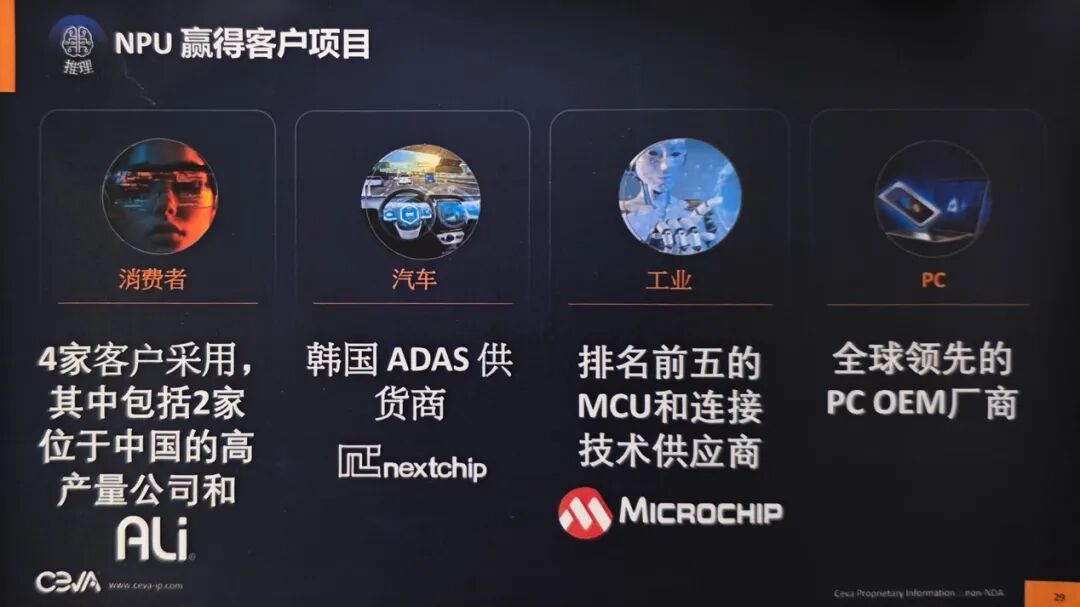
“Customers are always seeking long-term cooperation.” “For example, Microchip—one of the top 5 MCU suppliers globally, serving 120,000 customers and driving billions of devices across multiple markets, was originally a customer of our connectivity products. When considering an intelligent architecture across different devices and performance levels, Microchip expects their AI solutions to be scalable and have software requirements—including AI model training, optimization, and deployment. They purchased the entire product line of Ceva’s NPU IP.”
It is said that from last year to now, Ceva has secured 10 customers in the reasoning domain: in consumer, automotive, industrial, and PC fields. Iri stated that while he cannot disclose the revenue generated from the connectivity, perception, and reasoning products at Ceva, “connectivity still generates significant revenue and is our cornerstone; perception is also important; but the growth rate of reasoning is quite rapid.”
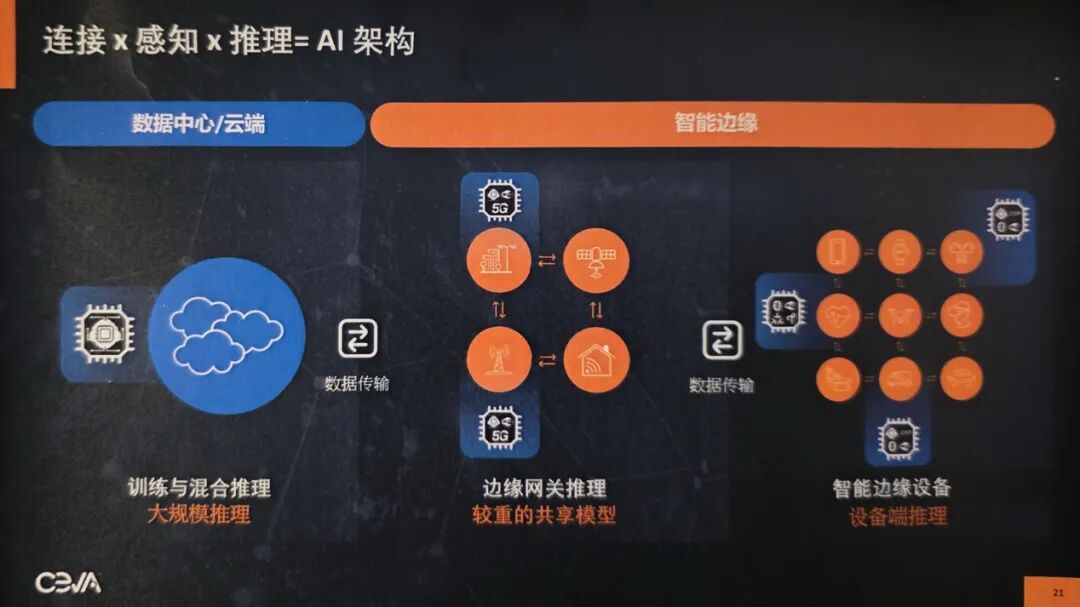
Thus, Ceva proposed the concept of connectivity x perception x reasoning = AI Fabric—”this is the foundation for achieving Physical AI.” Iri explained, “AI Fabric is not a specific product, but a combination of technologies that truly empower devices to move towards Physical AI.” For example, he mentioned that cars initially needed to have perception capabilities, such as ABS systems that existed long ago; by the 2010s, cars began to incorporate WiFi, Bluetooth, and 5G connectivity capabilities; modern systems like ADAS require AI reasoning capabilities.
“Additionally, TWS headphones started with wireless connectivity; gradually added perception capabilities—head tracking, noise cancellation, spatial audio all require perception; recently, reasoning capabilities have also been added—we have signed many collaborations in this area.” “All of these lead us towards AI Fabric.”
In this context, connectivity is seen as the “backbone” of Ceva’s AI Fabric: this is closely related to Ceva’s 68% market share in the wireless IP field and its market position in cellular data IoT, Bluetooth, 5G RAN, cellular data modems, WiFi, and other areas.
The annual shipment volume of Bluetooth devices alone is in the billions; Iri also discussed numerous market opportunities in WiFi, including WiFi 6 becoming mainstream and WiFi 7 soon to be launched; furthermore, smart cities will further integrate with 5G: 5G/V2X will be used for perception sharing and edge learning, and 5G robots will become the norm, all of which are opportunities Ceva sees.

The recently popular Nothing headphones in the digital market utilize Ceva’s perception technology for spatial audio.
The opportunities in the perception segment are even more significant, as by 2025, the average number of sensors per IoT device will exceed 4, and devices such as AR glasses, robots, cars, and health wearables are all in a rapid development phase that relies on a large number of sensors. Ceva primarily provides software and general DSP products in the perception layer.
Iri discussed embedded application software solutions—including currently popular features such as spatial audio, motion tracking, voice clarity, and AI voice assistants—such as spatial audio, which provides a clear sense of direction and a more immersive listening experience as the head moves and turns. These software capabilities can also serve as additional royalty income and enhance customer stickiness.
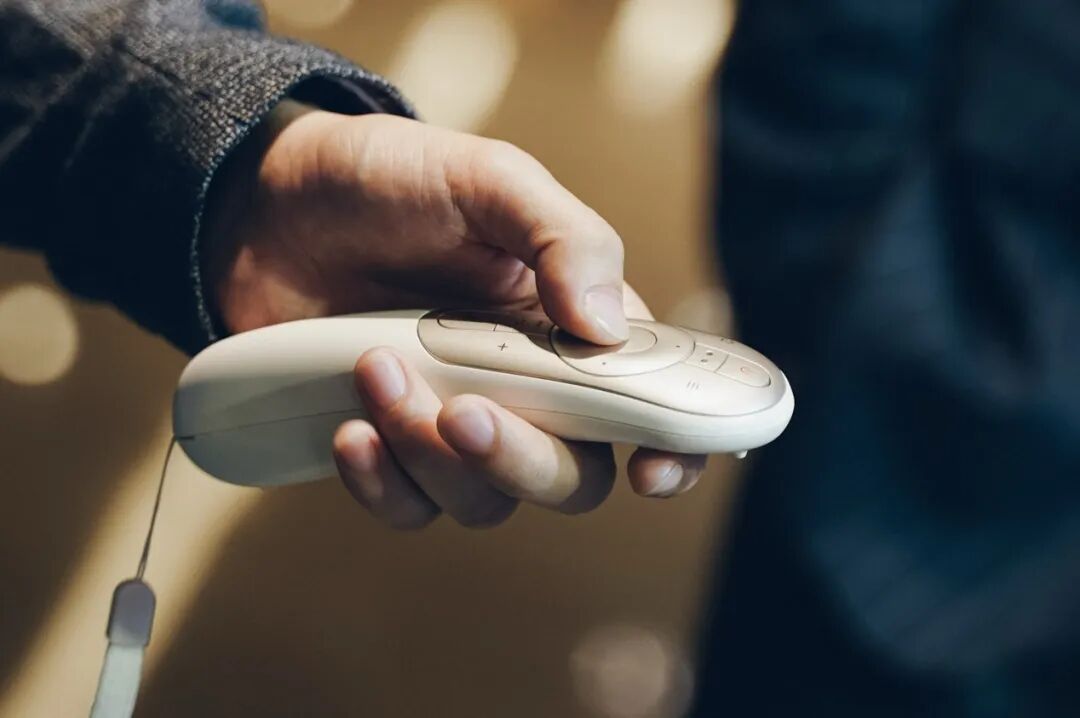
IMU-based remote controls can be used like a mouse.
Reasoning is the next growth point.
Regarding reasoning, in Ceva’s products, in addition to the SensPro AI DSP, the focus is on NPUs including NeuPro-Nano for embedded AI and NeuPro-M for generative AI, covering low-power predictive maintenance, health monitoring, object recognition, surveillance, and higher computational requirements for ADAS and Co-Pilot.
From Iri’s statements, it is clear that Ceva is optimistic about the market prospects for this segment: in Iri’s words, “Training is more like an investment; to monetize, one must look at the reasoning market.”
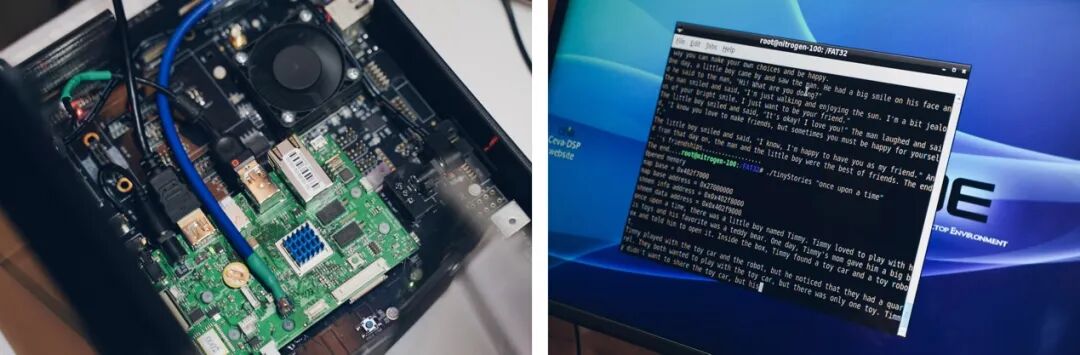
Demonstration of NeuPro-Nano NPU running SLM, focusing on natural language interaction with wearable devices.
When mentioning new customers and collaborations, in addition to discussing recent gains in the connectivity field with semiconductor companies and United Micro, Iri specifically mentioned Ceva’s collaborations with embedUR and Mobvoi. The former provides developers with models, typically for keyword wake-up and object detection; the collaboration with the latter integrates Mobvoi’s TicHear technology into the NeuPro-Nano platform, providing audio front-end and keyword detection solutions.
These two collaborations can be seen as Ceva’s enhancement of its NPU software ecosystem, not solely reflected in the IP products themselves. It also provides a glimpse into the efforts Ceva is making in reasoning solutions. During the media Q&A session, we specifically asked Iri about the differentiation of Ceva’s NPU IP products.
Iri’s response was: on one hand, the completeness of the different computational power product combinations and the scalability of the architecture—”Many customers choose us not only for our excellent PPA but also because we provide a complete solution with a scalable architecture (scalability).” He mentioned that many competing IPs lack scalability and cannot effectively utilize investments, which is a critical flaw. On the other hand, beyond software, ecosystem, and development toolchains, it also includes the capability and flexibility for model support, with the aforementioned collaborations being part of that.
“In the past two years, we have seen this market consolidate, unlike before when there were so many market participants.” “Ceva has emerged as one of the leaders.” Coupled with Ceva’s connectivity products winning long-term trust from customers, “I believe we will become the winners in the NPU IP market.”
Continuing to Advance Collaborations in China
Many of the customers Iri listed in his speech, including some recent collaborations, are Chinese companies—and many are not only adopting one of Ceva’s products but are simultaneously encompassing connectivity, perception, and reasoning. Wang Xuehai stated, “Ceva has established deep-rooted partnerships with most successful semiconductor chip companies in China.” “Products empowered by Ceva’s key IP are ubiquitous in today’s Chinese market.”
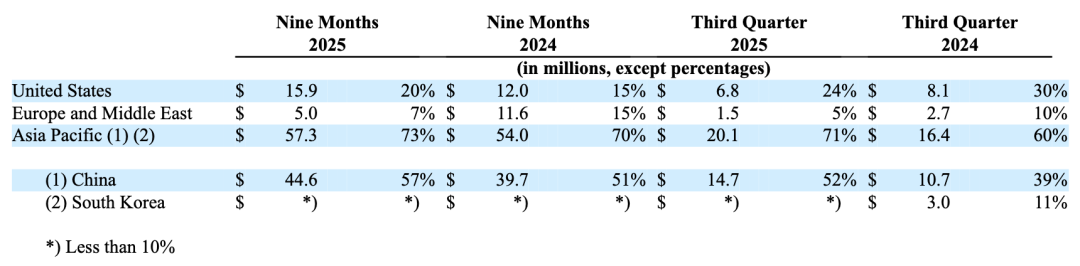
Source:Ceva Q3 2025 Quarterly Report
According to Ceva’s recently released Q3 report, the Chinese market accounted for 57% of Ceva’s total revenue in the first nine months of this year—last year, this figure was only 39% in Q3. China is now Ceva’s largest single market—this aligns with China’s recent push to develop chip design. Therefore, Iri stated that Ceva has established a strong sales and engineering support team for Asian customers.
Wang Xuehai mentioned, “Our best engineers and scientists are closely collaborating with leading domestic customers, which will inevitably have a significant impact on the future of China’s semiconductor industry and AI sector.” Leveraging the foundation provided by AI Fabric, in this era of rapid AI development, on one hand, “by utilizing Ceva’s mature IP technology, we enable customers to quickly bring products to market”; on the other hand, “effectively reducing customers’ trial and error costs and R&D investments, helping them launch differentiated and cost-effective products”; ultimately allowing “customers to maintain market and technological leadership.”
This is essentially the basic business logic that allows the IP licensing business to continue in the industry, only now with the added trend of AI. Seizing the opportunities in edge AI and successfully expanding the business, whether in China or other markets, will become the greatest driving force for Ceva’s continued development as an IP supplier.
THE END
Follow “Electronic Engineering Magazine” and add the editor’s WeChat
Regional groups are now open, please send a message 【Shenzhen】【Shanghai】【Beijing】【Chengdu】【Xi’an】 to the public account